A Boy and his Bronzi by Kent Hill

71250721_408620106696277_4300613795014770688_n

It has been the dream of many an artist to be able to do what they love for a living. Find the thing you love to do, and you’ll never work a day in your life…so the saying goes. Thus my cinematic adventuring has brought me to the cinema of Rene Perez…and the man they call…..Bronzi.

It began as a trickle on social media. Fleeting glimpses rumors permeating of the man who would be Bronson. Who was he…was he a relative…the product of an onset love affair…? I went, as I often do, to the director of what would turn out to be bold cinematic statements which would not only shine a spotlight on the incredible one-man-band movie-maker who is Rene Perez…but also…it would cement the coming of a new age DTV or VOD genre icon – his name Robert Kovacs . . . aka Robert Bronzi.

It has been documented by the New York Post, Variety as well as our brothers and sisters in the cinema-obsessed website and podcast community . . . and now, it comes at last….to Podcasting Them Softly. Here I present the furiously, fascinating life of a work-a-day filmmaker. Rene is a man I admire greatly. Surviving via a high output of commercially released B movie productions, he sleeps little and creates much – the price he pays for being in essence, a solo auteur. Generating genre staples in the arenas of Horror, Action and Westerns – Perez has the distinction of having directed Bronzi in such films as Death Kiss, Cry Havoc, From Hell to the Wild West and the most recently released, Once Upon a Time in Deadwood.

So listen now to my chat with the inexhaustible Rene Perez and then continue to scroll down for my interview with the man himself….Bronzi.

https://youtu.be/OBrN6VEsdko

In another time, in another place….in the age of VHS…this story of two artists colliding at the right time, at the right place would not be uncommon. There are many stories of thrilling partnerships in genre cinema history. They came together and transformed the B movie into an event. And, in this age where the video stores are dead and the streaming services rule the world…a glorious sight it is to see this…a type of mini-cataclysm…rise out of the rivers of mass media…pooling in an ocean of awesomeness. I give you…A Boy and his Bronzi….

RENE PEREZ

72962667_2337271819867645_1259959605815934976_n

Rene Perez is a movie Director known for “Playing with Dolls: Havoc” and “Death Kiss”. In addition to being the Director, Perez is also the Cinematographer, Editor and Writer of his films. Born and raised in Oakland California, Perez started writing and drawing comic books as a child and in his teen years he became a musician known as ‘The Darkest Machines’. Perez still composes music under the stage name “The Darkest Machines”. Perez now lives in a small town in northern California with his wife and children. He works full time as a movie director / producer for hire for several producers and distributors
ROBERT BRONZI

deathkiss-still

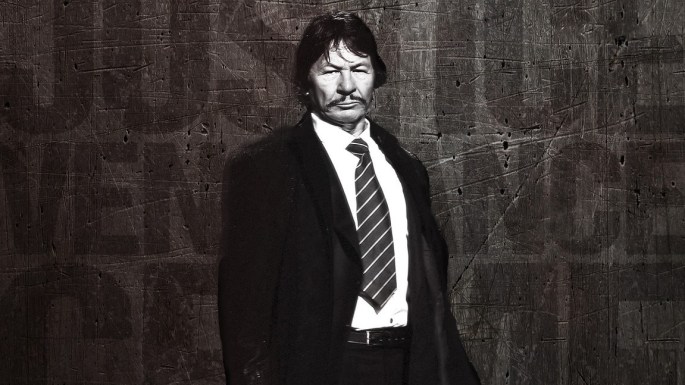
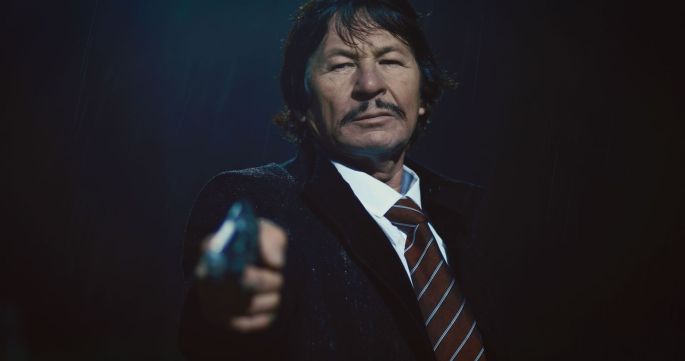
When Rene related the story of how he uncovered a living, breathing…for all intents and purposes the reincarnation of Charles Bronson – and let me go on the record once more when I say to you…he walks like Bronson, he pulls a gun like Bronson, he walks boldly into the face of certain doom like Bronson…in fact…for my money Robert Kovacs, the guy that Rene saw a picture of and figured it to be a digitally remastered photo of an old picture of Charles Bronson, is more than just a guy that reminds us of a dead icon. The truth is…Charles Bronson, like John Wayne before him, left us a-ways back. But they live forever in their movies – we can visit them anytime we like. So, Bronzi, like Bronson will enjoy his moment in the sun. Some would argue that the novelty will be short-lived…? That maybe the case, but for right now, we have ourselves a brand new B movie icon . . . I think that should be celebrated…?

Here’s my chat with Robert Bronzi . . .

KH: Could you tell us a little of your life before you started making movies?

RB: I’m an actor musician and stuntman ,I did a lot of different things in my life. I worked as a horse breeder and horse trainer. I performed at western shows in Hungary and Spain. I’m an accordionist; I played music in bars, in weddings and private parties.

KH: The million dollar question . . . at what point in your journey did people start saying, “Hey, you know you look a hell of a lot like Charles Bronson?

RB: Many years ago in Hungary I worked as a horse breeder where there were a lot of visitors every day. People told me that l looked a lot like Charles Bronson. I worked with my good friend Peter, he would always say that I looked like him and he began calling me Bronzi.  So he gave me this nickname.

KH: Was it purely this attribute that attracted attention and motivated filmmakers to want to work with you?

RB: I would say yes. A short story: Director Rene Perez saw my photo on a saloon wall in Spain in the western village where I worked as a stunt performer. He thought it was a photo of Charles Bronson years ago. He asked the owner about the photo. When he found out it wasn’t Bronson it was me, he told him, “I want to meet this guy immediately!”

KH:  I recently saw a sneak preview of Cry Havoc, directed by Rene – I especially love the scene where you prepare to lay it all on the line for your daughter in the film – your pull the shirt off and walk towards him, staring death in the face. I cheered loudly watching it and woke my wife who was in bed. What was that scene like to shoot?

RB: I really enjoyed it; this is a very important part of the movie as I fight to save my daughter, for life or death. In addition, we were shooting in a burnt forest where thick ash covered the ground. Ashes flew everywhere during the fight.

KH:  You have worked with Rene now on a number of films. Do you enjoy the creative freedom on offer shooting with him? He also told me when I interviewed him, that you also help holding microphones and other duties beside your work as an actor?

RB: Working with Rene is easy, he is a very talented director, he knows what he wants, but if I have some ideas, we discuss them and he is usually open to making changes based on my suggestions. Of course, I help with filming that’s in my own best interest isn’t it? We are often up in the mountains or shooting in difficult conditions. I help him with a few things, and not just me, everyone out there, I think we’re a team and we need to help each other out.

KH: Are you at ease with, in a way, being engulfed by the shadow that is being a performer that is recognized for the whole “he looks like Bronson” deal?

RB: I have used my appearance to my advantage throughout my career as a stuntman and actor and I am grateful for the resemblance that I have to the great Charles Bronson as it has created many opportunities for me.

KH: Would you work on a big budget film should you be presented the opportunity?:

RB: Yes of course I would love to have that opportunity and I’m sure it will happen in the near future.

KH: What are the types of movies ‘you’ want to be in, or are you happy to be offered the type of parts you are making a name for yourself with at present?

RB: So far my roles have been quite varied and I would like to continue making western and action movies in the future.

KH: I can’t get over – not just the amazing and uncanny resemblance – plus the fact that even the way you carry yourself on screen is so similar to the legendary Bronson – would you be happy if this is your mark on cinema history?

RB: I am very grateful for my resemblance to Bronson, and I am proud to be compared to him. I also appreciate the opportunities that I have had because of this but ultimately, I really want to be remembered as an actor in my own right, as Robert Bronzi. I put a lot of work and effort into each role that I take on and I want my personal skills and talents to be my legacy.

KH:  If Charles Bronson were alive today…if you met him…what would you say to him, and what do you think he’d reply?

RB: I would say to him, “Mr. Bronson nice to meet you in person and I am very proud to be your double. I try to do everything well, with my best knowledge and talent as an actor, and I hope you will be proud of me.” And hopefully he would reply, “Nice to meet you too Robert I really like your personality and I think you represent me well. Best wishes for your future career. I give you my blessing.”

You heard it here folks. Out of the shadow of a legend he came. His place in genre cinema…I’d say is a lock!

Be excellent, love movies…

K.

Blood on the Frontier: Nate’s Top Ten Horror Western films

I love a good horror western. There’s something about the American West that lends itself to to mystery, menace and an ever felt presence of supernatural evil. Be it ghosts in the mountains, giant cryptozoological behemoths from beneath the earth, terrifying cannibalistic psychos, cursed burial grounds or haunted ghost towns dotting the vast plains, there’s an unspeakably harried energy to be found in this setting and the combination of dust, horses, blood and terror is a delicious mixture akin to movies and popcorn for me. There’s a lot of them out there ranging from low budget B grade junk to beautifully crafted genre efforts, but whether gooey schlock or eerie art house, the genre mashup has no shortage of creative efforts. Here are my ten favourites.. Oh one more thing! I’ve tried to stick to films set in the Old West as that to me is what a western is, while more contemporary stuff set closer to present day feels like cheating. I did make an exception with one entry though because despite being set somewhere in the 80’s, it totally falls squarely into Western territory and deserves inclusion. Enjoy!!

10. J.T. Petty’s The Burrowers

There’s something nasty dwelling beneath the acrid soil, something that was once content to feed on bison until the population was driven scant by millions of hunters. Now it’s forced to breach the earth and feed on humans, while a gaggle of gnarled character actors like Clancy Brown, Doug Hutchison and William Mapother form a posse to try and face them. This is a genuinely frightening creature feature with graphic, sickening violence and a sly commentary on capitalist colonial tendencies that swept across the land during that era.

9. Grim Prairie Tales

This is a creaky old anthology flick from the 80’s that sees James Earl Jones cast against type as a gregarious, grizzled bounty hunter and the great Brad Dourif as a timid businessman trading spooky stories around the campfire. Their tales involve murder, haunted canyons, betrayal and more and although are hit and miss occasionally provide chills. The real fun though is the interaction between these two brilliant actors and honestly I would have preferred the filmmakers not cutting away to every story and just having James and Brad tell the whole thing, leaving the rest to our imaginations.

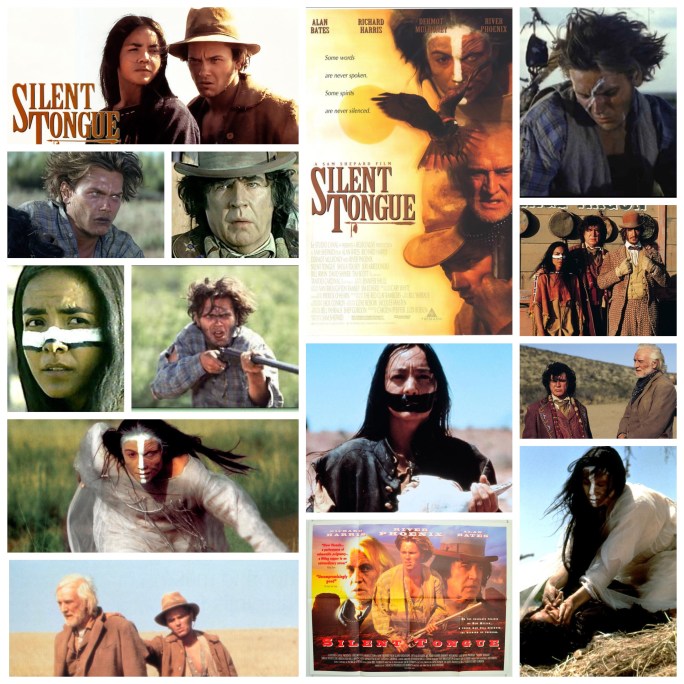
8. Sam Shepard’s Silent Tongue

River Phoenix sits out in the desert looking haggard and grieving over the corpse of his Native American wife before she comes alive to haunt him. This is a bizarre, disjointed film full of terrific ideas and striking imagery, and although I can’t quite wholeheartedly recommend it because overall it doesn’t work, it’s worth to see vivid performances from Phoenix, Alan Bates, Richard Harris and particularly Sheila Tousey as the vengeful ghost.

7. Dead Birds

Several confederate outlaws and their hostages hide out on one severely haunted farmland after robbing a bank in this low budget but well made chiller. There’s nicely gooey creature effects, a pseudo twist ending and cool work from varied folks like Mark Boone Jr, Patrick Fugit, Henry Thomas, Muse Watson, Nicki Aycox and Michael Shannon.

6. From Dusk Till Dawn 3: The Hangman’s Daughter

The best of the Dawn sequels (better than that lame duck TV show too) is a prequel set in the past outlining how the vamp bar the Titty Twister acquired it’s business license of sorts and how evil princess Santanico Pandemonium (Ara Celi) came to power. The real treat here is seeing legendary Michael Parks playing real life poet Ambrose Bierce, who really did go missing near the end of his life. This film plays ‘what ifs’ with that notion really nicely and just has a wickedly imaginative story that builds upon the Mexi Vampire mythos in a cool way.

5. Avery Crounse’s Eyes Of Fire

This one is almost damn near impossible to find, but my god is it worth it. A weirdo minister (Dennis Lipscomb) is booted from a pilgrim colony for being a creepy polygamist and sent along with his followers out into the wilds of Missouri. They accidentally wander through the burial ground of a Native Tribe though, and the ghosts are none too happy. This is a surreal, pagan style trip through eye catching folk horror elements, witchcraft lore and strange earth magic. Trees come alive, spectral figures loom out from thickets and the sheer creativity behind production design is commendable. Their low budget goes a long way in crafting something beautiful and striking. Good luck finding it though, it never made the jump to DVD and VHS’s seem to be lost to time. There was a YouTube version so that’s probably your best bet. Like I said though, this one is something special, and well worth the hunt.

4. S. Craig Zahler’s Bone Tomahawk

Kurt Russell and his entourage hunt down deadly troglodyte (such a great word) cannibals in this paced, aggressive, atmospheric and arresting piece. What makes Zahler’s aesthetic so special is he takes time getting to know his characters, their eccentricities and relationships to one another in meticulous fashion before throwing them to the wind, and whatever comes howling along with it. In this case it’s a tribe of terrifying cave dwelling inbred psychos who provide a formidable enemy for Russell’s grizzled Sheriff and Co.

3. Ron Howard’s The Missing

This film is tied with Backdraft as my favourite Howard film and I’ve never understood why it’s so low rated. Cate Blanchett plays a plucky frontierswoman whose young daughter (Evan Rachel Wood) is snatched by an evil witchdoctor (Eric Schweig) who is also a part time human trafficker. Together with her estranged and dysfunctional halfbreed father (Tommy Lee Jones), she hunts them down across plains and mountains to an eventual showdown. This is a frightening, atmospheric genre film that I’ve always loved and provides the actors with excellent roles to have fun with. Plus it’s got a Val Kilmer cameo that he only took to spend time around Blanchett, but can you blame him?

2. Kathryn Bigelow’s Near Dark

Not a traditional western but bite me. Bigelow’s lyrical, dreamy take on the vampire mythos is an enduring masterpiece with colourful character work from Lance Henriksen, Bill Paxton and others. It’s a nice touch that the word vampire is never mentioned but the energy and ambience around those legends couldn’t be thicker. That gorgeous Tangerine Dream score is one for the books too.

1. Antonia Bird’s Ravenous

Probably the quirkiest film on this list, it’s a spectacularly gory, pitch black horror comedy that sees ex soldiers Guy Pearce and Robert Carlyle facing off against the breathtaking backdrop of the Sierra Nevada Mountains sometime after the Mexican American war. This is a curious film that approaches the taboo of cannibalism with a cheerful, nonchalant attitude and wholeheartedly plunges down a narrative with no end in sight but blood, guts and mayhem. A literal acquired taste, it has offbeat energy, a kooky but beautiful score and spooky, campfire story energy that has always spoken to me.

Thanks for reading!! What are your favourite horror westerns?

-Nate Hill

Sam Shepard’s Silent Tongue

Sam Shepherd’s Silent Tongue is a bizarre one. The writer/director is usually in succinct, assured control of his art but here he kinds of makes a mess in the sandbox, literally since this is set in the deserts of the American Southwest. There are some outright fantastic ideas at play here and scenes of striking beauty and chilling poetic morbidity, but the narrative isn’t fixed together solidly enough and much of it is lost on the viewer in a hail of haphazard scenes and a story that barrels along with scant exposition, a complaint that you will rarely, if ever hear from me, but here we are.

This is River Phoenix’s last film before an untimely passing, and it finds him sitting half crazed out on the frontier, grieving the death of his halfbreed Kiowa wife Awbonnie (Sheila Tousey), who perished during childbirth. He’s an already slow kid who is driven positively mad by this tragedy, and sits there with her corpse on a makeshift alter howling at the moon and brandishing a giant rifle at anyone and anything who comes near them. Because of his refusal to give her proper burial rights, she comes back as a vengeful, spooky ghost to harass and haunt him, something like a desert legend crossed with a spectral Kabuki costume. Elsewhere the boy’s distraught father (Richard Harris) returns to the dusty travelling circus where he bought Awbonnie in hopes of purchasing her twin sister Velada (Jeri Arredondo) to console his son out there on the plains. The circus owner and father of the two (Alan Bates) is less than cooperative when he learns of his first child’s passing and his son (Dermot Mulroney) is downright hostile. Seeing no other option, Harris kidnaps the girl and high tails it for the desert enclave where Phoenix sits and Awbonnie roams around like a lost soul tormenting him.

This isn’t a pretty boy western, a shoot em up or a cowboy picture, it’s a gnarly, fucked up frontier horror story populated by strange people and punctuated by odd, supernatural occurrences and disturbing flashbacks involving the mother of the two Kiowa girls (Tantoo Cardinal), who is called Silent Tongue for a very specific and unsettling reason. Phoenix is convincingly unhinged and plays the horror well, Harris is weary and understated, while Mulroney seems miscast and stumbles over the articulate western dialogue. It’s Bates who takes the cake though as the constantly drunk circus owner who has to face his past out there on the plains, he practically fills up the whole runtime with his ranting and raving, it’s a wonder he could sustain that level of mania for an entire performance. Tousey is intense and elemental as the ghost, adorned in eerie makeup and face paint and spewing out freaky threats in a guttural voice. Shepherd tries his best to anchor everything in symbolism and provide a story that makes sense, but it simply gets lost in a muddle and ends up making little emotional impact, which is kind of unforgivable because this story technically *does* make sense when you work it out in your head and *should* make a landing like that. I’m not usually one for remakes but this one practically begs for it because the story and ideas are so beautiful and full of potential, but the execution turned into kind of an inconsequential shit show. Shame. Great score by Patrick O’Hearn though.

-Nate Hill

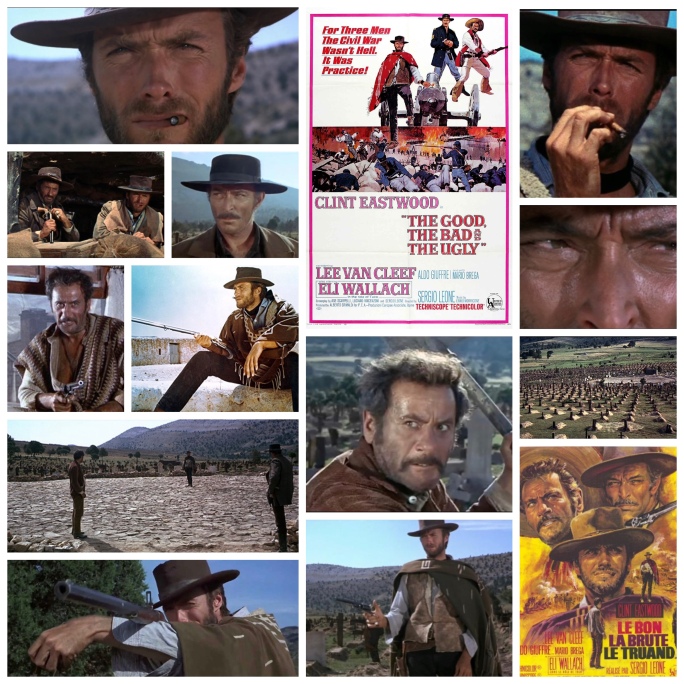
Sergio Leone’s The Good, The Bad & The Ugly

How iconic has the image become of Clint Eastwood, poncho adorned, rolled cigarette locked firmly in that drawn snarl, peering out from a wide brim, dust caked hat atop a horse? The Man With No Name is such a household name these days that he’s shown up everywhere from Stephen King lore to an animated Johnny Depp movie, but it all began with Sergio Leone’s original spaghetti western trilogy, the best of which is the fireball classic The Good, The Bad & The Ugly.

The trilogy itself not only launched an entire sub-genre in the early sixties but created a mood, a feel that no one besides Leone has ever been able to so specifically distill. Extreme closeups on eyes deep set in furrowing brows. Languid establishing shots of frontier town streets, expansive railroads and acres of dry brush-lands. The actors aren’t necessarily blocked from scene to scene with any kind of briskness but rather wade languidly through an ambient space seemingly at their own leisure and never with haste. Spaghetti westerns are never about the plot, but about the moment, the setup, the apprehension in the saloon, grotto, civil war torn graveyard or desert that these hard bitten folks find themselves in.

Eastwood’s nameless gunslinger meanders across a bitter, busted up American west that is, of course, actually Italy, engaging in war games and an obsessive treasure hunt with two other pieces of work, the sociopathic monster Angel Eyes (Lee Can Cleef) and the lecherous, untrustworthy rodent Tuco (Eli Wallach). All three are after a legendary gold stash somewhere out there in the desolation and are prepared to kill anyone who stands in their way, bonus points for each other. Eastwood is cold, calm and opaque, Cleef is cheerfully, sadistically ruthless, Wallach oozes weaselly survival instinct and together they make a captivating trio.

Three scenes in particular stand out in my mind; the first is the epic showdown between them all, stood a few hundred paces apart in a triangle, locked in a tense pre shootout stare-down as Ennio Morricone’s gorgeous and threatening score booms around the landscape and plays with expectations wonderfully. It’s a kicker of a scene and probably the showcase Western showdown in cinema. The second (and I’m assuming at this point that anyone who’s read this far has seen the film) is the final sequence where Eastwood taunts Wallach by literally leaving him hanging and riding away as Morricone yet again gives our eardrums symphonic bliss. It’s a wicked little epilogue that illustrates the character’s dry, subtle sense of humour nicely and I remember my dad (this was a favourite for him) rewinding it just to catch the beats a second or third time. The third is a moment where Eastwood comes across a soldier who is dying in the dust. He offers the man a drag off his cigarette, and the simple action suggests a beating heart and flickers of compassion in a mostly hard, stoic fellow. Nice touch.

-Nate Hill

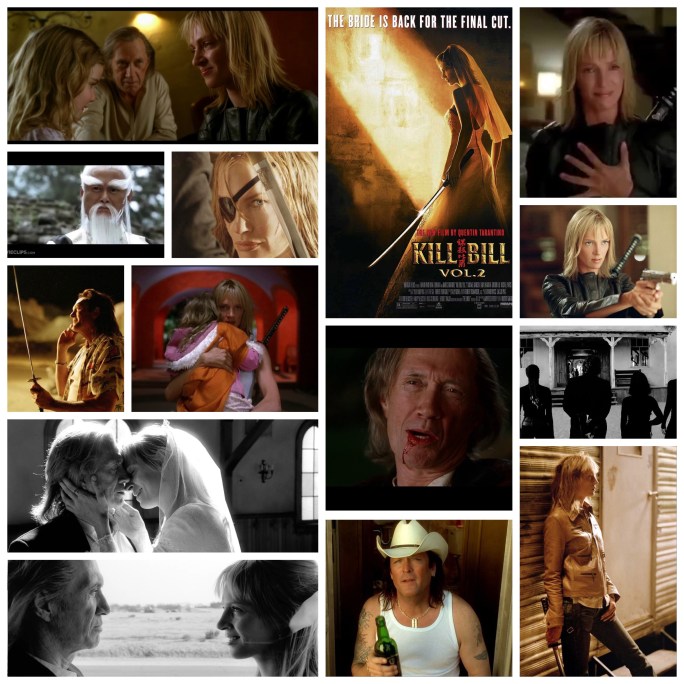
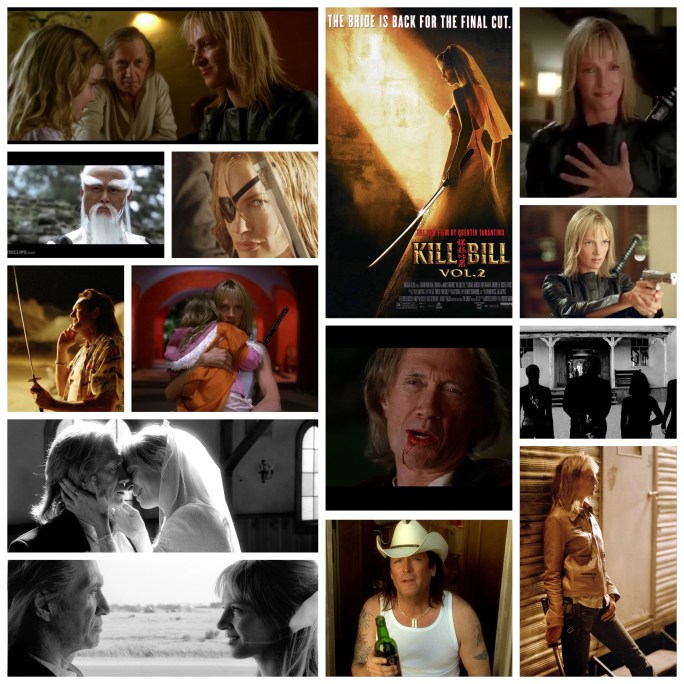
Quentin Tarantino’s Kill Bill Volume 2

Roger Ebert observed about Quentin Tarantino’s Kill Bill Volume 2 that although it takes place in a heightened reality that’s removed from the realism of our own, the human behaviour and emotions explored couldn’t be more real or more relatable. That insight is precisely why it is my favourite Tarantino film and in particular I think that the last half hour or so is the best, most thoughtful and intuitive thing he’s ever directed in a career that for the most part hasn’t dug that deep in such a way.

Every filmmaker must duck expectations and adapt or fall victim to self parody and repetition, and the guy understands this well. Volume 1 is a thrilling love letter to samurai films, peppered with sword fights, hectic editing and celebrates movement, choreography and synergistic expression. With this film though he moves inward, not just showing us the extreme actions of these characters, but why they’re doing them. The first film opens with the how, as Bill (David Carradine) tenderly puts a loaded gun to the temple of The Bride (Uma Thurman) and pulls the trigger. This film shows us what led to that, and the consequences yet to come, why indeed she feels the need to Kill Bill. It’s a beautiful story that’s acted to the nines by Thurman and Carradine, both giving their career best. The samurai vibe is somewhat present again but here the tone is that of a spaghetti western. Anyone who knows or loves this genre (pauses typing and raises hand) is familiar with the aesthetic: languidly paced shots, long glances lingered on by a camera that moves slowly, stolidly. Orchestral significance placed upon seemingly mundane or small gestures and measured, introspective performances. It’s all here, from the glorious wide shots of the California desert to the laconic inwardness of Michael Madsen’s Budd to the Morricone strains that Quentin loves to sample.

The Bride continues her quest stateside, taking on Madsen’s lowkey deadly cowboy, tussling with Daryl Hannah’s treacherous banshee Elle Driver, punching her way out of a sealed coffin six feet deep and even finding time to stop in for a quick visit with Michael Parks, sneakily playing a different role than Volume 1. Madsen is off the chain spectacular as Budd, a gruff, sadistic badass who has seen better days and seems done with life until she brings out the fire in him once again. His quiet scene with Carradine outside the rundown trailer is a showstopper, as is his priceless expression when chewed out by an asshole boss (Larry Bishop, providing the funniest moment in either of the two films). Tarantino brings out the best in Madsen and this is their finest collaboration, proving in tandem what creative forces both or them are.

This is the Uma and David show when it gets down to it though, their eventual confrontation is what we’ve been anticipating since the beginning, but he doesn’t quite give us what we expect. They meet at a quiet Mexican villa, she sees her daughter for the first time and the words spoken between them cut deeper than any of the physical blows, of which there are barely any. Both The Bride and Bill know exactly what their respective actions have done to them both individually and as a couple, and that there’s no going back from a betrayal like that. The fascinating thing, for me at least, is seeing how despite this anguish and hatred, they are still very obviously in love with each other, something that isn’t easy to get across without spelling out, but these actors nail it. I love the writing here, the body language, the time and attention spent on exploring the pathos, I think it’s Quentin’s showcase sequence and the one that dispels anyone from thinking of him only as ‘that guy who makes violent movies.’

He often works with his pal Robert Rodriguez and most people might immediately think of GrindHouse or Sin City but this is my favourite of their collaborations. Robert isn’t seen or present behind the camera but he composes an original score that is heartfelt, evocative of the western genre and altogether a brilliant composition, particularly the cues around Madsen. This is unique in the fact that it’s the only film Tarantino has made using a score in a career of distinctive soundtrack choices.

From the stunning opening sequence shot in dreamy black and white and aching with palpable yet guarded emotion to the intense, exhaustive training montages with warrior Pai Mai (Gordon Liu, also showing up in a different role) to the blood n’ dust takedown of Elle and Budd in the bone dry desolation out west to the final showdown and reconciliation of sorts with Bill, this is a fantastic story and one hell of a piece of filmmaking on every level. The two Volumes are so very different and I noticed the other day that although I’ve seen both probably hundreds of times, I’ve never watched them back to back. They are separate entities, two sides of the same coin. Bill tells The Bride that her side ‘always was a little lonely.’ The same goes for Volume two, there are less characters, more time spent on emotion and a slightly mournful feeling that the frenzy of Volume one just didn’t have time for. I love this portion of the story the most, I’ve always felt just a tiny bit more at home in Volume 2, and I will never have anything but absolute love for it.

-Nate Hill

Sergio Leone’s Once Upon A Time In The West

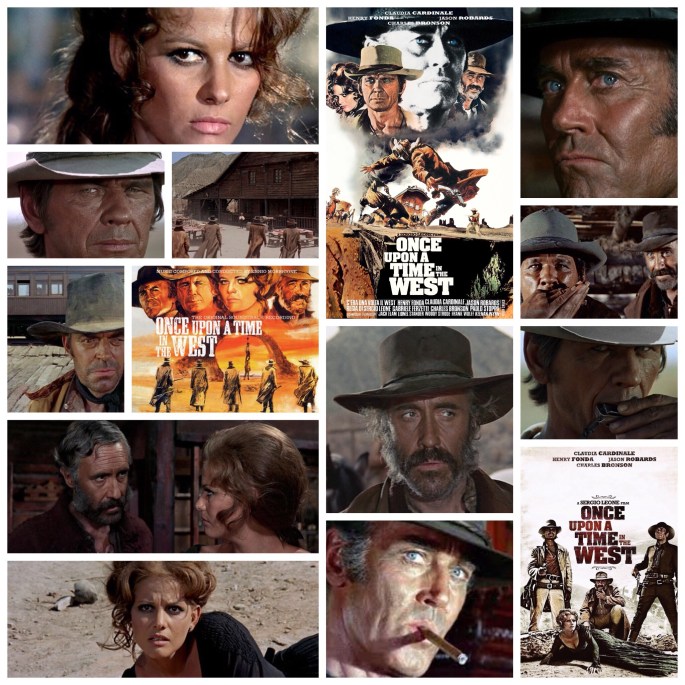
There isn’t much I can say about Sergio Leone’s Once Upon A Time In The West that the mythical, larger than life masterpiece couldn’t say for itself, especially on its magnificent, crystal clear Blu Ray transfer that blows the dust out of the cracks and showcases it’s sunny cinematography in full remixed glory. From the coming of the railroad to a fledgling empire, the corrupt businessmen employing hard bitten thugs to do their nefarious bidding (a prophetic motif if there ever was one), the searing forbidden romance between the archetypal ex-working girl and the silent, lethally dangerous drifter, the dusters adorning gunfighter that sway in a lilting prairie breeze, the trod of hooves, the thunder of impending gunfire preceded by the eerie calm of the showdown before, this is the western to end all westerns, the textbook example, the crown jewel of the genre and the one wheat-stalk saga that I just can’t get enough of. Leone basically patented an entire sub-genre between this and the Man With No Name trilogy, it’s a now timeless flavour that rippled down throughout the generations and changed the face of the western forever. The film itself is perfectly balanced symphonic storytelling, in every aspect of the medium. Charles Bronson’s mysterious loner Harmonica blusters into town, opaque and uttering few words save for the melancholic strains of his instrument brought to wailing life by composer Ennio Morricone. Henry Fonda’s elegant, magnetic and unbelievably evil mercenary Frank hovers over everything like a black cloud of portent. Claudia Cardinele’s drop dead gorgeous Jill violently carves out her own path of survival, lust and grief amidst the unforgiving frontier. Jason Robard’s half injun outlaw Cheyanne tries hard not to wear an obvious heart of gold on his sleeve while seeking retribution for a diabolical frame-job. These mythical, monolithic individuals invite shades of grey into what we’ve become accustomed to in Western archetypes too, which is another hallmark of Leone. Gone are the stalwart sheriffs, stoic heroic leading men and obvious moustache twirling of clearly delineated villains. Bronson is rough, callous and never straight up chivalrous, Fonda is reptilian but oh so charming, the kind blue eyes barely suggesting what evil leers beneath, and Robards for his part turns an outright scoundrel into something of a teddy bear during his arc. It’s in the little, drawn out interactions and moments that we learn what we need to know about these characters, and Leone lets their performances, Morricone’s iconic score and the lingering space between action tell the story, so that by the time the monumental showdown rolls in, we know what we need to know about these wild, complex personalities and can get swept up in the revelatory spectacle of it. One for the ages.

-Nate Hill

Scott Cooper’s Hostiles

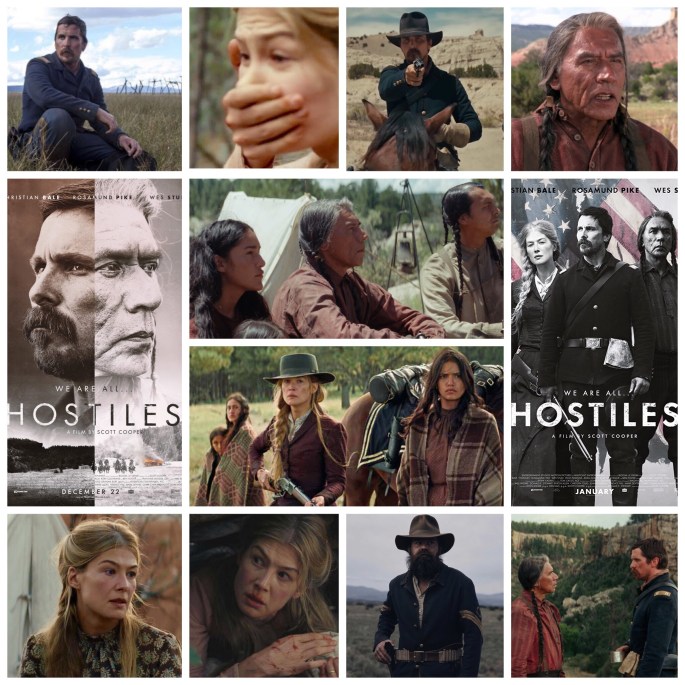
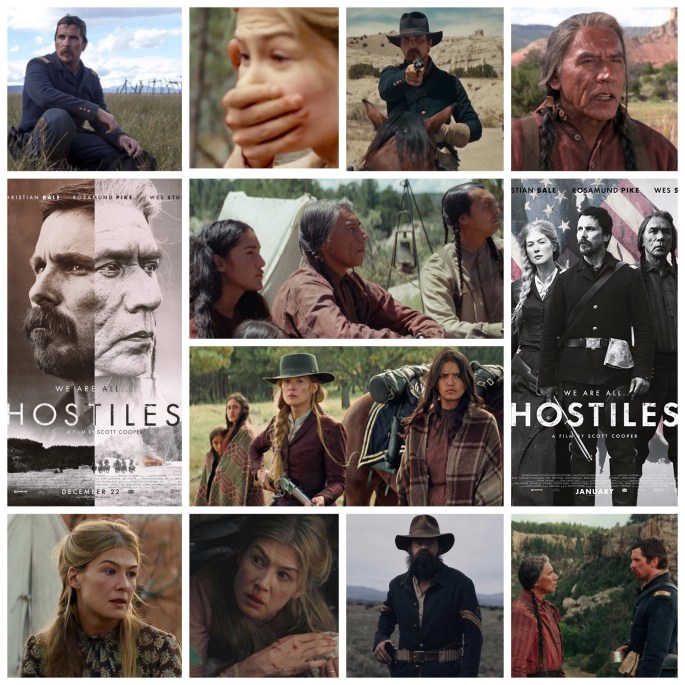
Scott Cooper’s Hostiles is beautifully shot, competently staged, well produced, acted and scored, but there’s a certain depth, development and complexity lacking, and I lay the blame on script, which seems a little south of the polished stage, with one foot still rooted in the blueprint phase. It’s a shame because the actors are game to give the film all they’ve got, but the script handed to them just isn’t on par with their efforts. Christian Bale is implosive as ever in one of his best performances as Blocker, a decorated civil war vet who has spent a great portion of his career heavily involved in the war and genocide against Native American tribes, and as such has become a hard, mean and brittle tempered creature. It’s fascinating to observe how someone like him, who does have a decent soul deep down, can be turned so backwards and hateful in circumstances like that, another theme the film doesn’t quite follow through with. Blocker is tasked with one last mission before semi-early retirement: Escort legendary Cheyenne Chief Yellow Hawk (Wes Studi, excellent as ever) and his kin from Arizona back to his home in Montana to live out his remaining years. Blocker bristles at the thought, but when his salty superior officer (Stephen Lang) threatens his pension, he begrudgingly saddles up. The film then showcases their journey, several hardships and skirmishes they find themselves in, all to fertilize the eventual bond and understanding formed between the two groups and their decision to work as a unit, and even respect each other. Here’s the problem: the script isn’t deep or thoughtful enough to make any of these arcs believable. The Native characters are painfully underdeveloped, particularly Yellow Hawk’s son and his wife, played by Adam Beach and Qorianka Kilcher, two actors more than capable of handing in great work when the material comes their way. The one thing that does work and is probably the best quality that film has is a character played by Rosamund Pike, a frontier farmer whose entire family is slaughtered by vicious Comanches in the film’s arresting opening scene. She joins Bale’s company, and Pike plays her with harrowing sadness, terrifying vengeful poise and gives one of the most realistic, un-cinematic portraits of grief I’ve ever seen. Come awards season next year, she should be a front runner. The film almost doesn’t deserve her sterling subplot, but it does it’s best, and reaches some heights here and there. Bale’s company is played by a reliable troupe including upright Jesse Plemons, melancholic Rory Cochrane and grizzled Peter Mullan. Also appearing is western veteran Scott Wilson in a brutal last minute cameo, always nice to see him still in the game. There’s an unbalanced focus between the soldiers and the natives, who I wanted to learn more about but were left as mainly tagalong bystanders with scant dialogue. When Bale’s arc reaches it’s final stages, I felt slightly cheated by everything that came before: I didn’t quite believe that what he’d been through was enough to sway over two decades of hate and prejudice, and once again the fault lies with script. A little more care, preparation and editing could have turned this from a good film into one for the ages.

-Nate Hill

Walter Hill’s The Long Riders

◦ I’m pretty sure that Walter Hill’s The Long Riders does something that no film had done before or after, least to that extent: pull off the biggest sibling stunt casting session in history. Based on the rowdy, violent exploits of the James Younger gang in the old west, Hill casts real life brothers as the troupe, a choice which could have been south of silly in any old director’s hands, but works like gold here. James and Stacy Keach play Frank and Jesse James, David Robert and Keith Carradine are the Younger clan, while Randy and a very mean, very young Dennis Quaid fill the boots of the Millers. It’s fairly brilliant, well organized and pays off nicely, especially if you’re a fan of any of these guys, which I am and then some. Now, the film. Most westerns about these hotshot outlaws take a quippy, cavalier standpoint and go for sterling silver charm. Not Hill, a notorious trend shirker and trailblazer whose tactics in casting, music, editing and tone have never followed the Hollywood grain. The film is downbeat, somber and mostly a series of vignettes that topple against each other like dominoes. The gang shuffles from robbery to holdup almost reluctantly, like it’s written in the stars and they have no choice but to commit crimes. They clash royally with the ruthless Pinkerton agency, who cause more than a few casualties on their side. The shootouts here are no sanitized 50’s Lone Ranger fluff, they’re brutal, bloody and amped up to extreme violence, which is always to be expected from Hill. The life of an outlaw is not glamorized here either, a choice rarely, if ever made in the western department. These are hard men resigned to their rough lives, not fast talking hot-doggin prince charmings like insufferable Young Guns type crap. There’s scattershot subplot about the brother’s lives, but mostly the focus is rooted in their exploits and run ins with the law. David Carradine’s Cole Younger has a cool knife fight sequence up against half breed injun Sam Starr (Hill favourite James Remar) over the favour of pretty hooker Pamela Reed. The actors are all gritty and grizzled, from James Keach’s long-faced, Moody Jesse James to Dennis Quaid’s volatile psychopath Ed Miller. Hill’s go to music guru Ry Cooder provides another achingly gorgeous score with echoes of his composition on Southern Comfort a few years later, a melancholic tune stripped bare of any action sequence swells or orchestral hoo-hah. Pretty damn underrated as far as big screen westerns go, with a tone and look that seems somehow far more genuine than many others in the genre.

-Nate Hill

Paint Your Wagon

I’ve never understood the cloud of negativity surrounding Paint Your Wagon, a terminally eccentric, raucously bawdy musical western epic in which old school tough guys Lee Marvin and Clint Eastwood get to sing, or at least do their best. Sure it’s a giant unwieldy spectacle, not all of the songs make a three point landing and it runs on far too long, but it’s such an interesting piece from many perspectives, it doesn’t deserve even half the shade thrown on it by critics over the years. I like it specifically because of how odd and random it is at times, how it meanders and lingers across the gold rush frontier town it takes place in, following the paths of it’s strange characters diligently. Marvin is the life of the party as Ben Rumson, a booze soaked, misanthropic prospector idling his way through the west in a haze of hangovers and hijinks. Eastwood is Pardner, a soft spoken stoic type whose life is saved by Ben, and the two strike a bond that’s eventually tested by Elizabeth (Jean Seberg), the beauty who loves them both. The trio makes the best of life in a rough n’ tumble settlement called No Name City, a feverish shantytown on the precipice of nowhere, populated by scoundrels, miscreants and hooligans. And that’s pretty much it, the story punctuated by a whole gallery of songs, some brilliant and others excruciating. The best is a haunting, melancholy melody by Marvin called ‘Wandering Star’, which is so good it could be listened to on repeat. ‘They Call The Wind Mariah’ is a gorgeous tune belted out by a young looking Harve Presnell as Rotten Luck Willie, a slick kingpin who basically runs the township. ‘There’s a Coach Comin In’ rouses spirits, and the titular theme is well staged too. Unfortunately all of the songs sung solely by Eastwood are a slog through the mud, as he bleats like a goat and gets saddled with the most boring tracks like ‘I Talk To The Trees’, the sappy ‘Elisa’ and ‘Gold Fever’, a musical sleeping pill. Whenever Marvin is around it’s a banger of a party, he goes the extra mile to keep the energy levels unbridled, while Eastwood is a little sleepier. There’s no way the film deserves the dodgy reputation it’s been slapped with though, a lot of it is fun as all hell, the big budget is spent well on fantastic production design, epic sets and big names who earn their keep, Marvin in particular.

-Nate Hill

20,000 Leagues of Cinema and Literature: An Interview with C. Courtney Joyner by Kent Hill

51A1E+schsL._UX250_

C. Courtney Joyner is a successful writer/director/novelist. He was a zombie in a Romero movie, he hangs out with L.Q. Jones and Tim Thomerson, he was once roommates with Renny Harlin and made the breakfasts while Harlin got the girls. It makes me think of Steve Coogan’s line from Ruby Sparks, “how do I go back in time and be him.”

Truth is we are the same in many instances. We’re just on different sides of the globe and one of us is in the big leagues while the other is at the scratch and sniff end of the business. But we both love movies and fantastic adventures. We both wrote to the filmmakers we loved long before the director became celebrity. We both longed for more info from behind the scenes – long before such material was in abundance.

He grew up in Pittsburgh, the son of a doctor and a reporter. He came of age in the glory days of monster movies and adventure fiction. Then he headed west and after college it wasn’t long before his writing caught the attention of producers and thus a career was spawned.

Spending those early years working with Charles Band and his company, Empire, Joyner was prolific, and soon the writer became a director. All the while he was working on a dream project, a work we all have in us, that he was fighting to bring into the light.

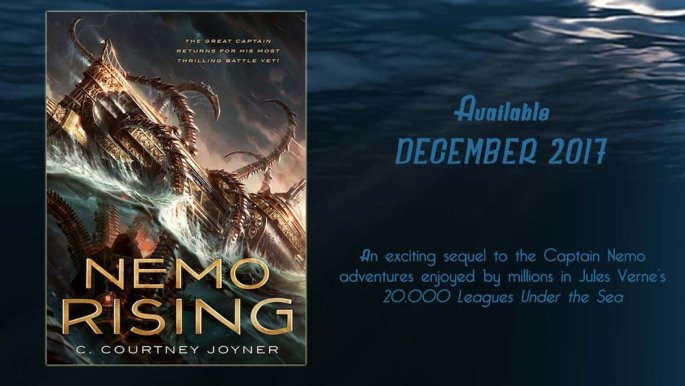
It was a love of Jules Verne and the “what if” type scenario that gave birth to the early version of the story that would become his current masterwork Nemo Rising; a long-awaited sequel, if you will, to 20,000 Leagues under the Sea.

His story would go through several incarnations before finally reaching the form into which it has now solidified. Swirling around him were big blockbuster versions which never quite surfaced. Names like Fincher and Singer and stars like Will Smith were linked to these big dollar deals.

trancers-3-deth-lives-movie-poster-1992-1000231140

Unfortunately even Joyner’s long-form TV version came close, but didn’t get handed a cigar. So at a friend’s insistence he wrote the book and his publisher, in spite of the property being linked at that time to a screen version that fell apart, agreed to still put the book out.

Thus Joyner’s Nemo has risen and at last we can, for now, revel in it’s existence. I believe it is only a matter of time before it shall acquire enough interest – and the new major playing field – the field of series television may yet be the staging ground for Courtney’s long-suffering tribute to the genius of Verne and the thrilling enigma of a character known as Captain Nemo.

nemo4

Long have I waited to chat with him and it was well worth the wait. So, here now I present my interview with the man that director Richard Lester (The Three Musketeers, Robin and Marion, Superman II)  once mistook for a girl that was eagerly interested in film.

Ladies and Gentlemen . . . C. Courtney Joyner.