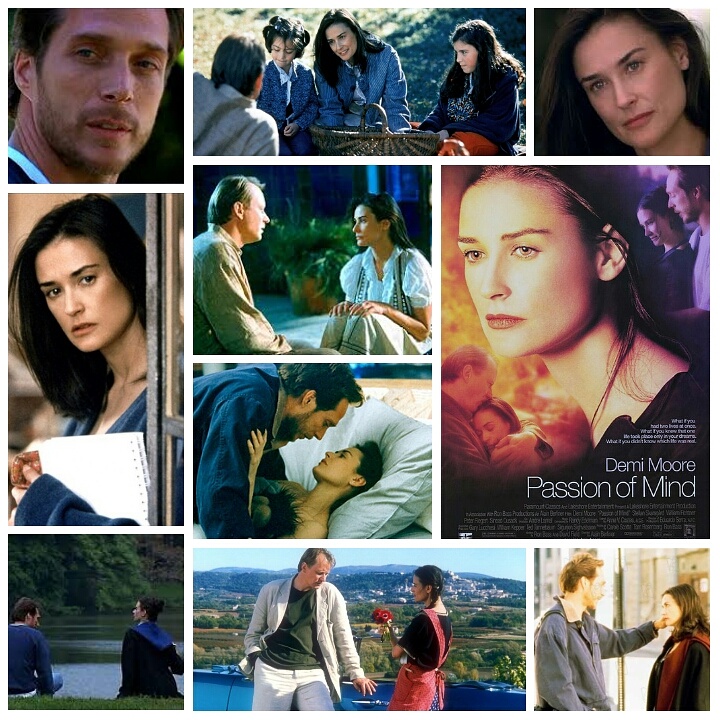
Passion Of Mind is a little seen fantasy romance tale that stars Demi Moore as a woman named Marie, essentially living double lives in a way. She lives and works in New York, and is as ordinary as any other woman in the world, but when she goes to sleep she wakes up to another life in the French countryside, with another job and children who aren’t in New York. She lives a day in the French life, goes to sleep, wakes up back in the New York life and lives for another day before going to sleep and back again. And so it goes. Is one life a dream? Or both? Is she imagining things, or stuck in some rift? To complicate things, as always happens in film, there are two men, one for each life. Aaron (William Fichtner) is a kind, caring businessman in the New York life who she begins a relationship with. In France she meets compassionate, romantic William (Stellen Skarsgard) who she also begins to fall for. Quite the predicament, no? If the premise sounds familiar to you, here’s why: there was a short lived NBC drama called Awake which ran for one season, starred Jason Isaacs and had the exact same setup. Now while the show obviously borrowed it’s central plotline from this film, it’s no big deal because it’s such a great idea it deserves more than just one shot. The film is quiet, pleasent and sweet, never really taking steps to explain it’s concept but simply letting it’s characters live within it in perplexed, whimsical harmony. Moore has an inherent sweetness to her and she’s wonderful here. One might think a protagonist who is put through a scenario would be confused, stressed out and damaged. Moore plays it her own way, as she always had. Her character is enchanted by her situation, if a little wary. Skarsgard and Fichtner are left field choices for romantic leads, as both are kind of considered character actors with stark, specific looks. Both play it straight here and their casting helps the film loads. Marie has two separate therapists, each from one of the lives (an element which the NBC show used as well), played by Joss Ackland and Peter Riegart. It’s not to serious, not too fluffy, just the right kind of low key romance with an imaginitive streak and a high concept that fits neatly into the story.
Author: natewatchescoolmovies
Things We Lost In The Fire: A Review by Nate Hill
Things We Lost In The Fire takes an unblinking look at addiction, recovery, redemption, grief and the ways in which various people cope with all of the above. It shirks the dramatic stereotypes and instead shoots for realism, or at the very least, an unpredictable narrative within a genre that often follows rigid blueprints. It also contains two exceptional performances from Halle Berry and Benicio Del Toro. Berry plays Audrey Burke, mourning the loss of her husband Brian (David Duchovny could write a textbook on understated acting that cuts deep) to a really unfortunate accident. The last minute arrival of his longtime best friend Jerry Sunborne (Benicio Del Toro) adds a new element to the family’s grieving process. Jerry is an ex lawyer who is now addicted to heroin. Brian stood by him for many years, never judging or intervening but simply being there to spend time with, and look out for his friend. Duchovny appears in multiple flashbacks with both Berry, Del Toro and his two remarkable children (Micah Berry and Alexis Llewellyn) that instil a lingering presence that not so much casts a shadow over everything, but brightens and flavours it with memories. Audrey is unspeakably lonely and devastated, and despite the fact that she despised Jerry and what he represented for years, invites him to live in their garage, in flat out pure desperate instinct, and probably in an attempt to be closer to Brian after he’s gone, by bringing what was close to him closer to her. Jerry is great with the kids, supportive and wants to change, even accepting employment assistance from their kindly neighbour (excellent John Carroll Lynch). The demons do their best to pull him back though, as is their purpose, and a rift forms as we begin to see that Audrey has not fully accepted Brian’s death and is in the throes of miserable confusion. Director Susanne Bier uses many intimate close ups of eyes, hair, smiles and frowns to bring us into the mindset of her characters, a tactic which works wonders here and keeps minds and hearts of her audience glued to the proceedings. Berry is dynamite, pure and simple. The finest acting moment I’ve ever seen from her comes deep from the gut and late in the third act, an agonizing moment in which she has a splintering realization that her husband is gone for good, that final, resolute place that sinks in and grabs hold which we’ve all heard about from family members or news stories in which loss of loved ones has played a part. I don’t know if Berry has experienced this for herself in her own personal life, but she sure damn well embodies it here with every ragged sob, and it cast her in an entirely new light for me. Del Toro is Brando-esque, a shambling, unshaven pit of insecurity and inner turmoil, giving Jerry the mutilated soul he deserves without ever dipping in self pity, given the phoenix treatment and rising from the ashes of his longtime affliction simply by being exposed to Audrey and the kids. One would think that the relationship between Audrey and Jerry might end up going into romantic territory, but Bier and company is more interested in the road less travelled, showing us a story which unravels in a way that’s much more akin to believability. Between her directorial skills, Berry and Del Toro’s virtuoso work, this is not one to miss.
Frankie & Alice: A Review by Nate Hill
There needs to be more films about mental illness that treat the subject with the vital care and compassion that Frankie & Alice does. It should be re-titled ‘The Halle Berry and Stelllen Skarsgard Show’, because for just over 90 minutes the two of them give some of the bravest, challenging work of their career in telling this story. Granted, it takes a few liberties with what we know about multiple personality disorder and what still to this day lurks in the shadows of the vast human consciousness, but it’s in service to character and story and is never exploitative. This film was made in 2010 and mired in distribute hell for nearly four years before dropping off of a most unceremonious assembly line into weak marketing. No one I’ve asked has even heard about it, which is a shame because it’s Berry at her most shattering, sexy and charismatic, and it’s somewhat based on a true story as well. She plays Frankie here, a wayward exotic dancer prone to destructive episodes in which Alice, an alternative personality, takes over and wreaks havoc in her personal life. Alice is a racist, southern white girl and Frankie is a black stripper in 1970’s New York. You can imagine the predicament. She ends up in a psychiatric halfway house under the care of Dr. Oz (Stellen Skarsgard) a man who is not remotely familiar with the term ‘giving up’. He sees the issues with Frankie clear as day, where his shirt tucking colleagues (Matt Frewer and Brian Markinson) are skeptical and impatient with his process. Oz is trying to unlock the secrets of Franki’s mind through the knowledge of each alter personality, all of whom are related to a tragic incident in her past that we get brief, fractured glimpses of through the broken prism of her mind. Director Geoffrey Sax keeps the melodrama to an agreeable minimum and let’s his two leads feel their way through the work both through each other and the material. Berry and Skarsgard have never been better, setting one another alight with the kind of chemistry many lead pairs can only dream of. Berry writhes with fury, confusion and loneliness, her coherence a flower that begins to bloom when Oz shows her kindness and the desire to really help her, something which. O one has ever done for her before in life. Skarsgard is an interesting guy because he’s equally great at inhabiting cold, sociopathic villains (King Arthur, Ronin) and he’s also compassion manifest when he wants to be (Passion Of Mind, Powder Keg). The performance he gives here radiates with warmth and assurance, a lighthouse in the fog of Frankie’s illness. Newcomer Vanessa Morgan is also excellent as the 16 year old version of Frankie, caught in a hailstorm of racism and sadness that no doubt are the seeds for her future condition. I’d love to know more about the real story of Frankie, and see how it contrasts with the film. Even if the differences are great and the liberties taken are considerable, we are in the end left with a superbly made film that takes mental illness head on and is one step further in erasing the stigma. A film that’s woefully unseen, so,etching I hope this review will change.
Frankie & Alive: A Review by Nate Hill
There needs to be more films about mental illness that treat the subject with the vital care and compassion that Frankie & Alice does. It should be re-titled ‘The Halle Berry and Stelllen Skarsgard Show’, because for just over 90 minutes the two of them give some of the bravest, challenging work of their career in telling this story. Granted, it takes a few liberties with what we know about multiple personality disorder and what still to this day lurks in the shadows of the vast human consciousness, but it’s in service to character and story and is never exploitative. This film was made in 2010 and mired in distribute hell for nearly four years before dropping off of a most unceremonious assembly line into weak marketing. No one I’ve asked has even heard about it, which is a shame because it’s Berry at her most shattering, sexy and charismatic, and it’s somewhat based on a true story as well. She plays Frankie here, a wayward exotic dancer prone to destructive episodes in which Alice, an alternative personality, takes over and wreaks havoc in her personal life. Alice is a racist, southern white girl and Frankie is a black stripper in 1970’s New York. You can imagine the predicament. She ends up in a psychiatric halfway house under the care of Dr. Oz (Stellen Skarsgard) a man who is not remotely familiar with the term ‘giving up’. He sees the issues with Frankie clear as day, where his shirt tucking colleagues (Matt Frewer and Brian Markinson) are skeptical and impatient with his process. Oz is trying to unlock the secrets of Franki’s mind through the knowledge of each alter personality, all of whom are related to a tragic incident in her past that we get brief, fractured glimpses of through the broken prism of her mind. Director Geoffrey Sax keeps the melodrama to an agreeable minimum and let’s his two leads feel their way through the work both through each other and the material. Berry and Skarsgard have never been better, setting one another alight with the kind of chemistry many lead pairs can only dream of. Berry writhes with fury, confusion and loneliness, her coherence a flower that begins to bloom when Oz shows her kindness and the desire to really help her, something which. O one has ever done for her before in life. Skarsgard is an interesting guy because he’s equally great at inhabiting cold, sociopathic villains (King Arthur, Ronin) and he’s also compassion manifest when he wants to be (Passion Of Mind, Powder Keg). The performance he gives here radiates with warmth and assurance, a lighthouse in the fog of Frankie’s illness. Newcomer Vanessa Morgan is also excellent as the 16 year old version of Frankie, caught in a hailstorm of racism and sadness that no doubt are the seeds for her future condition. I’d love to know more about the real story of Frankie, and see how it contrasts with the film. Even if the differences are great and the liberties taken are considerable, we are in the end left with a superbly made film that takes mental illness head on and is one step further in erasing the stigma. A film that’s woefully unseen, so,etching I hope this review will change.
44 Inch Chest: A Review by Nate Hill
44 Inch Chest is packed full of bloated, preening masculinity, cold hard chauvinism and dense, wordy exchanges that seem pulled right off the stage, an intense bit of British pseudo-gangster quirk with two writers who seem intent on heightening every syllable to near surreal levels of style. The same scribes are responsible for the glorious verbal stew that can be found in Paul McGuigan’s brutal Gangster No. 1 as well as Sexy Beast, and while the level of viciousness here is left almost entirely to the spoken word alone, the elliptical sting of their script still hits home, and even ramps up a bit from those films. A mopey, consistently weepy Ray Winstone stars as boorish Colin Diamond, an gent whose wife (Joanne Whalley Kilmer) has been caught in an affair with a chiseled french pretty boy (Melvil Poupoud). He resorts to a melancholy, comatose state as his perceived manliness visibly circles the drain. His circle of friends arrives, each with their own flamboyant ideas for resolving the situation. Velvety Meredith (Ian McShane, cool as a cucumber) looks on in snooty amusement. Violent guttersnipe Mal (Stephen Dillane, replacing Tim Roth) has the brawn but neither the brains nor ambition to act. Archie (Tom Wilkinson) is the bewildered everyman. Old Man Peanut (a fire and brimstone John Hurt who devours the script like a lion feasting on a gazelle) is a bible thumping, crusty old pot of fury who suggests that wifey should be stoned to death for her indecency and betrayal. They spend the better part of the film pontificating like a babbling senate, whilst Winstone languishes in despair. One wonders what the point of it all is and where it’s going, until we arrive at an oddly satisfying third act that somehow negates almost everything we’ve seen before it. Strangely enough, though, it works, if only to give us something we’ve never quite seen before, pulling the rug of genre convention out from under us and giving us a piece that almost could resemble a spoof of other works, if it weren’t so damned straight faced and persistent in its execution. In any case, I could watch this group of actors assemble ikea furniture and it would still be transfixing. It’s just a room full of talent shooting the shit for most of the running time, and in a genre where one can scarcely here the performers talk over the gunfire and cheekily referential soundtrack a lot of the time, I’ll damn well take something a bit more paced, quiet and stately. Winstone smears over his usual seething anger with a morose depression would almost be endearing if it weren’t so pathetic. Wilkinson brings his usual studious nature. McShane is pure class in anything (even a few B movies I’m sure he’d love to forget) and he swaggers through this one like a regal peacock, getting some of the best lines to chew on. Dillane is detached and indifferently cruel, with seldom a word uttered, his lack of mannerism contrasted by the vibrant animosity of his three peers. Hurt is pure gold as the closest the film comes to caricature, just a vile old coot who belongs in the loony bin raving to the walls about awful things that happened ‘back in his day’. Different is the key word for this one, and one might be easily fooled by the poster and synopses into assuming this is a revenge flick populated by action and violence. Not so much. Although a lot of the time that is my cup of tea, it’s nice to get a welcome deviation once in a while, and this one is a real treat.
B Movie Glory with Nate: 2103 The Deadly Wake
2103: The Deadly Wake strives to stand out from the B-movie masses by giving turning it’s straightforward sci-fi concept somewhat on its head. It’s set in the very distant future, in which earth’s oceans have become so contaminated that they have all taken a gaseous form, with corporations sending forth spaceship type vessels that deliver goods and wage warfare. They resemble submarines basically sailing through colored fog, and it’s one of the neatest and adorably ambitious futuristic settings I’ve seen. Malcolm McDowell is damn excellent in a rare hero role as Captain Sean Murdock, a salty old sea dog who lost a ship years before and is somewhat disgraced. Forlorn and fed up, he’s in a slump when hired to transport a massive ship across the ocean, with a mysterious cargo that’s guarded by a sinister mercenary and security expert (Michael Paré). Usually in this type of thing it’s Paré as the hero and Mcdowell as the villain (which has actually happened in Roland Emmerich’s Moon 44), but here they pull a Tarantino and switch up the type casting which is wonderful to see and makes for a fresh vibe. Paré works for the sultry, sleazy (Heidi Von Palleske), the company CEO who wants an eye kept on the cargo hold. Paré and Mcdowell bit heads, there’s murky conflict and the ship’s Artificial Intelligence engine is called B.A.B.Y. and is quite literally a fetus in a big gooey tank with wires attached to its brain. If that isn’t worthy of a medal in the ambition department I don’t know what is. Theres an odd sort of climactic fight scene that plays like a dream and doesnt involve fighting at all really, more like just a laser show with strange dialogue. Despite it being set in the future there’s a nifty retro style, with soldier uniforms and the darkly poetic tone almost calling forth the sensibility of the 40’s. I was reminded of Titanic in scenes, but that could be my weird cinematic free association. This one’s a keeper for fans of off kilter, under the radar oddities.
Sinners And Saints: A Review by Nate Hill
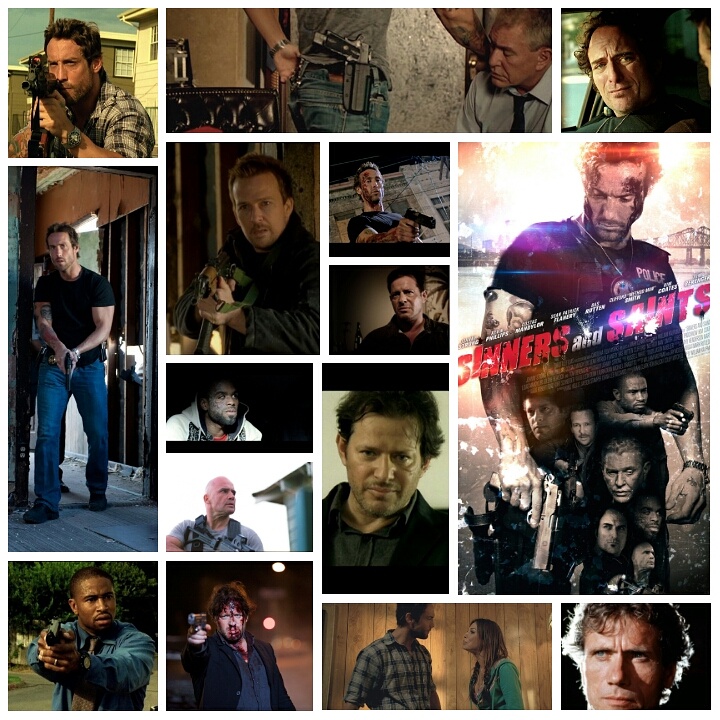
Sinners And Saints is a very adeptly made New Orleans set cop thriller that pays homage to tough archetypes of yore such as Lethal Weapon, Dirty Harry and Bad Boys. It’s far more serious and sinewy than those movies though, sucking the humour off its own bones and leaving a grim tale of one man ditching the force and going rogue in an attempt to hunt down some extremely bad people. Johnny Strong, a formidable, mscular guy, plays Detective Sean Riley, trying to sort through the post-Katrina chaos of the city whilst internally dealing with the loss of his wife and infant son. Strong is known for The Fast And The Furious as well as Black Hawk Down, quickly making it his calling card to play tough outsiders who get shit done with a fiery knack for not always playing by the rules. As it turns out, New Orleans is rife with psychopathic criminals up to no good, starting with evil mercenary Raymond Crowe (a badass, hateable Costas Mandylor), leading a crew of paramilitary scumbags into some very nefarious deeds. Riley discovers that his old army buddy Colin (the blonde half of the Boondock Saints, Sean Patrick Flanery, getting some nice, quiet moments of introspect before the firefights) is involved somehow, spurring him further into action. His commanding officer Trahan (Tom Berenger, stoically reminiscing about the youthful days in which he headlined flicks like these), worries that the path he’s headed down is too dark and similar to the men he is hunting. He’s paired with an unseasoned rookie (Kevin Philips), and an inevitable bond is forged in between and during bouts of gunfire. The action is wickedly staged, rising above the ineptitude that usually brands direct to video efforts like this. No, these filmmakers know exactly what they are doing and how to raise a pulse, demonstrating care and passion in creating their battle scenes. The cast is stacked high as can be as well. A boisterous Kim Coates has a fleeting scene to kick off the film. Resident baddie Jurgen Prochnow shows up a few times as malicious arch villain Mr. Rhykin, pulling strings which we are never fully privy to (I’ve heard rumblings about a sequel, hopefully with answers regarding his character). The other Mandylor brother Louis plays a bleach blond Australian mercenary and is beyond priceless. UFC legend Bas Rutten plays Dekker, a frightengingly nasty dude who proves a tough obstacle for Riley. Rapper Method Man even rears his head as a bad tempered, disfigured street thug who has his part to play in the whole cluster fuck. I watch countless direct to video action flicks that try their absolute adorable best to emulate the films they admire, often very lazily and without adding any new flavors. Can’t say that about this one. It fires up such a wicked, visceral punch while maintaining it’s own solid gold originality that it can scarcely even be called a B movie save for the fact that it wasn’t released theatrically. It’s pure, first class action, and demands a watch from anyone who says they’re a completist of the genre, before that claim can be validated.
Gothika: A Review by Nate Hill
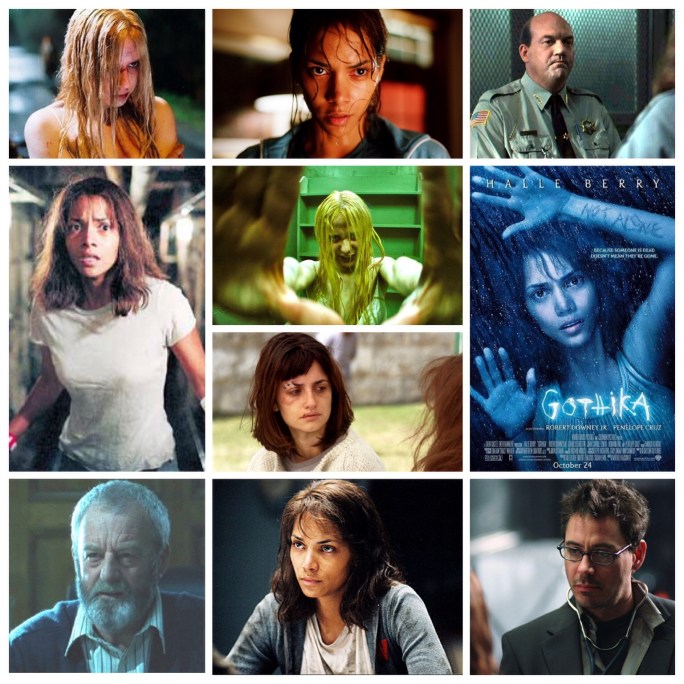
Matthieu Kassovitz’s underrated chiller Gothika is thick with a horror atmosphere that goes straight for the jugular in terms of scares, a psychological ghost story that actually raises hairs a frightens, or at least did for me. It sometimes sacrifices logic for style, but what style it’s got! Any horror flick set in an asylum just has to to be cloaked in workable atmosphere to be effective, and this one is positively dripping with it, hence the evocative title. Halle Berry plays a laid back psychiatrist who wakes up one day in the asylum she works at, only now a patient. She’s told she brutally murdered her husband (Charles S. Dutton) yet has no memory of the act. As if that weren’t a terrifying enough situation for her to be in, she starts having waking nightmares, haunted by a gnarly ghost of a girl (Kathleen Mackey) with mysterious ties to the facility’s past. Her colleague and friend (Robert Downey Jr. gives the dour proceedings his usual chipper pep) seems unable to help her. A guard (John Carroll Lynch) is hostile towards her, angry at the loss of her husband who was his friend. An erratic fellow patient (a de-glammed Penelope Cruz) seems to know more than her vacuous babbling would suggest. The asylum Director (Bernard Hill, excellent) is perplexed by the whole situation. It’s a twisty funhouse of a plot that probably piles on one stark plot turn too many, they’re nevertheless fun to be left aghast by as the rattle by with little regard for plausibility. Berry is convincing in her tormenting position, radiating desperation and resilience that claws at the cobwebs of insanity. Kassovitz piles on the gothic atmosphere relentlessly, and it really works, until we have a visual palette that looks like the dark underside of Tim Burton’s unconscious mind. The ghostly scenes have a threatening, intense edge to them and feel unnervingly realistic, putting us right in the hot seat with wide eyed Berry. Style over substance? Maybe. Okay, probably. But I care not. If the style, composition and palette are enough to draw me into a story, I can roll with it. This one imprints troubling negatives on the celluloid which latch themselves onto your psyche. Maybe it works well because it’s got a European director, and they’re more in tune with the supernatural in general. Maybe it just does a nice job at being effective horror. Either way, I enjoyed.
Tony Scott’s The Last Boy Scout: A Review by Nate Hill
Tony Scott’s The Last Boy Scout is pure stylistic grime, an exercise in early 90’s action with the blackest of humour. The tone is set with a square jaw early on: a star quarterback for a hotshot NFL team is under a lot of underground pressure to make that perfect play and in turn please the loan sharks. He buckles under the heat, ends up pulling a gun on the field and murdering a score of opponents before turning the gun on himself. Now horrifying as that is, if you have a sick sense of humor like me it conjures a dark chuckle of the most guilty variety, because.. well, it’s funny! Albeit in the darkest way possible, which is the arena this one skates in, love it or leave it. Upon closer examination of the script we discover it’s penned by that wonderful man Shane Black, who gave us Kiss Kiss Bang Bang and the upcoming The Nice Guys. No one can produce such heinous mayhem with a cavalier attitude and actually get away with it as well as Black does. The guy is a prodigy of dark humour, and who better to embody his protagonist here than a sheepish Bruce Willis as Joe Hallenbeck, a jaded ex detective who is so sullen and cynical he’s almost comatose. He’s paired with equally slummy former quarterback Jimmy Six (Damon Wayons), lazily trying g to solve a case involving the murderous quarterback and some shady politicians. Along the way that’s paved with many a sarcastic, beleaguered exchange they cross seedy paths with shady villains (Taylor Negron, RIP, and a youthful Kim Coates), a beautiful working girl with ties to the case (Halle Berry) and Willis’s spitfire of a dysfunctional daughter (Danielle Harris). There’s a wonderfully bloated supporting cast including Noble Willingham, Chelsea Field, Joe Santos, Bruce McGill and more. It’s got a bite that stings, mainly thanks to Black’s frighteningly stinging screenplay which give the film it’s sardonic, put – upon aesthetic. This meshes together nicely with Scott’s trademark sun soaked, pulpy, picturesque tone and provides one hell of an action movie rode. Nasty in all the right places, funny when the story begs for it, and build to last.
Batman Vs Superman: Dawn Of Justice – A Review by Nate Hill
Batman Vs. Superman: Dawn Of Justice. Wow. Where to even start. What a symphony of scorched earth heroics, a two and a half hour maelstrom of thundering action, introspective gloom and very current vibes of apocalyptic dread. I’m not sure if I was watching an entirely different film from some of these bitter bottomed critics who are maiming it with inaccurately nasty reviews. Balls to them. Zach Snyder should be proud of this achievment, for in the face of both ruthless odds and rabid fans who would make any one of us piss down our legs at the thought of ‘getting it right’, he has mounted a titanic epic of a superhero flick, hitting all the right notes and fuelling both casual moviegoers and salivating super fans with a rekindled love for comic book films. A much welcomed grit and violent edge creeps into the proceedings here, a tone which Snyder has a passion for and is incredibly deft with. We begin with a visually arresting opening credit sequence, which Snyder previously perfected to hair raising brilliance in Watchmen, a ten minute opus set to Bob Dylan. Here he inter cuts shots of young Bruce Wayne, both discovering the prophetic swarm of bats and on the fateful night of his parents murder, a sequence done over a thousand times in film, but never quite with the inventive flair used here. We then arrive with adult Bruce (Ben Affleck) in Metropolis right as it’s being ripped to shreds by the Def Jam smackdown match of Superman (Henry Cavill) and Zod (Michael Shannon). There’s eerie shades of 9/11 as Bruce darts through the ashen rubble, attempting to save the employees in one of his towers. One senses the fear and rage in Wayne right off the bat (pun intended). He glowers in seething fury at the man of steel, primally threatened and haunted all over again by loved ones he couldn’t save a second time around. This film addresses the ludicrous amount of destruction that Superman wrought upon Metropolis in several ways. Political nerve endings are fried as Senate and State alike get hostile towards the god in the red cape. No one is more aggressive than Batman, though. This brings me to Affleck as Batman. Without a doubt my favourite cinematic incarnation of the caped crusader, and his debonair counterpart to date. Yes, even more so than Bale. Nolan’s The Dark Knight is still tops for me, but the portrayal of Batman by Bale didn’t strike as harmonious a chord with me as Affleck. It just didn’t feel like pure Batman, it was real world Batman. Affleck feels much more rooted in the comics, and God damn it all if he isn’t the most savage, violent Bats to come our way, well… ever. I’ve always been bothered by the nagging fact that Batman refuses to kill. Even in in a beatdown he could easily inadvertently cause death, so why bother trying? Here, he doesn’t go out of his way to deliberatly kill, but he sure has no problem brutally breaking bones and stabbing his adversaries without an iota of faux-noble hesitation. That’s the kind of Batman I want to see. Fuming, fired up and full of rage demons that erupt into fantastic action scenes. One sequence involving a room full of thugs is just jaw dropping and probably my favourite sequence of the film, even over the titular smackdown with Superman. There’s an earthy, simplistic take to him as well, with a modest suit that gives nods to Frank Miller and even Batman: The Animated Series. He is by far the elemental force that the character should be, and the part of the film that I connected with most. I hope he gets his standalone film real soon. Henry Cavill has grace and intuition as Superman, and a surprisingly earthly aura as Clark Kent, in a fit about Batman’s vigilante tactics. He’s the outsider here, an orphaned deity truly trying to do his best in a world that often shuns him in fear. He was never my favourite superhero, or even on the list, but Cavill combined with Snyder make him a force to be reckoned with, and a hero I can get behind. The two eventually meet in a remarkably choreographed clash of the titans, a duel that really only lasts a few minutes and isn’t central theme, which raises questions in my head about the first part of that title. Their fight is composed of Batman’s hard hitting, blunt force physicality pitted against Superman’s fluid, elegent invincibility which is satisfyingly put to the test by the appearance of a certain green mineral we all know about. The James Cameron-esque suit Batman wears for the fight is a grinding wonder that looks like it weighs a metric ton and could level buildings alongside the man of steel. The combat feels urgent, from the gut and roars into action perfectly. Of course, that isn’t where the fireworks stop, but I ain’t sayin any more than that. Gal Gadot is truly wonderful as Wonder Woman, I also can’t wait for her solo outing, and wish she’d been in the film more. Her much talked about entrance is the definition of crowd pleasing, and will make you cheer in approval, which I did out loud. She’s endlessly gorgeous, and has the toughness to go along with it, a great casting decision by anyone’s tally. Jesse Eisenberg wowed me as a young, jittery Lex Luthor, in what is probably the most clinically insane portrayal thus far. Forget bumbling Gene Hackman and hammy Kevin Spacey, this guy seals it for me. There’s a true madness to his Lex, which when given enough money and resources can have cataclysmic results. It’s a villain to remember, and Eisenberg exudes palpable danger from every pore, his psychopathic sheen of logic barely shrouding the mania beneath. Jeremy Irons is a more restrained, jaded Alfred who is still unconditionally supportive of Wayne, but is reaching the end of his rope which is tethered to pure world weariness. He gets some of the only humerous bits of the film, albeit of dry, brittle variety. Amy Adams is reliably terrific, her eyes pools of perception that mirror the horror and spectacle of the events through the mind of a human, with every ounce of nerve and courage as those around her that have superpowers, or expensive toys. Diane Lane is weathered wisdom and maternal compassion as Martha Kent, nailing her scenes with the small town, kindhearted patience that a film this noisy deserves, tipping the scales to provide occasional serenity in the eye of the hurricane. Kevin Costner makes a brief appearance in one of the films numerous and often confusing dream sequences. He was a highlight in Man Of Steel, and brings the same baleful, gruff adoration here, in a wonderful but brief scene with Clark. Laurence Fishburne is another source of rare humour as the perpetually exasperated Perry, CEO of the Daily Planet. Aggravated and cheeky, he commands every frame he’s in and had me chuckling no end. Holly Hunter has forged a career of playing no nonsense hard asses, here a ballbreaking US Senator here who shares a moment of distilled intensity with Luthor proving that Superhero films can have some of the best written dialogue. Harry Lennix makes great use of said writing too as the steely Secretary Of Defense. Callan Mulvey and Scoot McNairy are memorable in supporting turns. Listen hard for Patrick Wilson and Carla Gugino, and look for a certain ocean dwelling dude in the briefest of moments. Jeffrey Dean Morgan also has a cameo that’s almost too good to be true. Hans Zimmer and Junkie XL, who was so top notch with Mad Max: Fury Road, combine efforts for a score that knocks it out of the park and several miles further. Batman has a soul rousing battle cry of an overture, with subtle shades of Zimmer’s work on the Nolan films, built upon to give us something truly unique and fitting for the character. Lex Luthor is accompanied by a fitful cacophony of strings that sound like the Arkham Asylum charity orchestra having a collectively unnerving seizure. My favourite riff though I think is for Wonder Woman, a deviously disarming jaunt that strays from the grandiose, baroque theme and feels wickedly subversive, getting you just so pumped for her character. Zimmer’s work on Interstellar made it my top score of 2014, because he leapt out of the box of his usual tricks and gave us something we’d never heard from him before. Here he shreds that box with ingenuity and creative output, a varied, explosive piece that assaults your ears splendidly. My one concern with the film was a dream sequence midway through concerning Batman, and anyone who’s seen the film knows what I’m talking about. I’m sure comic book fans have some point of reference or context regarding it, but the casual viewer doesn’t, and a little more explaining would have been nice. I will say though it showcases Batman in an entirely new light which took me off guard nicely. This is what a superhero movie should be, plain and simple. Big, bold, audacious, stirring and full of high flying action, dastardly villains, conflicted heroes clashing like the ocean tides and a sense of pure adventure. Forget what the critics are saying, this one comes up aces in all categories and is a perfectly wonderful start to the stories of a group of characters that I look forward to seeing in many a film to come. Especially Affleck’s Batman.