John Carpenter’s Escape From New York

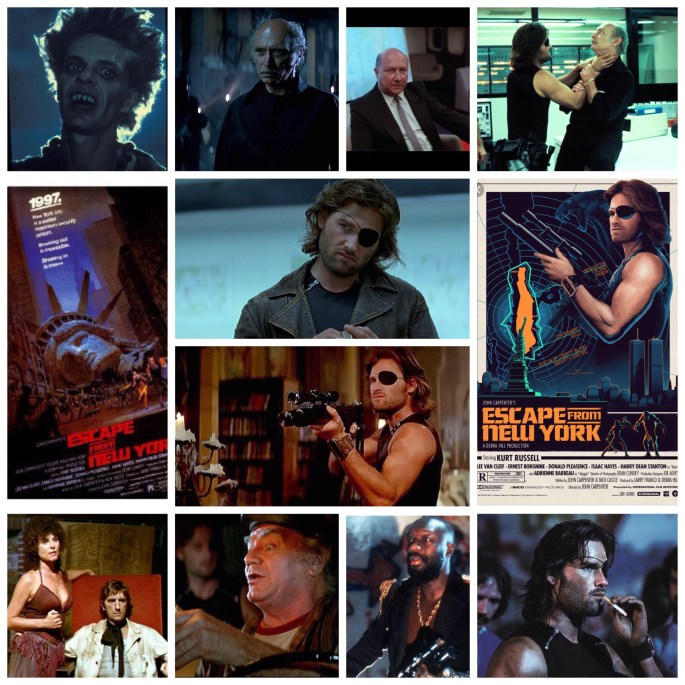
John Carpenter’s Escape From New York is lean mean, brawny and one of the director’s best efforts, one of his leaps into non horror territory and a high concept, exploitation template that has become so iconic that he’s had to sue one production for literally copying and pasting. More iconic still is growling Snake Plissken, a nasty, uncooperative, maladjusted piece of work that has calcified into both a genre titan and one of Kurt Russell’s most instantly recognizable, badass characters. Plissken is basically a villain transplanted into the protagonist’s seat, where he gets to shake up the formula and push the boundaries of being an antihero nicely. By now everyone knows the story. The President (Donald Pleasence) ejects out of Air Force One and crash lands in futuristic NYC, now a giant penitentiary housing unwanted criminals from all over, cordoned off from the rest of the world. Snake is sent in by General Hauk (Lee Van Cleef is a sadistic snake in his own right) as a ‘fight fire with fire’ ditch effort, given twenty four hours to retrieve POTUS at an extraction point and implanted with a microchip that will blow him into hamburger helper if he doesn’t make his deadline. Cue explosions, car chases, wicked stunts and set pieces galore, done in Carpenter’s careful, tactile, authentic and slightly non-Hollywood manner. The guy just has a knack for taking formulaic premises and giving them a just-south-of-normal spin, his own flavour and one that makes cult classics that are built to last. Adrienne Barbeau, Isaac Hayes, Ernest Borgnine, freaky Frank Doubleday, Charles Cyphers, Tom Atkins and good old Harry Dean Stanton all provide standout support. My favourite aspect of the film is the original score, composed by Carpenter himself, of course. It’s a spooky, atmospheric riff that’s akin to the music in The Thing, and just has this synth-y way about it that transports you to the specific time and place of the film flawlessly, it’s a showcase example of an auditory mood board. No remake could ever touch this, it’s too idiosyncratic and special to be updated, and the sooner studios realize their never ending goose chase to capture lightning in a bottle twice is a fool’s errand, the sooner we’ll get back on track and make original contemporary films that will becomes genre classics in the future, just like this. I love Plissken’s final act of brutal rebellion, a reminder that this is not a nice guy we’re dealing with here, but one who plays by his own rules and shirks the standards, much like Carpenter himself. I imagine Plissken’s reaction to news of a remake would be similar, if not more hotheaded, than that final, lethal sleight of hand prank he pulls on a government that stabs him in the back. Solid gold.

-Nate Hill

The Farrelly Brothers Dumb & Dumber To

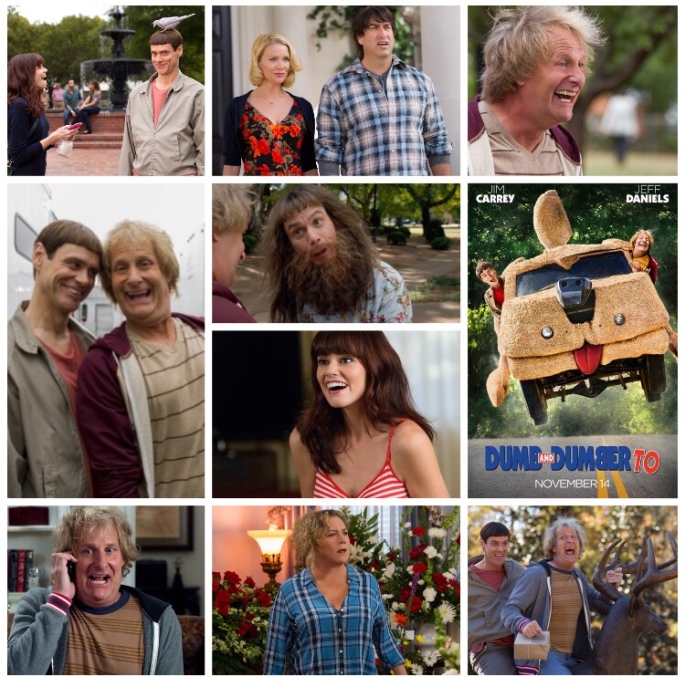
I might catch some royal shit for this, but I loved Dumb & Dumber To, the Farrelly Brother’s decade’s later follow up to pretty much one of the best comedies of all time. It’s different; meaner, raunchier, a tad more meta and way less down to earth than its predecessor, it seems to be almost universally projectile vomited upon by critics and loyal fans alike. Fuck em if they can’t take a joke, because there’s no arguing that this one isn’t funny. In bad taste? Sure, but so was the original in its own 90’s way. Less charming? Maybe, but suck it up. Discontinuous to the nature of the leads in the original? Granted,

but it’s been like twenty years and the filmmakers/actors have changed as artists. Bereft entirely of valuable, effective humour? Not a chance. Just be thankful we got something to erase the pungent memory of Dumb & Dumberer, a prequel wholly undeserving of the legacy’s name. Jim Carrey and Jeff Daniels are a little older and a little more leathery, but they’re still Harry and Lloyd, the two dim witted pioneers of mid 99’s gross out humour and buddy comedy shtick, resurrected for a brand new adventure. After a prologue where Harry rescues Lloyd from a care facility (that catheter is a wince moment), they’re off to find Harry’s daughter (Rachel Melvin) who he spawned with the notorious Freida Feltcher, brought to life by none other than Kathleen Turner in full hoe mode, she’s a face I haven’t seen in movies for years. There’s a half baked crime melodrama unfolding around them just like in the first one, and just like then, they’re too dumb to get what’s going on, a running joke that villains Laurie Holden and Rob Riggle (doing a double shift) carry amiably enough, but they’re no Joe Mental or Nicholas Andre, let’s be real. The highlight for me was when Harry and Lloyd bumble their way onstage at a TED Talk-esque (updating set pieces for a new millennium) as judges, and hurl moronic criticism at every invention that graces the desk. It’s not the same as the original but it’s been years, after all. The Farrelly’s have always been about distasteful, raunchy, whacked out humour that aims low and beats the laughs out of you, which is exactly what I found to be on display here. Vastly undervalued.

-Nate Hill

Alex Garland’s Annihilation

Alex Garland’s Annihilation is a stunning, incredible, awe inspiring and strikingly unique piece of work. It’s the kind of film that has you leaving the theatre and wanting to run up to strangers on the street passing by, shout how great it is in their faces and promptly buy them a ticket of their own. It’s reassuring that smart, dazzling big budget science fiction still thrives in Hollywood, and projects like this build upon and terraform the preexisting genre to produce things previously unseen, stories that wear their influences upon their sleeve whilst simultaneously hitting you as something you’ve never conceived in your wildest fever dreams. It’s also not the film you might be expecting from trailers and descriptions so far, in the best possible way. Is it about a team that heads off into a strange, quarantined area to investigate a possible extraterrestrial presence? Yes, but not really. Is it a clever blend of Alien-esque horror and trippy, delirious cosmic futurism? Sort of, but that’s just the tip of a very large, very deep iceberg surrounded by a wall of scintillating effervescence dubbed ‘The Shimmer’ by wary scientists and the military. It’s into this enshrouded no man’s land that biologist Natalie Portman and a team of professionals with nothing to lose venture, and where the film really kicks off. Every character has some kind of inner trauma which has caused them to self destruct in their own ways, an unnerving theme that Garland holds up to his audience like a prism and explores with equal scrutiny. Portman has never been better, changed by the disappearance of her soldier husband (Oscar Isaac) and eerily drawn to The Shimmer. Jennifer Jason Leigh is Ventress, coldly stoic and freakily collected as team leader. Tessa Thompson caught my eyes with her fiery work in both Westworld and Thor: Ragnorak, she’s purely haunting here as the detached, withdrawn and highly intuitive Josie, nailing her final scene with earth shattering poise. Gina Rodriguez burst onto the scene with her excellent work in Deepwater Horizon and is pure dynamite here as Josie, the emotional firebrand of their troupe, giving the character’s eventual meltdown scene a remarkably authentic edge. These four actresses pull the tapestry of the film’s narrative together with their collective and individual work ; they’re nothing short of superb. Garland has found a way to express otherworldly phenomena in an artistic and scientific way that no other filmmaker has yet achieved. The images are breathtaking, the visual effects beyond top tier, the ideas are ambitious and reach full on for the stars, and the whole deal should be the gold standard of genre films at the multiplex. I’ll say no more, and let you discover it for yourself. Oh but I have to mention Geoff Barrow and Ben Salisbury’s score, an indescribable auditory experience that reaches dreamy levels of expressive percussion in the third act. Ok, I’m done, just go see it right now.

-Nate Hill

Nicolas Roeg’s Eureka

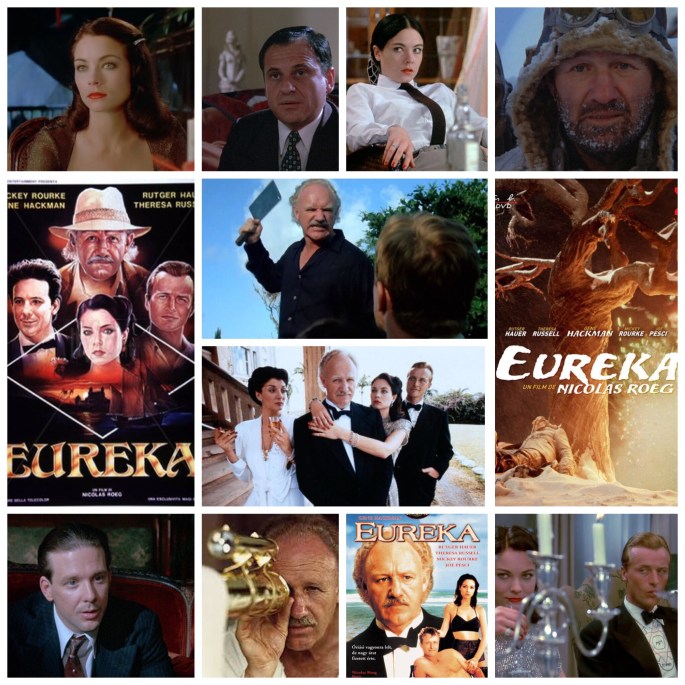
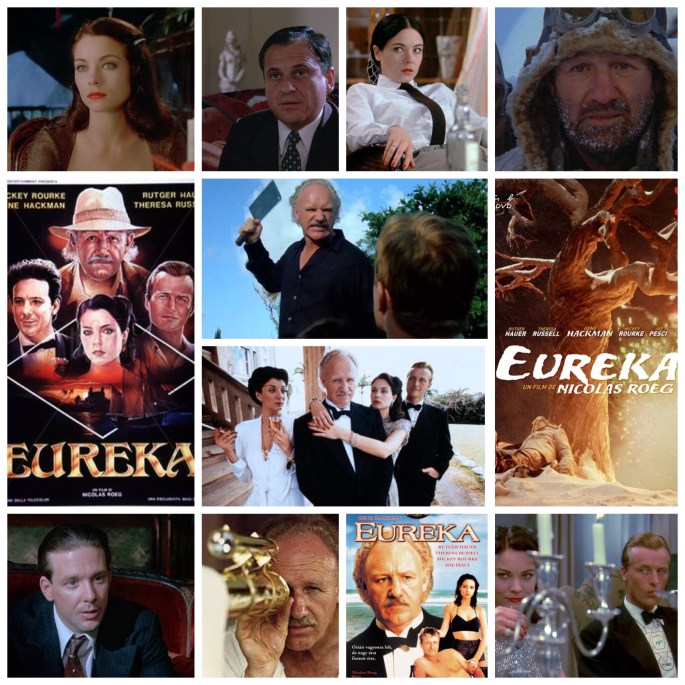
Nicolas Roeg’s Eureka is one of the strangest films I’ve ever seen, and I mean that in more of a disturbing way as opposed to a compliment. It’s a story that could have been given the straight n’ narrow Hollywood biopic treatment, and instead plays like the loudest, most disconcerting fever dream you’ve ever had, and you find yourself wondering how such a straightforward story can just seem so *odd*. A lurid meditation on greed and a balls-out cautionary tale for people who think that money can buy happiness, most of it focuses on Gene Hackman’s stubborn prospector Jack McCann, who after striking gold in a melodramatic Yukon set prologue, retires to his own Caribbean island to languish in riches. Life is anything but happy for him though, as his troublesome daughter (Theresa Russell) has brought along her scheming boyfriend (Rutger Hauer), who clashes with McCann right off the bat. Hauer is a no good schmooze with his hands in a bunch of dirty pies, Russell is headstrong and belligerent, and soon McCann becomes paranoid, angry, volatile and wrapped up in his own deluded mind. It also doesn’t help that a crime syndicate from Miami wants to build a casino on his island, an idea he abhors. They’re headed up by Joe Pesci and Mickey Rourke, two memorable faces who are ultimately eclipsed by the volcanically intense and overbearing performances from our three leads. This is an ugly, brutal picture of human beings at their utter nadir of social interaction and mental well being, a swirling maelstrom of malcontent that circles the toilet boil and plummets down the drain to a graphically violent conclusion from which there is no respite or glimmer of catharsis. I kind of get what Roeg was going for, but he’s so tonally off kilter and tries to hammer it home with such pulverizing, unnecessary force that we feel too shellshocked to get any sort of real message from the thing. The acting is quite impressive though, credit where credit is due. Hackman has never been more terrifying, Hauer is sleaze served a la flambé and Russell has a staggering courtroom monologue that should be in record books for most lines memorized in a single take, not to mention be up for acting awards all over the board. Bring a strong set of nerves to this one, and be prepared for little payoff after you sit through the depravity it has to offer.

-Nate Hill

B Movie Glory: Stranger By Night

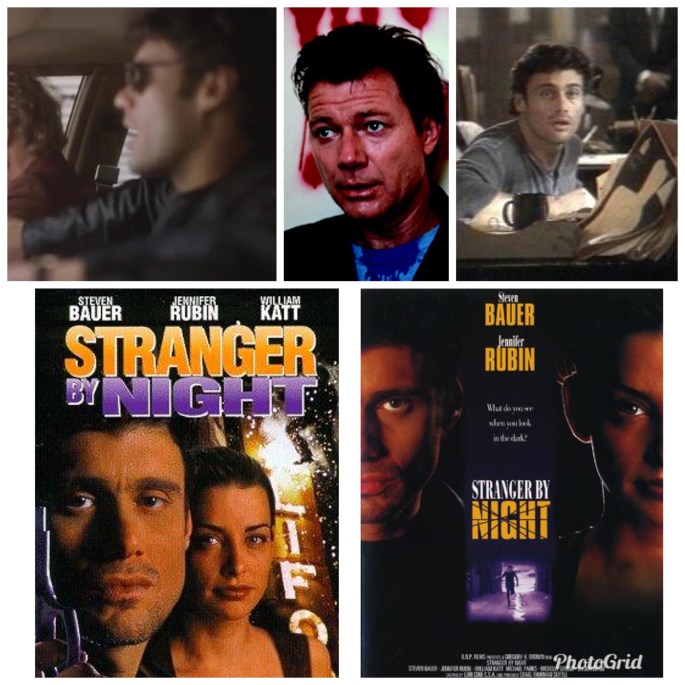
Stranger By Night is an all but forgotten cop thriller starring Steven Bauer, a charismatic actor who, after a showcase role in Brian DePalma’s Scarface and a handful of other prolific 90’s appearances, fell from grace into the netherworld of direct to video releases, like so many other former heavy hitters. This one sits above the bilge water because of a uniquely psychological angle towards the ‘killer terrorizing an urban neighbourhood’ motif, a great central performance from him and some memorable scenes. Bauer his precinct are looking for a murderer, but the kick is that he has a sketchy mental mindset, experienced weird blackouts, fits of rage an missing hours, which not only makes tracking down any suspects difficult, but always puts the crosshairs of suspicion on him. He’s an unreliable protagonist who means well but keeps getting sabotaged by his own demons, a theme played up nicely. The story involving the killer is fairly run of the mill, but anything to do with his character developments is cool stuff, especially in an introspective conversational has with his father (J.J. Johnston). There’s another cop played by the great Michael Parks, but the underwritten role is wasted on an actor meant to shine, but at least the production benefits from his credit. This one is low key, but I enjoyed the exploration in character for Bauer, as well as a hectic opening montage that sets the maniacal tone.

-Nate Hill

Resident Evil Film Series

Resident Evil Film Series

2002-2017 . Directed by Paul W.S. Anderson, Alexander Witt, & Russell Mulcahy.

Resident-Evil_apocalypse20120218_001
Initially based on the popular video game franchise, the Resident Evil films are equally maligned by critics and revered by loyal fans.  Rather than breaking down each individual film, this review will be about the work as a whole, focusing on the themes of the series.

Filled with endless Looking Glass allegories, on the surface, these stories are about the evolution of Alice, the series’ protagonist.  The manipulation of memory, dreamlike flashbacks, and a repetitive rhythm form the basis of Resident Evil’s mythology.   Alice begins the film as the mirror of a video game persona.  Confused and abandoned in a lush mansion that sits atop a nefarious laboratory, she descends into the madness below, embarking on an odyssey of bullets, blades, and the undead.  The thing is, none of it actually matters because the films purposefully abandon the plot of the game in favor of making a rather provocative statement.

Each entry has a theme.  The first film is focuses relationships and how the same event is remembered differently by the two participants. The second film is explores the military as a business, while the third is an apocalyptic story about the culture of government surveillance.  The fourth is a dissertation on cloning and multiple past lives.  The fifth brings these elements together by forcing the hero to work with the villain in order to save humanity.  The six and final entry is the capstone, a summation Anderson’s iconoclastic vision.

It doesn’t fully click until the fifth film, when the various clues hidden in each film start to come together: There’s a beautifully shot sequence by Glen Macpherson involving an endless procession of clones, all of them various characters from each of the films.   No matter the environment, the women are always scantily clad while the men appear as macho ideas rather than fleshed out characters.  Virtually every film is critically panned but yet manages to make a staggering amount of money.  Finally, there is the idea of the good guys being forced into bed with their corporate foils in order to succeed.

These films are a scathing indictment of Hollywood and a love song to creative freedom.  They’re remarkably presented and equally catty, all while espousing the idea that art, in its various forms is a part of the creator who gives it life.

Recycled characters and plot lines, hordes of zombie like fans, authoritative control on everything we experience down to our visual memories, and on and on and on.  The argument loses some water with reference to the first two films, but in the third, when the series finally finds its stride is where it begins to reveal its true intent.  The final three films, helmed by Anderson drive the point home.  They feature some legitimately beautiful cinematography by Macpherson, pure adrenaline laced fight choreography by Brett Chan, wicked costumes by Wendy Partridge, and a performance by Milla Jovovich that is both committed to the story and loyal to the rebellious underpinnings.

Available now for digital rental, the Resident Evil series of films may not be for everyone, but the sum of its parts is an important examination of the current box office obsession that is dividing fans and critics, crushing independent creativity, and burning virtual bridges across social media.  It took a fellow film lover to point my attention to the artistic level of these films and once I revisited them with this idea in mind, I’m unable to disregard them as D level horror entries.  These (particularly the last four) movies are renegade film making at its finest.  If you’re interested in seeing some outstanding action sequences, gorgeous visuals, and an unapologetic ode to personal creativity, these films will not disappoint.

Highly Recommend.

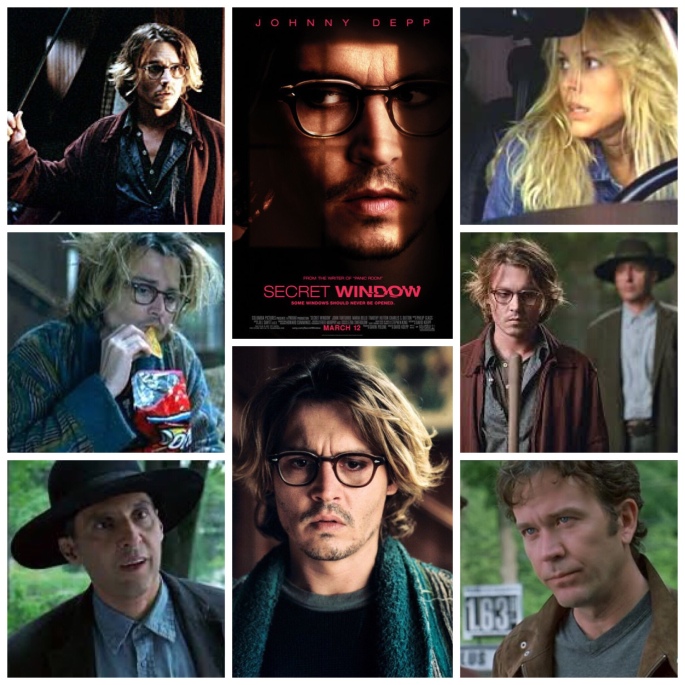
David Koepp’s Secret Window

David Koepp’s Secret Window is a terrific little psychological chiller, with just the right doses of fright and camp. Based on a Stephen King short, it’s got everything you’d want in a little vignette from the master: secluded wilderness setting, paranoia, whacked out protagonist, cerebral mind games wrapped in a classically meta package, the story being about a writer itself. The problem with the film is that it has a twist, and in this day and age after the loss of cinema’s innocence, everyone and their mother has seen a film with some variation of the revelation that Window has to offer. But this is not the film’s problem, really, because it hails from a simpler time back in the late 90’s, early 00’s, when twists like that were still somewhat new. The Sixth Sense hype had barely died down, the new age of psychological horror hadn’t yet dawned and stuff like this seemed really fresh. This one is terrific on its terms though, and has a certifiably loony central performance from Johnny Depp as Mort Rainey, a depressed nut-job novelist who’s holed himself up in a cabin on a lake to cook up his newest book, but really he’s just there to mope about his wife (Maria Bello) leaving him for the considerably less dreamy Timothy Hutton. His bout of self loathing is interrupted when freaky stranger Shooter (John Turturro) shows up at his door and aggressively accuses him of plagiarism. Turturro plays the guy in a weird Amish getup and with enough menace in his southern drawl to rival his perverse lunatic Jesus from The Big Lebowski. Anywho, after that Depp descends into sketchy paranoia, unsure of what’s real, who’s real, who double-crossed who and who’s trying to get the better of him. Set in rural Maine as per usual, this is classic King and benefits a lot from Depp, who wisely chooses to make his performance fun, engaging and just cartoonish enough where other actors might try to be too realistic or serious. If you watch it these days in the wake of countless other thrillers that have filled the gulf of time between 2004 and now, you might not be all that impressed. Try and retain your sense of wonder in terms of the genre, you may have a blast. I always enjoy this one.

-Nate Hill

For Your Ears Only: Thunderball

Image result for thunderball poster

Tom and Frank are back with their latest installment of Podcasting Them Softly’s James Bond series, For Your Ears Only. This time they discuss Terence Young’s final outing as Bond helmer with THUNDERBALL. Tom and Frank are joined by fellow James Bond aficionado Mark Ashby as they discuss in great detail what many consider one of the best Bond films.

Michael Mann’s Collateral

I love Michael Mann’s Collateral so much. Few other films evoke the detached, hypnotic atmosphere of a metropolitan city, the thrum of a single night passing by, the hard bitten nature of a city whose main brand of social interaction is usually crime. Mann has a way with restless urban nocturnes and the weary, resolute characters who drift through them, personified here by Jamie Foxx’s shy, plucky cab driver Max and Tom Cruise’s lupine, charismatic hitman Vincent. They’re on odd pair to spend a murky, digitally shot Los Angeles night with, but the two actors make it a clash, confrontation and ironic companionship for the ages. Max is veering close to being a career cabbie, his dreams of entrepreneur enterprising fading fast in the rear view. He’s meek and soft spoken but we get the sense that somewhere in there is the capacity for violence and unpredictability, if prompted by the right catalyst. Speak of the devil with Vincent, a whip smart apex predator who hijacks Max into helping him make several high profile stops before a 6am flight out of LAX, each one leaving a cadaver in its wake, all related to an interwoven criminal syndicate that DA is trying to bring down. It’s high concept done on slow burn, with action taking a backseat beside Vincent, while story, character and brilliant dialogue command the forefront, a technique rarely employed in the big budget Hollywood blockbuster, but always a surefire way to success. Mann captures the pulse of LA almost better than he did with Heat, albeit to a smaller scale and constricted to one night, a nervous time-sensitive mood-scape that gives the proceedings a haunted aura. Cruise has never been better, sporting a silver fox get-up and enough scary micro-mannerisms to more than make us believe he’s an expert at his profession, until jaggedly unravelled by Foxx’s presence, who goes from unassuming hostage to razor sharp thorn in the side real quick. Jada Pinkett Smith is brilliant as a lawyer who Max picks up in the opening scene, their extended conversation set against the dreamy LA backdrop serving as a neat, Elmore Leonard-esque way to set up shop. The supporting cast are like easter eggs hidden throughout, they’re never obvious or given key monologues, but exist in harmonious flow to the chamber piece unfolding mostly in the taxi. Mark Ruffalo shows up in his coolest role to date as a detective who gets wise to Cruise uncannily quick, Javier Bardem has a showcase scene as an angry mob boss, and watch for Bruce McGill, Debi Mazar, Wade Williams, Klea Scott, Paul Adelstein, Peter Berg, Irma P. Hall, Emilio Riveria, Jason Statham, Richard T. Jones and the always excellent Barry Shabaka Henley as a jazz club owner with a few skeletons in his closet. My favourite scene is a wordless one, in which Vincent and Max see a lone coyote loping across the freeway in the hazy night. Each of them reacts, the sight of the beast meaning something different to them, internally, they share the moment, and move on. Taken out of context it could mean anything, stand on its own as a fifteen second short film, or be injected into a crime drama masterpiece like this to make it all the more atmospheric and special. It’s moments like this, along with a few other key scenes, one set on a subway train and the initial conversation between Foxx and Jada, that inject a surface level genre film with something intangible, something elemental. Mann gets this, every frame of his urban crime epics are filled with that kind of energy, and this stands as one of his best.

-Nate Hill

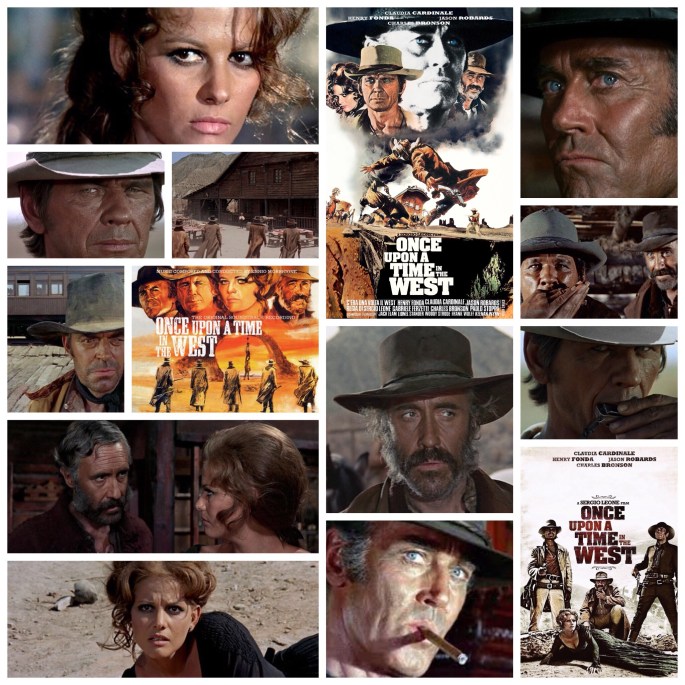
Sergio Leone’s Once Upon A Time In The West

There isn’t much I can say about Sergio Leone’s Once Upon A Time In The West that the mythical, larger than life masterpiece couldn’t say for itself, especially on its magnificent, crystal clear Blu Ray transfer that blows the dust out of the cracks and showcases it’s sunny cinematography in full remixed glory. From the coming of the railroad to a fledgling empire, the corrupt businessmen employing hard bitten thugs to do their nefarious bidding (a prophetic motif if there ever was one), the searing forbidden romance between the archetypal ex-working girl and the silent, lethally dangerous drifter, the dusters adorning gunfighter that sway in a lilting prairie breeze, the trod of hooves, the thunder of impending gunfire preceded by the eerie calm of the showdown before, this is the western to end all westerns, the textbook example, the crown jewel of the genre and the one wheat-stalk saga that I just can’t get enough of. Leone basically patented an entire sub-genre between this and the Man With No Name trilogy, it’s a now timeless flavour that rippled down throughout the generations and changed the face of the western forever. The film itself is perfectly balanced symphonic storytelling, in every aspect of the medium. Charles Bronson’s mysterious loner Harmonica blusters into town, opaque and uttering few words save for the melancholic strains of his instrument brought to wailing life by composer Ennio Morricone. Henry Fonda’s elegant, magnetic and unbelievably evil mercenary Frank hovers over everything like a black cloud of portent. Claudia Cardinele’s drop dead gorgeous Jill violently carves out her own path of survival, lust and grief amidst the unforgiving frontier. Jason Robard’s half injun outlaw Cheyanne tries hard not to wear an obvious heart of gold on his sleeve while seeking retribution for a diabolical frame-job. These mythical, monolithic individuals invite shades of grey into what we’ve become accustomed to in Western archetypes too, which is another hallmark of Leone. Gone are the stalwart sheriffs, stoic heroic leading men and obvious moustache twirling of clearly delineated villains. Bronson is rough, callous and never straight up chivalrous, Fonda is reptilian but oh so charming, the kind blue eyes barely suggesting what evil leers beneath, and Robards for his part turns an outright scoundrel into something of a teddy bear during his arc. It’s in the little, drawn out interactions and moments that we learn what we need to know about these characters, and Leone lets their performances, Morricone’s iconic score and the lingering space between action tell the story, so that by the time the monumental showdown rolls in, we know what we need to know about these wild, complex personalities and can get swept up in the revelatory spectacle of it. One for the ages.

-Nate Hill