Clive Barker’s most ambitious film, Nightbreed was hacked to pieces by studio execs prior to release and then by critics after its lackluster debut. Horrendously marketed as a slasher film, Barker’s misunderstood opus has thankfully gained a cult following over the years, and a recent Director’s Cut release by Scream Factory, allowing Barker’s incoherent monster-centric fable to be viewed in its intended form.
Boone is a drifter who thinks he may be killing people. His dreams are filled with visions of a city called Midian, a place where monsters dwell. He sets out in search of the city with his paramour, Lori. Pursued by the authorities and his murderous therapist, Decker, Boone discovers that Midian is not only real, but that his coming has been foretold by dead gods, prophesying a war between the inhospitable forces of humanity and the savagely noble legions of outcast creatures known as the Nightbreed.
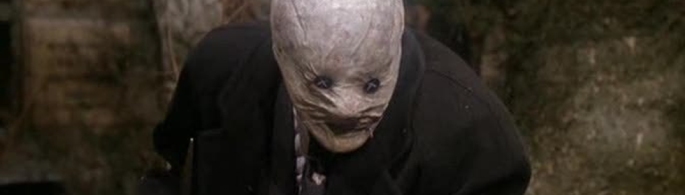
The biggest problem with this film is also its strongest attribute. Barker throws so many balls into the air that it’s a foregone conclusion that not everything will hit the mark, and yet, Nightbreed comes off as wonderful combination of serial killer fodder, a Gothic fairy tale, and a hauntingly rich form of original mythology. There are dozens of characters that inhabit Barker’s epic with the monsters eclipsing their human foils, save for David Cronenberg’s sadistic Decker, who is one of the more vital roles in the bloated ensemble. Oliver Parker as Peloquin is the monstrous standout, with his flesh dreaded faux Rastafarian killer barking the film’s best lines.
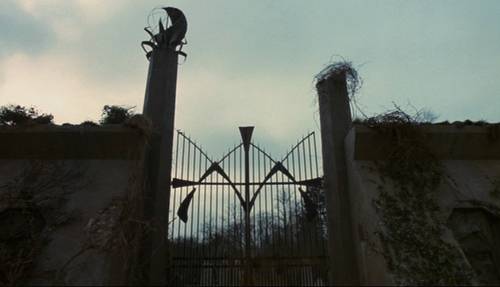
Mark Coulier’s freakish makeup designs are both elegant and obtuse, as some creatures appear as tangible nightmares and others come across half rendered, in part due to Robin Vidgeon’s stormy cinematography that bounces through lonely cemeteries and ancient catacombs without stopping to catch a breath. The shame is that many of the creature designs are revealed as horrific intricacies, whenever the viewer is allowed to glimpse their unspeakable splendor. Danny Elfman’s amazing score enhances the mythic quality of the story, but it’s offset by the cardboard villainy of the humans and the wholesale familial slaughter that looms in the background throughout the narrative.
A feeling of too little, too fast is the mantra of Nightbreed. What begins as a menacing serial killer story mutates into a quest for Midian, with Boone’s Christ-like ascension saturating the central act. There’s also the race war between the monsters and humans and the various social dynamics of the underworld that come into play, but in regrettable portions. The confusion is when all of these elements collide in an uneven stream of sexually charged violence during the final confrontation. Despite the inconsistencies, the final battle is an amazing blend of CGI, practical effects, and gritty stunt choreography that is easily Nightbreed’s strongest aspect.
Available now on Netflix, or on an excellent blu ray transfer by Scream Factory, Nightbreed is a unique horror saga that succeeds as much as it fails. The director’s cut fills in many gaps, but also leaves the viewer wanting more, which while eternally frustrating, is also a testament to Barker’s meticulous world building. This is a film that drives the viewer down a pot hole ridden dirt road into another world filled with esoteric mysteries and dark wonders, delivering an excellent horror fantasy unlike anything ever attempted in the genre.
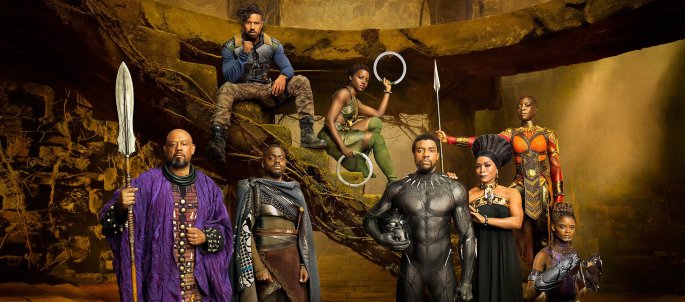
Shoehorned into an already well stuffed Marvel sequel (and…let’s do Giant Man!) in the successful Captain America franchise was a blink-and-you’ll-miss-it origin story for T’Challa, better known to fans as The Black Panther. A marvelous mid 60s creation of Stan Lee and Jack Kirby, this hero defined aspirational black culture—a king from the fictional African country of Wakanda, rich enough in natural resources and groundbreaking technology that the influence of the white western world was not only unnecessary, but actively avoided. Despite the rush job in Civil War, that film did a fairly good job of introducing Chadwick Boseman in the role, giving him a tragedy to rise above and an enemy to vanquish. Considering the popular reaction to the character and an increasingly diverse Hollywood, it makes perfect sense that the Marvel Machine would give Black Panther his own film. The biggest questions for the production probably revolve around how well such a film would balance action movie hijinks with themes of racial justice and history; I’m glad to report that Boseman, director Ryan Coogler and an extremely talented cast of supporting characters storm through thrilling paces and deftly deal with a variety of elephants in the room using equal parts style, humor, character and heart.
Boseman, coming off an underappreciated turn in last year’s Marshall, has quickly joined his DNA with that of the Wakandan king and protector. He strikes a perfect balance between heroic swagger and humble duty to his people, and as noted early and shown often, it’s a tough job that will take more than birthright to master. He’s aided by a cadre of magnificent women, a sister, a lover and a lieutenant who exhibit mastery in their respective fields of science, spycraft and soldiering. There’s an ongoing debate over what kind of role in the world a hyper advanced but secretive nation should play, which along with many nice touches including but not limited to some fun tech upgrades (this is Marvel, after all) to T’Challa’s classic costume end up serving as subtle but overarching metaphors on race and society, both from the past and very much today. This leads to one of the best-conceived and executed villains of the MCU, Killmonger, played with anger and menace by Michael B. Jordan as the natural corollary to T’Challa’s thoughtful grace. All heroes must pass a variety of trials by fire, and Killmonger brings both physical and spiritual obstacles to batter our protagonist with that truly lead to a transformative character arc while illustrating several complicated dichotomies between the foes. The rest of the players involved soar—even Martin Freeman as the overwhelmed CIA operative Everett Ross gets some heroic notes—and by the time the dust has settled, we’re staring at what may become one of the most popular Marvel heroes to ever splash across the silver screen. As names like Hemsworth, Downey Jr. and Evans age/expense out of their seemingly iconic roles, Boseman and a few other young upstarts appear to be more than ready to take on whatever challenges Marvel Studios cook up for their ever-expanding fictional universe.
Pirates Of The Caribbean: Dead Man’s Chest is so good it almost gives the first one a run for it’s money in terms of visual effects, imagination, swash and buckle. It does have it’s issues with letting some of the action set pieces run on literally forever (that rolling windmill sword fight tho) until you seriously start to question the limits of cardio in those involved, but director Gore Verbinski has always been an advocate for cheeky excess, so who can complain. In preparing a sequel to Black Pearl, they no doubt had a daunting task in equaling, and if possible outdoing the sheer bliss that came before, and they kind of succeeded and then some. Jack Sparrow, Will Turner, Elizabeth Swann and a whole circus sideshow of others are propelled on a dazzling adventure that spans past the isle of Tortuga, beyond the waters of Port Royal and to the far ends of the Caribbean, not to mention amping up the supernatural aspects of the first to dizzying heights. In Captain Barbossa’s absence (well, almost;), they also had to find a villain to match his adorable theatrics, and Bill Nighy’s moody Davy Jones, a hentai tentacled tyrant cursed by the ocean’s magic, doomed to sail the baroque galleon The Flying Dutchman forever, fits the bill. His crew are a gnarly, barnacled bunch of miscreants adorned in enough wicked cool marine biology and detailed special effects to get an Oscar nomination, which they did. Other new character additions include mopey Stellan Skarsgard’s bedraggled Bootstrap Bill, Naomie Harris’s spooky voodoo babe Tia Dalma, as well as familiar faces like Commodore Norrington (Jack Davenport), who gets a lot more to do here than twiddle the stick up his ass as he does in the first one, Governor Swann (Jonathan Pryce), Gibbs (Kevin R. McNally, deadpan as ever) and the whole motley crew. Depp takes what made Sparrow so charismatic and weird in Black Pearl and soars over the rainbow with it, he really and truly carries these films with his presence and it may just be the best characters created by him. A worthy sequel, kickass adventure and one for the books.
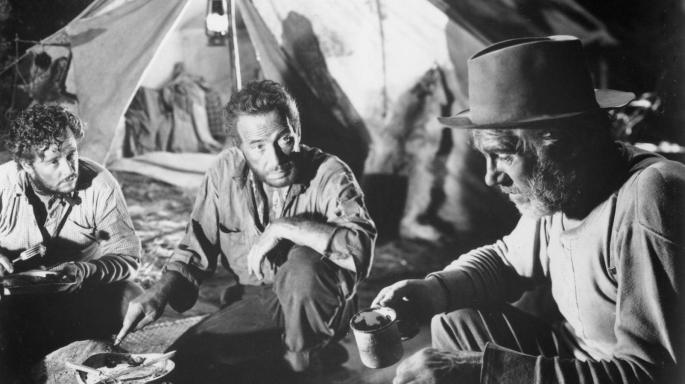
In this week’s Critics’ Corner, Kyle and Ben talk about John Huston’s classic, The Treasure of the Sierra Madre, the Warner Brothers classic which screened recently in theaters for its 50th anniversary.
BEN: I was glad I had the opportunity to see this film on the big screen. I loved the characters and their gritty settings, which lent a realism to their down and out status. I loved the fact that Humphrey Bogart wouldn’t let his character get swindled.
KYLE: Paul Thomas Anderson repeated watched this film while he was working on There Will Be Blood. I think you can see a lot of both Huston’s influence and Bogart’s legendary performance in the DNA of PTA’s masterpiece.
BEN: What makes John Huston’s adaptation of B. Traven’s novel is the struggle the characters went through to get to the treasure. The story treats their struggle as an adventure, something we don’t see much of today. But when you look at the amount of treasure they managed to get, the amounts don’t seem like much. That’s probably because we tend to think of gold in bars, not dustings like the film portrays.
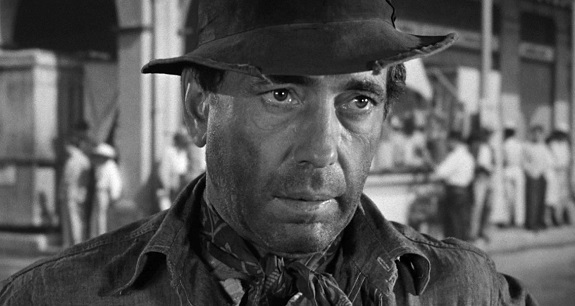
KYLE: Agreed, it is the Pyrrhic nature of the story that makes its such an important film. This is an analysis of not only he debilitating effects of greed and paranoia, but also a fable-esque morality tale on the perils of self-centered apathy. Dobbs’ entire arc is also intriguing, as he is easily the darkest of the central trio. It’s difficult to root for him because he’s morally compromised from the jump, however as the final act begins, Bogart’s flawless performance subconsciously builds empathy with the audience.
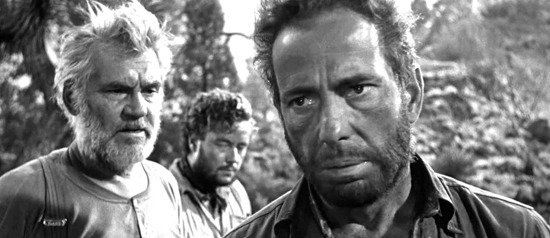
BEN: It was obvious that this was Humphrey Bogart’s film. As Dobbs’ he makes such a strong case for why he was a leading man. His look was always the same, but his eyes always sought out adventure, and friendships. Which is why Tim Holt as Curtin was a good match for him. They both carried off their respect for one another as partners, but they didn’t necessarily trust each other. And that’s where I felt Walter Huston as the old prospector, Howard was a good third party. He had been in the hills before, he knew where to find the treasure. And, technically he did so twice.
KYLE: I’m glad you brought up the trust angle. I think that is probably my favorite aspect of the film, outside of Ted McCord’s brilliant cinematography. The setting of a lawless land, populated by rogues is then distilled through three personalities at the center, amplifying the feeling of uneasiness that runs through the heart of Treasure. The dynamics of trust and betrayal that pervade the bulk of the narrative have quite simply, never been outdone without drifting into satire or melodrama.
BEN: The last act truly represents the fulcrum of the triangle started by Dobbs. As a flawed “ideas man,” it was his initiative, and his business sense that allowed them to start the journey. Without Curtin, we wouldn’t have our conscience to guide us, and to keep our compass straight. And, without Howard, we would never have had a journey to go on.
KYLE: That’s a great observation. In some ways, whenever I view No Country for Old Men, I’m reminded of this, mostly because of the trio of male actors at the center, with each of them representing different aspects of the narrative.
BEN: It’s truly remarkable that John Huston directed his dad, Walter to an Academy Award nomination for Best Supporting Actor. The younger Huston won the Academy Award for Best Adapted Screenplay, and rightfully so.
KYLE: He also won for director. Really a once in a lifetime situation.
BEN: They say flattery is the highest form of honor, especially when it comes from Mel Brooks.
Here is the original scene:
Here is the homage:
KYLE: That’s amazing!
BEN: I had a blast talking about this one, Kyle. 50 years later and the film is still so remarkably strong for its message and its characters. Until next time!
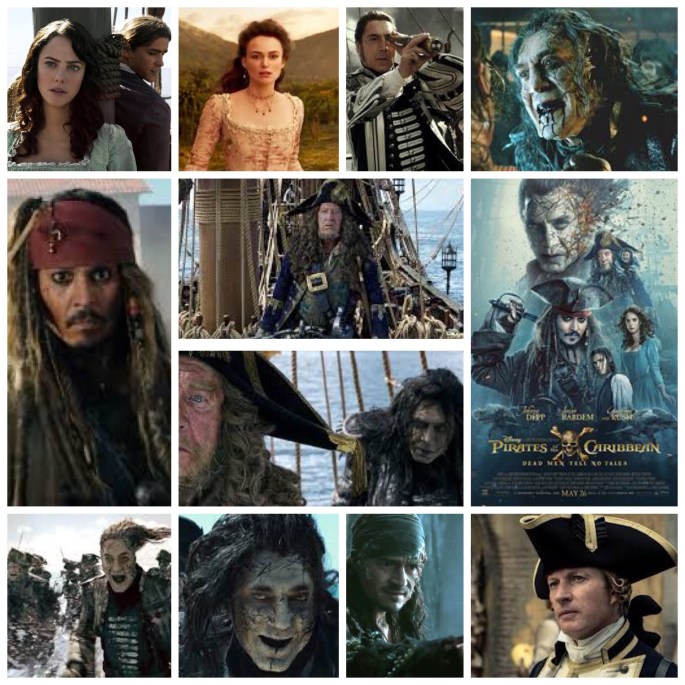
The Pirates Of The Caribbean franchise has been a long and wild rollercoaster ride so far, with each new addition mining for fresh oceanic mythology to throw at Jack Sparrow & Co., as well as tossing in as much commotion, cameos and FX wizardry that Hollywood will cash out to a lucrative legacy like this. So the anthology arrives at it’s fifth excursion, titled Dead Men Tell No Tales, and it’s nice to know these films still have some wind in their sails, because this is actually a fairly fun and engaging entry, if a little more grey and somber than some of the livelier chapters. The characters have been through enough at this point it’s a wonder they still have their sanity and good looks, although a few have disappeared or fallen on hard times (Orlando Bloom’s Will Turner finds himself in a weird, prophetic predicament here). Jack Sparrow seems to soldier on undaunted though, perma-sloshed on The Caribbean’s finest rum, which is always in shortage, and as much a trouble magnet as ever, chased here by ghosts from his past, and I mean that quite literally. Jack himself is stuck in a bit of a drudge when we reconnect with him, cooling his heels in jail after a spectacularly botched bank robbery with his old crew (ever hilarious Gibbs present and accounted for). He’s shanghaied into another series of hijinks by a mysterious young lad (Brenton Thwaites) who’s searching for something, while the ghostly crew of a marooned Spaniard ship is searching for Jack. It’s captain, a spooky spectre called Salazar (Javier Bardem) has a personal bone to pick with out hero, dating back to the rascal’s teenage years. Played with sallow devilish glee by Bardem, Salazar is actually probably the scariest villain in the series so far, which isn’t saying much but it’s nice to get a little spine tingle from the combo of his work and the eerie special effects. Geoffrey Rush’s seemingly immortal Captain Barbossa returns again too, and sort of gets more and more garishly ridiculous with each incarnation, but Rush somehow manages to sell it, the champ. There’s a female heroine too (Kaya Scodelario) whose origins are also shrouded, the shrewd military prick that always shows up, played here by Lord Of The Ring’s David Wenham, and a sly cameo from Paul McCartney as another far flung relative of Jack’s. While nothing will ever top Curse Of The Black Pearl, this one both tones down the bloat of Dead Man’s Chest and reigns in the mania the nearly derailed At World’s End, as well as giving some life where blandness crept into On Stranger Tides. It’s not the best of the series, or even silver medal, but does the trick nicely and tries a few neat variations on the formula.
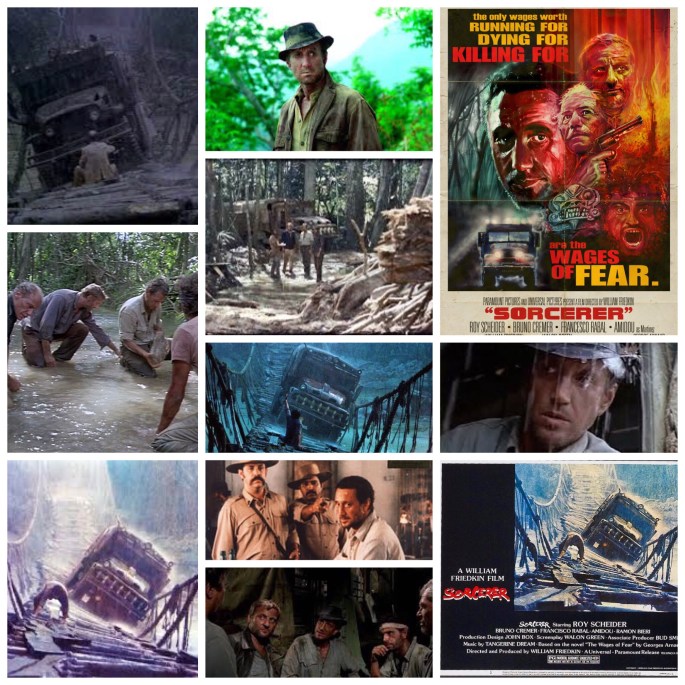
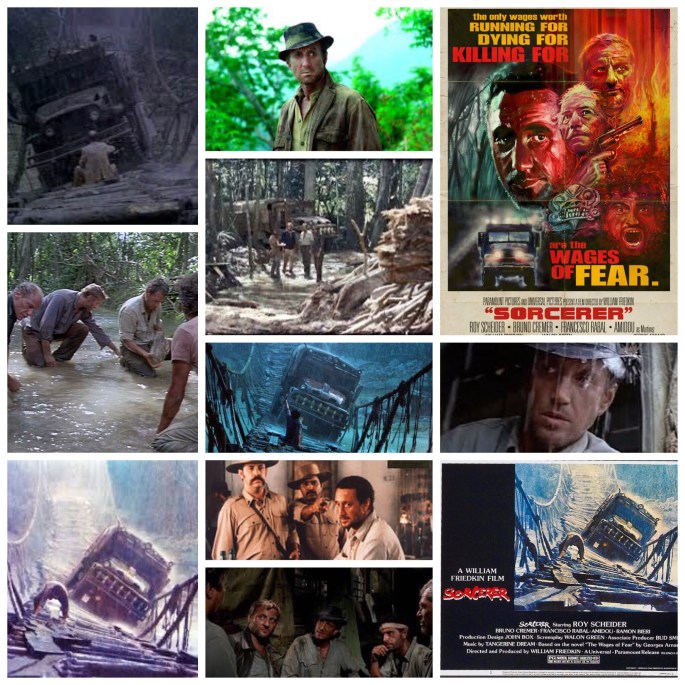
William Friedkin’s Sorcerer is less of a film than it is a visceral, ‘fly on the wall’ glimpse into the breathless plight of a rugged troupe of villains from various parts of the world, thrown into an impossible situation together, a lean, mean, anti-cinematic survival picture that has one of the most suspenseful set pieces ever filmed, now a legend and showcase in Friedkin’s rough n’ tumble career. The story focuses on a quarter of thoroughly rotten human beings who are an inspired choice to light as protagonists: a disgraced New Jersey hitman (Roy Schneider), a corrupt French banker (Bruno Cremer), a dangerous gangster (Francisco Rabal) and an Arabic terrorist (Amidou). They’re a heinous bunch, each on the run in their own way, but each’s situation is their own fault, which is the setup for the purgatorial horrors that befall them in the remote South American jungle. Each cast out into the primal ether of that region, their collective hope for a modicum of redemption, not to mention financial stability, comes in the form of a nightmarishly dangerous task: transport several giant tanker trucks across the region, each loaded with enough volatile nitroglycerin to blow a crater in the jungle. It’s low concept that pays off for high thrills, especially when monsoon season conveniently shows up right when our quartet are trying to navigate the trucks over a horrifically rickety set of of wooden suspension bridges, a sequence so unbelievably white knuckle, so deeply frightening it’s a wonder and a half it was allowed to be filmed. There’s a twisted catharsis in seeing these unsavoury fellows put through such fresh hell, but they’re so violently resourceful and charismatic that by the end of it we’re rooting for them, by both default and earned respect simply for the desperation of their situation. A simple, brawny piece of cinema that uses it’s straightforward story to tap into something more earthy and primeval, as well as a long standing, finely aged example of action/survival cinema and probably Friedkin’s best film to date.
Taika Waititi’s Thor Ragnarok has got to be the most fun I’ve ever had watching a Marvel film. Trust Hollywood to make a sterling decision once in a blue moon, and hiring a deftly comic, renegade underdog subversive improv genius like Waititi to take the wheel is a smart, bold move. Now before I sing it’s praises to Valhalla, they don’t quite let him (he’s the Kiwi wunderkind behind the newly minted classics Hunt For The Wilderpeople and What We Do In The Shadows) go completely bonkers, which he clearly wants to do, and although he’s kind of bogged down by a generic villain and a recycled point of conflict in plot, a lot of the time he’s allowed to stage a zany, uncharacteristically weird (for the MCU, anyways) pseudo space opera that is a blast and a half. Thor finds himself, after a brief encounter with Benedict Cumberbatch’s Dr. Strange, carted off to a giant garbage planet surrounded by space portals (one of which is referred to with a straight face as ‘The Devil’s Anus’, which sent me into a fit) and lorded over by a certifiably loony Jeff Goldblum as the Grand Master, a demented despot who holds intergalactic gladiator matches for his own entertainment. There Thor is forced to fight his old buddy the Hulk, and somehow find a way to escape Goldblum’s nefarious yet hilarious clutches. He’s got just south of reliable allies in his brother Loki (Tom Hiddleston) and an exiled Valkyrie (Tessa Thompson) with an attitude problem, as well as rock-armoured warrior Korg, voiced hilariously by Waititi himself as the film’s most engaging character. Meanwhile back in Asgard, trouble brews when the equally dangerous and sexy Hela (Cate Blanchett, with enough authoritative, husky smoulder to make me weak at the knees) tries to steal Odin’s throne for herself, with the help of defector Skurge (Karl Urban, who gets a mic drop of an action set piece later on). Here’s the thing about Hela: Blanchett is in top form, a commanding, dark presence… but the role is as blandly written as a number of other MCU villains, and one wonders how they’ve managed to flunk out at creating engaging antagonists a few times over now. She’s stuck in a subplot that we’ve all seen before, one that’s stale and at odds with the fresh, humorous and wonderful storyline between Thor and Banner. Their side of things is like buddy comedy crossed with screwball fare and works charming wonders, especially when they’re blundering about in Goldblum’s cluttered trash metropolis, it’s just inspired stuff. Throw in a great 80’s inspired electro pop score and a cool VHS retro vibe (I’m all about the old school) and you’ve got one of the best MCU movies to date, and most importantly one that *tries something new*, which the genre needs more of, even if it doesn’t ultimately fully commit, this is still a gem we have on our hands.
The Lincoln Lawyer was the first film in the revival of Matthew McConaughey’s career after a lengthy slump stretching back to the early 2000’s, and what a banger of a pseudo courtroom drama it turned out to be. Based on the series of novels by Michael Connelly which focus on slick, morally untethered defence attorney Mick Haller (played to perfection by Matt), director Brad Furman whips up an enjoyable, razor sharp yet laid back LA crime saga that’s smart, re-watchable and competently staged, not to mention stuffed to the roof with great actors. Haller is something of a renegade lawyer who operates smoothly from the leather interior of his Lincoln town car, driven by trusty chauffeur Earl (the always awesome Lawrence Mason). Mick is ice cool and seldom bothered by the legal atrocities he commits, until one case follows him home and digs up a tormented conscience he never knew he had. Hired to defend a rich brat (Ryan Phillipe) accused of murdering a call girl, events take a turn for the unpredictable as older crimes are dug up, double crosses are laid bare and everyone’s life starts to unravel. It’s a deliciously constructed story with twists and payoffs galore, as well as one hell of an arc for McConaughey to flesh out in the kind of desperate, lone wolf role that mirrors the dark side of his idealistic lawyer in Joel Schumacher’s A Time To Kill. Let’s talk supporting cast: Marisa Tomei is sexy and easygoing as Mick’s ex wife and rival, Bryan Cranston simmers on low burn as a nasty detective, William H. Macy does a lively turn as his PI buddy, plus excellent work from Frances Fisher, Shea Wigham, John Leguizamo, Bob Gunton, Bob Gunton, Pell James, Katherine Moennig and the great Michael Paré as a resentful cop who proves to be quite useful later on. There’s a dark side to the story too that I appreciated, in the fact that not every wrong is righted, or at least fully, a sad fact that can be seen in an unfortunate character played by Michael Pena, but indicative of life’s brutal realities, something Hollywood sometimes tries to smother. One of the great courtroom films out there, a gem in McConaughey’s career and just a damn fine time at the movies.
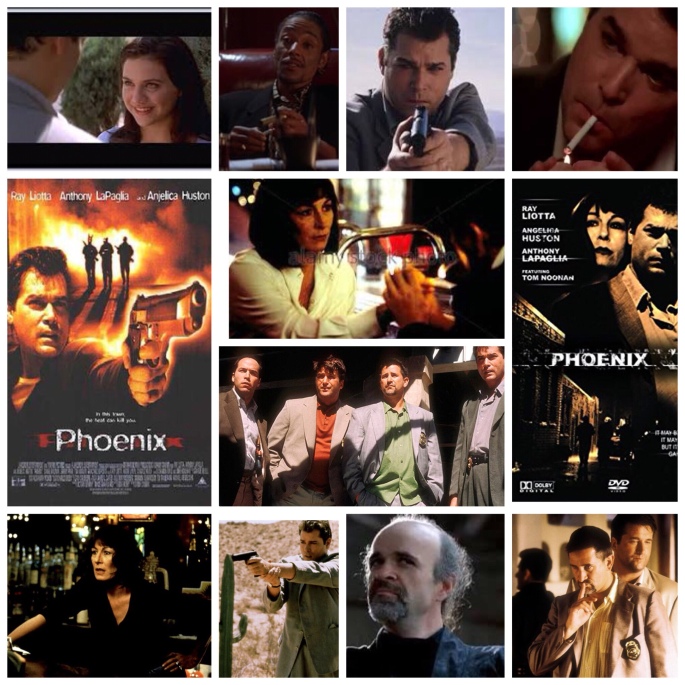
Phoenix is a half forgotten, neat little Arizona neo-noir noir that isn’t about much altogether, but contains a hell of a lot of heated drama, character study and hard boiled charisma anyways, which in the land of the crime genre, often is an acceptable substitute for a strong plot. Plus, a cast like this could hang around the water cooler for two hours and the results would still be engaging. Ray Liotta is terrific here in a mid-career lead role as an a police detective with a nasty temper, huge gambling problem and just an all round penchant for trouble. He’s joined by his three partners in both crime and crime fighting, Daniel Baldwin, Jeremy Piven and Anthony Lapaglia. There’s no central conflict, no over arching murder subplot and no orchestrated twist or payoff, it’s simply these four sleazy cops just existing out their in the desert on their best, and it’s a lot of sunbaked, emotionally turbulent fun. Liotta vies for the attentions of a weary older woman (Anjelica Huston, excellent) while he’s pursued by her slutty wayward teen daughter (Brittany Murphy) at the same time. He’s also hounded by eccentric loan shark Chicago (Tom Noonan with a ray ally funny lisp) and trying to close countless open cases in his book. Piven and hothead Lapaglia fight over Piven’s foxy wife (Kari Wuhrur) too, and so the subplots go. The supporting cast is a petting zoo of distinctive character acting talent including Glenn Moreshower, Royce D. Applegate, Giovanni Ribisi, Xander Berkeley, Al Sapienza, Giancarlo Esposito and more. I like this constant and obnoxious energy the film has though, like there’s something in that Arizona sun that just drives peoples tempers off the map and causes wanton hostility, a great setting for any flick to belt out its story. Good fun.
Gary Oldman is charming. He’s effortless and he’s incredibly affable, which is a stark contrast to many of the prickly characters he’s most well known for playing. He spoke with Leonard Maltin for a little under two hours before the dapper and coarse Ben Mendelsohn presented him with the Maltin Modern Master Award.
Oldman said it was seeing Malcom McDowell in THE RAGING MOON that lit the burning desire for him to pursue a career in acting, which led to Oldman being turned down by a premiere drama school in England where a lot of the greats had studied, including Peter O’Toole.
Oldman spoke about how he fanboy gushed over John Hurt while working with him on TINKER TAILOR SOLDIER SPY, Anthony Hopkins during the filming of DRACULA, and over Denzel Washington while working with him on the set of THE BOOK OF ELI.
A very charming moment in the show was when Maltin showed a clip from a Harry Potter film, and Oldman went on to speak about his fondness for the young co-stars he worked with and how they were like a family, and he watched them grow up over the course of ten years. It was a very special period of his career for him, stating that his fanbase went from forty year olds to ten year olds overnight.
During the filming of BATMAN BEGINS, Oldman attributed James Gordon’s world weariness to jetlag, due to the fact that he was flying from LA to England a day or two at a time to film his scenes, not staying on set due to the fact of being a single dad and raising his two young sons.
Maltin asked Oldman about his character of George Smiley, and asked if he would be playing him again. He responded with an almost certain yes, telling Maltin that he really loved playing Smiley, and missed that character dearly. Asked about his preparation for Smiley, Oldman said that he was overly particular on the glasses his character would be wearing, and that he tried on at least one hundred pairs before settling on the pair that was used in the film.
When asked about his many accents he’s used, from Dracula to Churchill, Oldman said he uses not a voice coach, but an opera singer to condition his voice to drop or gain octivs, and once he is done filming said character he essentially unlearns how to speak that way, saying it’s like a muscle and that he can no longer recreate the Dracula voice or his Churchill voice on command.
Ben Mendelsohn was there to present Oldman with the Maltin Modern Master Award once the Q&A was finished. Mendelsohn gave a speech only he could give with his token outback roughness and lewd wit, speaking of Oldman’s many masterpiece performances and how he is one of his idols.
Gary Oldman is a cinematic treasure. He has crisscrossed many aspect of film from hard independent pictures, genre films, as well megabudget franchises. His latest turn as Winston Churchill in Joe Wright’s DARKEST HOUR will surely award him the Best Actor Oscar, which for a performer like Oldman an Academy Award is long overdue.












 Podcasting Them Softly