The Specialist: A Review by Nate Hill 

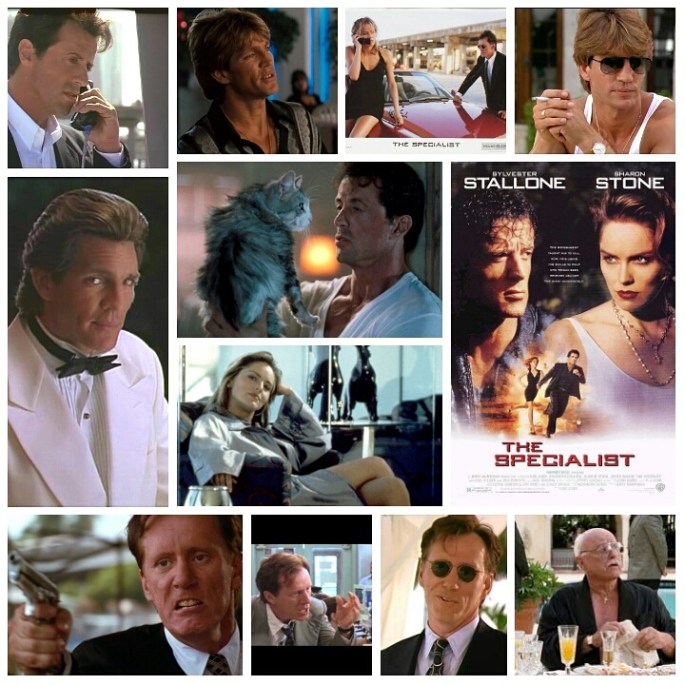
The Specialist is everything that action was about in the 90’s, and simply one of the most exhilarating Stallone flicks out there. This is the type of early career stuff he tried to infuse into his meta action extravaganza The Expendables, and while fun, those films always seemed like a mimicry of original gold like this, trying a little too hard to recreate feelings from a bygone era. This one is right up there with Nighthawks and Rambo as one of his best, despite a lukewarm reputation that has long since settled. You can’t even find a decent dvd of it, which is kind of sad. Sly plays Ray Quick, an ex explosives special ops tough guy who turned in his talents after a falling out with former livewire partner Ned Trent (a rabid James Woods) resulted in needless bloodshed. He spends his days moping around Miami until his services are once more required, by a woman in trouble. Sharon Stone is mysterious May Munro, whose entire family were slaughtered when she was but a young’n hiding in the closet. The mustache twirlers responsible are Cuban mafia don Joe Leon (Rod Steiger juggles his accent like three filing cabinets) and his brash, violent son Tomas (Eric Roberts, never scummier). They have anticipated Ray’s involvement though, and as soon as bombs start decimating their lovely beachfront nightclubs, they hire none other than (guess who) James Woods, now a berserker of a freelance mercenery, to hunt our hero down. It’s big, bold and full of explosions, machismo, gunfights and old school bad boys doing what they do best. Woods nearly walks off with the whole film in a performance so robust it almost outshines the pyrotechnics themselves. Stallone dispatches hordes of baddies using both fists and fancy C-4 gadgetry, bringing home the action bacon enough to sate the fans. Using the sweaty, neon spattered locales of Miami as a playground for these heightened characters to leer at one another and blow everything to smithereens, the filmmakers have forged what I consider to be one of the best in the genre for the decade. 
HECTOR BABENCO’S IRONWEED — A REVIEW BY NICK CLEMENT

3

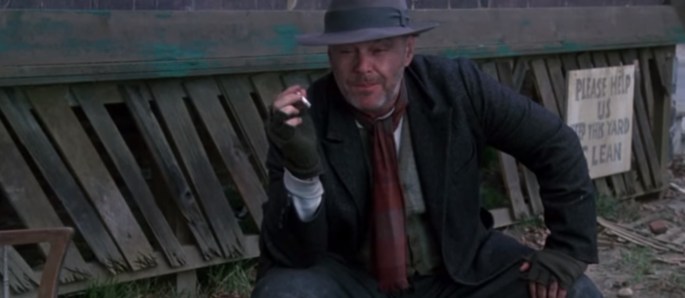
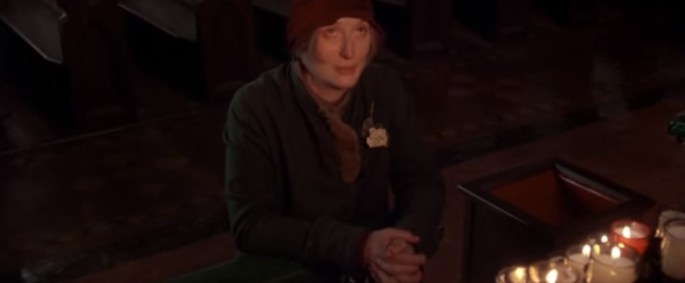
The critically acclaimed 1987 powerhouse period piece Irownweed pulls no punches. This is spectacular dramatic cinema with blistering performances from Jack Nicholson and Meryl Streep, both of whom seemed utterly smashed all throughout the production. I was not prepared for how grim this movie would be, and I credit the director, Héctor Babenco (Kiss of the Spider Woman, At Play in the Fields of the Lord), for never allowing the material to escape his firm grasp, as this story could easily have gone the cheap and easy route towards the end. It doesn’t. And because it doesn’t, it resonates. Nicholson has rarely been better than he was in Ironweed; for some reason his quiet and soulful work in The Border came to mind while watching him in this film. Set during the Great Depression and taking place in and around Albany, NY (where it was shot on location), this is one of those slow-burn pieces of cinema that sticks to the ribs. Playing a deeply depressed former baseball player who could be responsible for the accidental death of his infant son years ago, Nicholson nailed the wobbly and boozy character with tremendous gusto, yet never went too far over the top into overwrought histrionics. Has Streep ever been bad in a film? I doubt it. In Ironweed, she plays a woman beyond the reach of help, and her tired eyes and sickly visage helped to create a portrait of a woman who is literally falling apart on both the inside and the outside.

2

The two lost souls search for some sort of meaning in their broken lives, while probably knowing deep down inside that they are three sheets to the wind and unlikely to find solace. And even if the worldview is bleak and limiting, the strength of the performances and the forceful nature of Barbenco’s directorial style keeps the film extremely watchable, despite the obviously tough subject matter. William Kennedy adapted his own Pulitzer Prize winning novel for the big screen, so as a result, one gets the impression that this is precisely what the original author would have wanted to see. The deep supporting cast includes   Carroll Baker, Michael O’Keefe, Diane Venora, Fred Gwynne, Nathan Lane and Tom Waits. The filmmakers also wonderfully evoked a very specific time and place, with Lauro Escorel handling the un-showy, measured cinematography, which made great use of the authentic, lived-in production design by the great Jeannine Oppewall (L.A. Confidential, Pleasantville). The costumes also played a big part, with designer Joseph G. Aulisi (Nobody’s Fool, The Pope of Greenwich Village) stressing tattered garments and dirty, disheveled garment pairings to amplify the sorrowful mood. The flashbacks and frequent introspective beats allow for a dream like vibe, and when the unrelenting ending comes around the corner, there’ll be no escaping it. Because that’s how it had to go. Both Nicholson and Streep were rightfully nominated for Oscars. Ironweed is available as a free HD streaming option on YouTube via the Paramount Vault channel.

1

Lasse Hollstrom’s The Shipping News: A Review by Nate Hill 

Lasse Hollstrom’s The Shipping News is two thirds of a great movie, but unfortunately has a first act which introduces it’s main character in the most heavy handed of ways, and sort of shoots itself in the foot. It helps that the rest of the film is lovely, but it takes some time to get the sour taste out of your mouth. Kevin Spacey is Quoyle, a meek milquetoast dude who has spent his entire life moping and whining, constantly being walked all over and never standing up for himself, starting right from his childhood relationship with his father (Jim ‘sippy poo’ Lahey, the glorious bastard). He’s so pathetic and such a loser that one wonders where can you go from here, and why did Spacey choose to start his arc at such a sad extreme, instead of livening it up a bit? By chance (and I mean chance) he marries Petal ( half mad Cate Blanchett), a wayward woman-child with barely an ounce of sanity or sensibility in her, and has a daughter with her. She runs off to a tragic self inflicted end, and he is left to raise the girl. Suddenly he receives news that a relative has passed in a small coastal fishing village his ancestral home of Newfoundland, so he packs it in and the two of them head on out there to begin anew. From there it’s an awakening for him, and bit by bit his character becomes believable and tolerable, two traits that were simply not there up until this point. He meets a long lost relative (a salty Judi Dench), befriends a local gal (Julianne Moore), starts working for the gruff local newspaper magnate (Scott Glenn, wonderful) and essentially finds a self within him that he never had before, a life to fill the pointless void he’s lived in for his whole existence so far. The town is charming, the atmosphere authentic and the acting terrific, including Rhys Ifans and the late great Pete Postlethwaite. I just wish the first act could have measured up to the rest and not stuck out like such a misplaced and noticeable sore thumb. Hallstrom has an ear for intimate, rural set family drama (check out An Unfinished Life with Robert Redford fpr his best work), and for the most part, this one delivers the goods. 

Notes On A Scandal: A Review by Nate Hill 

Notes On A Scandal shines an unblinking and often bitterly tainted spotlight into what makes people tick, how they interact with one another and what a slap in the face it can be when you see what they really think and feel, independent of how they may carry themselves in public. Judi Dench is acid personified as an older woman and veteran teacher at a local high school, who’s ranks have recently been joined by a younger art instructor (Cate Blanchett). Dench is jaded, her only friend being her cat Portia, and has an insidious habit of keep a diary in which she writes down prickly little barbs about everyone and everything around her, often cruel and judgmental in nature. She takes a shine to Blanchett, who is married to a much older and renowned man (the excellent Bill Nighy) and has every vibrant thing in life that Dench is bereft of, left with the vacuum of her own empty existence. She envies, aspires to and resents Blanchett’s existence, and pours a malicious cocktail of verbal attacks into her journal, safe in the knowledge that it’s just as personal and private as her own thoughts, and that she’ll never be found out. Or will she? I’ve lived long enough to know that secrets you try to hide have a way of working their way to the surface, becoming known and hurting those you love or try to connect to. Speaking of secrets, things get incredibly complicated when Blanchett gets caught up in a torrid affair with a teenage boy she teaches, lured in by lust’s song and deaf to consequence, which is something that befalls us all more than we’d care to admit. Dench thinks she can use her knowledge of the affair as leverage to get what she wants, which she may not even be sure of at all, beyond it obsessively involving Blanchett. The two of them are dynamite as two sides of the many faced coin of ambiguity. The human behavior in this film somewhat defies the usual story structure and parameters of character we are used to in film. Decisions are arbitrary, ugliness is exposed, people are contradictory and confused in a way that leaves them stranded without beats to fall back on with their work. High praise is deserved to a piece this honest and willing to explore these places. 

Phil Joanou’s Heaven’s Prisoners: A Review by Nate Hill 

Phil Joanou’s Heaven’s Prisoners is a great little sweaty southern crime yarn that, as I recall, went through a modicum of production hell which some people seem to think stunted any chance it had. I for one think it came out just fine, a moody little neo noir with an intense yet laconic turn from Alec Baldwin, a gorgeous lineup of femme fatales to contend with played by some of the most talented gals out there, and a wily supporting turn from a cornrow sporting Eric Roberts. Baldwin plays Dave Robicheaux, an ex New Orleans who is rousted from tranquil relaxation on the bayou when a mysterious Cessna plane crashes into the marsh near him. Upon exploring it he turns up a considerable amount of drugs, no doubt on their way from somewhere bad to someplace worse. This is the catalyst for a whole whack of trouble falling into his lap, literally and figuratively. He is drawn into a lethal dragnet involving corrupt DEA, his old pal and drug lord Bubba Rocque  (Roberts, a prince in the limited screen time he gets), his dangerous moll (Teri Hatcher, sexy and malicious), and more. Baldwin navigates it all with a cold eyed cool of a professional who has been to these places before, both as actor and character. The stakes are high though, as he has a wife of his own (Kelly Lynch) who could potentially be dragged into the mess, and a former flame (Mary Stuart Masterson) who blows back into his life like a tropical storm cell. This film is based on a series of novels by James Lee Burke, all starring Robicheaux and chronicling his hard boiled adventures. You can also check out the excellent In The Electric Mist, another of these yarns from 2008 where Tommy Lee Jones takes up the mantle. Joanou knows the ropes and rigs of film noir, and paces this baby nicely, never too loud or proud and always with the laid back, simmering vibe of the south. 

THE LIMEY – A Review by Frank Mengarelli

Steven Soderbergh’s THE LIMEY is the epitome of a hard nosed genre film, fused from the late 1960’s to mid 1970’s films that rarely get made today. Sure, every once in a while we get a token film here or there, but few live up to the masterful craftsmanship of Steven Soderbergh.

The Limey 1

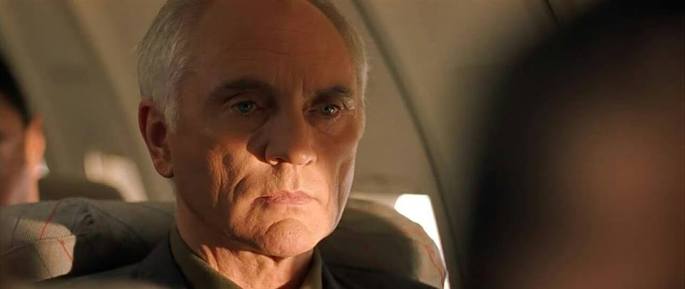
The film’s tone is set instantly. The gravely voiceover by Terence Stamp that quickly cuts to him stoically sitting on an airplane with The Who’s THE SEEKER drowning out anything your mind is thinking about, forcing you quickly focus solely on the film.

Soderbergh, who’s career has taken a precise and taut trajectory, created something of an anomaly with this film. While he’s relied on the brilliance of Cliff Martinez scores, he never quite dabbled in the usage of popular music like he did with THE LIMEY.

THE SEEKER completely sets the tone, as well as the story instantly. Stamp is a man on his way into a bombastic suicide mission of finding the man or men responsible for the death of his daughter, and killing them and anyone who gets in his way.

As phenomenal as Stamp’s intro music is, Soderbergh one ups himself by using The Hollies KING MIDAS IN REVERSE to introduce us to one the coolest cinematic antagonists ever to be on film, Peter Fonda as the sleek, yet smarmy, Teddy Valentine.

The Limey 2

Soderbergh’s casting is paramount in this revenge thriller. Along side Stamp and Fonda, are seminal actors from the era of the film’s kinship including Leslie Ann Warren, and Barry VANISHING POINT Newman.

The most fascinating aspect of the film is Sarah Flack’s editing. I’m not saying she’s Alan Heim, but she’s pretty damn close. The timeline jumping, fast paced editing is unlike any other film, and not only is it convenient as a plot device for foreshadowing, but it completely and utterly turns the film into a quick paced, nonstop clinic on not only filmmaking, but film editing.

THE LIMEY remains my favorite Soderbergh film, among a body of work that is made up of sheer quality and proficiency that can be comparabled to the works of Woody Allen. If anyone is studying filmmaking, in particular film editing, you need to watch ALL THAT JAZZ and THE LIMEY. On repeat.

BARRY LEVINSON’S BUGSY — A REVIEW BY NICK CLEMENT

2

The director’s cut of Barry Levinson’s brooding and stylish gangster epic Bugsy is sensational entertainment, made huge by a massive lead performance from Warren Beatty, fabulous production values, an all-star supporting cast, and a pungent and gritty screenplay by James Toback that peppered the proceedings with humor, heart, and an appropriate amount of violent confrontation. Released in theaters in 1991, the theatrical version excised 13 additional minutes which can be seen on the DVD, and sadly, the movie didn’t do as well as expected at the box office despite generally excellent reviews, but over time, this has solidified itself as one of the better offerings in this very crowded genre. Spanning the turbulent and erratic life of mobster Bugsy Siegel, Beatty’s larger than life performance as the titular hoodlum brought him a much deserved Oscar nomination, while future wife Annette Bening dropped a sensitive and stellar early star turn as Siegel’s love interest, Virginia Hill. Featured in the background were Harvey Keitel, Ben Kingsley, Elliot Gould, Joe Mantegna, Bill Graham, and Bebe Neuwirth, all knocking it out of the park, while master cinematographer Allen Daviau evoked old-school Hollywood with his burnished and elegantly composed photography. Ennio Morricone’s rich and full-bodied score only sweetens the deal. This is easily one of Levinson’s strongest overall films, and fully reminds that when he was firing on all cylinders, he was capable of smart and well-appointed films that knew how to balance commercial demands with artsier instincts.

3

Veronica Guerin: A Review by Nate Hill 

I can remember seeing Joel Schumacher’s Veronica Guerin when I was first allowed to start checking out R rated, more intense fare. Being far more impressionable that the desensitized veteran you see before you today, I had a royal emotional gut punch coming that I wasn’t even prepared for. I didn’t know what it was about or what I would see, all I knew was I loved watching movies and I was going to devour each and every one I could get my hands on. Well, it tells the true and very tragic story of Veronica Guerin, an incredibly fearless Irish journalist who almost singlehandedly waged war on the drug trade back in 1996. It’s a suicidal mission that involves hassling very dangerous people, putting her and her family’s lives in jeopardy and overturning stones that lead to nothing but trouble. But she won’t back down for a second, and Blanchett finds the noble belligerence in her. Now anyone who knows the story also knows that later in life she was assassinated, by order of the very same drug lord she was trying to take down, John Gilligan (Gerard McSorley). I feel like it isn’t really a spoiler and should be spoken of in a review, as it’s a huge beat and the essential part of the film. Poke the hornet’s nest and you’re liable to get stung, it’s just a shame that no one on her side could have done more to protect her and prevent the outcome, but when you have one woman crusading against both evil and casually corrupt indifference then I suppose she’s on her own anyway. “” is a chilling monster, an absolute sociopathic maniac who will go to any lengths of cruelty and darkness to keep his empire, and McSorley will give you shudders with his portrayal. Ciaran Hinds is great as sleazy and slightly conflicted John Traynor, an underworld informant who fed Veronica information and played a big part in her story. Colin Farrell shows up in an odd and completely random cameo, and watch for Brenda Fricker too. The end of the film and the events surrounding her death are intoned with a haunting musical montage, and I dare you not to burst into to tears or be swept away and deeply affected by Schumacher’s tender direction, the cast’s work and the sheer tragedy of it all. There’s another film about Guerin called When The Sky Falls with Joan Allen, and it’s worth a look, but this is the real deal, going to great pains to show the personal nature of Veronica’s quest, how much it meant to her, the sickness of a nation infected with drug addiction and corruption, and the game changing power which one human being can have over it all, even if they must sacrifice their life for it. Powerful stuff.

B Movie Glory with Nate: The Prophecy II 

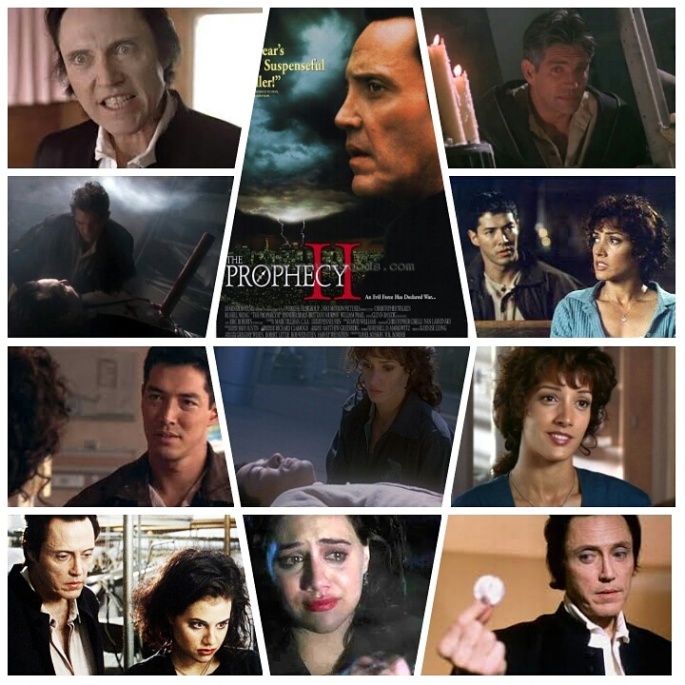
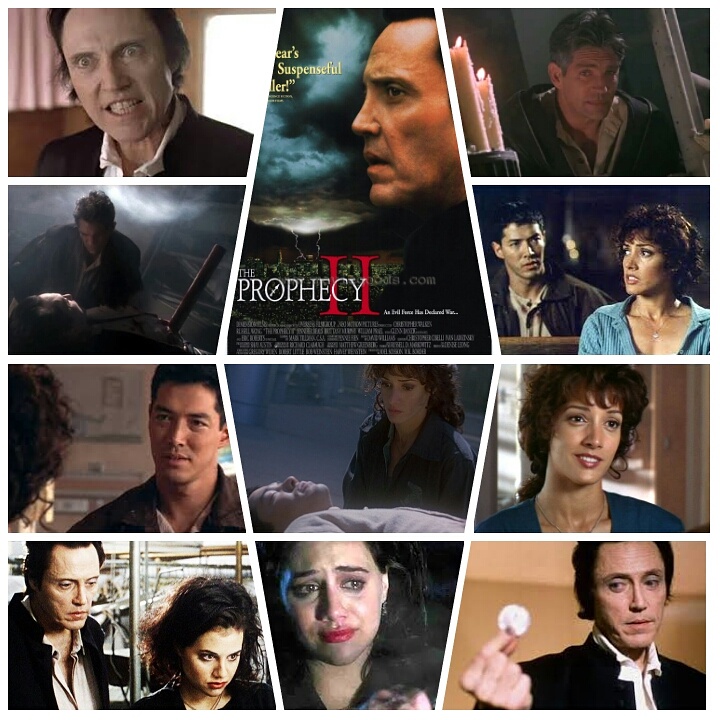
The Prophecy II continues around the same time the first entry left off, and while it’s not the same haunting, unique genre poem they managed with their first crack at it, it’s still got a few terrific things going for it, namely Christopher Walken. The guy is just charisma incarnate, and the implosive work he puts in as an angry, bitter Angel Gabriel in this franchise is some of the best I’ve ever seen from him. Gabriel is once again out to harm the humans, or ‘monkeys’ as he dryly puts it. The story is as murky as any self respecting Dimension films horror sequel should be, but from what I remember, an innocent human woman (Jennifer Beals) is impregnated by some sort of demi-angel named Danyael (Russell Wong), and the resulting birth will give humanity a kind of savior. Naturally, Walken tries to put a stop to this by hunting her down in appropriately scary fashion, and all sorts of schlocky supernatural hijinks ensue. It ain’t intellectual hour, but it’s held up very nicely by Walken, who clearly loves playing this character, and an eventual confrontation with Archangel Michael, played by Eric Roberts in what is delightfully inspired casting. The two of them have a quiet, focused exchange that elevates the material to near celestial heights which the film scarcely deserves. “How many world’s must burn before you’re satisfied?” Roberts inquires. “Just one. This one.” Walken purrs back. It’s a great scene and to this date the only time these two titans of the craft have shared the screen, and I’m thankful for it. Theres an amusing bit with Brittney Murphy, and a cameo by musician Glenn Danzig as well. The rest of the film is so so, but whenever Walken is there, baby it crackles. 

TODD PHILLIPS’ WAR DOGS — A REVIEW BY NICK CLEMENT

war_dogs_ver2_xlg

With War Dogs, it’s clear that cinematic funnyman Todd Phillips (The Hangover, Due Date, Old School) wanted to make a film that would raise his dramatic credibility as a storyteller. Sort of akin to the transition that Adam McKay made with his blistering financial meltdown drama The Big Short, this new and extremely entertaining film takes a real-life story and runs with all of its most absurd aspects, and as a result, the audience is left with a larger than life tale that feeds off of everyone’s collective desire for quick and sensational success. This is exactly the sort of movie that I want to see on the big screen. It’s smart, it’s got bite, it’s got some pointed social commentary, and it further showcases the notion of the Misguided American Dream, a concept that has informed other recent efforts like Michael Bay’s terrific Pain & Gain and Martin Scorsese’s juggernaut The Wolf of Wall Street.

1

At this point, with very few exceptions, I am all set with CGI dominated movies. I am TOTALLY done with swirling vortexes in the sky that have to be defeated in the final act. I want to see real films based on real stories that are tangible and topical and that feature characters that are morally questionable and interesting on various levels. Phillips and his extremely talented cinematographer Lawrence Sher tip their aesthetic hats in the direction of Scorsese, employing freeze frames in some choice spots, and using on-screen title cards that then become lines of dialogue in the next passage. This is an energetic and visually vibrant and distinctive movie, much like the rest of Phillips’ output, and even if War Dogs is satisfied to harness a traditional arc rather than anything groundbreaking, when a story is told this confidently by the chief creative parties, you just sit back and go for the ride and watch the wheels eventually fall off the operation.

2

Inspired by the Rolling Stone article and subsequent novel by Guy Lawson and previously known as Arms and the Dudes (a title which I personally prefer), War Dogs was written by Phillips, Jason Smilovic, and Stephen Chin, and charts the improbable but true story of two 20-something arms dealers, Efraim Diveroli (the absolutely amazing Jonah Hill) and David Packouz (a solid Miles Teller), who were able to procure government contracts to supply various types of weapons and ammo to U.S. troops stationed in Afghanistan during the high points of the War on Terror. Riffing on some beats that the more cynical Lord of War explored, the filmmakers offer up some potent questions about military and governmental decision making, the ease in which people are able to get their hands on vast quantities of weapons, and how those who are smart enough will always find a way to exploit the system.

war_dogs_xlg

While the film is no doubt dramatized for poetic license and dramatic effect, the root of the story remains intact, and what the audience is presented with takes the shape of an edgy, sometimes dangerous “process narrative,” where we see and learn what it takes to accomplish what Diveroli and Packouz did. Co-starring a shady Bradley Cooper as the team’s potentially devious mentor and the alarmingly photogenic Ana de Armas as Packouz’s disapproving girlfriend, War Dogs wisely chooses to center much of the action on the dynamic between Hill and Teller, with some major laugh out loud moments coming courtesy of Hill’s blustery and obnoxious creation of a toxic soul run amok. That obnoxious and creepy laugh seals the deal. He’s really cornered the market on aggressive, potentially hostile, and totally unpredictable loose cannon-characters; he could be the next Joe Pesci as he has that brilliant actor’s impeccable sense of comedic timing. War Dogs is easily one of the better movies that I’ve seen this summer.

3