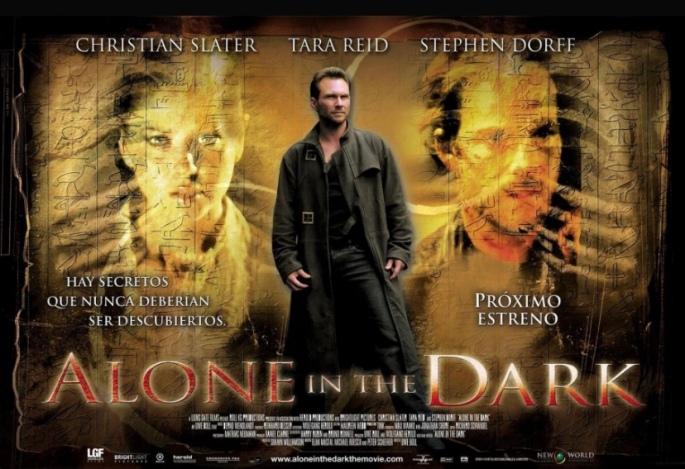
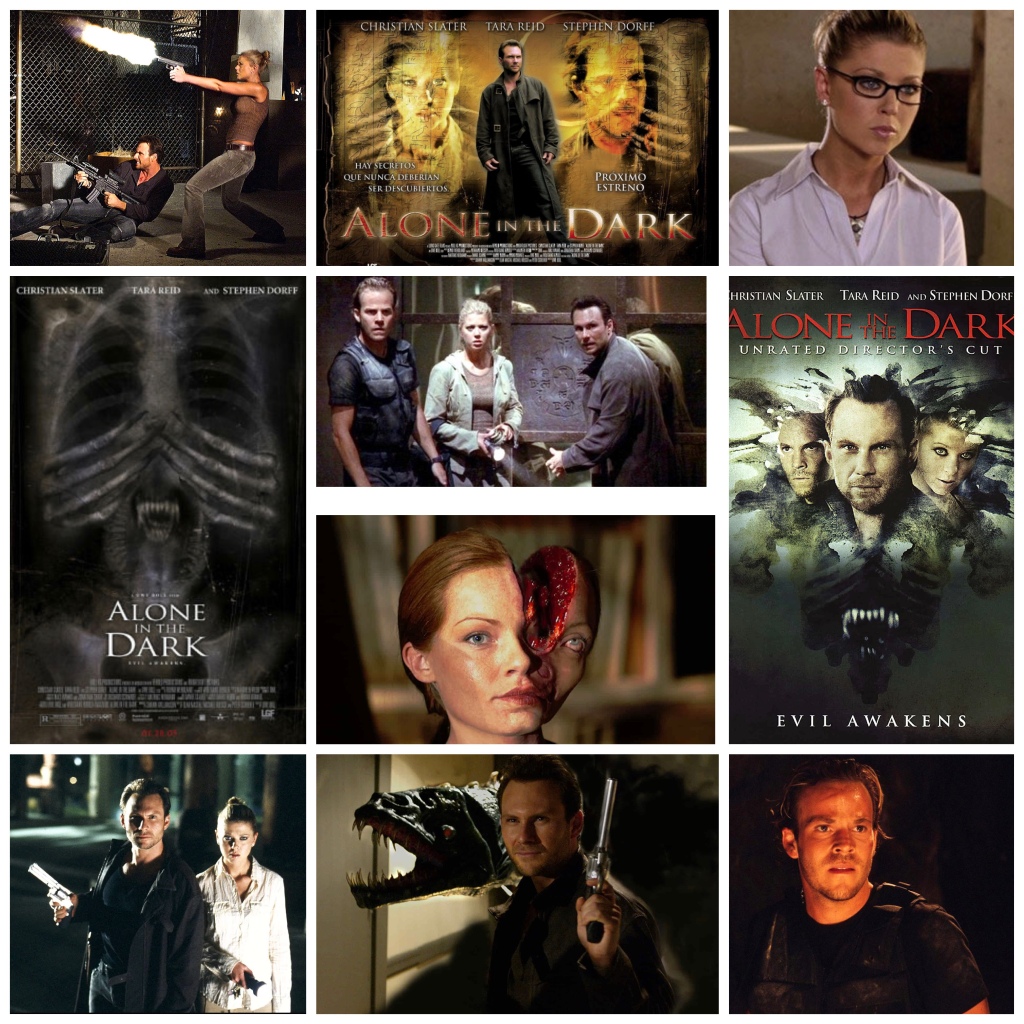
Uwe Boll’s Alone In The Dark

I know Uwe Boll’s reputation as a horror video game adaption filmmaker and I’ve seen a few of them so my personal expectations for Alone In The Dark were set pretty damn low, and yes it was a terrible godawful cheap mess but not… *quite* as bad as I was anticipating. Here’s the thing: I have years of watching B grade horror trash under my belt and when you’ve got that kind of buffer there’s not much, Boll’s output included, that can make you really, truly recoil, like I love trashy shit, it’s fun if it knows it’s place and fits it’s groove. This? This one is especially lowbrow and unapologetically so, as we see Christian Slater being a wannabe Blade/Van Helsing type monster hunter complete with an emo trench-coat, hilariously moody narration and a sexy/nerdy scientist sidekick played by Tara Reid who is about the farthest from nerdy scientist type you can get, which is great for a laugh here. Slater is embroiled in some murky supernatural hogwash involving human inter dimensional hybrid monster things that lurk around dark corners and disembowel people occasionally. He shoots some of them in between bouts of adorably sincere expository diarrhea dialogue and silly high tech gadgetry, and clashes with the gruff commander (Stephen Dorff) of a paranormal tactical squad and that’s about it. A weird subplot about an orphanage and the kids being used for experiments there back in the day went right over my head but I never played the game this is based on so that could be why, although I suspect it’s Boll’s haphazard direction and complete lack of focus in editing. I will hand it to the guy though for doing Vancouver proud, he not only films most of his stuff here in my city (and owns a restaurant in Gastown no less) but he actually sets it here too, so that Britannia Mines, Lions Gate Bridge and the Robson art gallery actually get to play themselves for once and not double for some hack USA location. This is cheap slipshod stuff, full of dodgy effects, indecipherably shadowy monster attacks and complete with an out of nowhere soft-core porn sex scene between Slater and Reid set to a giggle inducing emo lament by a group called ‘Nightwish’ who I’ve never heard of but outdo themselves in the Evanescence-lite department. This is one of the rare cases where there’s a sequel that’s way better than the original, they made a follow up with Lance Henriksen and Danny Trejo that actually attempts to do something worth watching, whereas this is just shameless, throw-in-the-towel dogshit.

-Nate Hill

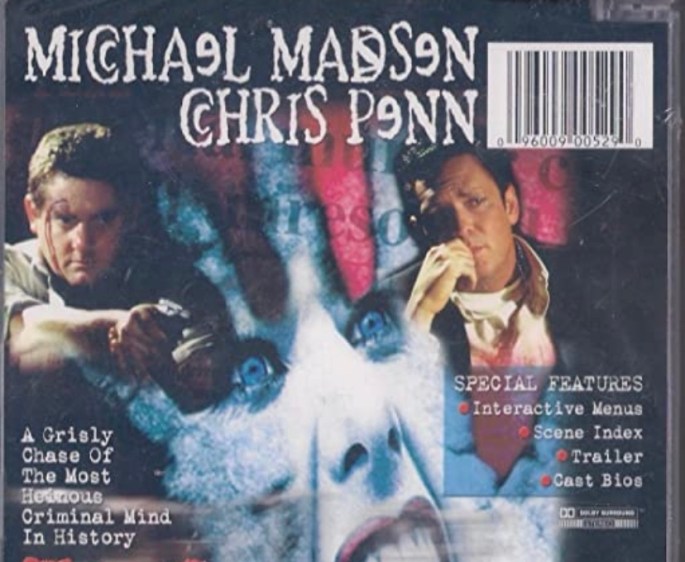
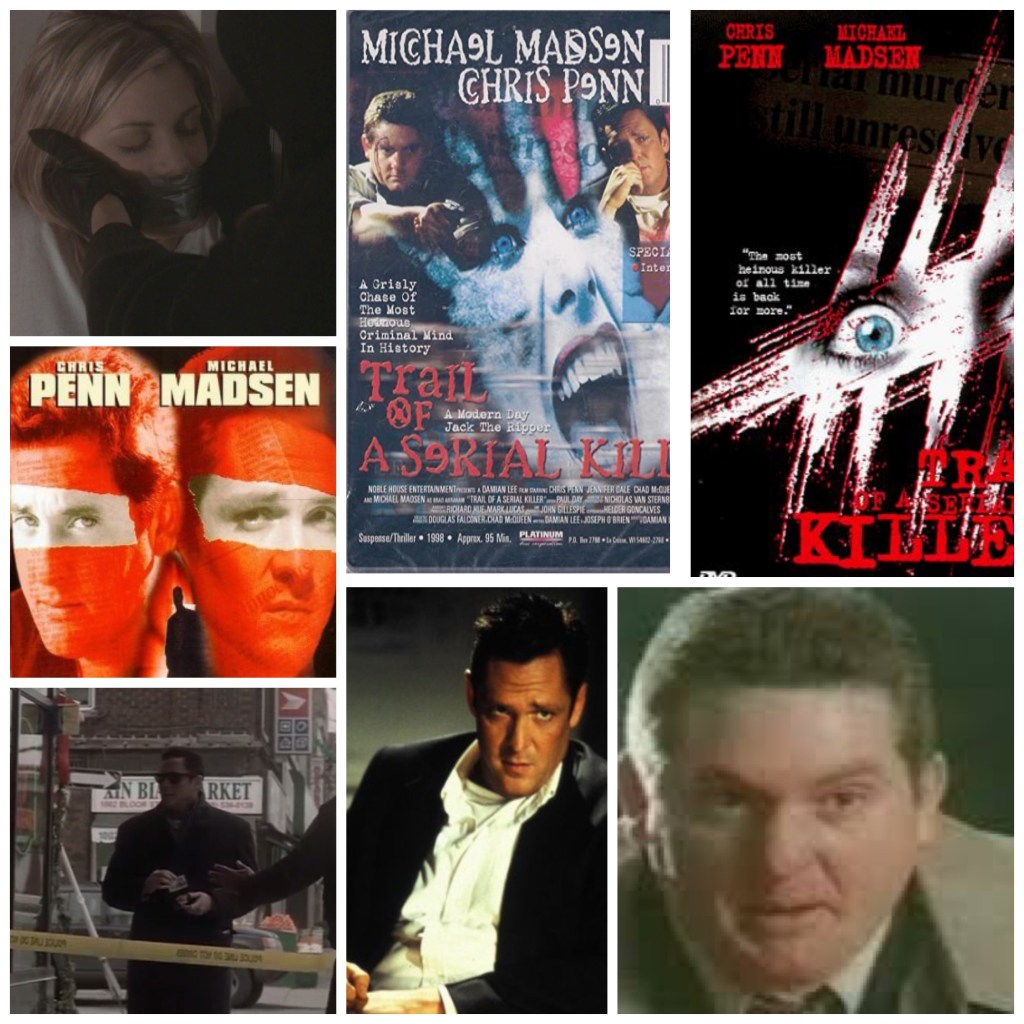
B Movie Glory: Papertrail aka Trail Of A Serial Killer

In the realm of cheap, lazy, perpetually nocturnal Seven ripoffs you can do worse than watching Papertrail aka Trail Of A Serial Killer but unfortunately you can also do way, way better. This is a murky, messily plotted, bizarrely acted, clunky, borderline incomprehensible mess that is given the dimmest bit of pedigree from two things: Michael Madsen and Chris Penn. The two have acted together quite a bit over the years before Chris’s untimely death and here they give notably overcooked tough guy turns as FBI Agents stationed in Toronto, one a weary, stressed out one (Madsen) and the other a disgraced unstable one (Penn). The latter is apparently a notoriously gifted asset for hunting killers in the tradition of Will Graham and such and is lured in by the former to track a murderer who has been eluding them for several years. Their investigation leads them to many dimly lit, depressing urban locales and eventually to the therapy group of a mysterious shrink (Jennifer Dale), one of whose patients, it seems, might just be the killer. While we’re on the subject of ripoffs, that idea is a blatant loft from the Bruce Willis erotic flick Colour Of Night, I might add. That’s about the most sense I could make out of the plot, which at best is a lurid frenzy of odd elements parading by and at worst is a flatlining series of WTF plot turns with no real interest. Penn was a genuinely good actor, despite what some people may tell you, and he isn’t half bad here as the near suicidal divorced lawman who is at the hysterical end of his rope. Madsen gives a performance that is just plain weird, he’s fired up and pissed in scenes that require him to be restrained and low key and then he’s oddly relaxed in instances where he should be on edge. It kind of works in a counterintuitive fashion, if you’re willing to overlook credibility and just accept that any Madsen is good Madsen in a film. This is honestly just a shamelessly trashy B grade pile of nonsense that I would never have lent ninety minutes of my time to if it didn’t star these two great actors, and I won’t lie in saying that if you aren’t an avid fan of both, you’re gonna hate this thing and resent giving it a shot.

-Nate Hill

Dark Places (2015)

Any fans of deep southern gothic potboilers with shamelessly lurid trappings, hectic, labyrinthine mysteries spanning decades acted wonderfully by a massive cast of character versions both old and young should greatly appreciate Dark Places as much as I did. It’s based on a book by Gillian Flynn who also penned the source material for David Fincher’s Gone Girl but for me this was a much, much stronger and more rewarding film. Fincher approached the material with his custom clinical, cynical tunnel vision detachment and meticulously calibrated style while director Gilles Paquet-Brenn adopts a much more sprawling, scattered, rough around the edges vernacular that is more narratively oblong and hazy yet no less compelling and even throws in the faintest glimmer of humanity. Charlize Theron is excellent as ever as Libby, the lone survivor of a farmhouse massacre that left her entire family dead when she was a kid, the killer never found and her left wandering as a broken adult trying to cope. The film intersperses dense, overlapping flashbacks to her difficult childhood life, a troubled brother (Tye Sheridan and Corey Stoll in present day scenes) who was ultimately blamed for the crimes, a desperate mother (Christina Hendricks) and aggressive deadbeat father (Sean Bridgers) who all may have had some hand in the events, although nothing is made clear until you are well beyond neck deep in this tragic, increasingly bizarre small town family saga. Chloe Grace Moretz gives a terrifically creepy performance as her brother’s unstable, untrustworthy teen girlfriend and there’s lots of solid supporting work from great folks like Glenn Moreshower, Andrea Roth, Jeff Chase, Laura Cayouette and Drea de Matteo as a shady stripper with ties to Libby’s past. You know this is a film for true crime fans (even if the story itself is fictitious) when a subplot literally features a club of true crime aficionados led by a twitchy Nicholas Hoult who reach out to Libby in attempts to help her bring the case to a close. There is a *lot* going on in this film, and while not all of it gels into an ultimately cohesive tapestry, the resulting patchwork quilt is beautifully scrappy, full of jagged loose threads and is just an awesome, inky black, deliberately overcooked, chokingly sleazy pit of depravity, hidden half truths, deplorable human beings and even some very well buried pathos that sneaks up out of the slime to surprise you in the back end of the final act. Theron anchors it with her haunted, pensive aura as a fiercely guarded woman who is likely a lot more vulnerable and damaged than she’d care to admit, and the messy, bloody trajectory she must descend down to solve an infamous murder she was unwittingly at the centre of. Absolutely great film.

-Nate Hill

Captain Ron

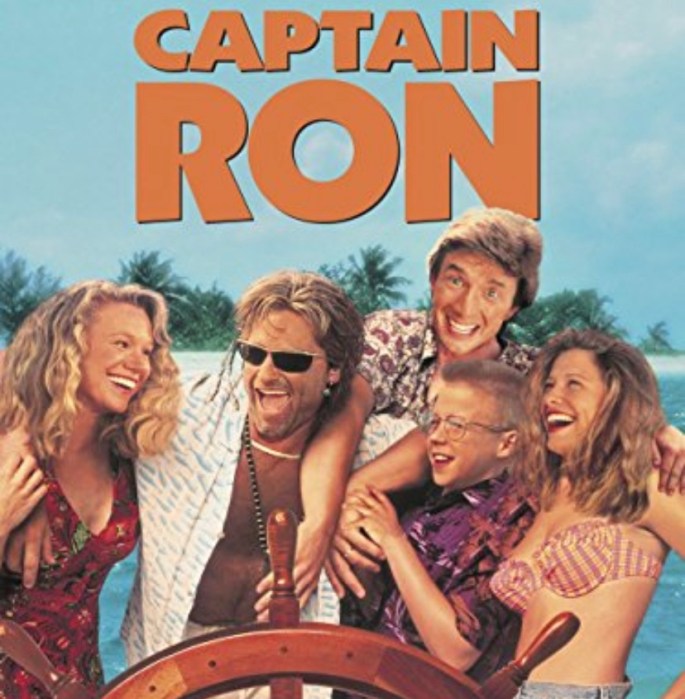
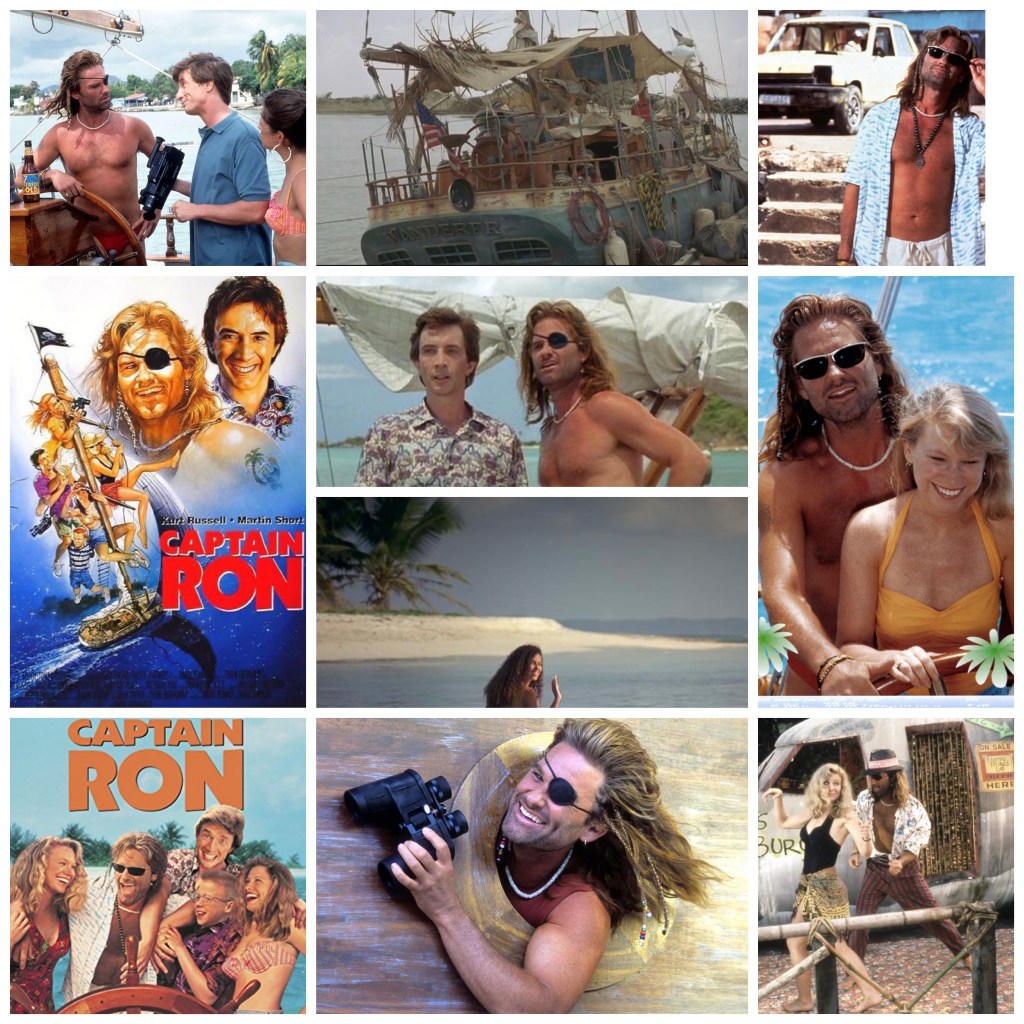
Kurt Russell doesn’t usually go for the comedy scripts so I wasn’t quite sure what to expect from Captain Ron but it was a legit blast of good times and the character he creates here is a legendary tornado of dreadlocked, suntanned, beer swillin’ manic energy. Martin Short plays a reliably high strung Chicago businessman who inherits a decent sized sailboat from a distant relative, and has to go down to the Caribbean to sail it back up before it can be appraised by an oily marine magnate (Paul Anka, of all people). So he decides to take his wife (Mary Kay Place) and two teenage kids along for the adventure, and since Russell’s renegade rascal Ron seems to be the only skipper on the rock who isn’t too hungover to be their guide and navigator, he hires him on the spot. What could go wrong? Well… not as much as I expected from the marketing on this thing but like… in a good way. The comedy is surprisingly restrained, very situational and well written where it could have been pretty 90’s silly slapstick and Russell’s performance, although loopy as all hell, is actually pretty subtle when it comes to getting those small, spur of the moment laughs that sneak in and become the funniest bits of the film. Like when he’s explaining the hierarchy of a ship crew to this clueless family and he goes “incentives are important. I learned that in rehab.” They encounter storms, pirates, packed harbours ready to party hard and armed ‘guerrillas’ (another joke that landed spectacularly) attempting to overthrow an unstable government and although Short’s attitude sometimes makes this feel like the ‘trip from hell downward spiral of insanity’ kind of flick it wants to be, it inadvertently just ends up having a great time out at sea and becomes a party, laidback hangout film, which is fine by me. This is thanks mainly to Russell and his effortless good ol’ boy charisma; even when he’s playing the most stoic, unfriendly badasses you always just get the sense that he’d be a guy you’d love to have a beer and just kick it with. Well you can do that here, and Captain Ron is one of the most easygoing, flat out hilarious and downright fun films of his career. Good times.

-Nate Hill

Ben Wheatley’s In The Earth

In The Earth is only the second film from Ben Wheatley I’ve seen, the first being his spunky noir shootout flick Free Fire which seems to be the odd duck out and a far cry from the dark, morose, esoteric folk horror fans are used to from him. This was a very interesting film and while the pieces don’t necessarily all fit together in a way that struck the ultimate timbre with me, it’s certainly a visually galvanizing, stylistically impressive work. As a research scientist (Joel Fry) and a park ranger (Ellora Torchia) trek deep into a wild forest in rural England on some sort of mission they encounter two very different individuals who are both trying to communicate and study some sort of… I dunno, entity or force that hides within the very structure of the natural world. There’s borderline zealot Zach (Reece Shearsmith) who lives as a homeless person would and approaches this being from a folk point of view, offering it iconography in a religious fashion like the pagans who lived in the region eons ago would have. His ex wife Olivia (Hayley Squires) lives in another region of the woods where nary the two stray into each other’s path (like most exes) and her efforts are a lot more scientific but no less bizarre, using complex machinery to reach out to this thing with light, sound and rhythm. The two leads find themselves stuck squarely between two duelling fanatics who are in way over their heads with a force of life neither can comprehend and are both slowly being driven mad by. And that’s as far as the plot goes in the realm of what is coherent and comprehensible anyways. The closest thing you could describe this entity as is a stone monolith punctuated by an opening through which you can view the stars, and nature on its terms but never is it presented as a physical or visible ethereal being beyond hints, abstract hallucinations and sounds out there in the dark. If that’s your thing than cool, I enjoyed the odd, surreal, impenetrable nature of it and recognized the welcome nods to many influences including Alex Garland’s Annihilation, M. Night Shyamalan’s The Happening and even John Carpenter’s Prince Of Darkness in a few brief strokes. Just don’t expect to walk out of this thing with answers; it’s a moody horror SciFi that quickly transforms itself into a wild arthouse romp from which there is no rhyme or reason to be distilled from but what one’s own intuition says.

-Nate Hill

Mark Pavia’s Fender Bender

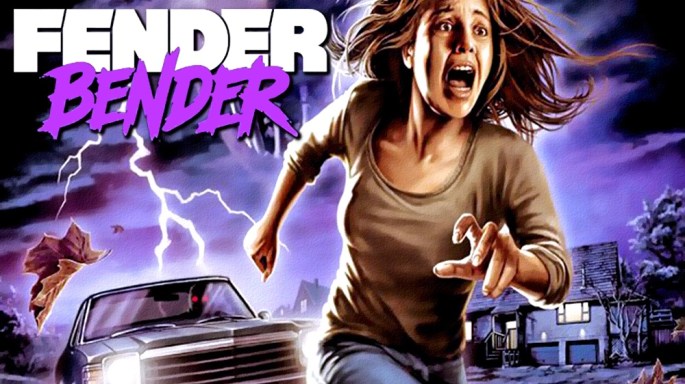
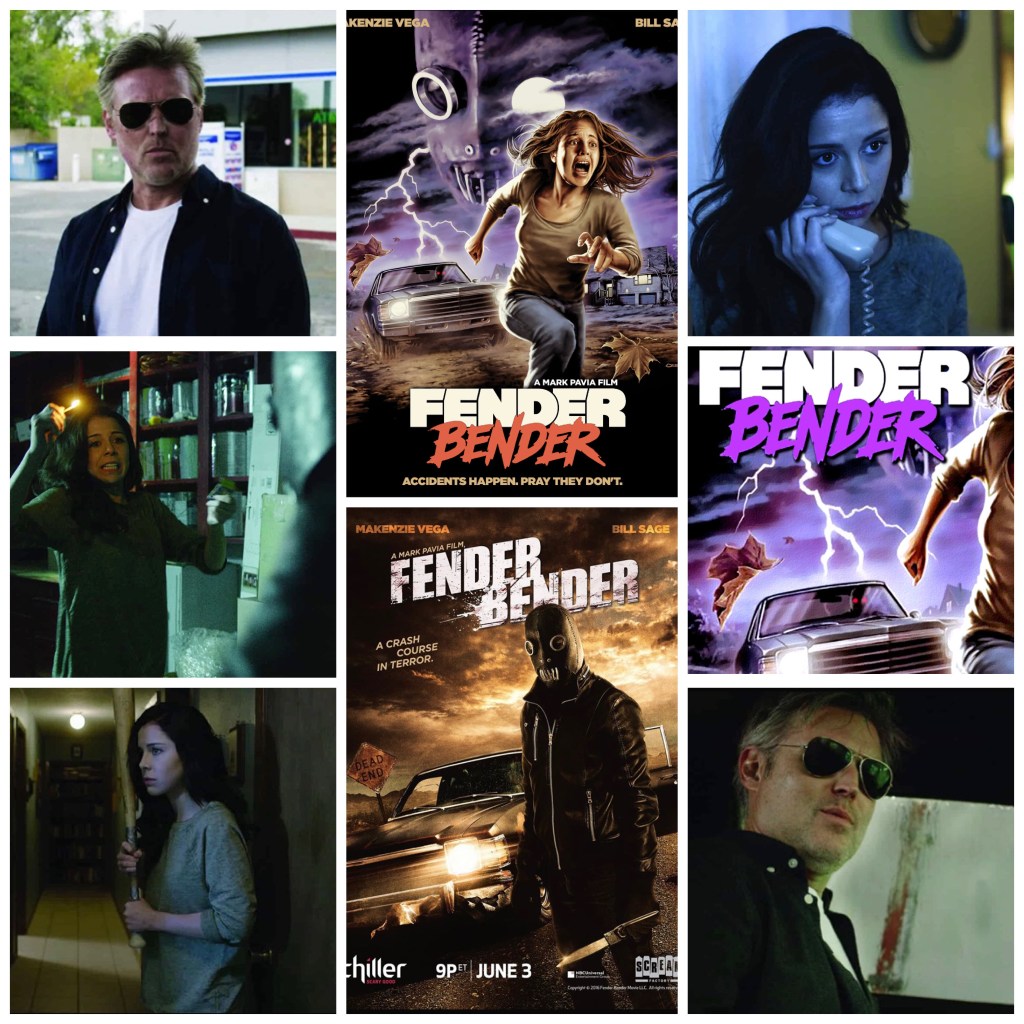
The next time you get into a mild vehicular dustup be careful how much of your personal information you give to the other party involved, lest you end up like the unfortunate girls in Mark Pavia’s Fender Bender, a vicious little Grindhouse exercise that doesn’t quite achieve genre greatness but is still good fun. When a teenage girl (Mackenzie Vega, Sin City) is rear ended by a weird guy (Bill Sage, American Psycho) in a mysterious black muscle car she exchanges information and heads home to face the disappointment and subsequent grounding alone at home from her parents for taking the car out, she discovers that that’s the least of her worries for the night. It turns out this guy, beyond just having creeper vibes, is a stalker/serial killer who deliberately causes fender benders and uses the insurance contact info to hunt girls down and murder them, and he’s on his way to her place. This leaves her to fight him off initially alone, and then with the help of two ditzy friends. Now, this is a competently made, atmospheric and very suspenseful piece and while I *usually* am not the type of person to be like “why didn’t this character do this” etc in terms of plot, these characters, including our lead, are especially stupid in their attempts to evade and overpower this guy, to the point where the ‘slasher trope’ excuse just doesn’t cut it. That aside it’s a good time and Sage is wonderfully sinister as this dude, credited simply as ‘The Driver.’ The score is done by an electronic group called Nightrunner and adds a lot of dark sonic synth ambience too, which is always great. Aside from how braindead the lead is in frantic situations this is a nice little retro slasher with tense set pieces and a genuinely memorable killer.

-Nate Hill

THE MICHAEL MANN FILES: THE LAST OF THE MOHICANS (1992)

I’ve never read anything by American novelist James Fenimore Cooper, author of the book from which The Last of the Mohicans was adapted. But if Mark Twain is to be believed a decent critic of letters, I’m not missing much. Or, to be precise and on the contrary, I’m missing a lot because, as a friend once opined, “I wish he were James Feniless Cooper.” So it seems that the consensus is that if Cooper was anything, it wasn’t economical. And neither, really, is filmmaker Michael Mann (though it’s not necessarily a bad thing with him). A man who toils in ostensible action films, Mann’s work slowly percolates before hitting a full roil as he allows minute details to create the fuller flavor when the action finally hits.

So it’s sort of a surprise that Mann’s adaptation of The Last of the Mohicans is such a tight and nimble affair that yet still feels robust and epic. But in all transparency, Mann’s film isn’t a finely combed reworking of the original source material, but is a copy of a copy; less adapted from the novel itself but from the 1936 adaptation by John L. Balderston, Daniel Moore, Paul Perez, and Philip Dunne which was the basis of the George Seitz-directed version of The Last of the Mohicans starring Randolph Scott.

Set in 1757 during the third year of the French and Indian war, The Last of the Mohicans spins the yarn of Cora (Madeline Stowe) and Alice (Jodhi May) Munro, daughters of British Colonel Edmund Munro (Maurice Roëves) who are attacked by their Mohawk-née-Huron guide, Magua (Russell Means) on a march to a military fort and are subsequently intercepted and led to safety by a frontier family unit made up of the white born/native raised Nathanial ‘Hawkeye’ Bumppo (Daniel Day-Lewis); his Mohican father, Chingachgook (Russell Means); and brother, Uncas (Eric Schweig). Throw in some frontier romance that looks like the cover of a million and one bodice-rippers that would litter the rack of a Safeway in years long extinguished, a gloriously unsubtle and full-blooded score by Randy Edelman and Trevor Jones, and Dante Spinotti’s cinematography making damn sure that every shot looks like a gorgeously textured painting, and you’ve got yourself one hell of a rousing adventure film that cleverly folds pulp into purpose.

If all of this sounds a little rustic for the glossy kind of urban plotting favored by Michael Mann, it’s not. For The Last of the Mohicans plays very well to Mann’s strengths and shows what makes him such a special filmmaker. Here the examination of a crime scene is replaced with the almost preternatural knowledge of just who and what slaughtered a defenseless frontier cabin. Nobody cases a score but Magua plots diligently and carefully to satiate his obsession with slaughtering the entire Munro family. Nobody has a history of existential baggage causing their personal lives to be high-tension quagmires of personal failure but there is an inevitable march to the same kind of doom and loneliness that befell Thief’s Frank and Miami Vice’s Sonny Crockett and caused the endings to their tales to contain bitter, Pyrrhic victories.

Aside from expanding the widescreen visual language that had eluded Mann the previous seven years during his sojourn in television, The Last of the Mohicans is perhaps the most foundational embodiment of the Mann hero. Nathanial Bumppo is a man without a heritage, a white man raised in a native family in a land that is wild and tangled beyond its small British foothold. Not only does this expand to Magua, likewise disconnected from his roots after being taken a slave by the Mohawk people, this also expands to Mann’s reflection of the America as contemporarily dressed westerns in which the protagonists reside in the absolute middle between law and lawlessness, even when they themselves are cops and/or criminals. Mann’s heroes are just the progeny of the cast of Sam Peckinpah’s The Wild Bunch; fiercely independent and untamed criminals with a modicum of personal honor battling against authority figures right on the dividing line of the two. This is why Nathanial’s declaration of “I do not call myself subject to much at all” sounds suspiciously like Frank’s “I am Joe the Boss of my own body.”

As is his wont to do, Mann’s insistence on giving Magua a third dimension and not rendering him a cartoon villain without proper motivation makes the character a little less than the symbolic Francis Dollarhyde from Manhunter who served as a literal reflection of the protagonist. Here, the antagonist is placed into much more devastating territory, painted as someone understandably twisted by a hate in regards to a tragedy with which the audience can empathize. After all, didn’t we cheer Clint Eastwood’s titular character in The Outlaw Josey Wales back in 1976 for doing pretty much the same thing? And let the record state that I don’t exactly not root for Magua to kill Colonel Monroe and eat his heart, I’m just a little bearish on him killing the kids.

Mann puts his actors through the absolute ringer as they traverse uphill and down dale in some pretty rough terrain, earning themselves every layer of dishevelment that occurs to their wardrobes along the way. And while the whole cast is amazing, special mention has to be given to Daniel Day-Lewis for giving straight men the meaning of what it is to look like a whole snack. Despite its technical prowess, flawless pacing, and containing some of the most beautiful cinematography this side of Barry Lyndon or The Duellists the secret sauce of The Last of the Mohicans is likely its casting. Every now and again, I see a tweet make the rounds that states “My sexual orientation is the cast of 1999’s The Mummy,” replete with four stills of its principles. Well, I’ll see your Mummy and raise you a Last of the Mohicans because I know of no other film that oozes base sexuality and affects its viewers quite like this one without doing much of anything at all (though, quite honestly, neither does The Mummy). For about 55 minutes into the film, Mann stages one of the most erotically charged moments of his career that is astonishing in its ability to raise the temperature to a ridiculous degree without showing a single thing outside a passionate kiss. And it serves as a reminder that, though not generally thought of as a composer of romantic moments, Michael Mann certainly knows how to create almost painfully gorgeous sequences of physical sensuality. When Madeline Stowe coos “The whole world is on fire,” one is tempted to mutter “Yeah it is. Go ahead and let it burn.”

Put another way, a family dinner with my much more conservative parents and sister turned into a literal thirst trap as my mom, a woman who thinks long hair looks positively awful on men, couldn’t help but bemoan the fact that Daniel Day-Lewis cut his hair after production on The Last of the Mohicans wrapped and my sister, generally demur in such moments, offered up “Now… see… I liked his brother in that.”

A little something for everyone, America.

(C) Copyright 2021, Patrick Crain

Silent House (2011)

Elizabeth Olsen has been making a huge impact on film these days and already was a decade ago I was pleased to learn with 2011’s Silent House, a superior, intelligent and unconventional horror film that showcases some of the best ‘scream Queen’ acting from her that I’ve seen in the genre overall. This is a simple story that sees her play a teenage girl who is helping her father (Adam Trese) and uncle (Eric Sheffer Stevens) pack up a house that they are about to move out of. Everything seems routine save for a little bickering until suddenly she finds herself trapped in a threatening netherworld version of the house, full of half seen ghosts, whispering voices and apparently no contact with the outside world. Is she dead? Hallucinating? The switch from the opening scenes into frightening territory is so swift and so abrupt that at first I had no idea what was going on and felt disoriented, but then realized that’s exactly how this poor girl must feel and noted how effectively and promptly the film drew me into its world and the point of view of its protagonist. She wanders about with little notion of what to do beyond hide, scream and run until she finds old Polaroids and other long forgotten totems of memory and we see the truth slowly come to light. It’s a sad, tragic revelation that so many girls who went through what she did as a kid must later unearth in their own repressed memories and Olsen’s performance is note perfect on every level. There are some deeply terrifying scenes here including a sequence where she uses the brief flash of the Polaroid camera to gain some visibility in the dark and quickly wishes she didn’t as we catch momentary glimpses of the horrors surrounding her. The camera work, staging and spatial dynamics are all excellently done by husband and wife directing team Chris Kentis and Laura Lau, who are remaking a Uruguayan horror film here of the same name that I have yet to see but based on the sterling quality level I experienced here, it must be something else indeed. This is dark, tragic, genuinely creepy horror on all levels, a story told in almost dreamlike fashion with a lead performance from Olsen so potent with raw fear and deep anxiety I’d almost be hesitant to discover what her actor’s process is. Really great stuff.

-Nate Hill

Taylor Sheridan’s Those Who Wish Me Dead

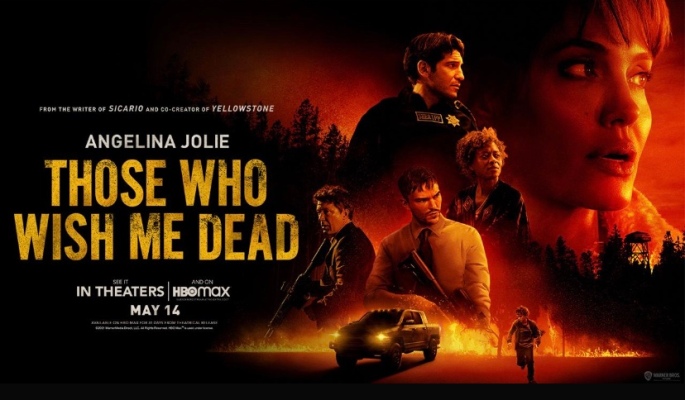
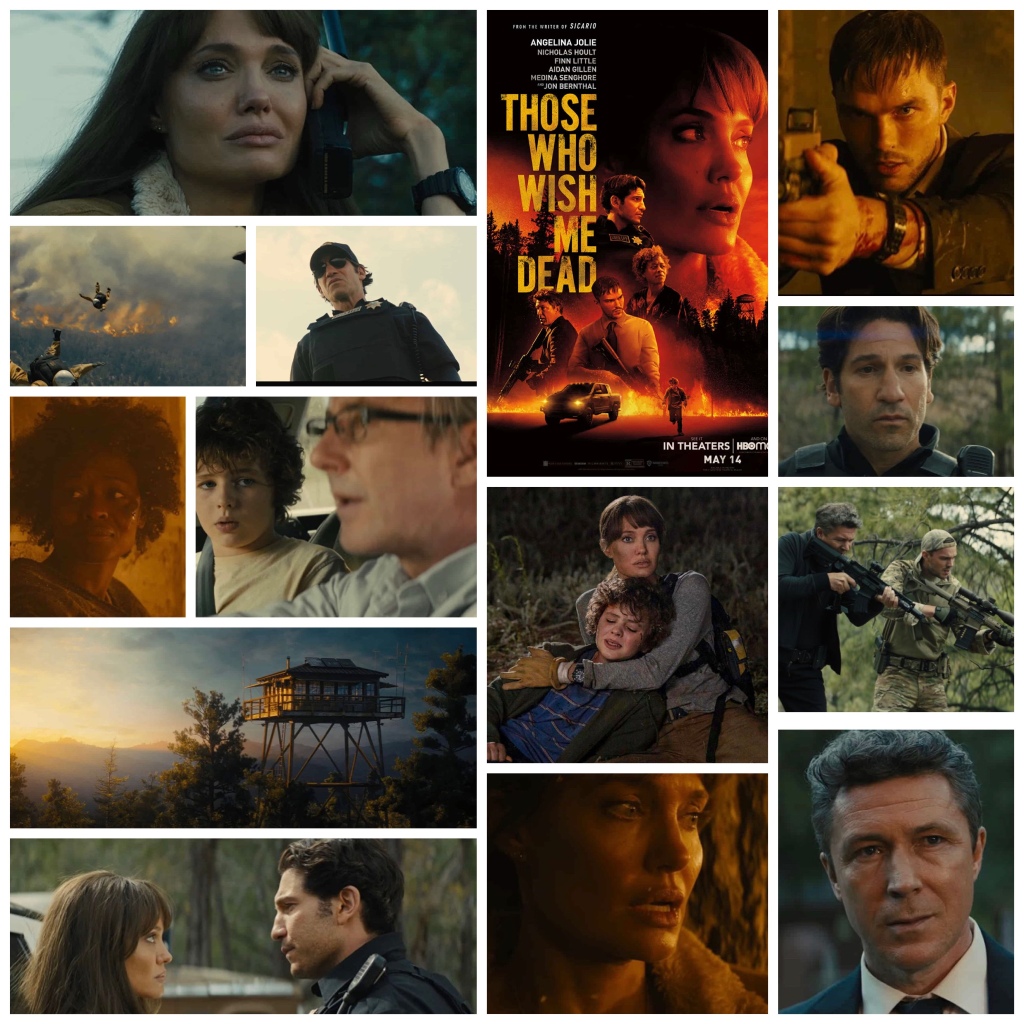
I miss the days in the 90’s or so when big budget, star studded thrillers dominated the summer and they’d often have slightly outrageous yet totally exciting high concepts that melded different elements into one palette. Taylor Sheridan’s Those Who Wish Me Dead is a terrific example of this and a banger of a film, the exact type of summer popcorn escapism I miss having around a lot. Angelina Jolie plays an ex wildfire fighter/smoke jumper with PTSD after a mission gone horribly wrong, now relegated to fire-watch atop a lonely tower and occasionally getting arrested by the local sheriff (Jon Bernthal) for doing insane daredevil stunts just to keep the pain at bay. One day a kid runs into her region of Montana forest trying to escape two psychotic contract killers (Aiden Gillen and Nicholas Hoult) who have chased him and his dad (Jake Weber) in there from the city, for dark reasons that are, wisely, only hinted at. It’s up to a haunted Jolie to protect this kid at all costs with the help of Bernthal’s badass lawman, his equally badass and very pregnant wife (Medina Senghore) and some of her former smoke jumping crew, but will it be enough to stop these incredibly heinous assassins? I’m not even kidding either, these two are literal cold blooded monsters who aren’t above blowing up houses with families in them, killing pregnant women and kids and even deliberately starting a wildfire that torches half a valley just to smoke out their prey. “I hate this place” growls an unreasonably sinister Gillen (if you thought he was slimy in Game Of Thrones, well…), to which another character replies “it hates you back” in trademark pulpy yet elemental Taylor Sheridan writing fashion. Jolie is stunning here and I wish she’d headline more films these days, she captures the flint-spark resilience and crushing vulnerability of her character beautifully in a top shelf performance. The sweeping Montana cinematography is gorgeous and threatening in equal parts, the violence and action vicious and unrelenting, as is the very effective suspense. I see that this has gotten lukewarm reactions almost all across the board and I’m really not sure what film most people were watching; this is the kind of blockbuster stuff I live for and miss greatly these days. It’s bombastic, grandly drawn, hearty genre meal material that’s exciting, tightly written, unforgivingly brutal and solidly directed. One of the best so far this year, I’m my books.

-Nate Hill

THE ROBERT ALTMAN FILES: VINCENT & THEO (1990)

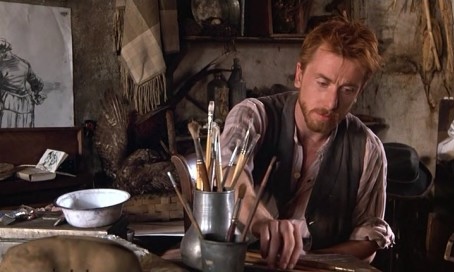
Robert Altman’s Vincent & Theo begins amid an industrial clang of a score by Gabriel Yared over a vibrant smear of colored oil paints which suddenly shifts to a Christie’s auction in which Vincent Van Gough’s 1888 still life, “Vase with Fifteen Sunflowers,” is going up for sale, climbing higher and higher in value as ridiculous amounts of money are outbid by even more ridiculous amounts. As the auction’s image gives way to a disheveled Vincent (Tim Roth coming in like a force of nature), crumpled up on a bed like a graying wet newspaper and awaiting a chewing out by his more responsible and nattily dressed brother, Theo (Paul Rhys perfectly camped out on the edge of an emotional outburst), the audience is given a sense of how much people are paying for pain and debasement when they’re investing in a Van Gough. For the disparity between a pauper’s life of misery and anguish and the revered saint of post-impressionistic art whose works can now fetch the price of a small island state is a vast one, indeed.

But Vincent & Theo isn’t about the raving mad Vincent Van Gough, although it has plenty of that. As Altman’s film is a two-hander and there is as much Theo as there is Vincent, it is a full examination of co-dependency and masculine love, almost becoming the California Split of painter biopics. But it’s also making a comment on the very tenuous and special relationship between the crazy, hedonistic, and unchained artist and the very real, very tangible world of dollars and cents that have to be considered which generally takes a cooler and more centered head to navigate. How in the wild world do these two things exist in a relationship?

I don’t know but it sounds an awful lot like the relationship between a producer and a director which is why Robert Altman seems so keen on this project. It’s a meditation about the heavy conflict between creation for sanity and curation for profit which dogged Altman almost throughout his entire career. While his work mostly settled on American culture and dotted the entire map like a beautiful quilt, Altman’s Vincent & Theo is decidedly outside the confines of the United States and, in terms of laying all of his out in chronological order, predates everything else in his canon, setting itself out to be an origin story of the independent artist guided by a mad spirit that cannot be defined.

Smartly written by Julian Mitchell, the story of Vincent & Theo is bracketed between Vincent’s desire to become a painter and his suicide, with his brother Theo, an art exhibitor and dealer, always playing the shadow side of the narrative coin. If 3 Women is Altman’s most Lynchian film, Vincent & Theo is almost Cronenbergian in its vision of intertwined beings who can hardly thrive without each other’s influence on the other. And while this dichotomous relationship certainly didn’t originate with Vincent and Theo Van Gough, Altman directs it like it did. By utilizing bold and rich colors to express mood and setting, time and place, Vincent & Theo is front-loaded with a crisp and stately style that feels very controlled while still registering as Altmanesque, preceding the brilliantly shaggy Masterpiece Theater approach taken with Gosford Park a decade later.

Vincent & Theo, helped in no small way by Jean Lepine’s ravishing cinematography, does a marvelous job recreating some of Van Gough’s landscapes, subjects, and locations such as the hangout that was immortalized in “The Night Cafe” or the many number of rustic and vast fields touched golden by the bright and boisterous sunlight. Initially made for British television and composed of four 50 minute episodes that function like the seasons, the construction of the narrative, always creating a give and take between the two characters and showing yin and yang contrasts, is nothing short of breathtaking. In one scene, Vincent and his prostitute model/companion, Sien (Jip Wijngaarden), finalize their living arrangements with each other and in the next, Theo and Marie (Anne Canovas) discuss the same, followed by a monologue in which Theo reminisces about a painting he saw in which he wanted to enter and never leave. Cut to the following scene where Sien’s young daughter literally steps into the staging area of a panorama to micturate; both fulfilling Theo’s wish to enter a painting and also subverting it by pissing all over it. The staid domesticity of the syphilitic Theo and Marie is contrasted with the rawer, gritty poverty-laden life of Vincent and Sien with both men ultimately achieving the same result as both are eventually left alone and slathered in oils as if they were forever destined to the same fate. This goes on until the film begins to examine the relationship between Vincent and Paul Gaugin (Wladimir Yordanoff) who acts as a spiritual relation in the absence of Theo, married and in Paris, his own health slowly deteriorating. The relationship between Gaugin is volatile and competitive instead of nurturing and supportive, which causes a rapidity in Vincent’s mental decline which parallels Theo’s physical one. The madness that inhabited Vincent manifests itself in Theo in the films closing moments as, spiraling toward a death that would occur only the following year of his brother’s, voids his gallery of all commercial artwork and covers it, almost pathologically, with nothing Vincent’s work.

After spending a decade in the wilderness crafting mostly small, intimate adaptations of stage plays, with both Tanner ‘88 and Vincent & Theo, the latter of which had been edited down by an hour and released in theaters in November of 1990 to very positive notices, Robert Altman entered the new decade with two of his most ambitious and successful projects since the late 70’s under his belt. But during that period in which Altman had kept a lower profile and focused on the more intimate tasks at hand, Hollywood was beginning to reckon with smaller, independent studios encroaching on their territory and allowing inroads for newer, fresher talent. When all of this came to a head in 1989 with Steven Soderbergh’s modest sex, lies, and videotape which became THE story at the Cannes Film Festival by winning the Palme d’Or and emerging a small financial bonanza as it earned $24 million domestically against a $1.2 million production budget, the future of cinema was given a breath of fresh air. As it looked to be 1968 all over again, Hollywood again tapped the vein of the new blood who were all too eager to get their foot in the door and this push gave us the aforementioned Soderbergh, Whit Stillman, Quentin Tarantino, and Altman acolyte Paul Thomas Anderson.

“Do you always have to go so far on principle, Theo? Or does it come to you naturally?” is the first line of scripted dialogue in Vincent & Theo. It goes mostly unanswered by Vincent. But as the Hollywood tides turned and Altman’s mid-career artistic peaks were occurring at just the right time for someone to give the old master (who, by that point, had become a patron saint to the new class of filmmakers) a chance to get back into the majors, Altman would definitely give it an answer in his next endeavor.

(C) Copyright 2021, Patrick Crain