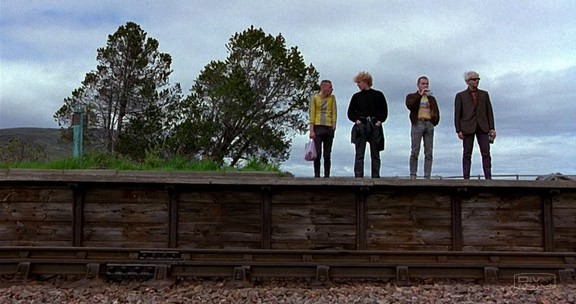
TRAINSPOTTING – A REVIEW BY J.D. LAFRANCE

00-32-14

Trainspotting flew out of the gates in 1996 and took the world by storm, first causing a sensation in the United Kingdom, and then moving on to the United States bolstered by a soundtrack that mixed classic rockers (Lou Reed, Iggy Pop) with contemporary ones (Blur, Primal Scream). Audiences couldn’t get enough of this gritty, often funny, sometimes harrowing tale of Scottish heroin addicts. Based on Irvine Welsh’s edgy cult novel of the same name, Trainspotting was adapted by a trio of filmmakers – director Danny Boyle, screenwriter John Hodge and producer Andrew Macdonald – who had previously collaborated on the nasty suspense thriller Shallow Grave (1994).

They chose just the right passages from the novel and proceeded to capture the spirit of what Welsh was trying to say without judging the characters. This resulted in the film getting into trouble as some critics felt it glorified drug addiction. The film takes an unflinching look at the lives of a group of drug addicts and shows why they do drugs — the highs are so unbelievably amazing. However, Trainspotting also shows the flip side: death, poverty and desperation, which lead to stealing, lying and cheating just to get more drugs. Regardless, the film was a commercial and critical success, spawning all sorts of imitators and influencing countless other U.K. filmmakers to go through the door that it kicked open.

The six-minute prologue does a brilliant job of introducing a group of Scottish drug addicts as seen through the eyes of one of them — Mark “Rent Boy” Renton (Ewan McGregor). His friends include a speed freak motormouth named Daniel “Spud” Murphy (Ewen Bremner), a suave ladies’ man, Simon “Sick Boy” Williamson (Jonny Lee Miller), straight-edged Tommy MacKenzie (Kevin McKidd) and sociopath Francis “Franco” Begbie (Robert Carlyle). Each one of them has their own distinct personality that each actor vividly brings to life. This prologue also sets the tone for the rest of the film as it starts literally on the run with Renton and Spud being chased by the cops to the pounding strains of “Lust for Life” by Iggy Pop (before it became overused thanks to countless commercials using it bizarrely out of context) as Renton’s voiceover narration talks about his “sincere and truthful junk habit.”

The energetic camerawork — fasting moving tracking shots (that recall Mean Streets) as Spud and Renton run from the police and the freeze frames (reminiscent of GoodFellas) with title cards identifying each character is an obvious stylistic homage to Martin Scorsese. Like many of his films, Trainspotting is bursting at the seams with energy and vitality that is very engaging. The prologue does its job by immediately grabbing our attention and drawing us into this world populated by colorful characters. After 30 minutes of showing the incredible highs of shooting heroin where we’re caught up in the euphoria of it with Renton and his friends, director Danny Boyle starts to show the ugly side, starting with the death of fellow junkie Allison’s baby due to neglect.

From there, Renton and Spud get arrested for stealing with the former going into a rehab program while the latter goes to jail but not before Renton takes one more hit and promptly overdoses in a surreal bit where he sinks into the floor and is taken to the hospital by taxi seen mostly from his zonked out point-of-view to the strains of “Perfect Day” by Lou Reed. However, Trainspotting’s heart of darkness is the sequence where Renton goes through the horrors of withdrawal and his reality becomes warped by hallucinations of Allison’s dead baby and his friends. Ewan McGregor really does a fantastic job of conveying Renton in the depths of a painful and terrifying withdrawal.

John Hodge’s screenplay masterfully distills Welsh’s novel to its essence and includes some of its most memorable dialogue. From Renton’s famous “Choose life” monologue (“Choose life … But why would I want to do a thing like that? I chose not to choose life: I chose something else. And the reasons? There are no reasons. Who needs reasons when you’ve got heroin?”) to Sick Boy’s “Unifying Theory of Life” speech (“Well, at one time, you’ve got it, and then you lose it, and it’s gone forever.”), Trainspotting has insanely quotable lines. This helped it develop a loyal cult following over the years that continues to champion the film even to this day. And yet what resonates most is its honesty. The film doesn’t sugarcoat its message and it isn’t preachy about it either. There is an ironic detachment that transforms it into a playful black comedy mixed with gritty drama and surreal sequences.

It doesn’t hurt that this excellent material is brought to life by a fantastic cast of then relative unknowns (especially to North American audiences). Ewan McGregor has the toughest role in the film playing an unrepentant junkie while also acting as the anchor that the audience identifies with and the character that the rest of the cast revolves around. It is a tricky balancing act because Renton does things that make him unlikable and yet we still root for him because of McGregor’s charisma. Fresh from his role as an American computer user in Hackers (1995), Jonny Lee Miller plays Sick Boy, Renton’s best mate but someone who lacks “moral fiber” despite his vast knowledge of Sean Connery. He ends up taking advantage of his friend in a dodgy scheme and Miller does a nice of showing how Sick Boy went from best mate to scheming con man.

Robert Carlyle is also great as the completely unhinged Begbie. The scene where he recounts a colorful story about playing pool (“I’m playing like Paul-Fuckin’-Newman by the way.”) and dealing with his cocky opponent (“You ken me, I’m not the type of cunt that goes looking for fuckin’ bother, like, but at the end of the day I’m the cunt with a pool cue and he can get the fat end in his puss any time he fucking wanted like.”) perfectly captures the essence of his character. Begbie gets his kicks from starting up trouble. As Renton puts it, “Begbie didn’t do drugs either. He just did people. That’s what he got off on; his own sensory addiction.” Carlyle has a frightening intensity and an unpredictability that is unsettling and exciting to watch. Ewen Bremner completes the core group of characters as the not-too bright Spud. He has a good scene early on when, hopped up on speed, he goes to a job interview with the notion of sabotaging it without appearing to. It’s a tricky tightrope that Bremner handles expertly.

Trainspotting also features one of the best contemporary soundtracks with an eclectic mix of British music from the likes of Primal Scream, New Order, Blur and Underworld, and from America, Iggy Pop and Lou Reed. The music veers back and forth from the adrenaline-rush of Iggy Pop’s “Lust for Life” to the faux spy music by Primal Scream to the drugged-out mellow mood music of “Perfect Day” by Lou Reed. Taking a page out of Scorsese’s book, the filmmakers use the music as signposts by conveying the transition of guitar-driven rock in the 1980s to the acid house music scene in the 1990s.

Producer Andrew Macdonald first read Irvine Welsh’s novel Trainspotting on a plane in December 1993 and felt that it could be made into a film. He turned it on to his filmmaking partners, director Danny Boyle and screenwriter John Hodge in February 1994. Boyle was excited by its potential to be the “most energetic film you’ve ever seen – about something that ultimately ends up in purgatory or worse.” He convinced Welsh to let them option the rights to his book by writing a letter stating that Hodge and Macdonald were “the two most important Scotsmen since Kenny Dalglish and Alex Ferguson.” (legendary European football player and manager, respectively, from Scotland) Welsh remembered that most people interested in optioning his book, “wanted to make a po-faced piece of social realism like Christiane F or The Basketball Diaries.” He was impressed that Boyle and his partners wanted everyone to see the film and “not just the arthouse audience.” Welsh agreed to sell the rights to them.

In October 1994, Boyle, Hodge and Macdonald spent a lot of time discussing which chapters of the book would and would not translate onto film. Hodge adapted the novel, finishing a first draft by December, while Macdonald secured financing from Channel 4, a British television station known for funding independent films. According to the screenwriter, his goal was to “produce a screenplay which would seem to have a beginning, a middle and an end, would last 90 minutes and would convey at least some of the spirit and the content of the book.”

Pre-production on Trainspotting began in April 1995. When it came to casting the pivotal role of Mark Renton, Boyle wanted somebody who had the quality “Michael Caine’s got in Alfie and Malcolm McDowell’s got in A Clockwork Orange”: a repulsive character with charm “that makes you feel deeply ambiguous about what he’s doing.” Boyle and Macdonald were impressed with the performance Ewan McGregor had given in their previous film, Shallow Grave, and cast him in advance. Ewen Bremner had actually played Renton in the stage adaptation but agreed to play the role of Spud because he felt “that these characters were part of my heritage.” Boyle had heard about Jonny Lee Miller playing an American in Hackers and was impressed with him when he auditioned by doing a Sean Connery accent. For the role of Begbie, Boyle thought about casting Christopher Eccleston who had been in Shallow Grave but asked Robert Carlyle instead. The actor said, “I’ve met loads of Begbies in my time. Wander round Glasgow on Saturday night and you’ve a good chance of running into Begbie.”

Once cast, Ewan McGregor shaved his head and lost 26 pounds. To research the role, the actor actually considered taking heroin but the more he read and learned about it, the less he wanted to do it. Then, he went to Glasgow and met people from the Carlton Athletic Recovery Group, an organization of recovering heroin addicts. He (and several other cast members) took classes on how to cook up a shot of drugs using glucose powder.

With a budget of $2.5 million, Trainspotting was shot during the summer of 1995 over seven weeks. The cast and crew moved into an abandoned cigarette factory in Glasgow. Due to the rather small budget and limited shooting schedule, most scenes were shot in one take with the effects done practically. For example, when Renton sank into the floor after overdosing on heroin, the crew built a platform above a trap door and lowered actor McGregor down.

When Trainspotting was shown out-of-competition at the 1996 Cannes Film Festival, it received a standing ovation. Once Miramax Films picked it up for North America, Macdonald worked with them to sell the film as a British answer to Pulp Fiction (1994), flooding the market with postcards, posters, books, soundtrack albums, and a revamped music video for Iggy Pop’s’ “Lust for Life” directed by Boyle.

Trainspotting has aged surprisingly well considering it was one of those zeitgeist-defining movies of the ‘90s. It also set the tone and style of later British exports, opening the floodgates for films like the nasty crime drama Twin Town (1997), the hyperactive rave culture comedy Human Traffic (1999) and the films of Guy Ritchie. In an interview for The Guardian, Boyle said, “Has it dated? I can’t tell you that. I am alarmed sometimes by how young the people are who say they’ve seen and loved Trainspotting, so it might have lost an edge it once had. Shallow Grave looks dated, fashion-wise, but Trainspotting has an abiding style.”
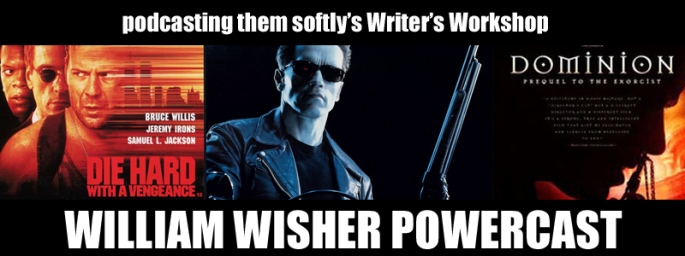
PTS PRESENTS WRITERS WORKSHOP with WILLIAM WISHER

WISHER POWERCAST

Wisher BrosnanPodcasting Them Softly is beyond excited to present a chat with screenwriter and producer William Wisher, who co-wrote The Terminator and Terminator 2: Judgment Day with James Cameron. William also collaborated with director John McTiernan on The 13th Warrior, he wrote the screenplay to Judge Dredd, and collaborated with Paul Schrader on Dominion: Prequel to the Exorcist. He’s also a contributor to the Die Hard franchise as screenwriter and producer, while also making some extremely memorable film appearances. He’s got a new film with Pierce Brosnan coming out later this year called I.T. and he’s working on a new action film with director John Moore called Come Hell or High Water, which based on the title alone, suggests something epic! He’s also a well known script doctor, which is an intriguing area of the business that both Frank and I are fascinated with. This is a fun, extremely informative chat with lots of interesting bits and pieces about the business and some of the biggest franchises ever to hit the screen. We hope you enjoy!
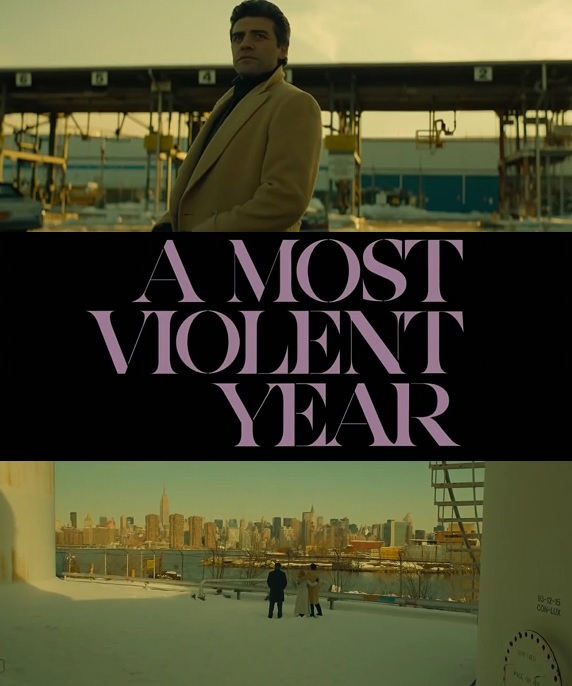
J.C. CHANDOR’S A MOST VIOLENT YEAR — A REVIEW BY NICK CLEMENT

a most violent year


How does a (mostly) honest man working in a thoroughly corrupt industry stay on the right side of the tracks? What’s wrong with cutting corners and being shady if all of your competitors are taking extra, morally questionable steps to ensure their success? What drives people to do the things they do? These are only some of the questions that the thematically rich film A Most Violent Year covers in an intimate, very 70’s way. Writer/director J.C. Chandor (Margin Call, All is Lost) summons the ghost of Sidney Lumet with this down and dirty, early 80’s NYC fable consisting of businessmen, politicians, cops, wives, children, and the constantly shifting dynamics between men of power and those who are needed to allow that power to continue and thrive.

Every character in this slow-burn drama (with a tad of melodrama thrown in at the end) is out to get their own; everyone has an agenda and enormous reasons for wanting the things they want. When one character asks another in this beautifully written story about ethics and morals: “Why do you want this?” the question takes on multiple meanings. And when the character answers with simply: “I don’t understand your question” you know that this is a film that isn’t interested in black and white notions of good and bad, but rather, the gray areas that separate us from doing right and wrong.

A Most Violent Year carries a metaphorical title that extends more to the atmosphere of NYC in the early 80’s then it does to constant violent action, which is something that this talky, low-key, and wonderfully observed movie is most definitely not interested in. Yes, you get some fantastic foot chases and one sensational, hair-raising car chase that echoes the POV hell-ride in James Gray’s The Yards (another Lumet homage), but A Most Violent Year is all about the distinct performances and the pungent writing and the burnished, dark, early morning and late night cinematography from shooter-of-the-moment Bradford Young. His work here is elegant and smoky, all browns and blacks and golds with splashes of orange and red for accent. I loved looking at every image in this movie.

Oscar Isaac was sensational as Abel Morales, a man trying to run a home heating-oil company with his wife Anna (a juicy, sexy Jessica Chastain, playing the ultimate snake-in-the-grass), and always attempting to run an honest business without cutting too many corners. Interesting in that he’s always being “mostly good,” Abel knows he could call his wife’s gangster father for support in any number of ways (someone is jacking his oil tankers and beating up his salesmen and drivers; people are waiting for him outside his new mansion in the late hours of the night with pistols, etc.) but he doesn’t want to do that. And despite probably knowing that his wife is more than meets the eye in any number of respects, he keeps his head up, doesn’t ask too many questions, and lets the assorted pieces to his complicated business puzzle take shape. By the end of this tense and gripping drama, if you loved it as much as I did, you’ll want to know more about what happens to the various characters as the screen fades to black – I know I did.

BATMAN V SUPERMAN: DAWN OF JUSTICE: A Review by Joel Copling

Rating in Stars: ***½ (out of ****)
Cast: Ben Affleck, Henry Cavill, Amy Adams, Jesse Eisenberg, Jeremy Irons
Director: Zack Snyder
MPAA Rating: PG-13 (for intense sequences of violence and action throughout, and some sensuality)
Running Time: 2:33
Release Date: 03/25/16

Batman V Superman: Dawn of Justice finds two super-egos doing battle and a megalomaniac who wants to control the situation for his own perceived glory. It’s as simple as that, really, except that that’s also far from simplistic. This film, as written by Chris Terrio and David S. Goyer, is an act of reconstructive revisionism of every concept we have of the characters in the surtitle. By the end, we also have our perception challenged with regards to the assembly of the league hinted at in the subtitle. This is not a movie that panders to its target audience (many of which may be unsatisfied by some of its risks and downright nuttiness), nor does it seem tailor-made, despite the obvious fact that it is, to lead to further sequels.

This Bruce Wayne is a haunted orphan whose parents’ deaths have taught him a surprising lesson about the ways of the world, and this Batman is a vigilante driven by rage. Ben Affleck’s performance as the man outside of the suit is a genuinely good one because of a focus that is borderline-cruel in nature, and his relationship with Alfred (Jeremy Irons) is uneasy at best. Inside the suit (which is bulkier and more metallic here, with a voice modulator), the actor is mostly asked to call upon his physicality, but it’s a trick that works. The title fight is a brutish and brutal one because, to put it informally, the guy is just freaking huge.

This Kal-El is an angry god. He trudges on in both of his alternate identities–that of Clark Kent, intrepid reporter alongside his girlfriend Lois Lane (Amy Adams, who unfortunately exists to be the damsel in distress here) for the Daily Planet, and Superman, the man in the blue suit and red cape who is seen here from one angle as a savior (Cinematographer Larry Fong consistently frames his entrances as that of a Jesus Christ figure), from another as a threat (A senator played by Holly Hunter calls hearings that are meant to put him on trial both legally and in a public forum), and from an indecisive third as something in between (A certain astrophysicist expands his idea of humanity’s smallness to reckon the existence of life elsewhere)–and Cavill’s stoic performance is still quite good here. The carnage that ended Man of Steel and another sequence here set in Africa that ends in more lost lives are the catalysts, and that is where our story starts.

The film re-frames the attack on Metropolis to be viewed from the ground as Bruce drives frantically through the streets to evacuate one of his company’s campuses. Death and terror–the film’s own reckoning of a 9/11-type attack–rain down around him as Kal-El and Zod (Michael Shannon) face each other. Fast-forward 18 months, and we find the Batman’s rein of vengeful justice catching the eye of both Kal-El, who questions the Batman’s motivation and methods, and Lex Luthor (Jesse Eisenberg in a strange performance–fittingly so), who has cottoned on pretty quickly to the real identity of both figures and wants to cause a rift. He also wants to unleash a kind of doomsday upon them, because, well, he’s insane.

The final confrontation between the Batman, Superman, and the mucous monster that Lex hath wrought (interrupted by a neat appearance from Gal Gadot as Wonder Woman) perhaps plays with the generic in a way that what proceeds it does not (The flashes of images of three other heroes certainly does, with their odd placement), but for a while, the climax keeps with the complex existential and philosophical battle going on here. Yes, the action sequences are well-conceived and executed (though the 3-D presentation doesn’t help what largely takes place in the dark) by director Zack Snyder, but they and, for that matter, the central question of who would win this fight are a secondary, even tertiary, concern. Instead, Batman V Superman: Dawn of Justice continues its immediate predecessor’s plan to pave a new path for these particular heroes in a way that feels starkly different to another group currently dominating the box office, and it’s a very intriguing step, indeed.

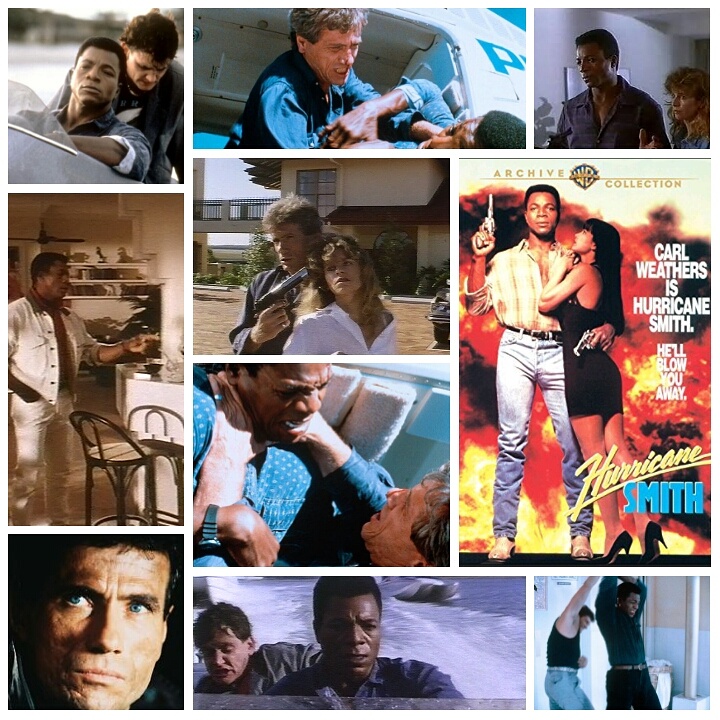
B Movie Glory with Nate: Hurricane Smith

image

Buckle up and watch built badass Carl Weathers head down under to take on vicious Australian criminals in Hurricane Smith, a blast of saxophone laced, trashy 80’s cheese that hits every beloved cliche in perfect chiming key. Weathers is an valued staple to the action genre, a memorable part of Predator and of course his thundering turn as Apollo Creed in the Rocky films. Along with his obvious commanding physicality, he has a likeability that lends itself nicely when it comes to playing heroes out for retribution. His character got the nickname Hurricane after he pulled a friend out of a falling building during the titular meterological event, cementing him as a tough guy worthy of carrying a ninety minute action flick on his shoulders. Hurricane is off to Australia, in search of his sister who has recently gone missing. He stumbles right into the midst of a hornet’s nest of a criminal organization, led by Charlie O Dowd (Jurgen Prochnow), a stunningly evil pimp and drug runner. Prochnow loves to paint his villains in broad, garish strokes and he downright outdoes himself here, careening through a performance of wanton carnage and positively dripping malice. Hurricane is a massive thorn in his side, dismantling his operation in every attempt to learn what happened to his sister. He gets romantically involved with a kindly hooker (Cassandra Delany) leading to the obligatory 80’s slow dance sex scene that everyone waits for in these type of flicks. There’s bullets, car chases, an action scene on a helicopter and all kinds of trademark B movie lunacy. Weathers makes a damn good hero. Prochnow is one hell of a wicked villain. Fun stuff.

The Big Empty: A Review by Nate Hill


The Big Empty is a quirky, off kilter little flick that packs a backpack full of borrowed elements from the Coen brothers and David Lynch, before embarking on a perplexing outing into the Twilight Zone. That’s not to say it rips any of these artists off, and indeed it’s got a style and cadence all its own. It just loves other oddballs before it and wants to wear it’s influences proudly. Everyone’s favourite lovable schlub Jon Favreau plays John Person, a flailing, out of work actor. He’s presented with a dodgy proposition by his whacko neighbour Neely (eternally bug eyed Bud Cort). Transport a mysterious blue briefcase to a remote town in the Mojave Desert called Baker. There he will meet a much talked about, little seen individual called The Cowboy (Sean Bean), who will take the case off his hands. He agrees, as he must in order for us to have a film to watch, and heads out to the back end of nowhere. In any respectable piece like this, the town our hero visits must be populated by weirdos, eccentrics, dead ends, missed encounters and an abiding, ever present atmosphere of anomalous peculiarity. Right on time, he meets a host of charming characters, including Grace (Joey Lauren Adams), her sensual daughter Ruthie (Rachel Leigh Cook), Indian Bob (Gary Farmer), grouchy FBI Agent Banks (Kelsey Grammar), and a bunch of others including Daryl Hannah, Melora Walters, Jon Gries, Brent Briscoe, Adam Beach and Danny Trejo. He’s led from one head scratching interaction to the other, each step of the way proving to be a step behind the elusive Cowboy, with no form of coherence appearing to ease poor John’s bafflement. I was reminded of Jim Jarmusch, particularly his masterpiece Dead Man, perhaps because Gary Farmer appears in both, but most likely mainly due to the fact that both films follow a hapless Joe on a journey that doesn’t seem to be going much of anyplace, but holds interest simply by being bizarre enough. Favreau is the only one that doesn’t fit, the outsider whose laid back suburban affability creates friction with almost every individual he meets, all who seem to have wandered in from the outer limits of some other dimension. Sean Bean is relaxed, mercurial with just a dash of danger as The Cowboy, quite possibly the strangest person John meets. The film has unexpected jabs of humour too, which occasionally breach the surface of its tongue in cheek veneer of inaccessibility. Upon meeting Indian Bob, John inquires: “Are you Bob The Indian?”. Bob jovially retorts “No, I’m Lawrence the fuckin Arabian.” Gary Farmer brings the same cloudy, sardonic cheek he brought to the role of Nobody the Indian in Jarmusch’s Dead Man, which had much the same type humour as this one: little moments of hilarity buried like treasures amongst the abnormal. Sometimes I muse that films like these which seem to really go nowhere in high style are there simply to give your brain a workout in odd areas that it wouldn’t normally play in. Set up a voyage like this, lead the audience down a yellow brick road and arrive at.. well basically nowhere in particular, just to chuckle at your efforts to figure it all out, jab you in the ribs and say “Don’t take this shit too seriously, man!”. Or maybe not. Maybe there’s deeper meaning behind the meandering, that will reveal some holy significance. This one, though, I doubt it. It’s pure playtime.

KEVIN REYNOLDS’ THE COUNT OF MONTE CRISTO — A REVIEW BY NICK CLEMENT

count_of_monte_cristo

Truly exciting modern swashbucklers are hard to come by. The first Antonio Banderas Zorro was great fun, and I’m a big, big fan of the Gore Verbinski Pirates of the Caribbean movies, as he’s a premiere visual talent who makes some of the most unorthodox and unique blockbusters. But one film that snuck in under the radar was 2002’s The Count of Monte Cristo, from Waterworld and Robin Hood: Prince of Thieves helmer Kevin Reynolds. Featuring two rock-solid performances from then up-and-coming stars Jim Caviezel and Guy Pearce, the film was bolstered considerably by fabulous production values; Andrew Dunn’s exceptional cinematography and the sumptuous set decoration and overall design by Mark Geraghty really evoked time and place with a great sense of style that was never over the top. Crisply adapted from the classic Alexandre Dumas novel by Jay Wolpert, who also worked on the first Pirates film, the plot was streamlined with the action elements beefed up, but the film never felt cheapened or dumbed-down for contemporary audiences, with both Caviezel and Pearce offering up impassioned performances that fit their respective molds just right. On a $25 million budget, the film became a theatrical success with a box office gross of $75 million worldwide, but this is certainly one of those films that has had a long shelf life on cable and disc. You can’t go wrong with a supporting cast that includes Richard Harris, Luis Guzman, Michael Wincott, James Frain, and Henry Cavill, and the sweeping musical score from Edward Shearmur immediately set an appropriately high-stakes tone with rousing emotional beats. This film didn’t try and pretend to be anything other than what it was — a spirited romp through classic material told with directorial panache and an unpretentious sense of classical Hollywood hat-tipping.

THE ABYSS – A REVIEW BY J.D. LAFRANCE

abyss07

The more times I see The Abyss (1989), the more I am convinced that it is James Cameron’s best film to date. Wedged between megahits, Aliens (1988), and Terminator 2: Judgment Day (1991), The Abyss was unfortunately lost in the shuffle. This may also have been due to the flood of leaky underwater films like Leviathan (1989) and Deep Star Six (1989) that were released around the same time. Even though The Abyss came out after these financial and critical failures, it was dismissed by most critics as yet another underwater disaster. Most reviewers were clearly tired of this string of underwater themed films and assumed that Cameron’s motion picture was no better than the rest. However, this is simply not the case with The Abyss, which, like many of Cameron’s films, is filled with stunning visuals, a strong ensemble cast, and a solid story that is never sacrificed at the expense of the movie’s special effects.

As the film opens, a United States nuclear submarine is accidentally sunk by a mysterious, unidentified source under 2,000 feet of water off the coast of Cuba. Nearby, a corporate owned underwater oil-drilling rig commandeered by Virgil “Bud” Brigman (Ed Harris) is subsequently ordered to aid a group of Navy SEALs, led by the no-nonsense Lt. Coffey (Michael Biehn), to salvage the downed sub and search for survivors, if any. To make the situation even more interesting is the surprise arrival of Bud’s soon-to-be ex-wife, Liz (Mary Elizabeth Mastrantonio), who designed the rig and rejoins the crew to ensure that everything goes smoothly. As the mission progresses, a storm rages topside causing many problems for the rig and its crew. Add to this the growing tensions of nearby U.S. and Russian naval fleets and you have a potentially volatile situation. But this is only the beginning of a string of dilemmas that beset Bud and his cohorts who gradually realize that there is something else down there with them, and it may not be human.

The Abyss
was a project that James Cameron had dreamed of making ever since he was 17 years old. He wrote a “very, very crude and simple story dealing with the idea of being in the very deep ocean and doing fluid breathing and making a descent to the bottom from a staging submersible laboratory that was on the edge.” His original short story concerned the adventures of a group of scientists in a laboratory at the bottom of the ocean, “which is the sort of sci-fi idea that appeals to all kids, I suppose,” he said. Over the years, Cameron became involved in numerous other projects but he never forgot about this underwater adventure and wrote several drafts that changed radically over time but the original idea that started it all remained intact. When Terminator (1984) and Aliens became bonafide box office hits, Cameron was in a position to make his dream project a reality. He had no idea the problems that he would face trying to realize this dream.

The bulk of The Abyss was shot in and around Gaffney, South Carolina. At first, this seems like a rather unlikely place to shoot an underwater epic, but it turned out to be the best place after their decision to shoot on-location became unrealistic. Cameron had originally planned to try filming in the Bahamas where the story is set, but soon realized that he had to have a totally controlled environment because of the stunts and special FX involved. To this end, Cameron found the Cherokee Nuclear Power Station, an abandoned site that proved to be ideal for what they needed. The film crew ended up shooting all of the underwater sequences (this comprised 40% of all live action principal photography) in two specially constructed concrete containment tanks: one holding 7.5 million gallons of water, and the other holding 2.5 million gallons.

As if this wasn’t enough of a challenge, the actual shoot consisted of a grueling six month, six-day, 70-hour a week schedule that took its toll on cast and crew alike. “I knew this was going to be a hard shoot, but even I had no idea just how hard. I don’t ever want to go through this again,” Cameron remarked at the time. And yet, the sense that what they were making was groundbreaking and worth doing was the glue that kept everything together. The film’s producer, Gale Anne Hurd clearly viewed The Abyss in this fashion. “No one has attempted this before, and we had to solve everything from how to keep the water clear enough to shoot, to how to keep it dark enough to look realistic at 2,000 feet where it’s pitch black.” By all accounts, the cast and crew thrived on this challenge, and as the final results demonstrate, succeeded in producing a truly stunning work.

Cameron’s production company had to design and build experimental equipment and develop a state-of-the-art communications system that allowed the director to talk underwater to the actors and dialogue to be recorded directly onto tape for the first time. For all of the underwater scenes they used three cameras in watertight housings specially designed by underwater cinematographer expert Al Giddings, known for his incredible work on The Deep (1977). Another special housing was designed for scenes that went from above-water dialogue to below-water dialogue. Underwater visibility was a major concern for Cameron as he wanted to see the actors’ faces and hear their dialogue. Western Space and Marine built ten experimental diving units for the film. They engineered helmets which would remain optically clear underwater and installed innovative aircraft quality microphones in each helmet.

In addition, Cameron was also breaking new ground in the area of special visual effects, which were divided up among seven FX divisions with motion control work by Dream Quest Images and computer graphics and opticals by Industrial Light & Magic. ILM was brought on board to create the amazing water pseudopod and spent six months to create 75 seconds of computer graphics needed for the creature. However, this work caused the film’s release to be delayed from July 4, 1989 to August of the same year.

The production difficulties that plagued The Abyss have become the stuff of Hollywood legend. There were reports from South Carolina that Ed Harris was so upset by the physical demands of the film and Cameron’s dictatorial style that he said he would refuse to help promote the picture. The actor later denied it and did press for the film. He did admit that the daily mental and physical strain was very intense. He recalled, “One day we were all in our dressing rooms and people began throwing couches out the windows and smashing the walls. We just had to get our frustrations out.” The actors were not happy about the slow pace of filming. Mary Elizabeth Mastrantonio remembered, “We never started and finished any one scene in any one day.” Michael Biehn was frustrated by the waiting. He claims that he was in South Carolina for five months and only acted for the three to four weeks. Cameron responded to these complaints by saying, “For every hour they spent trying to figure out what magazine to read, we spent an hour at the bottom of the tank breathing compressed air.”

Like all of Cameron’s other films the action plays a secondary role to the central love story — whether it was between Kyle Reese and Sarah Connor in Terminator or Ripley and Newt in Aliens. In The Abyss we are presented with a disintegrating relationship between Bud and Liz. And yet, as the film progresses and we spend more time with these two people, we begin to realize that they still love each other and that this is what adds a real element of humanity to the special effects-laden film. But The Abyss is much more than that. It mixes elements of an exciting thriller, action film, and science fiction story together in one great package. The way the film is structured, we are presented with several small movies that, when linked together, comprise a larger whole. It is this wonderful structure that makes one realize that there is more going on than a search for a missing submarine.

As Cameron demonstrated with Terminator, he has a real eye for action sequences and The Abyss is no different. One scene, in particular, demonstrates Cameron’s ability to create moments of white knuckle intensity. Several compartments of the underwater rig begin flooding, while crew members try frantically to escape to a safer area. Cameron’s hand-held camera follows these men through the claustrophobic hold at such a breakneck pace, via a compelling first person point-of-view angle, that one can’t help but get caught up in the feeling of urgency brought on by this dangerous situation. At times, it feels like you are actually bouncing through the tight corridors of the rig alongside the characters and this enhances the thrill and excitement of such adrenaline-fueled sequences.

The Abyss
is also similar to Cameron’s previous film, Aliens in the sense that both have a top rate ensemble cast. The crew of the rig all have their own distinctive personalities, which are each given their own moment to shine and never detract from the larger story. The interaction between these people has a ring of honesty and authenticity, which suggests that every character is important and crucial to the film’s outcome. But these colorful characters never obscure the three main principles that are also fully-fleshed characters each with his or her own agenda. Ed Harris portrays Bud as a man dedicated to his rig and his people, but he cannot balance his work life with his personal life. Mary Elizabeth Mastrantonio’s Liz is, as she later admits, “a cast-iron bitch,” but underneath the hard, tough exterior there are occasional glimpses of a sensitive dreamer fighting to get out. Cameron regular, Michael Biehn (an underused actor also seen in Terminator and Aliens, respectively) personifies intensity as the leader of the Navy SEALs who slowly loses his grip on reality and his priorities, posing a threat to the safety of everyone on the rig. Each of these characters has their own inner conflicts as well as the larger conflict that threatens everyone. One of the pleasures of watching The Abyss is seeing how these personal conflicts play out and resolve themselves by the end of the film.

The Abyss
deviates from Cameron’s other features in the sense that it stresses the idea of settling disputes through non-violent means. Violence in the film is not the solution to the problem, but the source. This idea is illustrated through Lt. Coffey, the main instigator of violence in the film. His violent acts create the many problems that the protagonists face and this ultimately results in his demise. On the other hand, Liz personifies the peaceful alternative. Where the selfish Coffey sees anger and hatred, Liz is willing to sacrifice herself for others. She is the calming effect on everyone and her presence on the rig is pivotal in resolving many of the story’s conflicts. It’s a refreshing view that you don’t often see in films nowadays where everything is solved at the end of a gun. Unfortunately, this viewpoint seemed to have disappeared from Cameron’s subsequent work, which regressed to the usual violent antics. Whether it was because of the film’s failure to connect and succeed on a mass level or the departure of long time partner, Gale Anne Hurd, is unknown, but with a film like True Lies (1994), Cameron abandoned a strong, independently minded female character for one that is objectified by the camera and on the receiving end of a lot of misogynistic behavior. It’s too bad because The Abyss contains none of this and instead points the way for a new kind of action-oriented film that stresses problem solving over violence, while still providing the requisite amount of thrills. This is a much-needed antidote to the mindless violence and anger that is problematic in so many films today.

The Abyss
is a truly special film that never lags in pace or interest thanks to the many stunning visuals courtesy of breathtaking computer animation from Industrial Lights and Magic (effects that were the precursor to ones used in Terminator 2). There are also fascinating characters and exciting, often intense situations that keeps the viewer involved in the story. The Abyss is one of those rare films that you wish wouldn’t end because the world and the characters that inhabit it are so compelling and exciting. This film demonstrates, yet again, that James Cameron is one the few directors who can make good science fiction films, with a strong story, a solid cast, and exceptional images that help elevate it above the usual Hollywood dreck and straight-to-video sci-fi clunkers. And that is truly something special at a time of militaristic, flag-waving propaganda like Independence Day (1996), which purports to be entertainment, but is just another mindless special effects workout.

MAN OF STEEL: A Retrospective by Joel Copling

Rating in Stars: ***½ (out of ****)
Cast: Henry Cavill, Amy Adams, Michael Shannon, Diane Lane, Russell Crowe
Director: Zack Snyder
MPAA Rating: PG-13 (for intense sequences of sci-fi violence, action and destruction, and for some language)
Running Time: 2:23
Release Date: 06/14/13

Immediately, Man of Steel vaults over the necessity to make this the usual superhero origin story, and in the process, it stands out immediately. The character of Superman is only as interesting as he is when his alter ego Clark Kent exists to introduce the dynamic of one becoming the other and vice versa. With this film, though, screenwriter David S. Goyer dismisses this until the final scene positions that dichotomy to be featured in a sequel and instead centers his focus upon, not Superman, but Kal-El, the Kryptonian citizen whose birth was closely followed by the murder of both parents by a man who was bred with a militant mind.

We know the beats of that story, of course, but Goyer approaches it with as much theatricality as it deserves. Jor-El (Russell Crowe) and his wife Lara (Ayelet Zurer) have given birth (the first natural one in centuries, apparently) to a son they hope will inspire good. The move is one that follows a distinct feeling on Jor-El’s part that Krypton is going to Hell in a handbasket, a feeling exacerbated when Zod (Michael Shannon in a performance that is over-the-top because the sensation is necessitated), a general, attempts to overtake the council that might save the planet. Jor-El and Lara respond by sending their son to Earth, whose younger, brighter star will help to hone his powers among a more youthful generation.

We do get a glimpse of the younger Kal-El’s (Dylan Sprayberry and Cooper Timberline play him at the ages of nine and 13) life on Earth among the Kents (Kevin Costner and Diane Lane), the family who takes him in and christens him Clark while grasping only guesses as to where he came from. He saves a school bus full of children using his super-human strength, and Dad warns him about revealing his other-worldliness, even at the sake of so many young and innocent lives. He, Dad says, is the answer to the questions of man’s solitude in the universe, and such questions are bigger than, really, any other, even that of complicity in allowing the bus to submerge.

It’s an act of planting stakes in Kal-El’s identity, so as an older figure, now played by Henry Cavill in a performance of great earnestness and as little outward personality as possible (and, subsequently, as much as is necessary), he takes up a job that will highlight his desire for anonymity: a worker on a fisherman’s wharf. He also saves a burning oil rig from killing most of those onboard before fleeing. Suddenly, a bigger threat awaits him: Zod and his lieutenants have escaped prison and arrived at the place they knew Kal-El to be, demanding that the inhabitants deliver him or suffer the consequence of annihilation.

The finale pits Kal-El, who has now been labeled “Superman” by the general public with the help of fearless reporter Lois Lane (Amy Adams), against Zod, who wants to preserve Krypton’s population through twisted and destructive methods (which afford the villain a motivation that is as cruel as it is easy to sympathize with) that include a massive engine that will align Earth’s atmosphere with that of Krypton, along the streets and into the buildings of Metropolis. The ensuing action goes on a bit, but it’s is as blustery and epic as director Zack Snyder (no stranger to either adjective when it comes to his movies) and cinematographer Amir Mokri can possibly make it. It’s also something of a secondary concern for Man of Steel, which is focused on uprooting our understanding of the title hero and laying down a different, more mythic foundation than we have known.

THE DARK KNIGHT RISES: A Retrospective by Joel Copling

Rating in Stars: ***½ (out of ****)
Cast: Christian Bale, Anne Hathaway, Tom Hardy, Joseph Gordon-Levitt, Gary Oldman
Director: Christopher Nolan
MPAA Rating: PG-13 (for intense sequences of violence and action, some sensuality and language)
Running Time: 2:44
Release Date: 07/20/12

Settling somewhere in between the modesty of 2005’s Batman Begins and the grandiosity of 2008’s The Dark Knight in terms of quality (and only, it must said, quality, as the film is bigger and longer than both of its predecessors), The Dark Knight Rises is a beast of a movie–blustering and flawed but thrilling in its best moments. It is also a terrific act of returning the series to its roots conceptually, pitting the titular hero against a reincarnation of his foe from the first film and examining, like the first sequel, the consequences of Bruce Wayne’s shift from millionaire playboy to brooding (literally, in this film’s case) wearer of a cape and cowl that project his worst fear upon his enemies. The comfort of a formula that must bring him both to the only end that makes sense and, in a way, back to his own start means that this film is more ambitious but, perhaps, less impactful than its predecessor.

It’s been eight years since Gotham’s most prominent politician was, according to official reports, murdered by the Batman after a madman forever altered public perception of both men. Bruce (Christian Bale, conveying a sense of great sadness in what probably stands as the actor’s best work in the series), still stinging from the loss of the woman he loved to that madman’s evil machinations, is now once again a recluse–this time in the lavish Wayne Manor, from which rumors spread about why the man has locked himself away and outside of which, every year, the city’s finest (and its politicians) meet to celebrate the old district attorney’s life. Retirement from heroism does not suit Bruce, whose limp from an old knee injury has gotten worse and whose standing with Gotham’s elite has fallen since disappearing from public life.

Bruce has been avoiding a partnership with Miranda Tate (Marion Cotillard), a member of the city’s elite, on an energy project because of the potential for the fusion reactor to be turned into a weapon. His influence has caused petty criminals such Selina Kyle (Anne Hathaway), who wears cat ears as just one of her disguises while taking from the rich to give to the poor, to invoke a kind of anti-capitalist bent that makes it easier when our new villain raises his hand to place a foothold both in thinking the rich elite are corrupt and in arming the citizens of Gotham against the whole system. It’s the least subtle element of a screenplay (written by director Christopher Nolan and his brother Jonathan) that also relegates the above characters to being red herrings until one of them must be good and the other bad.

The Batman’s legacy has turned from one of reverence to one of hatred. Commissioner James Gordon (Gary Oldman) knows the truth about what happened to give the Batman such a reputation, but the guilt attached to it has fractured his own family in half. Even Bruce’s faithful servant Alfred (Michael Caine, who is excellent here) says enough is enough, knowing where the conversation will head, when the Batman is forced back into action, collaborating with Gordon behind the backs of a police force who want to see him incarcerated (with the exception of a beat cop played by Joseph Gordon-Levitt who figures out the truth through inference and implication) and being supplied with gadgets and a flying, bat-shaped vehicle by Lucius Fox (Morgan Freeman).

This is a Gotham still rebuilding itself from a madman’s influence, and then another one appears. He is Bane (Tom Hardy), a cross between a pro wrestler in brutish features (His and the Batman’s throwdown fights are staged by Nolan in a way that lessens Hans Zimmer’s throbbing score and times Lee Smith’s editing to the punches and headbutts) and English royalty in lilting cadence (Hardy is commanding as he spouts of dialogue that might have come from Shakespeare), who shares an employment history with Bruce and a desire to rise from the shadows and continue his forebear’s work. He swiftly and brutally sweeps in, takes over Gotham with about as clear-cut and effective an order as probable to outside forces not to intervene, and sets up a dictatorial regime under the guise of a freeloading society with no rules. If the previous film’s villain was engaged in a battle for Gotham’s soul, this is a battle for the morsels that were left.

In addition to the bold, blunt lines used to draw the characters, the film suffers from pacing problems (The film rushes through a three-month period by way of montage, followed by a jump nearly an entire month more at the expense of the internal tension of a countdown clock) and contrivances (Bruce and Miranda enjoy a one-night stand just so a late-film revelation can have a flimsy, extra layer of stakes applied to it). But in the bigger picture of a movie that has the gall to approach perhaps a permanent end to the Batman legend, these are small quibbles. The Dark Knight Rises, which also features a denouement that could not have been played more perfectly, is also stirring, potent stuff.