B Movie Glory with Nate: Guns, Girls And Gambling

image

Guns, Girls And Gambling is an absolute doozy of a film. The term ‘so bad it’s good’ was invented for slapdash mockeries such as this, and with every stylistic cliche and ridiculous tactic, it owns the moniker vigorously. The filmmakers are obvious disciples of the neo noir crime thriller, as we see countless hard boiled walking stereotypes prance across the screen. Whenever a character shows up, a garish font announces them in writing below, which is crime genre 101. This happens so many goddamn times though, that eventually I felt like I was watching Mel Brooks’s attempt at a heist flick. It’s silly beyond words, derivitive enough to give you the onset of dementia and admirably dumb. But… I still had fun, at least in parts of it. It concerns the theft of a priceless Native American artifact from a tribal casino. The perpetrators? A gang of Elvis impersonators with, let’s say, interesting characteristics. There’s gay Elvis (Chris Kattan), midget Elvis (Tony Cox), Asian Elvis (Anthony Wong) and Gary Oldman Elvis, played by Gary Oldman who looks like he was dared into taking the role at a frat party. The bumbling Elvises break ranks post heist and the plot thickens, or should I say befuddles, with the arrival of every kooky, sassy assassin and archetype under the sun. Now from what I could make out: Christian Slater plays a dude called John Smith, a ‘wrong place at the wrong time’ type of guy who is swept up into the intrigue and is in way over head. He’s pursued by all kinds of unsavory people, and joined by the girl next door (Heather Roop). There’s The Cowboy (a salty Jeff Fahey), a gunslinging hitman who claims to never miss but literally misses upon firing the first bullet. The Indian (Matthew Willig) is a hulking tomahawk sporting badass. The Chief (Gordon Tootoosis) is the casino owner, muscling in on everyone to get back his artifact. The Sheriff (Dane Cook) is a corrupt lawman out for anything worth a buck. Best of the bunch is a snarling Powers Boothe as The Rancher, a good ol’ southern gangster who languishes in a white limo longer than the cast list of this movie, chewing scenery as vigorously as his cigar. There’s also a sexy blonde assassin called The Blonde (Helena Mattson) who wanders around quoting Poe right before she blasts people’s heads off. Its inane, mind numbing eye candy, with a cast that seems to have been blackmailed into participation. There’s even a last minute twist ending that seems to have wandered in from a much more serious film. It’s quite literally one of the most stupefyingly odd flicks I’ve ever seen. It’s earnestness in aping countless Pulp Fiction style films before it is beyond amusing, and the only thing that will make you laugh harder is how spectacularly and epically it flounders. It’s truly B movie gold, and one that demands a watch simply because it’s a sideshow unto itself.

Ca$h: A Review by Nate Hill

image

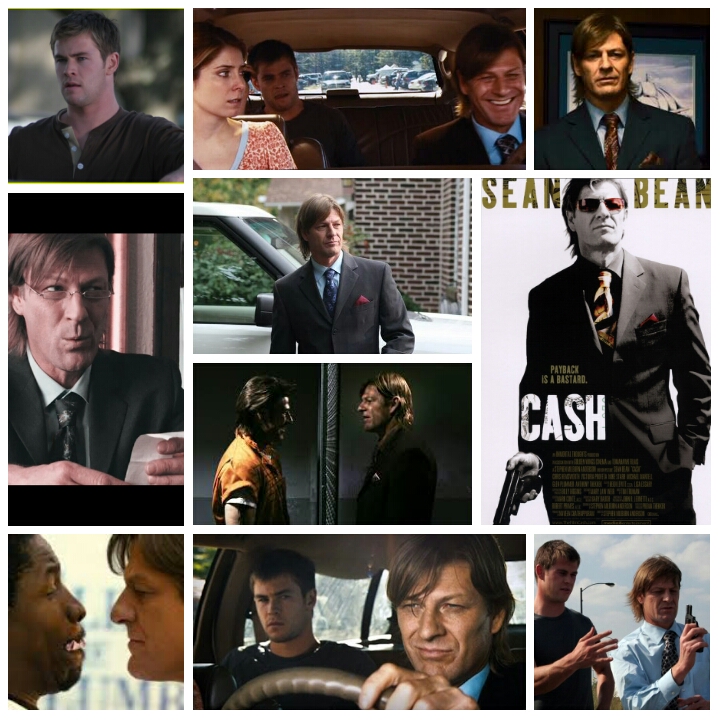
Ca$h has an obnoxiously tongue in cheek title, and a premise that could have easily run off the rails into the silly zone. But rejoice: It knows how to create a tense, unpredictable environment accented by the slightest bits of naturally occurring humour here and there, a winning combination indeed. Sean Bean doesn’t often get a movie to himself, or at least get to play the lead. Here’s he’s the top dog, and while most would argue that he’s the antagonist as well, I’m in the opposite corner on that one. Yes he’s a criminal, yes he goes to extreme lengths to get his money back, but he’s a rigidly disciplined and staunchly fair bloke, driven by a set of principles and operational tics that reek of Obsessive Compulsive Disorder, and trust me, it takes one to know one. Oh, and he gets to play identical twins as well, pulling a Parent Trap and acting opposite himself which is a delight to see. When reckless career criminal Reese Kubrick (Bean) dicks up a robbery, loses a bunch of money and gets apprehended, a young couple think they have hit the jackpot. Played by Chris Hemsworth and Victoria Profeta, they find the money and make that fateful cinematic mistake of trying to keep it for themselves. Before they know it, Reese’s brother Pyke (also Bean) comes looking for them, and believe me when I say that this guy is a dude who finds what he’s looking for. Fast. The young couple has already begun to indulge, and as Pyke barges into their lives he finds a great deal of the amount spent. He then buckles down and calmly,  coolly forces them to come up with every remaining cent of the ‘deficit’, as he calls it, even if it means doing a bit of illegal stuff themselves. Bean has a ball as the icy cool, ruthlessly efficiant prick who plays hardball with a glint in his eye. He’s karma manifest, a very real and very dangerous metaphor for the perilous risk of excessive currency and ill gotten gains. It’s a terrific role for him, both in the moments of dangerous serenity and the few rare instances where he loses his cool streak, which sting like daggers. Hemsworth and Profeta play their standard roles very nicely. An arbitrary bit of fun: the actor Glenn Plummer shows up for a hysterical cameo as a dude named, I shit you not, Glenn The Plumber, who receives a whollop of a verbal beatdown from Bean that serves as the film’s most lighthearted moment, and is a riot for anyone who gets the reference. Snuck into limited DVD release back in  2010, this one deserves more than the small shelf space it’s gotten. Fun stuff.

LEGEND – A REVIEW BY J.D. LAFRANCE

legend_8_tim-curry_darkness3

“The time is ripe for a John Ford of science fiction films to emerge. And I’m determined to be that director.” Ridley Scott told this to author Harlan Ellison when he asked him to write the screenplay for Dune (1984). Although, Scott’s version never happened, for years it looked like he was going to fulfill that bold statement with the incredible one-two punch of Alien (1979) and Blade Runner (1982). The 1980s was a fertile period for fantasy films with the likes of memorable efforts such as Dragonslayer (1981), Conan the Barbarian (1982), and Ladyhawke (1985) and not so memorable ones likes The Beastmaster (1982) and Krull (1983). The best of the bunch was Ridley Scott’s Legend (1985). With this film, he wanted to do for the fantasy genre what he did for science fiction with Blade Runner – create a visually stunning film rich in detail. He cast two young, and up-and-coming stars, Tom Cruise and Mia Sara, recruited acclaimed author William Hjortsberg to write the screenplay, have make-up genius Rob Bottin bring the various fantastical creatures to life, and get legendary composer Jerry Goldsmith to compose the score.

Sounds like the ingredients for a masterpiece, right? Partway through principal photography, the elaborate forest set created on a soundstage burned down. The studio, eager to appeal to Cruise’s youthful fanbase, replaced Goldsmith’s score with one by Tangerine Dream because they had scored Risky Business (1983), the breakout film for the young actor. To add insult to injury, the studio and Scott cut over 20 minutes of footage for North American audiences. After all the dust had settled, Legend was a commercial and critical failure, relegated to cult film obscurity. It’s too bad because even the mangled U.S. version has a lot going for it, namely Bottin’s groundbreaking prosthetic make-up and Tim Curry’s mesmerizing performance as the Lord of Darkness. In 2002, Ridley Scott revisited Legend for a souped-up Ultimate Edition DVD that allowed the director to assemble a version of the film approximating his original intentions.

The opening credits play over shots of a dense forest at night. In typical Scott fashion, we are fully immersed in the sights and sounds of this place. We see a goblin by the name of Blix (Alice Playten) walking through the forest until he comes across a foreboding marsh dominated by an imposing structure that resembles a massive tree. It is known as the Great Tree – “when evil anarchy ruled the land, the wicked came here to sacrifice,” a character says at one point.

The first words that are spoken in the film are, “I am the Lord of Darkness. I require the solace of the shadows and the dark of the night,” They come out of Tim Curry’s booming, theatrical voice, one that is absolutely dripping with menace. Not surprisingly, his enemy is the light of day, but he seeks to find a way to make it night forever. Since he is confined to the shadows, Darkness (Tim Curry) entrusts his “most loathsome of goblins,” Blix, whose heart is “black as midnight, black as pitch, blacker than the foulest witch,” to find and kill the two remaining unicorns – the most pure symbols of goodness and light. Darkness instructs Blix to bring him their horns – the source of their power.

Reclusive creatures, the unicorns can only be lured out into the open by innocence. Cut to Princess Lili (Mia Sara), a beautiful young woman traveling carefree through tall grass, singing happily to herself. Mia Sara, with her expressive big eyes and fresh-faced look (this was her feature film debut), certainly epitomizes the essence of innocence. When she’s not slumming with the common folk, Lili flirts with Jack O’ the Green (Tom Cruise), a young man who lives in the forest among the animals. While the film’s stylized dialogue doesn’t always sound convincing coming out of Tom Cruise’s mouth, he makes up for it with a very physical performance, moving gracefully at times like a classically trained dancer.

Jack shows Lili the wonders of the forest, including the rare unicorns. Their first appearance, captured in slow motion and soft focus, is a sight to behold. Unfortunately, Blix and two other goblins have been following Lili. When she dares to break the unwritten rule of the forest and actually touch one of the unicorns, the goblins strike, taking down one of the magical animals and removing its horn. Lili’s single act of selfishness plunges the world into darkness, blanketing the once lush forest in snow and transforming a nearby pond into ice. I wonder if Peter Jackson is a fan of Legend as the scene where Jack dives into a pond to retrieve Lili’s ring, with its use of a distorted lens, eerily anticipates a similar shot early on in The Fellowship of the Ring (2001) when the Ring’s backstory is recounted.

Lili runs off in shame and guilt, leading the goblins to the second unicorn that they capture. She finds her way to the Great Tree and is courted by Darkness, only to be bewitched and transformed into his dark bride. Crestfallen over Lili’s betrayal, Jack takes refuge in the forest and is discovered by Gump (David Bennett) the elf and two dwarves, Screwball (Billy Barty) and Brown Tom (Cork Hubbert) – providing much of the film’s comic relief. They are in turn helped out by a fairy named Oona (Annabelle Lanyon) who is smitten with Jack. Together, they go to the Great Tree to retrieve the unicorn’s horn and free its mate.

The corruption of Lili sequence is arguably the highlight of Legend as it takes on a captivating, dream-like atmosphere. Dazzled by sparkling trinkets and jewelry, she spots a figure dancing in swirling black garments. Lili is compelled to dance with this mysterious, featureless figure and pretty soon they merge into one and she adopts a stunning Gothic look, complete with black lipstick to contrast her pale alabaster skin. Lili has been bewitched by a powerful spell and it is at this point that Darkness chooses to reveal himself, emerging from a mirror.

Scott prolonged the reveal of Darkness’ entire appearance for as long as possible. All we get early on is a tantalizing glimpse of a hand or an arm. But here is the money shot and what an impressive creature he is: massive with two large horns and cloven feet. He is Rob Bottin’s crowning achievement, a creation so stunningly fully-realized that it still surpasses anything done in subsequent fantasy films, The Lord of the Rings trilogy included. Of course, it doesn’t hurt that Tim Curry’s personality is still able to permeate the tons of prosthetic makeup that he’s buried under. With that great voice and the deliberate cadence he adopts, Curry gives his dialogue an almost Shakespearean flair with the lyrical quality in which he speaks.

When filming The Duellists (1977) in France, director Ridley Scott came up with the idea for Legend after another planned project, Tristan and Isolde, fell through. He thought of a story about a young hermit that is transformed into a hero when he battles the Lord of Darkness in order to rescue a beautiful princess and release the world from a wintery curse. However, Scott felt that it was going to be an art film with limited mainstream appeal and went on to do Alien and then extensive pre-production work on a version of Dune that never happened. Frustrated, Scott came back to the idea of filming a fairy tale or mythological story. For inspiration, he read all the classic fairy tales, including ones by the Brothers Grimm. However, he wanted Legend to have an original screenplay because he felt that “it was far easier to design a story to fit the medium of cinema than bend the medium for an established story.”

By chance, Scott discovered books written by American author William Hjortsberg and found that he had already written several scripts for some unmade lower-budgeted films. Scott asked Hjortsberg if he was interested in writing a fairy tale. As luck would have it, he was already writing some and agreed. The two men ended up bonding over Jean Cocteau’s Beauty and the Beast (1946). In January 1981, just before Scott was to begin principal photography on Blade Runner, he and Hjortsberg spent five weeks working out a rough storyline for what was then called Legend of Darkness. Originally, Scott “only had the vague notion of something in pursuit of the swiftest steed alive which, of course, was the unicorn.” He wanted unicorns as well as magic armor and a sword. Hjortsberg suggested plunging the world into wintery darkness. Scott also wanted to show the outside world as little as possible and they settled on the clockmaker’s cottage. The quest was longer and eventually substantially reduced. Scott wanted to avoid too many subplots that departed from the main story and went for a “more contemporary movement, rather than get bogged down in too classical a format.”

The look Scott envisioned for Legend was influenced by the style of classic Disney animation which, incidentally, was the studio Scott originally offered the project to but they were intimidated by the film’s dark tone despite his reassurances that he would not go too far in that direction. Regardless, the director visually referenced Disney films like Snow White and the Seven Dwarfs (1937), Fantasia (1940) and Pinocchio (1940). Early on, Scott worked with Arthur Lea as a visual consultant, drawing some characters and sketching environments. However, Scott replaced Lea with Assheton Gorton, a production designer the director had wanted to work with on both Alien and Blade Runner. Scott hired Gorton because he knew “all the pitfalls of shooting exteriors on a soundstage. We both knew that whatever we did would never look absolutely real, but would very quickly gain its own reality and dispense with any feeling of theatricality.”

As with all of Scott’s films, Legend is a marvel of production design as evident from the interior of the Great Tree. For example, there’s the hellish kitchen where Jack and his companions find themselves imprisoned only to watch helpless as some other poor creature is tortured among infernal fires. There are the intricate carvings and finely crafted sculptures located in Darkness’ throne room, or the immense columns that lie just outside of this room and Scott gives you an idea of their scale as they dwarf Lili when she runs among them. You could pause the film at almost any moment and marvel at the detail contained in a single frame.

And yet for all of its visual grandeur, the film feels surprisingly intimate. It certainly is not set on the scale of say The Lord of the Rings and this actually works in its favor. Legend has a very specific focus with one overriding quest for our heroes to accomplish. There is a textured, hand-made quality to Scott’s film that seems to be missing from most post-Lord of the Rings films (with the possible exception of The Brothers Grimm as director Terry Gilliam was also working with a modest budget).

Scott also consulted with effects expert Richard Edlund because the director did not want to limit major character roles to the number of smaller people that could act. At one point, Scott considered Mickey Rooney to play one of the major characters but he didn’t look small enough next to Tom Cruise. Another idea they considered was to use forced perspective and cheating eye-lines (later used on in The Lord of the Rings films). Edlund came up with the idea of shooting on 70 mm film stock, taking the negative and reducing the actors to any size they wanted but this was deemed too expensive. Producer Arnon Milchan was worried that the budget for Legend would escalate like it did on Blade Runner and would be an expensive box office failure also. Scott had to find an ensemble of small actors.

After completing The Howling (1981), Scott contacted Rob Bottin about working on Blade Runner but he was already committed to doing John Carpenter’s The Thing (1982). Scott told Bottin about Legend and towards the end of his work on The Thing, the makeup wizard received a script for it. He saw this as an excellent opportunity to create characters in starring roles. After finishing The Thing, Bottin sat down with Scott and they reduced the amount of creatures to a workable number (the script suggested thousands). It would be a daunting task involving complicated prosthetic makeup that would be worn for up to 60 days with some full body prosthetics as well. According to Bottin at the time, Legend had the largest makeup crew ever dedicated to one project. He divided his facility into different shops in order to cover the immense workload. As actors were cast, Bottin and his crew began making life casts and designing characters on drafting paper laid over sketches of the actors’ faces.

The creature makeup in Legend features Rob Bottin at the height of his powers. Consider Meg Mucklebones (Robert Picardo), a nasty-looking witch with green skin, large ears and a crooked nose – exaggerated ugliness at its most inventive. In the film, she has long, spindly arms that end at curved fingernails. The amount of detail just in her face alone is incredible. With the exception of Cruise and Mia Sara, all the principal actors spent an average of three-and-a-half hours (with Tim Curry taking five-and-a-half hours) every morning having extensive makeup applied. Each person needed three makeup artists working on them.

Curry took considerably longer because his entire body was encased in makeup. At the end of the day he had to spend an hour in a bath in order to liquefy the soluble spirit gum keeping it on him. At one point, Curry got too impatient and claustrophobic and pulled it off too quickly, tearing off his own skin in the process. Scott had to shoot around him for a week. From that point on, he had to have an oxygen tank because the makeup was so claustrophobic. Out of all the characters the most challenging one in terms of makeup was Darkness. Bottin and Scott had agreed on a Satanic look for the character. Curry had to wear a large, bull-like structure atop his head with three-foot fiberglass horns supported by a harness underneath the makeup. The horns placed a strain on the back of the actor’s neck because they extended forward and not straight up. Fortunately, Bottin and his crew came up with horns that were lightweight enough to reduce the strain.

Set at a budget of $24.5 million (that by many reports escalated to $30 million), the film’s sets were constructed on six huge soundstages at Pinewood Studios in England, including the world’s largest film stage where a vast forest resided. It took 50 men 14 weeks to build. Principal photography on Legend began on March 26, 1984. The larger the production became, the less money Scott had to work with. Then, 16 weeks into production, and with 10 days left on the large soundstage at Pinewood, the entire set burned down during a lunch break. Flames from the fire leapt more than 100 feet into the air and clouds of smoke could be seen for five miles away. Scott quickly made changes to the schedule and only lost three days as the crew continued to film on another set on a different stage. Meanwhile, the art department rebuilt the section of forest set that was needed to complete filming.

Scott’s first cut of Legend ran 125 minutes long. He felt that there were minor plot points that could be trimmed and cut the film down to 113 minutes, testing this version for an audience in Orange County. However, it was felt by studio executives that the audience had to work too much to be entertained and another 20 minutes was cut. The 95-minute version of Legend premiered in France in September 1985 and the United Kingdom in December through its world distributor 20th Century Fox. Universal Pictures originally planned to release the film in North America on November 6, 1985 but pushed back the date after audience previews did not go well. They re-cut it and replaced Jerry Goldsmith’s score with one by Tangerine Dream. Goldsmith said, “That this dreamy, bucolic setting is suddenly to be scored by a techno-pop group seems sort of strange to me.” It must’ve been a bitter pill for the veteran composer to swallow. Normally, he would spend 6-10 weeks on a film score but for Legend he spent six months writing songs and dance sequences ahead of time “so they could shoot them. Of course all that is out now.” At the time, Scott said, “European audiences are more sophisticated. They accept preambles and subtleties whereas the U.S. goes for a much broader stroke.” As a result, he made the film simpler.

With Legend, you can see Ridley Scott aiming for the prestige and grandeur that Peter Jackson achieved with his The Lord of the Rings films. Scott’s film had the ambition and the sterling production values but failed to capture the popular imagination because of the lack of faith and belief that the studio had in it. Did Scott not do his homework and remember how Universal screwed over David Lynch on Dune (1984) and Terry Gilliam on Brazil (1985)? This was not a studio friendly towards fantasy and science fiction films. One wonders how Legend would have done back in the day (or now for that matter) if this director’s cut had been available and the studio put everything they had behind it like New Line Cinema did with The Lord of the Rings films. We’ll never know and as it stands, Legend is a fascinating cinematic what-could-have-been and a cautionary tale of an ambitious filmmaker succumbing to a myriad of problems and pressures that marred his original vision. Alas, Scott never did realize his dream of becoming the John Ford of science fiction and fantasy films. The commercial and critical failure of Legend, coupled with its production and post-production problems, scared him off from revisiting these genres until recently with Prometheus (2012).

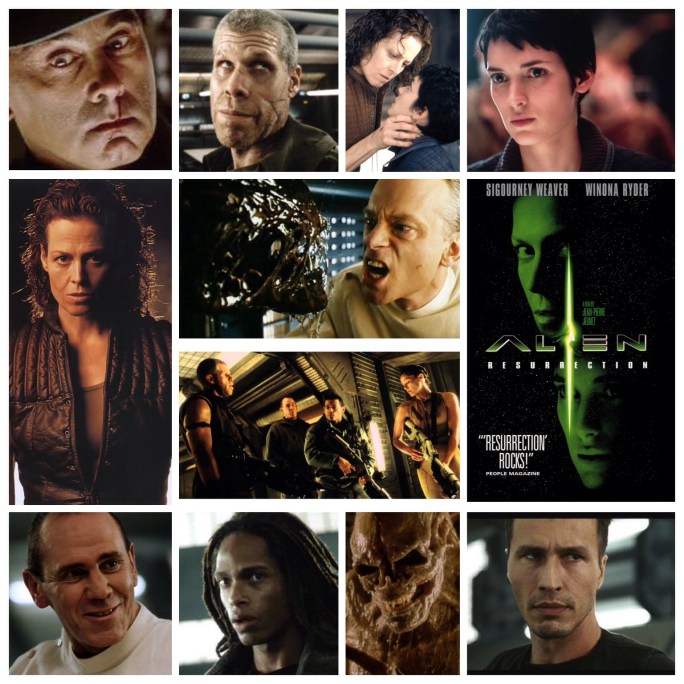
Alien Resurrection: A Review by Nate Hill

  
To this day it still amazes me how under appreciated and misunderstood Alien Resurrection is. The four films in the series are a quartet of vastly different stories, due to the fact that the torch was passed to four very diverse directors over the course of the legacy. Ridley Scott crafted a tense, claustrophobic catalyst. James Cameron made a rootin, tootin Wild Bunch set in a galaxy far far away where no one can hear you scream. David Fincher gave us an odd, inaccessibly disturbing thriller where the real monsters lurked inside the humans, literally. French Maestro Jean-Pierre Jeunet, best known for his own charmingly surreal quartet of distinctly European wonders Amelie, A Very Long Engagement, City Of Lost Children and Delicatessen, made the final film in the franchise. I once saw a post on IMDB which prompted users to describe each of the Alien films in one word. The one response that stuck with me was: Alien-suspense, Aliens-action, Alien3-unpleasant and Alien Resurrection-weird. Is this accurate? Depends on your opinion of the series. Resurrection is my second favourite, after Aliens. To some it was weird, to many a failure, but to me it’s a bona fide, rip roaring odyssey of gorgeous, gory design and offbeat ideas fleshed out by an absolutely legendary cast, headed up by Sigourney Weaver as Ripley. Two hundred years after she died, she is cloned using parts of the Xenomorph’s DNA, and kept sequestered on a titanic pseudo military ship run by whackos who have never heard of a certain expression involving curiosity and a cat. She awakens, the alien genes giving her a decidedly heightened awareness which Weaver plays with giddy, sinister glee. This ain’t the stalwart Ripley we are used to. Her eyes dance with an unearthly fire that pronounces ‘here be dragons’, in the spaces beyond science that humans foolishly venture into. The station is run by creepy, power hungry Dr. Mason Wren (underrated J.E. Freeman is almost ickier than the monsters themselves), and his sidekick Gediman, played by Brad Dourif in his final form, resembling a demented Pokemon who also raises more goosebumps than the aliens. The good doctor has commissioned a ragtag troupe of space pirates to bring him kidnapped humans in cryogenic sleep to be forcefully impregnated with alien fetuses. Lovely, right? This is where it gets interesting. Joss Whedon penned the script, and the crew of intergalactic badasses in this film are in fact the prototype for his endlessly successful TV series Firefly. Now, he claims that everything about the tone, delivery and execution of this film is wrong, and that the end result butchered his work. Here’s my take: I’ve seen Firefly. It’s good. But the team of space pirates in this movie are eternally more fascinating and worth spending time with. I feel that he really abandoned part of a great premise here, opting for a chipper, watered down version of a vision which presented itself to him and begged for further exploration. Firefly is fun, and it’s characters are a veritable Partridge Family of interplanetary characters to chill with, but it lacks the steel edged nastiness and grit that he began with here. Michael Wincott is a blast as the captain, Frank Elgyn, in a role that’s cut entirely too short but is aces while it lasts. Ron Perlman is a primate on earth and proves the same in space as Johner, the lovable lug of the crew. Gary Dourdan, the only black dude I know with blue eyes is Christie, with more than a few high powered tricks up his sleeves. Jeunet disciple Dominique Pinon plays wheelchair bound Riess, a tougher cookie than one might imagine. Lastly, Winona Ryder is Call, a doll with a pixie cut who takes an immediate shine to Ripley, leading them both to dark and dangerous places. Dan Hedaya makes lively work of Perez, the military honcho in charge, with Raymond Cruz, Kim Flowers and a shrieking Leland Orser rounding out the dream cast. As one might expect, all hell breaks loose in outer space as the creatures breed and hunt anything in their proximity. This provides loose cannon Jeunet with reason to fire off many a special effect that will give your gag reflex a workout and your pulse a solid pounding. There’s seriously gnarly stuff here, especially near the end with a certain fucking monster of an alien hybrid that acts as pure nightmare fuel while also being a bucket of fun at the same time. One of Whedon’s complaints was that his lighthearted script was given the heavy treatment, which obviously clashed with the vision he had. Fair enough. It was his baby after all. But for me though, it works bettering he ever planned. The characters maintain a sense of gallows humour laced with very real danger, garnished with cheeky levity in the face of unimaginable horror. That’s a good recipe to follow in any book I can think of. This one is ripe for redemption, certainly in the eyes of many who panned it upon release, and always ready for a revisit from myself.  

Q & A – A REVIEW BY J.D. LAFRANCE

MSDQANA EC007
Q & A, Nick Nolte (front, left), Timothy Hutton (front right), 1990. ©TriStar Pictures

Among the many genres prolific filmmaker Sidney Lumet has dabbled in, the one in which he excels and demonstrates the most affinity for is the crime thriller. In particular, he is fascinated with police corruption and how the law and order system works (or, in some cases, doesn’t work) in New York City. In the 1970s, he told the story of an undercover cop who deals with corruption among his fellow officers with Serpico (1973). In the 1980s, he depicted the plight of a police detective that informs on his cohorts after being busted himself in the magnum opus Prince of the City (1981). In the 1990s, Lumet tackled police corruption yet again but this time via the angle of racism with Q & A (1990). Based on the novel of the same name by New York judge Edwin Torres, Lumet’s adaptation received mixed reviews from critics and was largely ignored by audiences of the day. It has become something of a forgotten, underappreciated film in Lumet’s filmography and one that deserves to be rediscovered.

During the opening credits we see the rain-slicked streets of New York City through the back seat of a cop car. This sequence sets a nice, gritty tone and takes us on a mini-tour of the city where most of the film’s action takes place. However, Ruben Blades’ jarring song that plays on the soundtrack almost ruins it. I’m not quite sure what Lumet was thinking but it simply does not work here.

Lieutenant Mike Brennan (Nick Nolte) is a dirty cop as evident from his introduction where he ambushes an unarmed Latino drug dealer, blows the guy’s brains out and then bullies two nearby witnesses into saying that the man had a gun in his hand. Assistant District Attorney Al Reilly (Timothy Hutton) is assigned to the case. His boss tells him that the incident is a cut and dry one. He is told that Brennan is a good cop – a little rough in his methods but all of his cases have been tried successfully with no appeals. Reilly is instructed to collect the facts with the help of a stenographer and present them to a grand jury. His boss instructs him that “the Q & A defines what really happened. If it’s not the Q & A, it didn’t happen.”

Reilly is eager to please and is impressed with Brennan’s imposing presence and reputation. The young A.D.A. questions Roberto “Bobby Tex” Texador (Armand Assante), a drug dealer and racketeer, who, along with his wife Nancy (Jenny Lumet), witnessed the aftermath of the murder. He refutes the theory that the gun was found on the murder victim. Reilly begins to suspect that something might not be right with the case. He is also faced with a personal conflict as he used to be involved with Nancy and still has feelings for her. Reilly soon realizes that’s he’s taken on more than he can possibly handle. Sidney Lumet pits Brennan, Bobby Tex and Reilly against one another, each with their own agenda and the film gradually heads towards an inevitable confrontation between the three men.

Nick Nolte is a lot of fun to watch as a larger than life cop. He sports slicked back hair and a thick mustache that threatens to overtake his mouth. There’s a memorable scene early on where his character recounts a story to some other cops about how a mobster gave him a hard time when he tried to fingerprint him that is hilarious and disgusting. The scene has an authenticity of a veteran that delights in telling old war stories to inflate his own ego. Nolte’s Brennan is a chatty guy that loves to tell stories of past glories as he tries to buddy-up with Reilly until the A.D.A. lets him know that he’ll go after the veteran cop if he finds out he’s dirty. Nolte’s whole demeanor changes in a heartbeat and it is quite exciting to see him go from jovial to threatening in the span of a few seconds. Brennan is as corrupt as they get and enjoys the influence he exerts and the power he wields. He uses fear and intimidation to get what he wants. Nolte put on 40 pounds for the role because he felt that the character required it: “just the sheer mass of brutality. I felt that would be the right kind of thing. He had to be on the edge of his own dissipation.”

Armand Assante is a force of nature as Bobby Tex, portraying the crook with an aggressive swagger and an intensity that is impressively conveyed in his eyes. During Reilly’s initial questioning, Bobby oozes casual confidence and Assante does a great job of conveying it. He also imparts a keen intelligence. Bobby isn’t just some two-bit street punk. He doesn’t even blow his cool when Luis Guzman’s cop gets all in his face. Bobby matches his intensity and it is great to see two skilled character actors go at it. Assante ups his intensity when he warns Reilly to stay away from his wife. He gives the A.D.A. a seriously threatening look that would have most people shaking in their shoes. It’s Bobby’s first appearance in the film and Assante makes quite an impression.

Up against two lead actors playing colorful characters, Timothy Hutton wisely underplays Al Reilly. His character may be young and new to the job but he knows the law as demonstrated when questioning a mobster by the name of Pesch (Dominic Chianese) and his lawyer (Fyvush Finkel) in rather confident fashion. At first, it appears that the slick mob lawyer is going intimidate Reilly but the young man expertly turns the tables with his intelligence. Hutton is good as the straight arrow A.D.A. that decides to take on a highly respected cop and in the process uncovers an intricate web of corruption. The actor avoids stereotyping by showing layers to his character through the revelation of his feelings for Nancy which affects his approach to the case. Reilly starts off as an idealistic person but over the course of the film, as he’s exposed to corruption, he gains experience and becomes savvier when it comes to how things work. Early on in Q & A, there is a revealing conversation he has with Leo Bloomenfeld (Lee Richardson), a veteran attorney that has clearly been working in the system for far too many years. He’s jaded and tells the eager Reilly how things really are, giving him a taste of the corruption he will witness first hand later on. To prepare for the role, Hutton went on squad-car runs with police officers in Manhattan in order to get an idea of the challenges they face on the streets. He said of the experience, “in many cases the hands of the officer on the street are tied.”

Lumet shows how close these cops are by the short-hand between them and the familiarity they have with each other. In the scene where Reilly questions Brennan about the homicide in a room full of cops, the director really captures the camaraderie among these men. The dialogue sounds authentic and is delivered by the actors in a way that is so natural you believe that they are these characters. Consummate character actor Luis Guzman has a memorable role as a homicide detective that first suspects the Brennan case is rotten. He has a memorable moment where he jokingly defends Brennan’s casual racism: “He ain’t no racist. He hates everybody. He’s an equal opportunity hater.” Even though this is said in jest, in actuality it’s not far off the mark.

However, in his review for The New York Times, Vincent Canby wrote, “great little scenes overshadow bigger, more important ones. Characters come and go at speed. Watching the movie is an entertaining ride, but when it’s over it’s difficult to remember where, exactly, one has been.” USA Today gave the film two-and-a-half stars out of four and wrote, “Overkill ultimately wears Q & A down, despite two bravura performances and some Hutton understatement that’s adequate to the task. So, too, does unrelenting sordidness, a deadly love angle and a score (Ruben Blades) almost as awful as Cy Coleman’s sabotage of Lumet’s Family Business.”

One of the major themes Q & A wrestles with is racism. There is the casual kind between black, white and Latino cops and there’s the more damaging kind that resulted in the end of Reilly and Nancy’s relationship years ago. Racism informs a lot of the characters’ decisions and often motivates their actions. The film addresses racism in an honest way that you rarely see outside of a Spike Lee film. As he did with Prince of the City and later with Night Falls on Manhattan (1997), Lumet sheds light on how cops and crooks can be intricately linked and just how deep corruption runs in a sprawling metropolis like New York City. These films show how law and order works in fascinating detail and that feels authentic, much like the television show Law & Order does year in and year out.

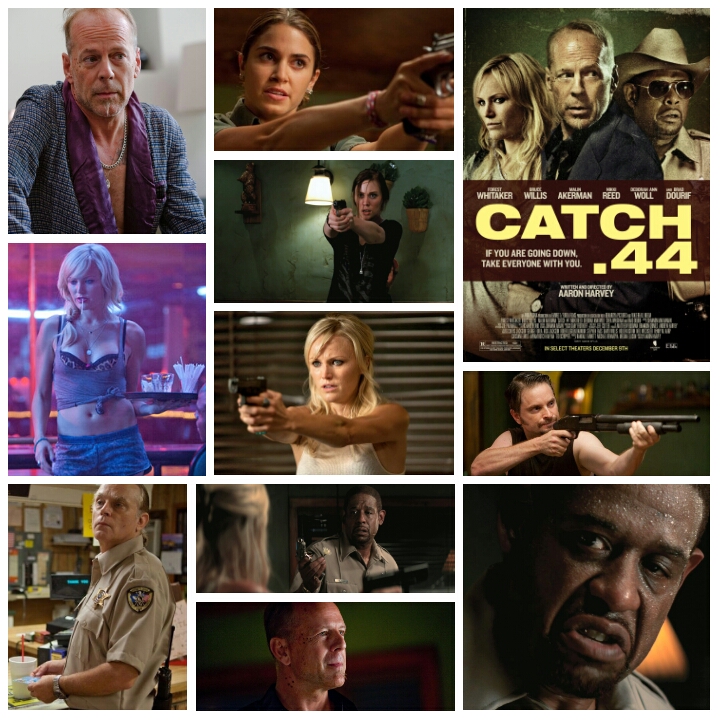
B Movie Glory with Nate: Catch 44

image

Catch 44 lives in that lurid interzone of direct to video crime thrillers that have the budget for the bare boned minumum: guns, a few big name actors stopping by for a paycheck, and a hard boiled, often ludicrous tale of criminals, cops and sexy chicks knocking each other off for some unnatainable trinket of wealth. Here we meet three lively femmmes fatale: Malin Ackerman, Nikki Reed and Daredevil’s Deborah Ann Woll, the angel’s to Bruce Willis’s Charlie, in this case a sleazy criminal kingpin named Mel. He tasks them with intercepting a mysterious package that passes through a lonesome truckstop diner. All hell breaks loose when the shotgun toting owner (Shea Wigham) takes them off guard,  and blood is shed. From there it all spirals into a mess of chases, strange pseudo artsy setups and the entire cast hamming it up royally as they essentially go nowhere fast. There’s Forest Whitaker who seems to have wandered in from the loony bin, playing a psychotic Sheriff who switches up his accent from scene to scene until we realize we are sitting there watching an Oscar winner warble out a choppy Tony Soprano impression and have to chuckle at the absurdity of it all. Willis has fun doing his nonchalant smirk to kingdom come and sporting a soul patch that steals his scenes before he gets a chance. There’s also an underused Brad Dourif as a confused highway patrolman who wanders in and out of the story. A lot of pulpy outings like this get accused of aping Quentin Tarantino’s style, and while that is often a lazy, bullshit critic’s cliche, here the claim is understandable and not necessarily a bad thing. The soundtrack is appropriately offbeat, the trio of girls have a Death Proof type cameraderie and Willis ambles through his scenes with a verbosity reminiscent of Pulp Fiction. The story is a little haywire and one wonders what the ultimate outcome even means, but it sure has a ball getting there in violent, kooky fashion.

Michael Mann’s Thief: A Review by Nate Hill

image

With Thief, Michael Mann distilled his crime film style into an archetypal, haunting aura that would go on to influence not only his excellent later work, but other filmmakers as well, everything from Refn’s Drive to the police procedural we see on television today. A style that consists of kaleidoscope neon reflections in rain slicked streets, Chrome cars bulleting through restless urban nocturnes and a lyrical, pulsating score, here provided by underrated German electronic maestros Tangerine Dream, who would go on to provide their dulcet tones for Mann’s phenomenal 1983 The Keep. Thief weaves the age old tale of a master safe cracker(James Caan in a beautifully understated performance) the high stakes at risk of him performing one last job to escape, with said stakes represented as his angelic wife (Tuesday Weld) and newborn son. Robert Prosky in his film debut is a serpentine wonder as Leo, Caan’s boss, whose chilling metamorphosis from paternal employer to domineering monster is a joy to watch. The jewel heist scenes are shot with a researched, assured and authentic feel, spurred on by Tangerine Dreams cosmic rhythms and are especially dynamic points of the film. Thief, for me, belongs that special subcategory of Mann’s career along with Heat, Miami Vice and Collateral, (Public Enemies doesn’t get to come in this elite cinematic treehouse club, it didn’t do anything for me) that are very special crime films. They possess an intangible, ethereal quality of colour, metal, music, and shady people moving about a thrumming urban dreamscape, professionals at what they do, cogs in the ticking clock of crime that inexorably drives toward the narrative outcome, be it bitter confrontation and violence (of which Thief has an absolute gorgeous, poetic revenge sequence) or cathartic resolution (like the conventionally satisfying way Collateral ends). Mann has captured neon lightning in a bottle with Thief, and against the odds of people saying you can’t catch lightning twice, he has spark plugged a good portion of his career with that same lightning, creating an artistic aesthetic all his own. To me that is the ultimate outcome of filmmaking, and art as a medium.

Haunted: A Review by Nate Hill

image

Haunted is an atmospheric, valiant yet frustratingly uneven ghost story effort, in the tradition of stuff like The Awakening and The Haunting. If the plot seems close to last year’s Crimson Peak, it’s because it is, and I’d bet that Del Toro had this forgotten entry in mind when he embarked on that journey. I say frustrating because there’s a certain few absolutely terrific moments of gothic horror that truly shiver your timbers, but they’re hopelessly mired in a mucky moor of a plot that unfortunately is not as effective as those key scenes. You David Ash is rough housing around wit his sister in the English countryside when she hits her head on a rock, and drowns in the pond below. He grows up soaked in guilt, dedicated to disproving the existence of paranormal phenomena. As an adult he’s played by Aiden Quinn, who is an average dude with slightly wild looking eyes who is always effective in the sense that he seeks out challenging, odd projects which test his everyday aura nicely. In the early 1900’s he is summoned back to rural Britain by an elderly woman (Anna Massey) who is convinced that she is surrounded by ghosts. He is greeted there by the luminous, attractive Christina (Kate Beckinsale), a friendly young thing with a distinct untrustworthy vibe and a penchant for getting creepy close with her two strange brothers (Anthony Andrews and Alex Lowe). She lives out there in isolation with them as well as their disturbed mother, and one gets the sense right off the bat that something is wonky. I suppose that’s the point though isn’t it? Beckinsale has carved a path of playing either somber, distraught women or tough, silent warrior chicks. This is the most animated work I’ve ever seen from her, and the most radiant she’s ever looked as well. It’s aslso to date the only nude scenes she’s ever put forth, and I don’t use the term lightly… she really bares it all here. The middle portion of the film meanders around with these characters, not revealing enough to push the plot forward enough, until the curtain  is whisked away jarringly in the third act, cementing it’s pacing issues for good. It’s a picturesque enough journey, I just wish we had something to latch onto besides that, some substance and a consistency in the creepiness factor to keep us invested. Alas. It’s got a spookily wonderful beginning, and an electric, full blooded ending, the only two instances where it shows true feeling and commitment. The rest is, well… stale. It’s worth a peek for a few reasons though, including Beckinsale’s solid performance and that one uber-scary scene in the opener.

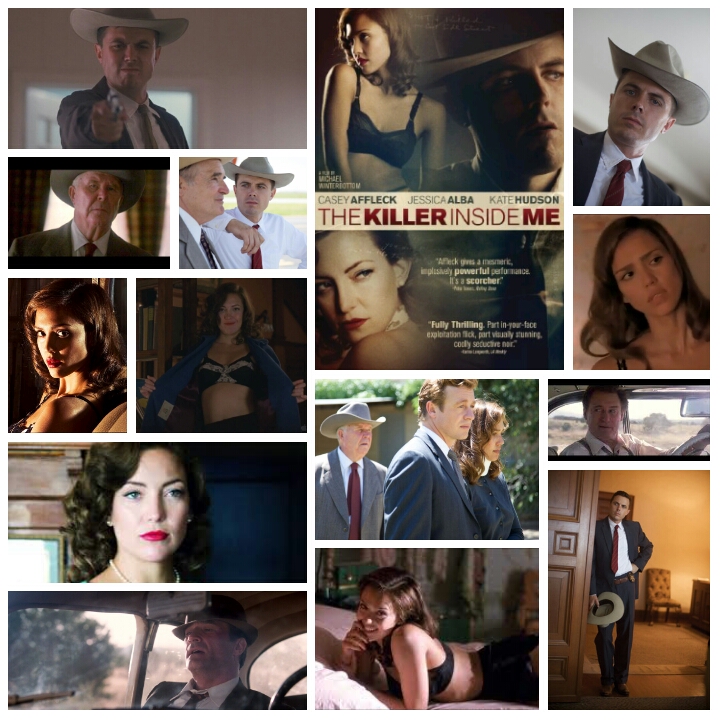
The Killer Inside Me: A Review by Nate Hill

image

Michael Winterbottom’s The Killer Inside Me is one of the most flat out disturbing films ever made under the sun, even if only for a few brief, harrowing sequences encased in a lurid, laconic, southern fried oddity of a story that defies genre confinement while still planting vague roots in crime drama. When the sequences I speak of show up, and you’ll know exactly when, it takes you right off guard and immediately notifies you that the film has no intentions of towing a line within anyone’s comfort zone. It’s an odd story for someone to strive to tell, and one wonders what inky black corners of the psyche that Jim Thompson was spellunking in when he scribed the novel on which this is based. It starts off conventionally enough, under the prosperous sun of the West Texas desert in the heat of the 1950’s. Sheriff’s Deputy Lou Ford (Casey Affleck) is a regular enough guy, tasked with rousing a local prostitute (Jessica Alba) living in nearby suburbia. He also deals with the dodgy real estate kingpin  Chester Conway (a blustery Ned Beatty) and his cronies. He’s also got a cute fiance (Kate Hudson). He’s calm, cool and connected, right up until the part where he turns out to be a certifiable grade murdering psychopath. Affleck let’s the authoritarian composure bleed away and reveal the layers of eveil beneath, until we begin to wonder if the film we are watching has been interrupted by someone taping over it with something far darker. But no… it’s the same movie. It just veers into territory we didn’t expect and may be taken aback by. Affleck discovers the psychopath within himself, and fits inside the characteristics like a glove. The first person to stray into his path is Alba, and there’s a sequence where he gives her a royal, merciless, and bloody beatdown that will shiver your spine in its blunt, head-on realism. It’s seriously stomach churning shit, and levels off both the film and Affleck’s role in pure stone cold seriousness. He’s a budding lunatic, made all the more dangerous by bis position of power within law enforcement and shielded by his trustworthy reputation. The film resists generic story beats, and instead meanders about, diligently following Affleck from encounter to macabre encounter, discovering his dark interior nature without much rhyme or reason as far as conventional plot goes. This has a wickedly prolific cast for such a risky film, with fine work from Bill Pullman, Brent Briscoe, Tom Bower, Simon Baker and the ever reliable Elias Koteas who adds to the cumulative unease. It’s Affleck’s  shown though, and he splinters nerves with his unpredictable, hollow and fascinating portrait of a psychopath. Soon we begin to wonder what he sees and heats is real,   as characters he interacts with seem to come back from the dead and knowingly coach him towards trouble in trademark indications of serious mental distrbance. This one arrives at it’s end severely south of where it started from, taking the viewer off guard. Those who appreciate the tantalizing, prickly nature of a thriller that isn’t afraid to seriously shake up your shit and take you places you’ve only been to on clammy nightmares will appreciate it. Just mentally psych yourself up for that scene I mentioned, because it will scar you and then some.

WALL STREET – A REVIEW BY J.D. LAFRANCE

00ef81a325de4cc6a07dcab0cbd38c42

When Oliver Stone made Wall Street (1987), he was riding high from the commercial and critical success of Platoon (1986). His father, Lou Stone, had been a stockbroker on Wall Street in New York City and this film was a son’s way of paying tribute to his father. Almost twenty years later, it has become one of the quintessential snapshots of the financial scene in the United States and epitomizes the essence of capitalism, greed, and materialism that was so prevalent in the 1980s.

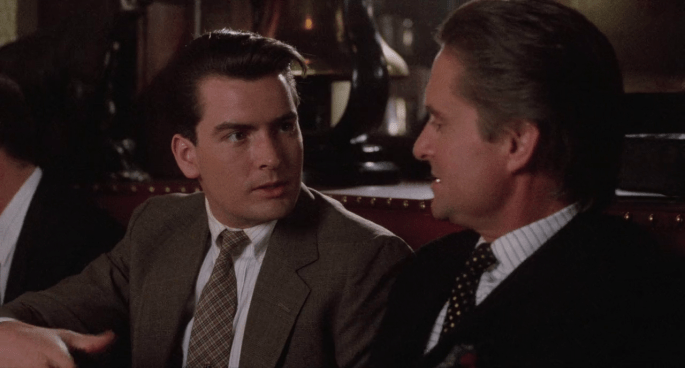
Right from the opening frame, Stone establishes the dominant presence of greed and money by using a gold filter over shots of the New York City skyline with Frank Sinatra (known by his cronies as Chairman of the Board, no less) singing “Fly Me to the Moon,” foreshadowing the dizzying heights that the film’s protagonist, Bud Fox (Charlie Sheen), will briefly ascend. He is an up-and-coming stockbroker in the cutthroat financial world. He is hungry and willing to do anything to get rich. He idolizes Gordon Gekko (Michael Douglas), one of the most ruthless Wall Street tycoons who buys and then takes apart companies for profit. Bud aggressively pursues Gekko in the hopes that he can work for the businessman and follow in his footsteps. Bud soon finds himself in a moral dilemma: does he sell his soul for the gold key to Gekko’s world, or remain true to the blue collar roots of his labor union father (Martin Sheen)?

After the success of Platoon, Stone started researching a film about quiz show scandals in the 1950s. However, at lunch with a film school friend and Los Angeles screenwriter Stanley Weiser, Stone heard an idea for a film that could be “Crime and Punishment on Wall Street. Two guys abusing each other on Wall Street,” as he remarked in an interview. The director had been thinking about this kind of a film as early as 1981. He knew a New York businessman who was making millions and working long days, putting together deals all over the world. This man started making mistakes that cost him everything. Stone remembers that the “story frames what happens in my movie, which is basically a Pilgrim’s Progress of a boy who is seduced and corrupted by the allure of easy money. And in the third act, he sets out to redeem himself.” Stone and Weiser began researching the world of stock trading, junk bonds and corporate takeovers. They met a lot of powerful Wall Street movers and shakers. Reportedly, Bud Fox is said to be a composite of Owen Morrisey, who was involved in a $20 million insider trading scandal in 1985, Dennis Levine, Ivan Boesky, and others.

Stone met with Tom Cruise, who expressed an interest in playing Bud Fox, but the director had already committed to Charlie Sheen for the role. To research his role, the actor spent two days talking with David Brown, a Goldman Sachs trader who pleaded guilty to insider trading charges in 1986. Stone and Weiser began researching the world of stock trading, junk bonds, and corporate takeovers. They met a lot of powerful Wall Street movers and shakers. Weiser wrote the first draft, initially called Greed, with Stone writing another draft. Originally, the lead character was a young Jewish broker named Freddie Goldsmith, but Stone changed it to Bud Fox to avoid the misconception that Wall Street was controlled by Jews. According to Weiser, Gekko’s style of speaking was inspired by Stone. “When I was writing some of the dialogue I would listen to Oliver on the phone and sometimes he talks very rapid-fire, the way Gordon Gekko does.”

Stone wanted to shoot the film in New York City and that required a budget of at least $15 million. The studio that backed Platoon felt that it was too risky a project to bankroll and passed. Stone and producer Edward Pressman took it to 20th Century Fox, who loved it, and filming began in May 1987. Stone switched from 12 to 14-hour days in the last few weeks of principal photography before an impending directors’ strike and finished five days ahead of schedule.

Stone brilliantly sets everything up in the opening minutes of the film. Bud is first shown as an insignificant cog in the city. He’s mixed in with all the other 9-to-5ers — packed in a subway and then in the elevator up to the company where he works. Bud looks uncomfortable and unhappy. He does not want to be in there with all of these other people. He wants to be on the other side with all the money and with Gekko, who rides alone in his spacious limousine. As soon as Bud gets into work, Stone shows a montage of a typical business day — the hectic, rapid-fire pace as people buy, sell, and trade shares.

Taking his cue from another Faustian New York City tale, Sweet Smell of Success (1957), Stone prolongs the first appearance of the film’s most charismatic character. When Bud goes to visit Gekko, we do not see him; we only hear his voice from within his office. It is an enticing teaser that makes Bud and the audience curious to see this man that everyone regards with such awe and reverence. When we finally do meet Gekko, it is a whirlwind first appearance. The camera roves around him aggressively as he never stops talking, making deals, and truly embodying the phrase, “time is money.” According to Stone, he was “making a movie about sharks, about feeding frenzies. Bob [director of photography Robert Richardson] and I wanted the camera to become a predator. There is no letup until you get to the fixed world of Charlie’s father, where the stationary camera gives you a sense of immutable values.” This is such a fantastic way to introduce Gekko as it perfectly conveys what makes him so alluring to someone like Bud: he is always in control, he is smart, and he knows exactly how to get what he wants.

Michael Douglas owns the role of Gekko, and by extension, dominates the film with his larger than life character. He gets most of the film’s best dialogue and delivers it with such conviction. Douglas remembers when he first read the screenplay. “I thought it was a great part. It was a long script, and there were some incredibly long and intense monologues to open with. I’d never seen a screenplay where there were two or three pages of single-spaced type for a monologue. I thought, whoa! I mean, it was unbelievable.” There is a scene between Bud and Gekko in a limousine where he tells the younger man how the financial world works, how it operates and lays it all out, pushing Bud hard to go into business with him. It is one of the strongest scenes in the film because you really believe what Gekko is saying and how Bud could be seduced by his words.

Douglas had just come off heroic roles, like the one in Romancing the Stone (1984), and was looking for something darker and edgier. The studio wanted Warren Beatty to play Gekko, but he was not interested. Stone initially wanted Richard Gere, but the actor passed and the director went with Douglas despite having been advised by others in Hollywood not to cast him. Stone remembers, “I was warned by everyone in Hollywood that Michael couldn’t act, that he was a producer more than an actor and would spend all his time in his trailer on the phone.” But the director found out that “when he’s acting he gives it his all.” The culmination of Douglas’ performance is his much lauded, often quoted, “Greed is good” speech that his character gives to a shareholders’ meeting of Teldar Paper, a company he is planning to take over. He concludes by saying, “Greed is right; greed works. Greed clarifies, cuts through, and captures the essence of the evolutionary spirit. Greed, in all of its forms, greed for life, for money, for love, knowledge, has marked the upward surge of mankind, and greed – you mark my words – will save not only Teldar Paper, but that other malfunctioning corporation called the U.S.A.” This is one of the best delivered monologues ever put to film, as Douglas goes from charming to downright threatening and back again, succinctly summing up the essence of ’80s capitalism and greed.

Stone was smart to cast Martin Sheen as Bud’s dad. He gets a lot of mileage out of the real father-son relationship between them. It makes their chemistry that much more genuine. It also lends itself to their heated conversations — especially the one in an elevator where Bud accuses his father of being jealous and ashamed that his son is more prosperous and successful. The shocked, wounded expression on the elder Sheen’s face says it all, and makes this scene that much more painful to watch. This scene also makes their tearful reconciliation at the hospital after the father suffers a heart attack all the more poignant. It is an intense, emotional moment as the tears start flowing and Bud begins along the gradual road to redemption.

However, Stone made the mistake of casting Daryl Hannah as Bud Fox’s materialistic girlfriend. She was having problems relating to her character and struggled with the role and personal problems. The director was aware early on that she was not right for the role, but arrogantly refused to admit the mistake. He remarked, “Daryl Hannah was not happy doing the role and I should have let her go. All my crew wanted to get rid of her after one day of shooting. My pride was such that I kept saying I was going to make it work.” Stone also had difficulties with Sean Young, who made her opinions known that Hannah should be fired and she should play her role instead. Young would show up to the set late and unprepared. She also did not get along with Charlie Sheen, which caused unnecessary friction on the set. In retrospect, Stone felt that Young was right and he should have swapped roles between her and Hannah.

Visually, Stone ends the film much as he began it, with Bud reduced to an insignificant cog in the city yet again, his future uncertain. Wall Street is a morality play about the seductive nature of greed, examining how far someone is willing to go and what they are prepared to do to become rich. The irony is that many people admired Gekko, and Stone has said on the supplementary material to the film’s DVD that people have approached him saying that they were inspired to get into the financial world because of this character. The 2000 film Boiler Room even features a group of young stockbrokers watching Wall Street on video and quoting along to some of Gekko’s more memorable dialogue. People who admire Douglas’ character don’t seem to realize that Stone is not idealizing him, but merely showing the seductive lure of someone like Gekko. He is not someone to admire, and the film leaves his fate somewhat ambiguous, while it is Bud who goes to jail. It is this stinging indictment that lingers long after the credits end — that rich, powerful men like Gekko never seem to get punished for their transgressions, while the common man, like Bud, suffer instead.