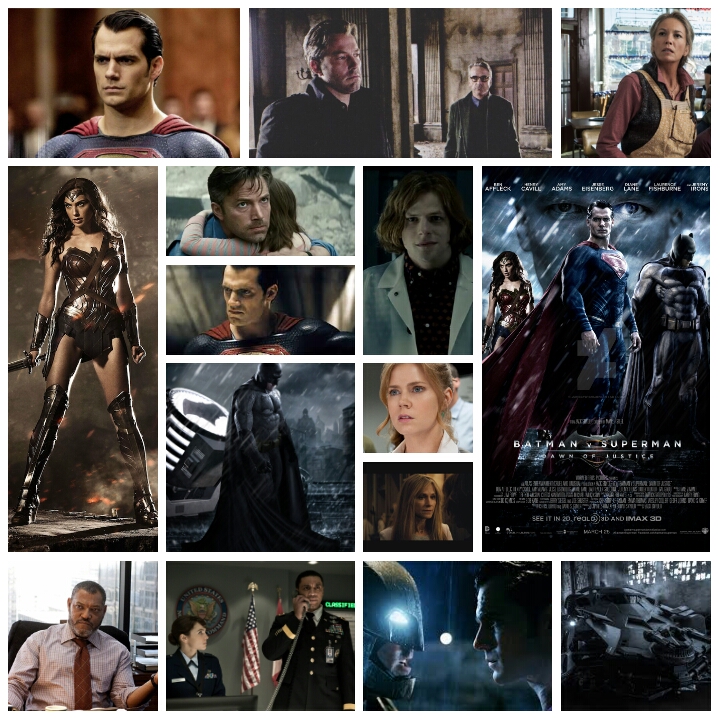
Batman Vs. Superman: Dawn Of Justice. Wow. Where to even start. What a symphony of scorched earth heroics, a two and a half hour maelstrom of thundering action, introspective gloom and very current vibes of apocalyptic dread. I’m not sure if I was watching an entirely different film from some of these bitter bottomed critics who are maiming it with inaccurately nasty reviews. Balls to them. Zach Snyder should be proud of this achievment, for in the face of both ruthless odds and rabid fans who would make any one of us piss down our legs at the thought of ‘getting it right’, he has mounted a titanic epic of a superhero flick, hitting all the right notes and fuelling both casual moviegoers and salivating super fans with a rekindled love for comic book films. A much welcomed grit and violent edge creeps into the proceedings here, a tone which Snyder has a passion for and is incredibly deft with. We begin with a visually arresting opening credit sequence, which Snyder previously perfected to hair raising brilliance in Watchmen, a ten minute opus set to Bob Dylan. Here he inter cuts shots of young Bruce Wayne, both discovering the prophetic swarm of bats and on the fateful night of his parents murder, a sequence done over a thousand times in film, but never quite with the inventive flair used here. We then arrive with adult Bruce (Ben Affleck) in Metropolis right as it’s being ripped to shreds by the Def Jam smackdown match of Superman (Henry Cavill) and Zod (Michael Shannon). There’s eerie shades of 9/11 as Bruce darts through the ashen rubble, attempting to save the employees in one of his towers. One senses the fear and rage in Wayne right off the bat (pun intended). He glowers in seething fury at the man of steel, primally threatened and haunted all over again by loved ones he couldn’t save a second time around. This film addresses the ludicrous amount of destruction that Superman wrought upon Metropolis in several ways. Political nerve endings are fried as Senate and State alike get hostile towards the god in the red cape. No one is more aggressive than Batman, though. This brings me to Affleck as Batman. Without a doubt my favourite cinematic incarnation of the caped crusader, and his debonair counterpart to date. Yes, even more so than Bale. Nolan’s The Dark Knight is still tops for me, but the portrayal of Batman by Bale didn’t strike as harmonious a chord with me as Affleck. It just didn’t feel like pure Batman, it was real world Batman. Affleck feels much more rooted in the comics, and God damn it all if he isn’t the most savage, violent Bats to come our way, well… ever. I’ve always been bothered by the nagging fact that Batman refuses to kill. Even in in a beatdown he could easily inadvertently cause death, so why bother trying? Here, he doesn’t go out of his way to deliberatly kill, but he sure has no problem brutally breaking bones and stabbing his adversaries without an iota of faux-noble hesitation. That’s the kind of Batman I want to see. Fuming, fired up and full of rage demons that erupt into fantastic action scenes. One sequence involving a room full of thugs is just jaw dropping and probably my favourite sequence of the film, even over the titular smackdown with Superman. There’s an earthy, simplistic take to him as well, with a modest suit that gives nods to Frank Miller and even Batman: The Animated Series. He is by far the elemental force that the character should be, and the part of the film that I connected with most. I hope he gets his standalone film real soon. Henry Cavill has grace and intuition as Superman, and a surprisingly earthly aura as Clark Kent, in a fit about Batman’s vigilante tactics. He’s the outsider here, an orphaned deity truly trying to do his best in a world that often shuns him in fear. He was never my favourite superhero, or even on the list, but Cavill combined with Snyder make him a force to be reckoned with, and a hero I can get behind. The two eventually meet in a remarkably choreographed clash of the titans, a duel that really only lasts a few minutes and isn’t central theme, which raises questions in my head about the first part of that title. Their fight is composed of Batman’s hard hitting, blunt force physicality pitted against Superman’s fluid, elegent invincibility which is satisfyingly put to the test by the appearance of a certain green mineral we all know about. The James Cameron-esque suit Batman wears for the fight is a grinding wonder that looks like it weighs a metric ton and could level buildings alongside the man of steel. The combat feels urgent, from the gut and roars into action perfectly. Of course, that isn’t where the fireworks stop, but I ain’t sayin any more than that. Gal Gadot is truly wonderful as Wonder Woman, I also can’t wait for her solo outing, and wish she’d been in the film more. Her much talked about entrance is the definition of crowd pleasing, and will make you cheer in approval, which I did out loud. She’s endlessly gorgeous, and has the toughness to go along with it, a great casting decision by anyone’s tally. Jesse Eisenberg wowed me as a young, jittery Lex Luthor, in what is probably the most clinically insane portrayal thus far. Forget bumbling Gene Hackman and hammy Kevin Spacey, this guy seals it for me. There’s a true madness to his Lex, which when given enough money and resources can have cataclysmic results. It’s a villain to remember, and Eisenberg exudes palpable danger from every pore, his psychopathic sheen of logic barely shrouding the mania beneath. Jeremy Irons is a more restrained, jaded Alfred who is still unconditionally supportive of Wayne, but is reaching the end of his rope which is tethered to pure world weariness. He gets some of the only humerous bits of the film, albeit of dry, brittle variety. Amy Adams is reliably terrific, her eyes pools of perception that mirror the horror and spectacle of the events through the mind of a human, with every ounce of nerve and courage as those around her that have superpowers, or expensive toys. Diane Lane is weathered wisdom and maternal compassion as Martha Kent, nailing her scenes with the small town, kindhearted patience that a film this noisy deserves, tipping the scales to provide occasional serenity in the eye of the hurricane. Kevin Costner makes a brief appearance in one of the films numerous and often confusing dream sequences. He was a highlight in Man Of Steel, and brings the same baleful, gruff adoration here, in a wonderful but brief scene with Clark. Laurence Fishburne is another source of rare humour as the perpetually exasperated Perry, CEO of the Daily Planet. Aggravated and cheeky, he commands every frame he’s in and had me chuckling no end. Holly Hunter has forged a career of playing no nonsense hard asses, here a ballbreaking US Senator here who shares a moment of distilled intensity with Luthor proving that Superhero films can have some of the best written dialogue. Harry Lennix makes great use of said writing too as the steely Secretary Of Defense. Callan Mulvey and Scoot McNairy are memorable in supporting turns. Listen hard for Patrick Wilson and Carla Gugino, and look for a certain ocean dwelling dude in the briefest of moments. Jeffrey Dean Morgan also has a cameo that’s almost too good to be true. Hans Zimmer and Junkie XL, who was so top notch with Mad Max: Fury Road, combine efforts for a score that knocks it out of the park and several miles further. Batman has a soul rousing battle cry of an overture, with subtle shades of Zimmer’s work on the Nolan films, built upon to give us something truly unique and fitting for the character. Lex Luthor is accompanied by a fitful cacophony of strings that sound like the Arkham Asylum charity orchestra having a collectively unnerving seizure. My favourite riff though I think is for Wonder Woman, a deviously disarming jaunt that strays from the grandiose, baroque theme and feels wickedly subversive, getting you just so pumped for her character. Zimmer’s work on Interstellar made it my top score of 2014, because he leapt out of the box of his usual tricks and gave us something we’d never heard from him before. Here he shreds that box with ingenuity and creative output, a varied, explosive piece that assaults your ears splendidly. My one concern with the film was a dream sequence midway through concerning Batman, and anyone who’s seen the film knows what I’m talking about. I’m sure comic book fans have some point of reference or context regarding it, but the casual viewer doesn’t, and a little more explaining would have been nice. I will say though it showcases Batman in an entirely new light which took me off guard nicely. This is what a superhero movie should be, plain and simple. Big, bold, audacious, stirring and full of high flying action, dastardly villains, conflicted heroes clashing like the ocean tides and a sense of pure adventure. Forget what the critics are saying, this one comes up aces in all categories and is a perfectly wonderful start to the stories of a group of characters that I look forward to seeing in many a film to come. Especially Affleck’s Batman.
Tag: film review
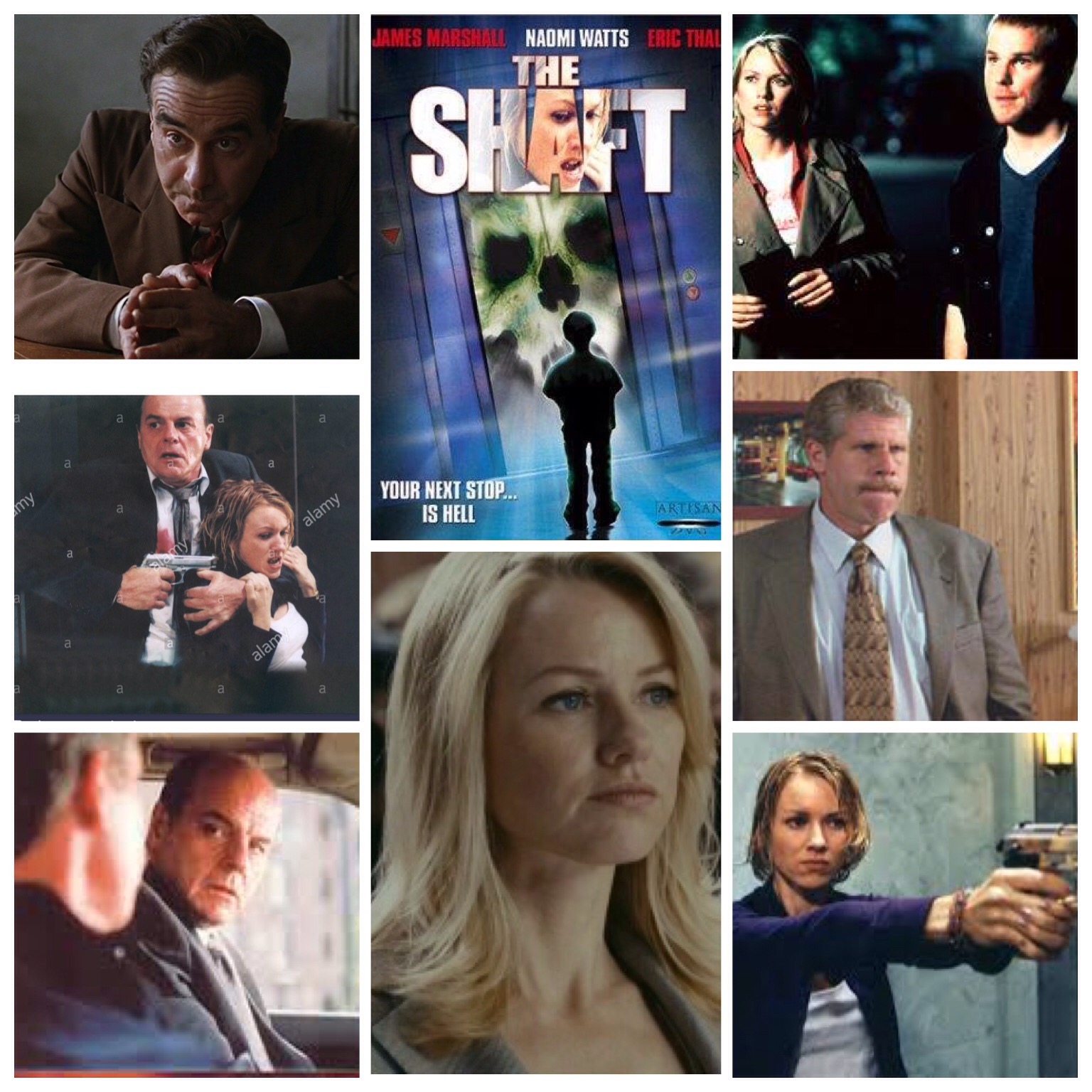
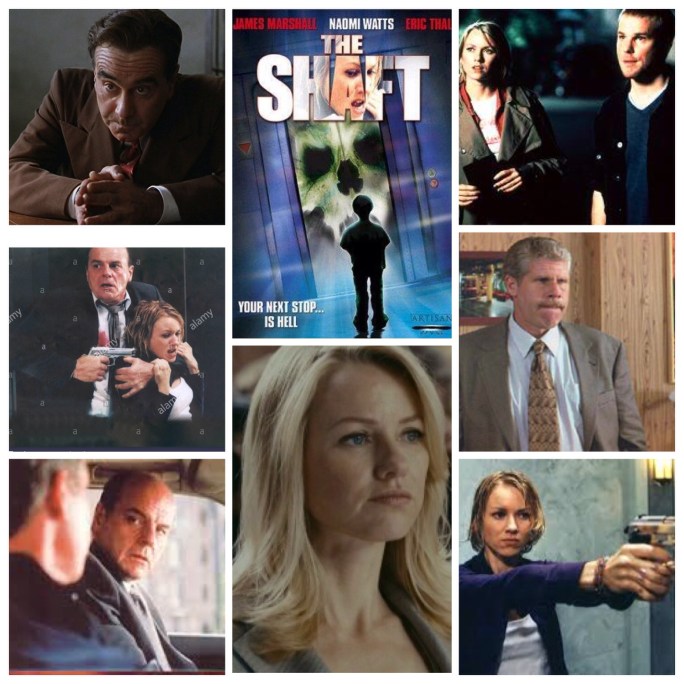
B Movie Glory with Nate: Down, aka The Shaft
Ever briefly get stuck in an elevator thats messing with you, malfunctioning and seems to almost have a mischievous mind of its own? That’s the premise of Down, also known as The Shaft. It concerns an elevator in a huge residential/office building that has gone homicidally haywire. It traps, drops and tricks people no end, raising and lowering the interior temperature to dangerous effect and generally just being a great big meanie. No one seems so know what’s going on with it though, especially the mechanic who installed it (Twin Peak’s James Marshall). The incidents accumulate, attracting a perky tabloid reporter (Naomi Watts having a ball) who makes up all kinds of tall tales to explain the situation in sensationalistic terms. This infuriates the CEO of the elevator company (now there’s a job title) played by a snarky Ron Perlman who gets a rant towards Marshall that walked in from a way better script (which leads me to believe it was the spawn of Perlman’s legendary improv skills). There’s also a cop played by Dan Hedeya who can’t seem to figure it out wither. The truth is a lot more interesting than you might expect and has nothing to do with ghosts or spirits at all, but centers around a deranged research scientist (Michael Ironside, whacked out to kingdom come). It’s not the least bit scary, but it’s worth a watch simply for the fact that it’s a movie about a fucking elevator that kills people lol. Cujo and Christine ain’t got nothing on this bitch. The scene where a gaggle of pregnant ladies enter the thing is just priceless in its blatantly gross out manner. Fun, fun stuff and great research to embarrass Watts with sometime down the road if you ever find yourself interviewing her on the red carpet hehe.
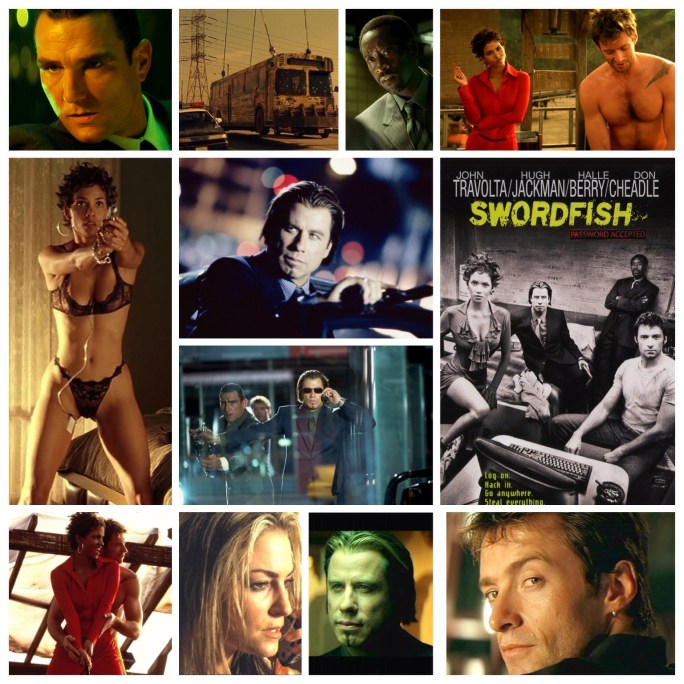
Swordfish: A Review by Nate Hill
Swordfish tries so hard to be cool, and save for a few moments of smirking silliness, it is pretty goddamned cool. The early 2000’s still carried lingering, reminiscent elements of the 90’s, the super cyber hacker archetype included. The cyber hacker is played by two types of people: basement dwelling, Mountain Dew drinking chatter boxes and virile, sexy supermodels. The latter is employed here, personified by Hugh Jackman as Stanley, a sly devil who can hack into almost anything effortlessly, but has been caught and never allowed to touch a computer again. Enter Gabriel (John Travolta), a silver tongued arch villain out to steal all the money and priceless artifacts he can hope to ever own. Although Travolta isn’t as truly off the rails as in some of his villain roles, the amiable charm he puts forth here is but a ruse to cloud the monster beneath. He’s a very bad man, putting Stanley’s loved ones in jeopardy and forcing him to work computer wizardry for ill gotten riches. Gabriel has a girlfriend named Ginger (Halle Berry, never sexier) who walks a moral tightrope between the two alpha males, torn between roguish indifference and and her conscience. Stanley is also hounded by an FBI Agent (Don Cheadle), with whom he has a tumultuous past. The film resists goin completely by the motions, lulling you just to the border of entropy and then throwing something surprising from a direction you didn’t look in. My favourite scene of the film shows Travolta giving a monologue on bank robbery etiquette, complete with a reference to Sydney Lumet’s Dog Day Afternoon, confirming the fact that this flick has a strong script to go with its pyrotechnics. He flexes his sonic directorial muscles in an especially extraordinary action sequence involving a bus and a helicopter that will seriously make your finger hover over the replay button. Vinnie Jones is an ambassador of cool, in a lively turn as Gabriel’s head thug. Sam Shepherd has fun as a corrupt Senator. There’s also fine work from Zachary Grenier, Tim Dekay, William Mapother, Rudolph Martin and Drea De Matteo. Director Dominic Sena comes from music video land, having also helmed the priceless Nic Cage Bruckheimer-fest Gone in 60 Seconds, as well as the fallout brilliant psycho road thriller Kalifornia. Here he doses the flash and sizzle of 60 seconds with the hard hitting violence of Kalifornia, presented in a story guaranteed to raise a pulse. It’s also got pretty much the coolest poster of 2001. I dare you to find a cooler one, go ahead. Oh, and Travolta’s manscaping here deserves its own spinoff film.
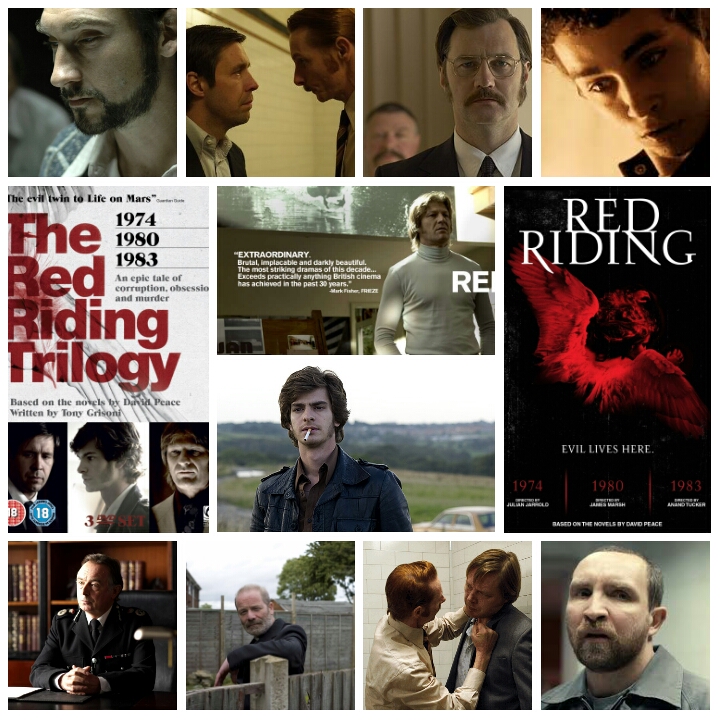
The Red Riding Trilogy: A Review by Nate Hill
The Red Riding Trilogy is one of the most dense, absolutely impenetrable pieces of work I’ve ever seen, let alone attempted to dissect with my clunky writing skills. It’s also fairly horrifying, as it chronicles the tale of the Yorkshire Ripper, an elusive and mysterious serial child killer who terrorized this area of Britain through the late 70’s and early 80’s. Viler still are the strong implications that very powerful people, including the brass of the West Yorkshire police, made every disgusting attempt to cover up the crimes and protect the killer, who’s murders included that of children. It’s a brave move by UK’s Channel 4 to openly make such notions obvious within their story, and commendable the level of patience, skill and strong ambition in the undertaking is quite the payoff, whilst simultaneously taking a toll on you for sitting through it. The sheer scope of it must be noted; it’s separated into three feature length films, each vastly different in setting, character and tone, and each blessed with a different director. The filmmakers even went as far as to film the first, which is set in 1974, in 16mm, the second in 35mm being set in 1980 and the third makes a leap to high definition video and takes place in 1983. Such a progression of time is a dismal reflection of the sticky corruption which clings to societies, decaying them stealthily over years, and the few keen individuals who will not let the truth die as long as there is a glimmer of uncertainty. Now, if you asked me exactly what happens over the course of this trilogy, who is who, what has happened to which characters and who is guilty, I simply wouldn’t be able to tell you. It’s a deliberatly fractured narrative told through the prism of dishonest, corrupt psyches and has no use for chronology either. Characters who you saw die in the first film show up in the subsequent ones, actors replace each other in certain roles, and there’s just such a thick atmosphere of confusion and despair that in the 302 minute running time I was not able to make complete sense. I think this is a great tactic to help you realize that the film means to show the futile, cyclical nature of reality, as opposed to a traditionally structured story with a clear cut conclusion. Events spiral into each other with little rhyme or reason, until we feel somewhat lost, knowing full well that terrible events are unfolding in front of our eyes, events that are clouded and just out of our comprehensive grasp in a way that unsettles you and makes you feel as helpless as the few decent people trying to solve the case. One such person is an investigative reporter searching for the truth in the first film, played by Andrew Garfield. He stumbles dangerously close to answers which are promptly yanked away by the sinister forces of the Yorkshire police, brutalized and intimidated into submission. He comes close though, finding a lead in suspiciously sleazy real estate tycoon Sean Bean, who’s clearly got ties to whatever is really going on. The level of willful corruption demonstrated by the police is sickening. “To the North, where we do what we want” bellows a chief, toasting dark secrets to a roomful of cop comrades who are no doubt just as involved as him. The kind of blunt, uncaring dedication to evil is the only way to explain such behaviour, because in the end it’s their choice and they know what they’re doing. Were these officers as vile as the film depicts in the real life incidents? Someone seems to think so. Who’s to know? Probably no one ever at this point, a dreadful feeling which perpetuates the themes of hopelessness. The second film follows a nasty Police Chief (David Morrissey) who is bothered by old facts re emerging and seems to have a crisis of conscience. Or does he? The clichéd cinematic logline “no one is what they seem” has never been more pertinent than in these three films. It’s gets to a point where you actually are anticipating every single person onscreen to have some buried evil that will get upturned. A priest (Peter Mullan is superb) shows up in the second film only to be involved in dark turns of the third. Sean Bean’s character and his legacy hover over everything like a black cloud. A mentally challenged young man is held for years under suspicion of being the Ripper. A disturbed abuse survivor (wild eyed Robert Sheehan) seeks retribution. A Scotland Yard Detective (Paddy Considine) nobly reaches for truth. Many other characters have conundrums of roles to play in a titanic cast that includes Cara Seymour, Mark Addy, Sean Harris, James Fox, Eddie Marsan, Shaun Dooley, Joseph Mawle and more. The process in which the story unfolds is almost Fincher – esque in its meticulous assembly, each character and plot turn a cog in a vast machine whose purpouse and ultimate function are indeed hard to grasp. I need to sit down and watch it at least two more times through before the cogs turn in a way that begins to make sense to me, and a measurable story unfolds. It’s dark, dark stuff though, presenting humanity at its absolute worst, and in huge quantities too, nightmarish acts that go to huge levels of effort just to produce evil for.. well, it seems just for evil’s sake, really. The cast and filmmakers craft wonderful work though, and despite the blackness there is a macabre, almost poetic allure to it, beauty in terror so to speak. It’s rough, it’s long, it’s dense and it thoroughly bucks many a cinematic trend that let’s you reside in your perceptive comfort zone, beckoning you forth with extreme narrative challenge, an unflinching gaze into the abyss no promise of catharsis at the end of the tunnel. There’s nothing quite like it, I promise you.
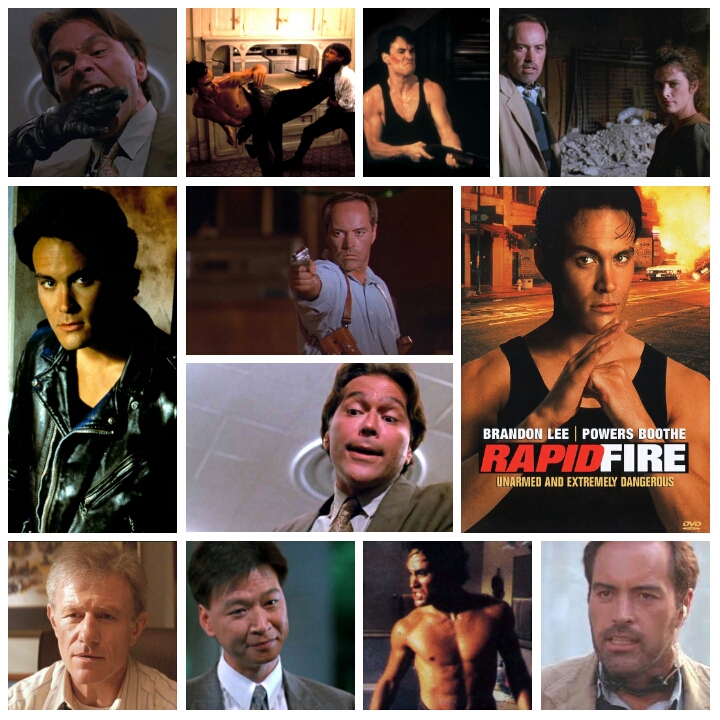
Rapid Fire: A Review by Nate Hill
Along with the classic The Crow, Brandon Lee made few other films before his heartbreaking accidental death. His natural charisma and likeability he brought to action hero roles, accenting the tough guy qualities with an angelic vulnerability, was tragically cut short by the incident. However, Rapid Fire is a gift to fans of both Lee and the action genre alike. It’s a little further away from the notoriety of The Crow, but packs a fuming punch of martial arts, gunplay and tough talking character actors strutting their stuff to a tune that any fan of the genre can hum along to. Lee plays Jake, a young college student with turmoil in his past, haunted by an incident involving a loved one in the Tienemen Square disaster. During a visit to Chicago, he inadvertently witnesses a brutal gangland murder perpetrated by drug kingpin Tony Serrano (Nick Mancuso). This immediately puts him in the hot seat and pretty much on his own after the federal agent assigned to him (Raymond J. Barry) betrays him. His only hope lies with grouchy, paternal Chicago Detective Mace Ryan (Powers Boothe) who is on his own rampaging crusade to bring down the drug trade. Jake merely wants to survive and get out of the mess he’s found himself in. Together they punch, kick, shoot and strategize their way out of getting offed by the mafia, and kick some serious scumbag ass along the way. Lee is ultimate protagonist material: his strong points arise out of the soft touch, never being brash or hogging the screen, always serving up a helping of humble that make the ass kicking resonate tenfold. Boothe is pricelessly grumpy as the haggard detective, showing brief but unmistakable glimpses of the bruised warrior’s heart beneath, rekindled by his bond with Jake. Mancuso is like a rabid pit bull let off the chain as Serrano, a truly untethered piece of geniune psychopathic anarchy. But that’s him, always the under sung wild card who lights up his scenes with wild eyed tenacity. Chinese acting legend Tzi Ma also clocks in as a heroin dealer with a short temper, looking very young which is even made into a meta joke itself. It’s pure uncut action, somehow feeling like more thanks to Lee’s incredible presence, as well as Boothe and Mancuso adding their own lively brand of spice to an already simmering stew. Essential viewing for any action disciple.
B Movie Glory with Nate: Death Race 2
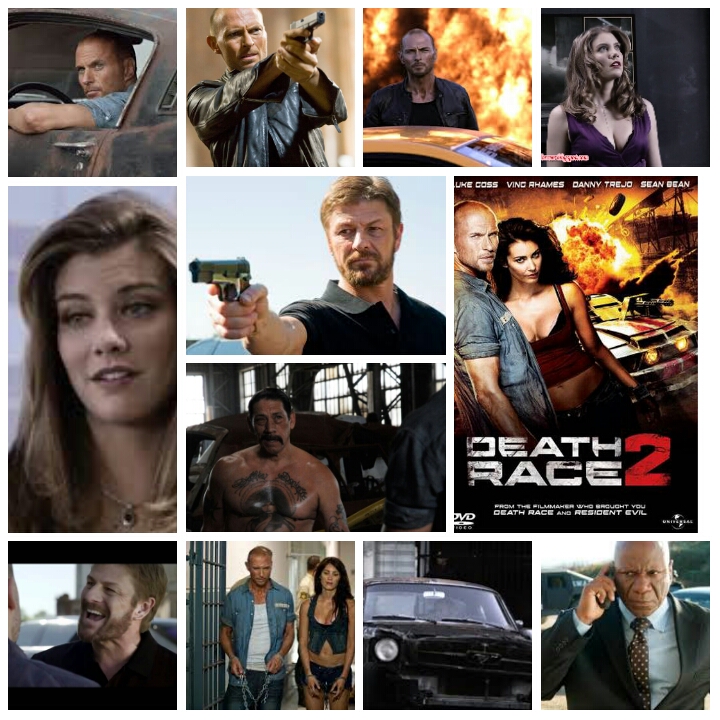
Death Race 2 is one of those sequels that is a little more colorful and off the wall than the first one, and less gloomy. Death Race tried a bit too hard to play it straight and serious, and while still a gnarly flick, I personally have to give the edge to this one simply for coming a little closer to the trashy mark that the genre begs for. Any franchise with a title like Death Race has just got to have a touch of camp, some balls out B-movie action and a good dose of pulp. This one is actually a prequel, now that I think about it, taking place in the same penitentiary that the first film did, a year or so before Jason Statham’s arrival. It follows the origin of Carl Lucas (Luke Goss), who would go on to be the masked driver known as Frankenstein in the original film. Lucas starts out as a getaway driver and thief for ruthless mobster Marcus Kane (Sean Bean). When a heist gone wrong lands him in Terminal Island prison, he’s introduced to ‘Death Match’, bloody gladiatorial fare instigated by a random prison fight caught on camera and broadcasted online. The prison warden Weyland (Ving Rhames) has his moral doubts, but in swoops opportunistic corporation head September Jones (Lauren Cohan) with a sociopathic agenda to turn simple combat events into all out vehicular warfare, with state of the art machines and artillery, all privately funded. Since this genre exists in a world without anyone, government or other, to protest, Death Race is born. The rules go that if you win a certain amount of races, you go free. Kane has his own plans on the outside though, making a pretty penny off of Lucas and his driving, cruelly trying to keep him inside. Bean is a cut and dry psycho as Kane, relishing in the kind of nasty arch villain skin that action films have to offer. Goss has always had a heart and level of gravitas along with his physical intensity (his villain in Blade 2 is still legendary), which he brings out in Lucas. Danny Trejo comes along for the ride as Goldberg, Lucas’s mechanic. The first Death Race was solid, but a bit monochrome in the personality department. This one lets its freak flag fly, getting down and dirty with the bone crunching violence, and thundering motor mayhem. It sinks a level below the first one, which is sometimes a great thing for a particular franchise. It knows how over the top it needs to be, and is all the better for it.
David Lynch’s Twin Peaks Fire Walk With Me: A Review by Nate Hill
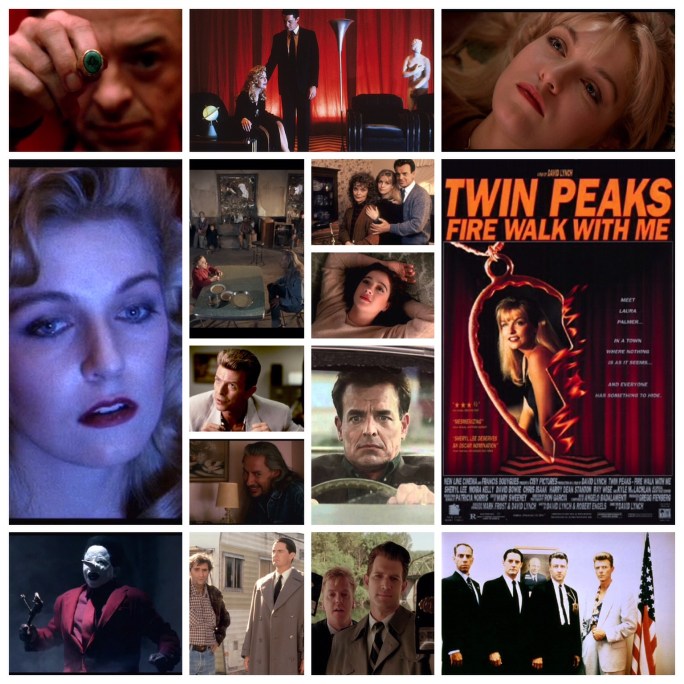
David Lynch’s big screen prequel/sequel to his television phenomenon Twin Peaks departs from the shows light, kooky and benignly eccentric sensibilities. It starts at the more surreal, dark atmosphere which sometimes materialized in the show, especially in the last episode, and plunges headlong down a rabbit hole of sex, murder, mysteries, federal agents, parallel universes, psychological torment, otherworldly spirits, supernatural phenomena, incest, more cups of coffee (Im not even kidding, there’s a scene where a stressed out looking Harry Dean Stanton makes a ‘cup of good morning America’), and above all, Laura Palmer. The beautiful, mysterious homecoming queen we only saw as a corpse in the series comes to wild, screaming life in this film, and what a performance from the gifted Sheryl Lee. She perfectly captures the menace, hurt, confusion, hope, torment and wild desperation of Laura, in a towering, stunning performance. Ray Wise is equally magnificent as Leland Palmer. Angelo Badalamenti switches up the tone as well, letting the beautiful Laura theme and the classic Twin Peaks tones only play in limited, selective fashion. His theme for the film is a powerfully dark, otherworldly melody which lulls you right into the film’s deep velvet grasp and haunts you in ways you can’t describe. The angel of the Roadhouse, Julee Cruise, gets another tune to croon as well, and it might just be my favourite of the bunch. Laura tearfully looks on as Cruise intones ‘Questions In A World Of Blue’, a transfixing lament that seems to be meant for her alone. Lynch is a true master of the subtle touch, and you’d have to read many an online forum as well as watch the film and the show several times to pick up on all the hidden implications and shrouded ideas that aren’t readily presented to you in a traditional narrative. That inaccessibility and refusal to play by the rules by serving things straight up is difficult for many people to get their heads around. To me though it’s such a fascinating way to tell a story. He doesn’t necessarily leave everything open to interpretation, he just hides the answers in a bewitching blanket of surreality, subtlety and dream logic, challenging the viewer to think using the unconscious mind and intuition to feel your way through the story, as opposed to tallying up facts and plot turns to analytically arrive at your cinematic destination. Perhaps this is why he meticulously oversees many of the DVD releases for his films, leaving out scene selections and unnecessary bells and whistles. The story matters most to him, in singular, unbroken form, a segment of his soul encapsulated on film in one cohesive effort, like a dream caught unawares by the lens. Fire Walk With Me was unfairly bashed, booed and downright critically clobbered for its stark and outright changes from the shows lighter tones, as well as its leaving out of some of the more popular characters that fans loved. Although this is jarring, I feel like Lynch has distilled all the elements in the show that mattered the most to him, and woven a gorgeous, seductive tapestry of pure Twin Peaks ‘feel’ and spectacle, as a loving gift to the fans who truly get it and are open to the wilder ideas explored briefly in the show. The film expands greatly on the ominous Black Lodge, and it’s dwelling spirits, including the strange Tremonds, the one armed Mike, and the little red suited Man From Another Place. The killer demon Bob is very prevalent in this film, and if you thought he was scary in the show, well.. His scenes in this are downright soul shatteringly. Moira Kelly makes a softer, doe eyed version of Donna Hayward, which I quite liked. Miguel Ferrer returns as the cynical wise-ass Albert, Lynch as the hard of hearing FBI boss Gordon Cole, as well as Heather Graham, Grace Zabriskie, Eric DaRe, Madchen Amick, Peggy Lipton, etc. Newcomers to the Twin Peaks mythology are great as well, including Chris Isaak and Kiefer Sutherland as more FBI agents investigating the case of Teresa Banks in Deer Meadow, Jurgen Prochnow as a trapped soul in the spirit world, and a confused looking David Bowie as an agent who has been mired in the time bending fog of the spirit world long enough to render him brain fried. It’s a love letter to the fans, really, but one that doesn’t compromise an inch and is every ounce a Lynch picture, capturing the director at his most creative adventurous. He strives to plumb the depths of human behaviour and the forces beyond our perceptions which govern and influence from other planes. Seeing these tricky themes explored so rawly in a film based upon a TV show that had heavy roots soap opera and an often lighthearted tone only garnished with the disturbing elements in the film can be hard to swallow, which is no doubt the reason for the sour reception upon release. The film has stood the test of time and aged wonderfully though, seen by many grateful, loving fans as a dark dream straight from the heart, and a perfect film. If one is willing to accept the changes in tone and ambiguous, challenging nature of Lynch’s storytelling (which I love!) then Fire Walk With Me is a sumptuous, gorgeous looking, vital piece of the Twin Peaks world, and in my mind Lynch’s masterpiece.
TRAINSPOTTING – A REVIEW BY J.D. LAFRANCE

Trainspotting flew out of the gates in 1996 and took the world by storm, first causing a sensation in the United Kingdom, and then moving on to the United States bolstered by a soundtrack that mixed classic rockers (Lou Reed, Iggy Pop) with contemporary ones (Blur, Primal Scream). Audiences couldn’t get enough of this gritty, often funny, sometimes harrowing tale of Scottish heroin addicts. Based on Irvine Welsh’s edgy cult novel of the same name, Trainspotting was adapted by a trio of filmmakers – director Danny Boyle, screenwriter John Hodge and producer Andrew Macdonald – who had previously collaborated on the nasty suspense thriller Shallow Grave (1994).
They chose just the right passages from the novel and proceeded to capture the spirit of what Welsh was trying to say without judging the characters. This resulted in the film getting into trouble as some critics felt it glorified drug addiction. The film takes an unflinching look at the lives of a group of drug addicts and shows why they do drugs — the highs are so unbelievably amazing. However, Trainspotting also shows the flip side: death, poverty and desperation, which lead to stealing, lying and cheating just to get more drugs. Regardless, the film was a commercial and critical success, spawning all sorts of imitators and influencing countless other U.K. filmmakers to go through the door that it kicked open.
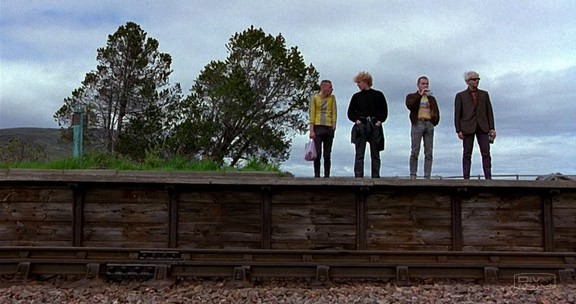
The six-minute prologue does a brilliant job of introducing a group of Scottish drug addicts as seen through the eyes of one of them — Mark “Rent Boy” Renton (Ewan McGregor). His friends include a speed freak motormouth named Daniel “Spud” Murphy (Ewen Bremner), a suave ladies’ man, Simon “Sick Boy” Williamson (Jonny Lee Miller), straight-edged Tommy MacKenzie (Kevin McKidd) and sociopath Francis “Franco” Begbie (Robert Carlyle). Each one of them has their own distinct personality that each actor vividly brings to life. This prologue also sets the tone for the rest of the film as it starts literally on the run with Renton and Spud being chased by the cops to the pounding strains of “Lust for Life” by Iggy Pop (before it became overused thanks to countless commercials using it bizarrely out of context) as Renton’s voiceover narration talks about his “sincere and truthful junk habit.”
The energetic camerawork — fasting moving tracking shots (that recall Mean Streets) as Spud and Renton run from the police and the freeze frames (reminiscent of GoodFellas) with title cards identifying each character is an obvious stylistic homage to Martin Scorsese. Like many of his films, Trainspotting is bursting at the seams with energy and vitality that is very engaging. The prologue does its job by immediately grabbing our attention and drawing us into this world populated by colorful characters. After 30 minutes of showing the incredible highs of shooting heroin where we’re caught up in the euphoria of it with Renton and his friends, director Danny Boyle starts to show the ugly side, starting with the death of fellow junkie Allison’s baby due to neglect.
From there, Renton and Spud get arrested for stealing with the former going into a rehab program while the latter goes to jail but not before Renton takes one more hit and promptly overdoses in a surreal bit where he sinks into the floor and is taken to the hospital by taxi seen mostly from his zonked out point-of-view to the strains of “Perfect Day” by Lou Reed. However, Trainspotting’s heart of darkness is the sequence where Renton goes through the horrors of withdrawal and his reality becomes warped by hallucinations of Allison’s dead baby and his friends. Ewan McGregor really does a fantastic job of conveying Renton in the depths of a painful and terrifying withdrawal.
John Hodge’s screenplay masterfully distills Welsh’s novel to its essence and includes some of its most memorable dialogue. From Renton’s famous “Choose life” monologue (“Choose life … But why would I want to do a thing like that? I chose not to choose life: I chose something else. And the reasons? There are no reasons. Who needs reasons when you’ve got heroin?”) to Sick Boy’s “Unifying Theory of Life” speech (“Well, at one time, you’ve got it, and then you lose it, and it’s gone forever.”), Trainspotting has insanely quotable lines. This helped it develop a loyal cult following over the years that continues to champion the film even to this day. And yet what resonates most is its honesty. The film doesn’t sugarcoat its message and it isn’t preachy about it either. There is an ironic detachment that transforms it into a playful black comedy mixed with gritty drama and surreal sequences.
It doesn’t hurt that this excellent material is brought to life by a fantastic cast of then relative unknowns (especially to North American audiences). Ewan McGregor has the toughest role in the film playing an unrepentant junkie while also acting as the anchor that the audience identifies with and the character that the rest of the cast revolves around. It is a tricky balancing act because Renton does things that make him unlikable and yet we still root for him because of McGregor’s charisma. Fresh from his role as an American computer user in Hackers (1995), Jonny Lee Miller plays Sick Boy, Renton’s best mate but someone who lacks “moral fiber” despite his vast knowledge of Sean Connery. He ends up taking advantage of his friend in a dodgy scheme and Miller does a nice of showing how Sick Boy went from best mate to scheming con man.
Robert Carlyle is also great as the completely unhinged Begbie. The scene where he recounts a colorful story about playing pool (“I’m playing like Paul-Fuckin’-Newman by the way.”) and dealing with his cocky opponent (“You ken me, I’m not the type of cunt that goes looking for fuckin’ bother, like, but at the end of the day I’m the cunt with a pool cue and he can get the fat end in his puss any time he fucking wanted like.”) perfectly captures the essence of his character. Begbie gets his kicks from starting up trouble. As Renton puts it, “Begbie didn’t do drugs either. He just did people. That’s what he got off on; his own sensory addiction.” Carlyle has a frightening intensity and an unpredictability that is unsettling and exciting to watch. Ewen Bremner completes the core group of characters as the not-too bright Spud. He has a good scene early on when, hopped up on speed, he goes to a job interview with the notion of sabotaging it without appearing to. It’s a tricky tightrope that Bremner handles expertly.
Trainspotting also features one of the best contemporary soundtracks with an eclectic mix of British music from the likes of Primal Scream, New Order, Blur and Underworld, and from America, Iggy Pop and Lou Reed. The music veers back and forth from the adrenaline-rush of Iggy Pop’s “Lust for Life” to the faux spy music by Primal Scream to the drugged-out mellow mood music of “Perfect Day” by Lou Reed. Taking a page out of Scorsese’s book, the filmmakers use the music as signposts by conveying the transition of guitar-driven rock in the 1980s to the acid house music scene in the 1990s.
Producer Andrew Macdonald first read Irvine Welsh’s novel Trainspotting on a plane in December 1993 and felt that it could be made into a film. He turned it on to his filmmaking partners, director Danny Boyle and screenwriter John Hodge in February 1994. Boyle was excited by its potential to be the “most energetic film you’ve ever seen – about something that ultimately ends up in purgatory or worse.” He convinced Welsh to let them option the rights to his book by writing a letter stating that Hodge and Macdonald were “the two most important Scotsmen since Kenny Dalglish and Alex Ferguson.” (legendary European football player and manager, respectively, from Scotland) Welsh remembered that most people interested in optioning his book, “wanted to make a po-faced piece of social realism like Christiane F or The Basketball Diaries.” He was impressed that Boyle and his partners wanted everyone to see the film and “not just the arthouse audience.” Welsh agreed to sell the rights to them.
In October 1994, Boyle, Hodge and Macdonald spent a lot of time discussing which chapters of the book would and would not translate onto film. Hodge adapted the novel, finishing a first draft by December, while Macdonald secured financing from Channel 4, a British television station known for funding independent films. According to the screenwriter, his goal was to “produce a screenplay which would seem to have a beginning, a middle and an end, would last 90 minutes and would convey at least some of the spirit and the content of the book.”
Pre-production on Trainspotting began in April 1995. When it came to casting the pivotal role of Mark Renton, Boyle wanted somebody who had the quality “Michael Caine’s got in Alfie and Malcolm McDowell’s got in A Clockwork Orange”: a repulsive character with charm “that makes you feel deeply ambiguous about what he’s doing.” Boyle and Macdonald were impressed with the performance Ewan McGregor had given in their previous film, Shallow Grave, and cast him in advance. Ewen Bremner had actually played Renton in the stage adaptation but agreed to play the role of Spud because he felt “that these characters were part of my heritage.” Boyle had heard about Jonny Lee Miller playing an American in Hackers and was impressed with him when he auditioned by doing a Sean Connery accent. For the role of Begbie, Boyle thought about casting Christopher Eccleston who had been in Shallow Grave but asked Robert Carlyle instead. The actor said, “I’ve met loads of Begbies in my time. Wander round Glasgow on Saturday night and you’ve a good chance of running into Begbie.”
Once cast, Ewan McGregor shaved his head and lost 26 pounds. To research the role, the actor actually considered taking heroin but the more he read and learned about it, the less he wanted to do it. Then, he went to Glasgow and met people from the Carlton Athletic Recovery Group, an organization of recovering heroin addicts. He (and several other cast members) took classes on how to cook up a shot of drugs using glucose powder.
With a budget of $2.5 million, Trainspotting was shot during the summer of 1995 over seven weeks. The cast and crew moved into an abandoned cigarette factory in Glasgow. Due to the rather small budget and limited shooting schedule, most scenes were shot in one take with the effects done practically. For example, when Renton sank into the floor after overdosing on heroin, the crew built a platform above a trap door and lowered actor McGregor down.
When Trainspotting was shown out-of-competition at the 1996 Cannes Film Festival, it received a standing ovation. Once Miramax Films picked it up for North America, Macdonald worked with them to sell the film as a British answer to Pulp Fiction (1994), flooding the market with postcards, posters, books, soundtrack albums, and a revamped music video for Iggy Pop’s’ “Lust for Life” directed by Boyle.
Trainspotting has aged surprisingly well considering it was one of those zeitgeist-defining movies of the ‘90s. It also set the tone and style of later British exports, opening the floodgates for films like the nasty crime drama Twin Town (1997), the hyperactive rave culture comedy Human Traffic (1999) and the films of Guy Ritchie. In an interview for The Guardian, Boyle said, “Has it dated? I can’t tell you that. I am alarmed sometimes by how young the people are who say they’ve seen and loved Trainspotting, so it might have lost an edge it once had. Shallow Grave looks dated, fashion-wise, but Trainspotting has an abiding style.”
B Movie Glory with Nate: Hurricane Smith
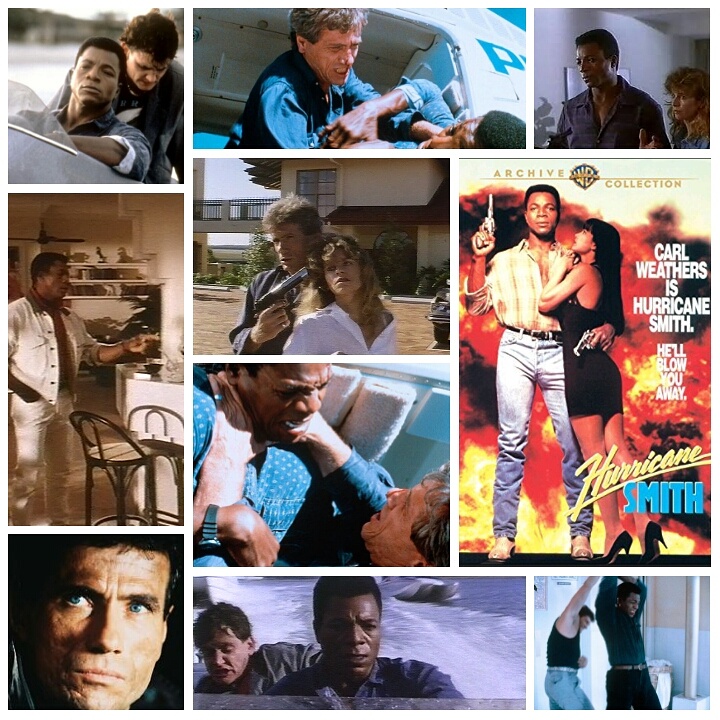
Buckle up and watch built badass Carl Weathers head down under to take on vicious Australian criminals in Hurricane Smith, a blast of saxophone laced, trashy 80’s cheese that hits every beloved cliche in perfect chiming key. Weathers is an valued staple to the action genre, a memorable part of Predator and of course his thundering turn as Apollo Creed in the Rocky films. Along with his obvious commanding physicality, he has a likeability that lends itself nicely when it comes to playing heroes out for retribution. His character got the nickname Hurricane after he pulled a friend out of a falling building during the titular meterological event, cementing him as a tough guy worthy of carrying a ninety minute action flick on his shoulders. Hurricane is off to Australia, in search of his sister who has recently gone missing. He stumbles right into the midst of a hornet’s nest of a criminal organization, led by Charlie O Dowd (Jurgen Prochnow), a stunningly evil pimp and drug runner. Prochnow loves to paint his villains in broad, garish strokes and he downright outdoes himself here, careening through a performance of wanton carnage and positively dripping malice. Hurricane is a massive thorn in his side, dismantling his operation in every attempt to learn what happened to his sister. He gets romantically involved with a kindly hooker (Cassandra Delany) leading to the obligatory 80’s slow dance sex scene that everyone waits for in these type of flicks. There’s bullets, car chases, an action scene on a helicopter and all kinds of trademark B movie lunacy. Weathers makes a damn good hero. Prochnow is one hell of a wicked villain. Fun stuff.
The Big Empty: A Review by Nate Hill
The Big Empty is a quirky, off kilter little flick that packs a backpack full of borrowed elements from the Coen brothers and David Lynch, before embarking on a perplexing outing into the Twilight Zone. That’s not to say it rips any of these artists off, and indeed it’s got a style and cadence all its own. It just loves other oddballs before it and wants to wear it’s influences proudly. Everyone’s favourite lovable schlub Jon Favreau plays John Person, a flailing, out of work actor. He’s presented with a dodgy proposition by his whacko neighbour Neely (eternally bug eyed Bud Cort). Transport a mysterious blue briefcase to a remote town in the Mojave Desert called Baker. There he will meet a much talked about, little seen individual called The Cowboy (Sean Bean), who will take the case off his hands. He agrees, as he must in order for us to have a film to watch, and heads out to the back end of nowhere. In any respectable piece like this, the town our hero visits must be populated by weirdos, eccentrics, dead ends, missed encounters and an abiding, ever present atmosphere of anomalous peculiarity. Right on time, he meets a host of charming characters, including Grace (Joey Lauren Adams), her sensual daughter Ruthie (Rachel Leigh Cook), Indian Bob (Gary Farmer), grouchy FBI Agent Banks (Kelsey Grammar), and a bunch of others including Daryl Hannah, Melora Walters, Jon Gries, Brent Briscoe, Adam Beach and Danny Trejo. He’s led from one head scratching interaction to the other, each step of the way proving to be a step behind the elusive Cowboy, with no form of coherence appearing to ease poor John’s bafflement. I was reminded of Jim Jarmusch, particularly his masterpiece Dead Man, perhaps because Gary Farmer appears in both, but most likely mainly due to the fact that both films follow a hapless Joe on a journey that doesn’t seem to be going much of anyplace, but holds interest simply by being bizarre enough. Favreau is the only one that doesn’t fit, the outsider whose laid back suburban affability creates friction with almost every individual he meets, all who seem to have wandered in from the outer limits of some other dimension. Sean Bean is relaxed, mercurial with just a dash of danger as The Cowboy, quite possibly the strangest person John meets. The film has unexpected jabs of humour too, which occasionally breach the surface of its tongue in cheek veneer of inaccessibility. Upon meeting Indian Bob, John inquires: “Are you Bob The Indian?”. Bob jovially retorts “No, I’m Lawrence the fuckin Arabian.” Gary Farmer brings the same cloudy, sardonic cheek he brought to the role of Nobody the Indian in Jarmusch’s Dead Man, which had much the same type humour as this one: little moments of hilarity buried like treasures amongst the abnormal. Sometimes I muse that films like these which seem to really go nowhere in high style are there simply to give your brain a workout in odd areas that it wouldn’t normally play in. Set up a voyage like this, lead the audience down a yellow brick road and arrive at.. well basically nowhere in particular, just to chuckle at your efforts to figure it all out, jab you in the ribs and say “Don’t take this shit too seriously, man!”. Or maybe not. Maybe there’s deeper meaning behind the meandering, that will reveal some holy significance. This one, though, I doubt it. It’s pure playtime.