B Movie Glory: Into The Grizzly Maze

I’ve never seen potential, cast and atmosphere so wasted like I did in Into The Grizzly Maze, there’s just no excuse for dicking up such a great premise like they did here. Originally titled Red Machine, which is way better anyways, it concerns various characters chasing down a monstrous rogue grizzly bear somewhere in the Pacific Northwest (actually Vancouver, naturally). These folks include ex con James Marsden, his park ranger brother Thomas Jane, Sheriff Scott Glenn, poacher Adam Beach and miscast Billy Bob Thornton as some sort of guru bear hunter. The character and writing are almost all flat, which amazes me because I’d be hard pressed not to write at least some engaging dialogue for a cast this badass, but nope. Marsden is as bland as sandpaper, Jane seems bored to tears, Thornton is so misplaced even his coat looks uncomfortable, Glenn is more grizzly than the bear but is underwritten, while Piper Perabo has a classic thankless chick role that’s beneath her talents. Seemingly immortal actor Bart The Bear is used effectively here but he can’t carry a film on his own and as a result the only truly memorable things are the beautiful locations and a particularly gruesome bit of makeup where half of Thornton’s face is literally slashed to ribbons, nice touch that. This seems to be a vague rehash of a 70’s bear flick that, from the looks of it, is probably eons better than this TV movie level garbage. Shame, as we’ll probably never see this cast together again. Avoid.

-Nate Hill

Panos Cosmatos’s Mandy

“When I die

bury me deep

lay two speakers around my feet…

wrap two headphones around my head, and rock and roll me when I’m dead”

Panos Cosmatos’s Mandy. Wow. This is a film I have been waiting a year for, and while I eagerly devoured up every production still, sound byte and trailer released for marketing, none of that diminished the thunderous, neon drenched nirvana that was the experience seeing it on the big screen. Cosmatos is madly, deeply in love with 80’s horror/fantasy/scifi cinema, and after the initial stroke of brilliance that was Beyond The Black Rainbow, he has evolved into something more cohesive and specific, but no less balls out surreal and brazenly expressionistic. Set in the same austere, timeless 1983 twilight zone meta-verse as Rainbow, this one sees tortured lumberjack Red (Nicolas Cage) exacting apocalyptic vengeance on both a maniacal cult and a clan of demon bikers for the murder of his beloved girlfriend Mandy (Andrea Riseborough). That is of course the nutshell, analytical summary you’ll see in the online rental guide. What really fills up this two hours of nightmarish bliss is a more free flowing, right brain amalgamation of everything special to Cosmatos in both cinema and music, mottled using material from his own lively imagination, wearing influences both proudly and organically on his sleeve and giving us the gift of one of the most intensely invigorating pieces of art I’ve ever seen. The rage is all about Cage and his gonzo performance, and while that is a sideshow later on, it’s certainly not the main event and the real strength of his performance lies in the restrained, beautiful relationship he has with Mandy, which only makes his crazed rampage cut all the more deep later on. Riseborough is really something special in her role too, she’s the crux of the whole deal and gives Mandy an ethereal, introverted aura that’s just creepy enough and cute enough to live up the film’s title. Linus Roache is really something else as Jeremiah Sand, the fiercely insecure, manically dangerous cult leader, it’s a career peak for the former Thomas Wayne and he plays him like a bratty failed folk musician who’s delusions have fused into his very soul and made him really fucking sick. Ned Dennehy is freakishly deadpan as his second in command, while chameleon actor Richard Brake has a key cameo and veteran Bill Duke shows up to provide both weapons for Cage and a tad of exposition regarding the Hallraiser-esque bikers. This is the final original score composed by Johann Jóhannsson before his untimely passing, and it’s one hell of a swan song. After a gorgeous, arresting opening credit sequence set to King Crimson’s Starless, its all dreamy synths, thunderclaps of metal, extended passages of moody, melodic strains and threatening drones, a composition that leaves a scorched, fiery wake in its fog filled path. One thing that’s missing or at least depleted in film these days versus yesteryear is atmosphere: Back then there were ten smoke machines for every acre of set, title fonts were lovingly hand painted and scenes took their time to unfold, rather than tumbling out of the drawer in a flurry ADHD addled action and exposition. Cosmatos is a physician to this cause and his films feel like both blessed nostalgia and an antidote to that which many filmmakers have forgotten. With Mandy he has created a masterpiece of mood, violence, dark humour, hellish landscapes, softly whispered poetic dialogue, Nic Cage swilling down a sixty pounder of vodka in his undies, fire, brimstone, roaring engines, beautiful music, a tiger named Lizzie, and a pure unbridled dove for making the kinds of films I want to see at the multiplex. Best of the year so far.

-Nate Hill

Leigh Whannell’s Upgrade

Leigh Whannell’s Upgrade is slick, bloody, wired Sci Fi action pulp and I loved every second of it, mounted on a high concept premise that’s just this side of outrageous and filled with both enough body shredding extreme violence and atmospheric mood to fuel an entire TV show. A quirky, intelligent mix of horror and futurism, Whannell puts the same brains responsible for the first Saw film into the story of Grey (Logan Marshall Green) a mechanic who is given a nifty new implant following the murder of his wife (Melanie Vallejo) that also leaves him a quadriplegic. Dubbed the Stem and cooked up by a weirdo tech mogul (Harrison Gilbertson), it latches onto his nervous system and makes him a super fast, highly capable killing machine and he sets out to find his attackers and… well.. kill them all in just about as violent ways as anyone could think up. There is actual thought, care and innovation put into this world and it’s construction though, until the very exploitive genre material feels lifted up by pure creation and we get something that thinks, feels and ponders just as much as it stabs and bleeds. An organic mix of Blade Runner style setting is welcome, as both the city they live in and the esoteric score by Jed Palmer are very LA 2049 with a hint of steampunk. Green is a great actor who has slowly been building steam in fits and starts, he had a smaller role in Prometheus and headlined the very underrated Cinemax original Quarry recently, but her he shows he can do leading man work in bigger projects, he’s tough, engaging and sympathetic. This is an extreme vision of a futuristic world that although seems alien to us, is not so different in many ways, and that makes it both scary and compelling. One of the best this year so far.

-Nate Hill

Peter Hyams’ End Of Days

Arnold Schwarzenegger versus The Devil. Just let that sink in. It had to happen at some point in the guy’s career, and I’m thankful it turned out to be Peter Hyams’ End Of Days, a slam bang action horror party of a film that is lowkey one of the best things Arnie has ever done, both in terms of production and the character he gets to play. As Jericho Cane, he’s a far cry from the competent badasses he usually plays, an alcoholic ex secret service agent dealing with the trauma of a murdered family. The last thing he needs is Satan setting up shop in Manhattan on his watch, but that’s exactly what’s in store, for every millennium or so, the red guy gets to take a vacation earth-side in a human host, and if he’s able to get laid with a carefully chosen girl, he gets to take over the world. Some dodgy theology there, but this is an Arnie flick. The human host in question happens to be slick stockbroker Gabriel Byrne, who is soon causing havoc all over the Big Apple in his search for Robin Tunney, the girl marked by a satanist cult decades before and groomed to be his concubine. Arnie’s hangdog private security tough guy and sidekick Kevin Pollak are unlikely heroes to stop the prince of evil himself, but Theron lies the fun, and Cane is actually one of his best, most unique characters to date. Throw in Rod Steiger as a priest whose middle name is exposition, Miriam Margoyles as Tunney’s sinister Aunt (also the only 5 foot tall, chubby middle aged woman to whip Arnie’s ass in a fight), Udo Kier as the freaky cult priest, CCH Pounder as a no nonsense NYPD bigshot, Mark Margolis as the melodramatic Pope in Rome and others, you’ve got one solid cast. Byrne really steals the show and is up there with my favourite cinematic incarnations of Beezle, especially in his smooth, smug and smouldering delivery of some truly patronizing, vicious dialogue to try and dispel Jericho. Arnie’s retort? “You ah ah fucking choirboy compared to me!!” Priceless. The action is big, loud and utilizes NYC to its full scope, with subway scenes, a daring helicopter chase sequence and all kinds of explosive mayhem. The horror element is spooky as all hell too, especially in the first third of the film where atmosphere mounts and dread creeps in (that weird albino dude on the train will forever haunt me), plus the score from “ echoes around like a spectre as well. Not one of Arnie’s most celebrated critically, but will always be one of my favourites.

-Nate Hill

Platinum Dunes’ The Hitcher

I won’t pretend to be a fan of horror remakes other than Rob Zombie’s Halloween, but when they cast Sean Bean as iconic highway madman John Ryder in the inevitable second lap of Robert Harmon’s horror classic The Hitcher, I perked up. Bean, like Rutger Hauer in the original, is one of my favourite actors of all time and I had to to see what he did with the character (he pulled out of another contract and jumped a plane just to accept this gig). The good news is.. he lives up to Hauer’s original asphalt angel of death, and I’ll fight anyone who argues. The bad news? The film doesn’t. It’s one of those dodgy, hit or miss Platinum Dunes horror updates (avoid Jason and Freddy like the plague, but their first Leatherface incarnation is quite good) and really misses out on the atmospheric, haunting pace of the first, where nightmares and reality blend into the mirages appearing on the desert horizon for lone motorist Jim Halsey… the thing is, here Jim isn’t alone at all but travelling with his girlfriend and that takes some of the primal fear out of it. Zachary Knighton fills C. Thomas Howell’s shoes and a surprisingly adept Sofia Bush plays the gal, on a road trip for spring break when they’re suddenly tormented by Bean’s Ryder, an intense creation by the actor that carefully avoids any callbacks or mimicry of Hauer. How could he though? Rutger made that role his own and Bean wisely does the same with a sardonic, smouldering aura all his own, and wins a spot in horror pantheon as a worthy update on this boogeyman of the backroads (he’s also better than Gary Busey’s kid was in that god awful sequel that no one wants to admit was even made). Everything here gets a torqued update, from the infamous body tied between two trucks scene (yuck) to the car chases (that Trans Am tho) to the violence itself, to legendary highway super-cop Lt. Esteridge, trading in cucumber cool Jeffrey DeMunn for hilariously hammy Neal McDonough, who kills it as the only officer who isn’t a bumbling moron. But who needs all that sound and fury when you’re trying to throwback to an atmosphere classic? I guess go your own way, but it really doesn’t do the Hitcher legacy any justice. Aside from Bean who elevates his scenes to horror greatness, it’s a slapdash, needlessly gruesome slice of knockoff cash grab slasher fare that takes everything that was spooky, shadowy and mysterious about the first one, shines a big broad daylight aesthetic on it that shakes off the cobwebs we never wanted gone in the first place, like Bon Jovi trying to cover a song by The Cure. There is, however, one moment that gets it right and rises to a level of quality deserving of the Hitcher brand. It’s right at the end, everything has gone haywire, all the cops are dead, all the cars have been thoroughly blown up, and Ryder makes one last dash to escape. Sofia Bush takes up a dead cop’s shotgun and musters one final confrontation with him, as the score by Steve Jablonsky swells to adrenaline heights and we get an exchange of dialogue between the two, both beautifully delivered, that is the first shred of originality the film displays and almost, *almost* redeems itself. Where was that for the previous eighty five minutes? In any case, this holds a spot in my heart simply because I’ve watched it enough times and has crystallized into something nostalgic, which as we all know sometimes supersedes what we know is quality from that which we know is not. Worth it for Bean, the score and that supersonic final scene.

-Nate Hill

Martin Scorsese’s Cape Fear

Martin Scorsese’s Cape Fear is a harrowing film, one with enough perverse psychosexual energy, dripping southern atmosphere, stalker suspense and domestic trauma to raise the dead from the swamps of North Carolina where it takes place. Technically a remake of an old 60’s black & whiter with Gregory Peck and Robert Mitchum, I have to give Scorsese’s version the edge no matter how controversial that opinion may be, he just had the freedom to take it further and not have to be so tame as films were back then. He also benefits from having star Robert Deniro in the hot seat as Max Cady, a monstrous, homicidal lunatic out to get Nick Nolte’s Sam Bowden, the slick heeled lawyer who put him away for years. Disclaimer: this is a thoroughly fucked up, highly disturbing film that goes to places you don’t even want showing up on the fringes of your nightmares, and doesn’t shy away from showing these atrocities in wild screaming life. Cady is an extremely clever, resourceful southern gentleman when he wants to be, and when the facade comes off he’s an unabashed, mass murdering psychopathic beast who will get at Sam any way he can, including the harassment and abuse of his wife (Jessica Lange) and teenage daughter (Juliette Lewis). It’s a setup for a wild ride of a thriller that seldom lets up once the wheels are rolling, and flies towards a conclusion set on the bayou that will raise hairs. Lewis, in one of her earliest roles, was rightly nominated for an Oscar, her simultaneous terror and mesmerization when Cady eerily seduces her is magnetic. The Mitchum and The Peck have two fun cameos too, the former as a sceptical cop and the latter as a hilarious, bible spouting asshole lawyer who shamelessly defends Cady. Nolte and Lange are charismatic in their scenes, but this is Deniro’s show all the way, and he creates a villain for the ages. Whether he’s beating up the guys Sam hires to beat him up, cackling maniacally in a movie theatre to piss everyone off, giving off violent rapey vibes to both Lewis and Lange or using freaky disguises to follow them all around, he’s a charming, ruthless boogeyman that has since become iconic. This is one of the premier psycho thriller of the 90’s, an intense, evocatively shot southern gothic freak show that has only gotten better with age.

-Nate Hill

Mike Figgis’s Cold Creek Manor

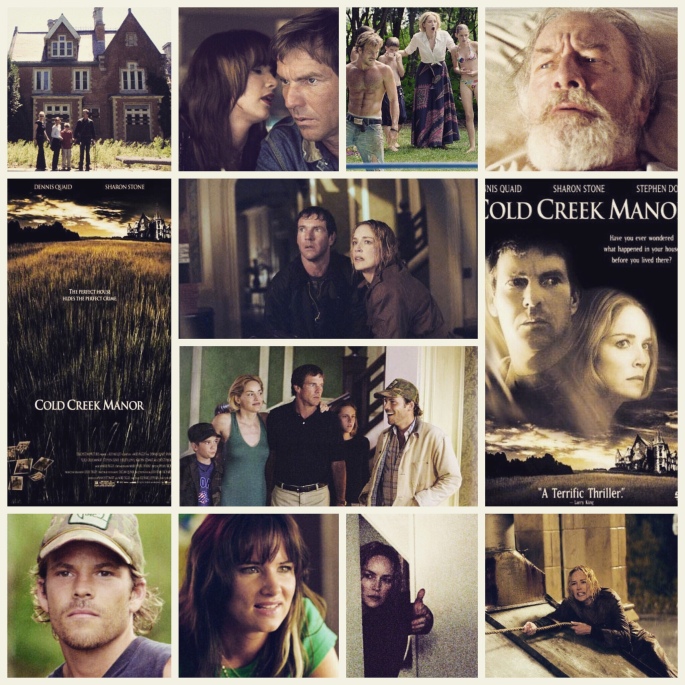
Mike Figgis’s Cold Creek Manor is one of those lurid thrillers that got absolutely shit on by critics, but I’ve always enjoyed its steely, mean spirited edge and nasty central antagonist performance from Stephen Dorff. There’s also the atmospheric locales of rural Ontario that add to the vibe, as well as the high pedigree class of actors you wouldn’t normally see in something this knowingly low brow. Dennis Quaid plays Cooper Tillson, a family man forced to move to the sticks for work. He buys up an ancient house in the woods with a lot of history behind it and some psychological baggage that’s not forgotten so easily. Dorff is Dale Massie, previous inhabitant and local roughneck who hates the idea of big city boy Quaid and his clan taking up roost in his former digs, probably because it stirs up past trauma for him and induces the scary, pissed off state he spends most of the film in. Quaid’s wife (Sharon Stone) and kids including a very young Kristen Stewart, start to get routinely creeped out when Dorff shows up more and more, insinuating his way into their collective idyllic country lives, until he gets downright violent and Quaid is forced to unlock the secrets of the manor to protect his family. Christopher Plummer has a barely coherent appearance as Dorff’s bedridden, dementia addled father, a deeply unnerving cameo if I’ve ever seen one. Spunky Juliette Lewis plays the local hoe-bag who openly mocks Quaid & Clan too. Ultimately this is glossy trash and they marketed it with trailers that made it seem like a straight up horror or supernatural thing, when in reality it’s much more of a stalker thriller, which is alright too, if you have a villain as intense as glowering, seething Dorff. It certainly doesn’t warrant the shit storm of bad reviews it’s amassed though, there’s fun to be had if you approach it with a popcorn movie mindset, and with that cast alone at least you get to watch them do their thing. Hey, at least it’s light years better than that fucking Dream House thing with Daniel Craig.

-Nate Hill

Brian De Palma’s Raising Cain

Not too many films can claim to be as certifiably, outright insane as Brian De Palma’s Raising Cain. Crazy, off the wall, nuts, there’s plenty of that in Hollyweird,

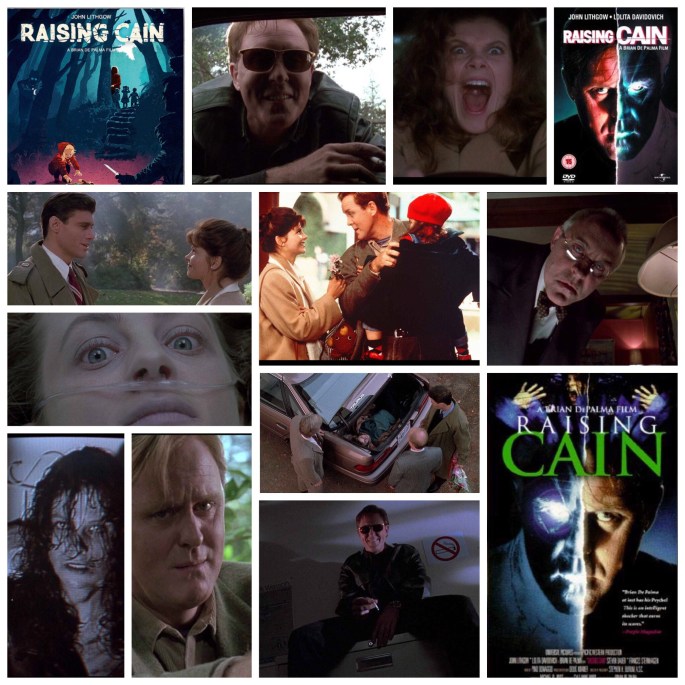
but Cain is so thoroughly deranged that I’m curious how De Palma arrived at such a specific brand of left field lunacy when he sat down at his typewriter. Get this: John Lithgow pulls an overtime shift playing Dr. Carter Nix, a slightly disturbed child psychologist who shows an unnatural budding interest in his daughter’s upbringing, so much so that it unnerves his wife (Lolita Davidovitch) to a degree. I describe him as only slightly disturbed because his level of mania pales in comparison to his multiple emerging split personalities, which is where the trouble really begins. Carter’s father (also Lithgow) was a psychotic Norwegian doctor who had a habit of using children for bizarre mind control experiments, and it seems that one of Carter’s multiples has decided to take up his work. Soon there’s a rash of baby kidnappings in the area and all hell breaks loose. His wife is too busy having an adulterous affair with a hunk (steamy Steven Bauer) to really take control either. Sounds crazy in writing? The film takes it way further than you could ever imagine. Lithgow always seems a bit nuts, even when playing straight-laced characters we always get this vibe like he’s a court jester who has lost his marbles, and he revs that organic looniness into overdrive here. Frances Sternhagen is a hoot as the obligatory exposition here, a stern doctor who lays out Carter’s complex, condition to two cynical detectives (Tom Bower and Gregg Henry, both great) who try to keep up with this whole circus. I can understand why this film didn’t do too well, I mean… how do you even classify it? Almost everything about the subject matter is highly uncomfortable stuff that threatens to siege over into the lands of taboo, and there’s all kinds of freaky shit in this screaming haunted asylum of a flick. That’s the fun of though, if you’re able to have some. De Palmer has always had a gift for shocker material even when he’s not operating in the thriller genre. There’s a cold, caustic edge to this film that barely contains the sea of menace and mirth roiling beneath, which is an odd, off colour and chilling mix. See it for yourself.

-Nate Hill

Francis Ford Coppola’s Twixt

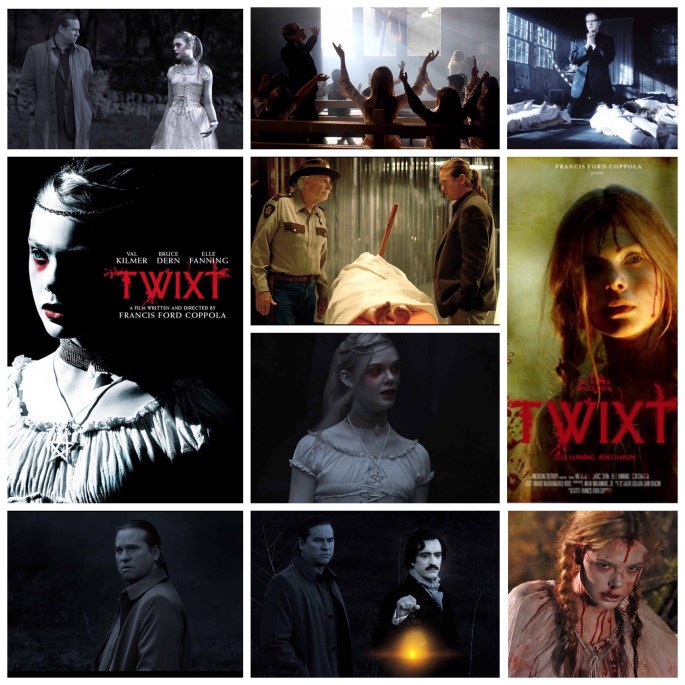
How to even approach Francis Ford Coppola’s Twixt. For a guy whose career has spanned decades from golden age Hollywood to contemporary and etched out a few mile markers that have practically defined the medium, this is definitely both the odd duck and black sheep of the man’s career. There’s no way around it either so I’ll be blunt: it’s kind of a mess. But it’s an intermittently breathtaking mess, like someone spilt a can of turgid motor oil in their garage, but a few gold and silver flakes of airbrush paint snuck into the oozing puddle. There’s a noticeable Stephen King vibe here, with flippant Val Kilmer as horror novelist Hall Baltimore, struck with writer’s block and hiding out in a creepy Midwest town to try and get the creative juices flowing. There’s murder afoot there, in more ways than one, and soon he’s visited by the ghost of a girl (Elle Fanning, darkly ethereal) who guides him along a chain of memories that recall missing children from the past. The town’s gruff, obnoxious Sheriff (Bruce Dern) doesn’t appreciate Hall nosing around his neck of the woods and harasses him at every turn. There’s Skype seasons with his wife (Joanne Whalley, Killer’s real life ex) that feel suspiciously improvised, an appearance by Edgar Allen Poe himself (Ben Chaplin) and creaky narration from none other than Tom Waits. Ultimately it doesn’t really connect, and feels so fascinated by itself that it fails to coherently tell us the tale in a way that sticks. What does take hold, however, are some truly gorgeous and striking visuals, lit by stark silver moonlight, accented by crimson blood and brought to unholy life by tactile, riveting slow motion, like a dream sequence in which Kilmer observes a group of ghost children frolicking on an eerie riverbank. Much of it feels subconscious and free form or lifted out of an Evanescence music video, but it’s beautiful nonetheless. It just needs the focus of the script to properly come across as a whole story, which, sadly, it mostly doesn’t have. Fanning makes the biggest impression as the ghostly waif, peering off the film’s poster and promising a poetic spook show, which… we kind of get. This has been seen as a shrill blast of emptiness by many critics, but there’s some fun to be had, and plenty of gothic eye candy to feast on, even if the brain goes hungry.

-Nate Hill

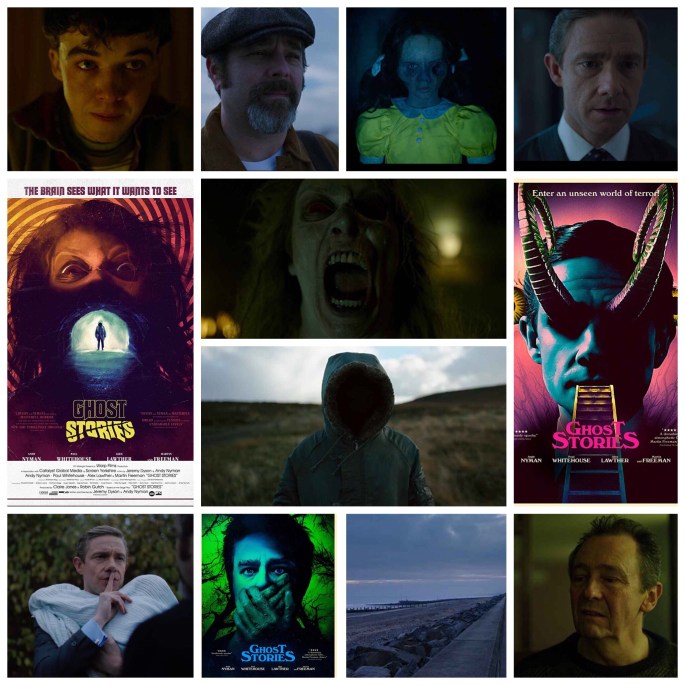
Ghost Stories

It’s always hard to find a horror flick these days that’s actually genuinely scary, not to mention fun as well. You have your endless found footage stuff, a consistent parade of ghost/exorcism fare, various creature features, and in the columns of hit or miss, unfortunately the latter weighs heavier. But once in a while there’s that terrifying ruckus of a haunted house flick that comes along and knows how to assault you on all sides with the creep factor, the laugh cannon and be a smart, well told and unexpected tale too. Ghost Stories is just that, a gleeful throwback to the BBC anthology horror of the 80’s that pulls the rug right out from you and frightens in a big way.

Set up in three distinct segments plus a kicker of a final fourth act, it follows a paranormal debunker (Andy Nyman) as he revisits three decades old spooky cases that have never been solved and haunt the afflicted to this day. The first and scariest sees a night watchman (Paul Whitehouse) on shift at an abandoned asylum who’s plagued by a restless spirit. In the second, a young boy (Alex Lawther) is harassed by a devilish creature as he drives through a forest in a stolen car. Lastly, father to be Martin Freeman is terrorized by a poltergeist in his home. These stories work great on their own but they really serve as a tapestry of clues to what’s really going on, and later down the line there’s some chilling revelations that are far more disturbing than any ghost going bump in the night. This is like the best, strongest points of Twilight Zone, Tales From The Crypt and Goosebumps done right with just a flourish of Black Mirror on the side. Freeman gives the best work, becoming cheerfully psychotic later and injecting delirious amounts of extremely dark humour into every mirthful grimace and off the wall mannerism. This is what horror should be.

-Nate Hill