Summer’s Moon: A Review by Nate Hill 

Summer’s Moon, also given the slightly less exotic title Summer Blood, is a fascinating little family centered psycho sexual treat, starring an actress who previously hadn’t ventures into such intense territory. Ashley Greene is a porcelain beauty best known for those Twilight train wrecks, and its that marketing style these filmmakers have latched onto because of her involvement. The poster has a hazy hue that almost hints at the dreaded vampiric sparkle we’ve come to loathe. It’s picturesque to be sure, but doesn’t really provide any warning to the disturbing, gritty and uncomfortably intimate nature ofnthe story. Greene plays Summer, a wayward drifter who arrives in a small bucolic burg, out to find the father she never knew. Enter the Hoxeys, an I’ll adjusted family of serial killers claiming to be her long lost family, and beckoning her into depravity with all the charm and hospitality that small town folks can muster. Her brother Tom (Peter Mooney) keeps a kidnapped girl in the basement as a plaything and sleeps with his unstable mother (Barbara Nixon), and that’s but a taste of the horror that Summer has waded into. The film takes on new virility when the resident patriarch Gant Hoxey blows back into town, played with visceral ferocity by veteran tough guy Stephen Mchattie. Intense is the word for this guy (ever catch his cameo in A History Of Violence? Christ), and he’s a beast as Gant, Summer’s estranged father, a man who functions on violence and feeds of fear. The film examines how a clan of murderers might indeed function, right down to twisted lover’s spats and drama right out of an R rated Addams Family special. Greene nicely shatters her teen image by bringing us a broken protagonist who finds her dark passenger through resilience and torment, the blackness that sweeps over her soul clearly visible, loomed over by Mchattie’s grim reaper influence. Murder and the desire to do so is regarded as a genetic trait in this film, passed along the line of kin, generation to generation, wreaking havoc in the process. A film that I underestimated going in, a terrific horror entry that takes its it’s with character and suspense, slow burning up to a spectacularly gory third act filled with tension, blood and Mchattie, that icy voiced devil who steals every scene he’s in. Well worth your time. 

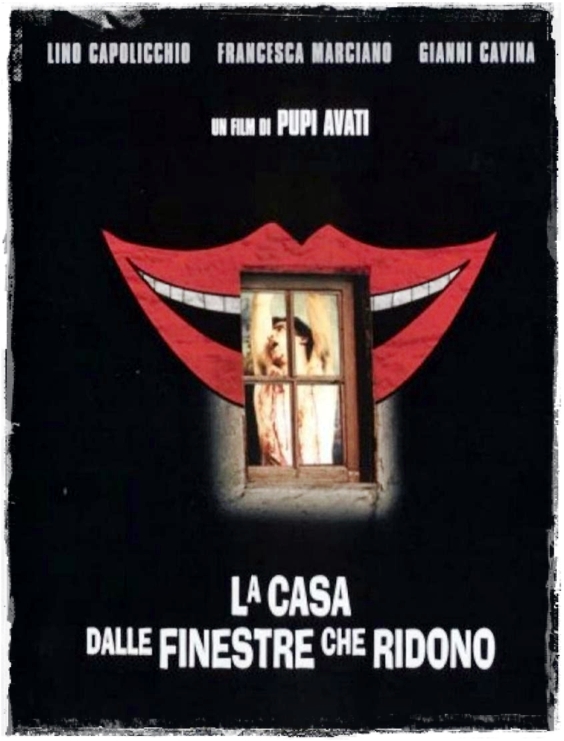
THE HOUSE WITH THE LAUGHING WINDOWS (1976) – A REVIEW BY RYAN MARSHALL

vlcsnap-2016-10-01-08h10m11s101.png

I must have been thirteen or fourteen at the time, and I don’t remember too much about what my world was like then, with the exception of it being a lesser variation of what it is now. If Argento, Fulci, and Bava are the more obvious names who introduced me to the black leather and brighter blood which would eventually shape my definitive creative conscious, director Pupi Avati opened up different doors entirely with his magnificent THE HOUSE WITH THE LAUGHING WINDOWS, a brilliant subversion of the Giallo formula with heavy doses of folk horror and genuine social-political subtext.

The Gialli that I am particularly fond of have more in common with THROUGH THE LOOKING GLASS than the standard crime narratives of the yellow paperback novels from which they derive their title, and as such, this is as important an entry as SUSPIRIA, Fulci’s THE PSYCHIC, or Sergio Martino’s delectably psyched-out masterpiece ALL THE COLORS OF THE DARK. What is perhaps most immediately intriguing is the placement of this particular rabbit hole in a twisted, though ultimately familiar semblance of reality. By association, the Giallo is a heightened affair, but Avati is skillful in how and where he engages with the fantastical.
vlcsnap-2016-10-01-08h06m37s379.png

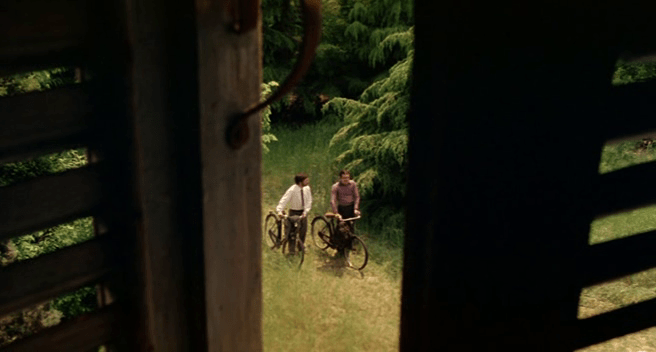
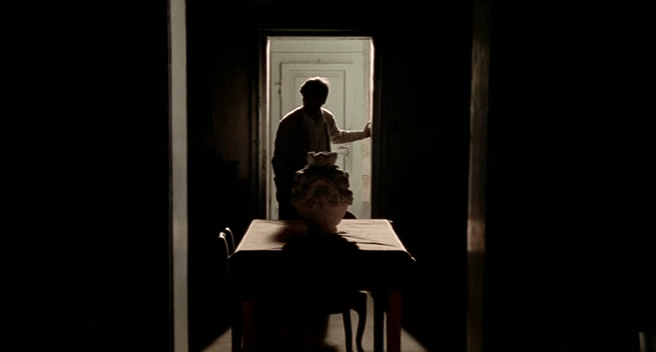
The log-line for this one is refreshingly simple: a man, Stefano (Lino Capolicchio) arrives at a small, seemingly quiet villa on business, tasked with restoring a fresco of (what at least appears to be) Saint Sebastian in the town’s church. Soon after arriving, however, things take a sharp turn for the macabre as our hero receives anonymous threatening phone calls and gets kicked out of his hotel to make room for another guest; a guest who never shows up, and was never booked to begin with. He then moves into an old house in the woods which he shares with only an elderly woman upstairs and although she never seems to leave her bed, movement is explicitly heard at all hours of the night. A dark secret seems to hang over the village, one the locals would prefer to keep from the knowledge of the general public. After the sudden murder of a friend who seemed to have some answers, Stefano decides to do some amateur detective work of his own which will ultimately drive him to madness.

But will curiosity kill the cat? When one is watching a Giallo – and a good one, to boot – all cards are on the table. As a long-time admirer of films that depict the deterioration of a mind in unison with depicting an industry, culture, or world at large on its way out, I find Avati’s film to be utterly fascinating. Here we have the classic descent-into-madness narrative, a staple of the genre, unfolding beside a positively post-apocalyptic landscape; the villa, with all its abandoned ambitions and lost souls, is most likely intended as a commentary on post-War Italy and how certain communities struggled to escape their past. Stefano’s various romantic flings with school teachers and conversations with drunks, bat-shit crazy altar boys, and of course the old woman upstairs reveal a tight circle of damned spirits, only a handful of whom dream of escape, though most only wish to keep a vicious cycle going for as long as it possibly can.

vlcsnap-2016-10-01-08h07m48s091.png

It’s quite interesting, or at least it might be to certain readers, to note that in the course of a career spanning nearly half a century, Avati only made (to my knowledge) about half a dozen features that could be branded as horror films, the most widely-acknowledged of which are this one and the equally exceptional ZEDER (aka REVENGE OF THE DEAD). Skimming through an extensive filmography such as this, it seems Avati has covered just about every base he can, returning to the realm of the macabre time and time again, but mostly at the helm of much lighter, though I’m sure no less thoughtful fare. It is clear that while he is not technically a “genre” director, Avati has a penchant for brooding phantasmagoria; a dark side that only shows itself when deemed absolutely necessary – which in turn makes for some of the most consistently engaging tales of terror on the market.

Pasquale Rachini’s photography is a real treat; I have always loved how the camera finds raw beauty early on, and throughout, in the wide lavish wetlands and partially destroyed old houses featured around the villa. A sense of purest reality is created, and then soon shattered, as day becomes night and lighting becomes more evocative, locating what lurks behind and between the shadows as well as what creates them in the first place. And yet, it will seem rather understated to those for whom “Giallo” is defined only by 70’s-era Argento (DEEP RED, SUSPIRIA, etc.), but alas, I believe it is as stunning as anything the genre has to offer. And who could forget to mention Amedeo Tommasi’s score, which swings effortlessly between nail-biting tension and fleeting romanticism, and remains shamefully unavailable to the general public to this day. One can only hope somebody, anybody, will rectify this sooner than later; it really is fantastic.
vlcsnap-2016-10-01-08h10m51s237

Some films just feel as if they were made for you, and at their best, Gialli have that precise effect on me. THE HOUSE WITH THE LAUGHING WINDOWS, for all its WICKER MAN-esque outsider horror, nevertheless feels like home. This may seem like a bit of an odd notion to those who seldom dance with the devils of celluloid, but if it happens that you do so more often than not, you will know exactly what I mean. Danger and mystery alike can be so invigorating, and Avati has conjured an atmosphere of dread so palpable that a knife (of any kind) simply wouldn’t cut it. Further proof that some of the genre’s best offerings come from those who don’t necessarily specialize in but nonetheless retain an honest appreciation for its seductive allure; one of many horror films that is more or less about watching horror films, and luckily, we are spared the usual contradictory moralism and regrettable air of superiority. Nothing but love emits from these frames. Love, blood, sweat, tears, purple flowers, tape recorders, and architecture with eyes and ears acute enough to catch even the lowest whisper.

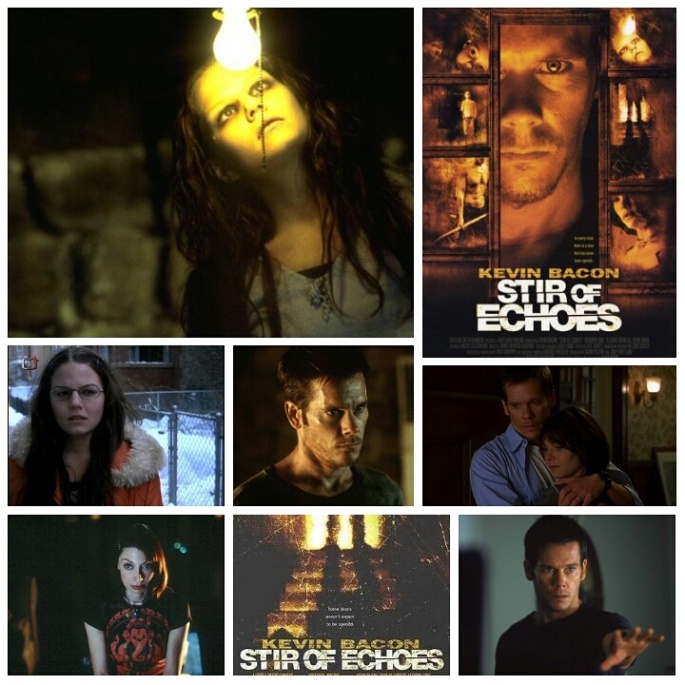
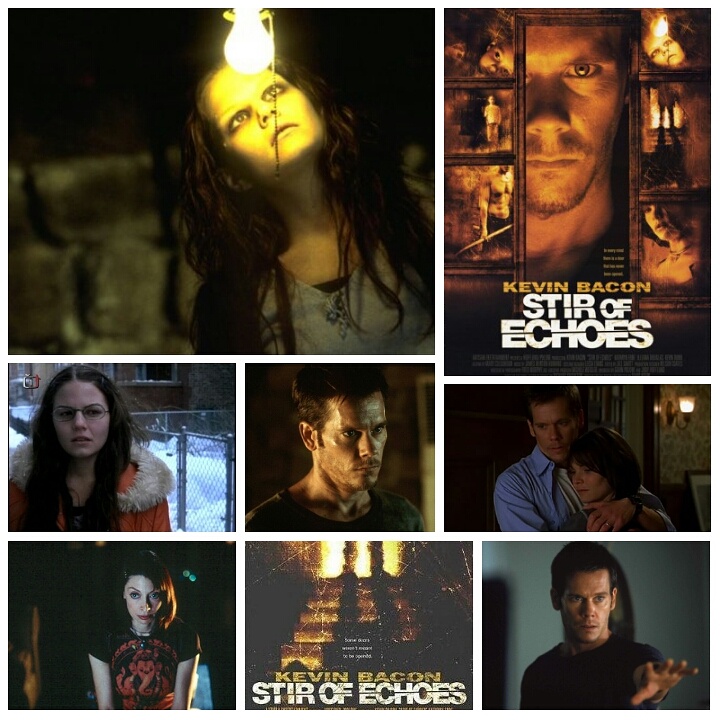
Stir Of Echoes: A Review by Nate Hill 

Stir Of Echoes is not outright horror, not plain old thriller but rests somewhere in between, a nerve frying festival of suspense and the type of scares which send those lovely shivers down your spine. Kevin Bacon plays Tom Witzky, an ordinary dude who agrees to be hypnotized, just for funsies, by his sister in law (Illeanna Douglas). As soon as he’s under, he’s subjected to a terrifying and confusion vision that suggests violent torment. It turns out that he’s one of the fabled ‘one percent’ of humans who are so succeptible to hypnotism that they unwittingly soak up other psychic energies in their vicinity. Something, or someone from the other side has found him and latched on, which is bad news for him and us, as we get to sit through several sequences that will cause you to need new pants. The initial vision is nothing outright or discernable; just images and abstract impressions that eventually serve as clues. That’s what makes it so creepy though. Someone being murdered is someone being murdered, but specific, harrowing little glimpses unnerve us all the more in their fleeting nature. Reminds me of that infamous videotape from The Ring in it’s style. Tom finds himself trying to solve a murder mystery, never sure whether the forces guiding him are on his side or pose a threat, always hit with a sense of dread upon turning every corner. This is the only kind of horror that actually scares me, in the true sense of the concept. Creeping, uneasy and subtle, where anything could be haunted and the scares aren’t predictable. What’s more,  it’s a smartly written, tightly paced, remarkably well made film. One of the best paranormal thrillers out there, plain and simple. There’s a sequel with Rob Lowe (of all people lol), but I’ve avoided it thus far, it looks kind of cheap. Stick with this original fright fest, it holds up wonderfully.  

Rob Zombie’s 31: A Review by Nate Hill 

I couldn’t help but feel fairly underwhelmed and a bit let down by Rob Zombie’s 31, which is a reaction I never thought I’d have to a film from one of the most dedicated and talented artists working in the horror genre these days. 

Now I’m not saying saying I hated it or even really disliked the film, there’s actually a lot of incredibly creative visual material and good old fashioned practical effects to feast your fangoria loving eyes on, but the fact remains that Zombie has regressed to the primal state he opened up his first few films with. 

  There’s two phases of his work so far: a rip snortin’ hoo rah gross out redneck scumbucket pile of profanity and bottom feeding trailer trash human garbage, which is what we saw in The Devil’s Rejects, House Of 1000 Corpses and somewhat in Halloween. Then there’s quieter, more thoughtful and meditative Zombie, using an art house, Argento psychedelic slow burn template that he brought hints of to the table in the excellent Halloween II and then full force with The Lords Of Salem, which to me is his best film so far. Now I love the trailer trash aesthetic to bits. It’s mile zero, the genesis of his fascinating career so far, and his writing is detailed, character driven, lifelike and oh so hilarious. But there’s a natural progression to any filmmaker’s career, moods and states which ebb and flow into new regions of stylistic exploration, and 31 just feels like a detour down the wrong road. I expected the atmosphere we got with Salem to churn forward and be a leg on the table of whichever phase came next. But alas, he has done a willful throwback to his earlier work, and although solid (I believe he’s incapable of making a truly bad film, there’s just too much creative juice with him), it’s sadly the least memorable among even phase 1 of his work. 

 31 is essentially a variation on The Most Dangerous Game, with a dirty dustbowl setting thrown in. A group of potty mouthed carnies, including Meg Foster, Jeff Daniel Philips and the ever present Sheri Moon Zombie, trundle through the desert, reveling in promiscuity and lewd behaviour, another trope that is getting old and icky, even on Rob’s barometer. Attacked and kidnapped one night by a band of scarecrows, they find themselves unwitting contestants in a vicious game called 31 (why is it called that? I still don’t know), on Halloween eve. The masterminds are a group of creepy aristocrats led by a plummy Judy Geeson and Malcolm McDowell, sporting a powdered wig, attire of french royalty and going by the name Father Murder. They release Moon and her peeps into a dismal maze and set a group of demented cackling psychopaths called the “heads” after them, dressed like clowns and seriously adjusted I’ll adjusted, these folks. Now you’d think that premise would be just a bucket of horror fun, and it’s nominally entertaining but just never really takes off into the desperate, visceral fight for survival I wanted to see. The clowns are varying degrees of scary and amusing. EG Daily fares well as whiny creepshow Sex Head, and there’s Sick Head, a chatty midget dressed up like Hitler who yowls at his prey in garbled Hispanic incantations. The film’s real energy shows up in the form of Richard Brake as Doom Head, a repellant maniac who is the only actual scary one of the bunch. Brake is a criminally underrated actor who I had the honour of interviewing some months ago, and when asked what the favorite role of his career is so far, he promptly said this. One can see why, it’s the most he’s ever been given to do in a film and he milks it with virile ferocity and animalistic sleaze that will leave you crying in the shower. McDowell and his cronies are here and there, but feel oddly disconnected from the events at hand, and while visually ravishing, ultimately aren’t given much to work with. I will say though that Zombie has a flair for the musical finale, and the end sequence set to ‘Dream On’ here is a blast that does indeed touch the epic heights of his older films. 

 And there you have it, kids. I wanted to rave about this one, I really did. But it use felt loose,

cobbled together and nowhere near as cohesive and brutally mesmerizing as his earlier work, all of which still hold up. There are elements here that work, but unfortunately just not enough, and framed by a whole lot of choices that feel copied and pasted. Now Zombie at his worst is still better than most in this sagging genre these days, but for those of you who know his work well and have expectations for the guy, you may just feel a little let down, like I did.

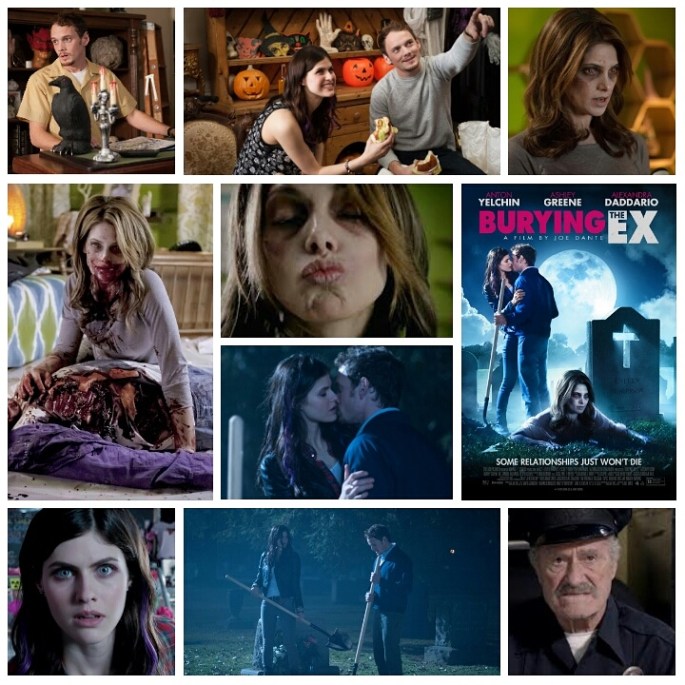
Joe Dante’s Burying The Ex: A Review by Nate Hill 

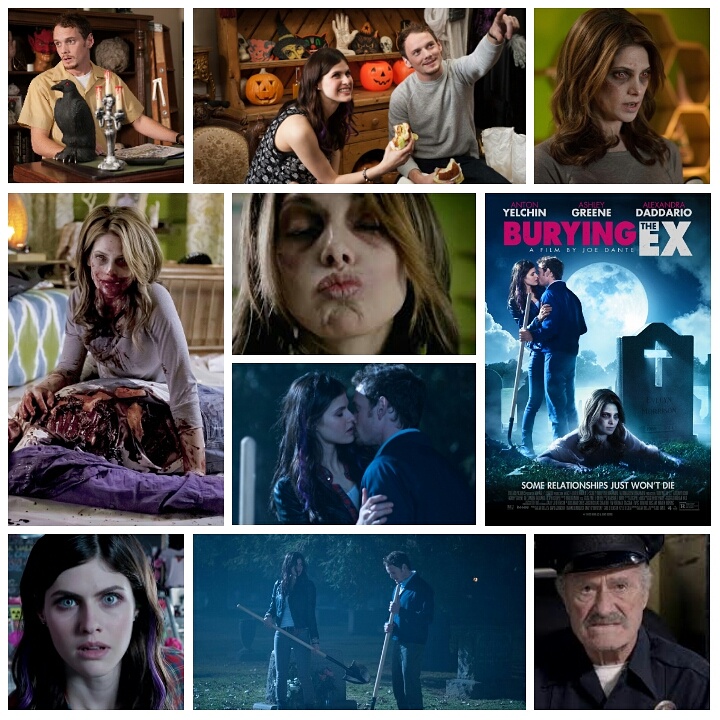
Everyone has that one psycho ex. Well… not everyone. But a lot of folks. I do, many do, enough do for there to be a whole lot of movies on the subject. Joe Dante’s Burying The Ex takes that predicament one step farther, straight into the realm of the supernatural, as the director always does. We haven’t had a Dante flick in a while (he’s the genius behind Gremlins, Innerspace and Small Soldiers, for those who don’t know), and it amazes me the lack of marketing which led to me taking my sweet time in seeing this. Glad I did, because it’s a treat. Any headline that boasts Dante, Ashley Greene, Anton Yelchin and the luscious Alexandra Daddario in the same film is automatically a rental, before I’ve even read a synopsis. This one is a darkly comic zombie romantic comedy and subtle Hammer Studios homage, an irresistible flavour indeed. Yelchin is a lad who works at a halloween FX store, has an affinity for retro horror and all things macabre, and is dating prissy Ashley Greene, who couldn’t be more different than him. She’s an abrasive, vegan type A personality jealous manipulative control  freak banshee who is sinking their relationship quicker than the Titanic. Enter Alexandra Daddario, a hip, horror movie themed ice cream parlor owner, and sparks fly between her and Yelchin. Those sparks are shot down by a dagger glare from Greene, and it’s in that moment Yelchin realizes he has to dump her. Before he can do the deed, she’s fatally hit by a bus, dies and essentially solves his problem. Or does she? Cue gothic organ music. Before he can take Alexandra on one date, she rises from the grave, now a sex starved psycho zombie bitch hell bent on keeping him for her own, pretty much forever. Quite the situation eh? Dante is never one for metaphors and heady trickery (a refreshing trait), all of his premises are straight up, face value, 100% genre simplicity. She’s dead, he needs to somehow kill her… again. It’s charming and lighthearted, while still retaining the macabre, like Tim Burton by way of Stephen Sommers. Greene is disarmingly hilarious as everyone’s worst nightmare of an ex, Yelchin is earnest and exasperated in equal doses, and Daddario is a babe and a half, always winning me over with them eyes. They all frolic in Dante’s casually R rated inter zone where everything is purely rooted in movie-land, and nothing needs to be seriously thought out. The writing is sharp, heartfelt and riddled with easter eggs for fans of horror from back in a better day. Brilliant stuff. 

B Movie Glory with Nate: 13 Sins 

13 Sins is a mean, mean movie, one that pushes it’s audience as far as the central premise does it’s characters. By push I mean it gleefully tries to figure out just how many acts of nasty human depravity it can parade before you before the laughs turn to “oh damn, that’s actually horrible.” Me being the sicko that I am, I laughed pretty much straight through til the bombastic finale, but I recognized the rotten nature in the story and felt the weight all the same. The idea is simple: One day a financially troubled man (Mark Webber, who just has one of those faces you want to punch) gets a mysterious phone call from a game show host sounding dude, telling him to swat a fly, after which one thousand dollars will be deposited into bis account. Easy enough, right? Yeah, sure. Now he’s had a taste of money, wants in on the game and has no clue what soul crushing horrors await. Each new task gets more violent, disgusting, risky, disturbing and (if you’ve got the right mind for it) increasingly hilarious. Make a child cry. Push an old woman down a flight of stairs. Set a church nativity scene on fire. Cheery stuff. Then shit gets real and he’s asked to do things right out of a horror movie, all in the name of green money. The aim, besides of course amusement, is to prove that anyone can be turned into a monster if the price is right. As funny as it is, it leaves a sickening feeling in the pit of your stomach, like you’ve been kicked in the nuts by every horrible news report of late, a gnawing reminder of what levels humans are capable of sinking too when they have too much time and money on their hands. Ron Perlman plays the obligatory baffled police detective, always one step behind the action, and watch for veteran Tom Bower too. The film kind of falls apart near the end, as what little believability it had evaporates alongside the forced plot twists, but had it remained lean and simple I think it would’ve fared better. All its forgiven when considering the impact it makes though, both as action social horror story, extremely black comedy and alluring thriller. 

Doom: A Review by Nate Hill 

Despite not having a whole lot to do with the video games, Doom is still a rush of schlock and awe silliness, getting more fun and ridiculous in equal amounts near it’s nonsensical ending. Karl Urban and The Rock are the tough guys for the job when it comes to scoping out a Martian research base that’s accidentally opened up a portal to hell, unleashing all kinds of lovely things. Rock is Sarge, stoic commander of this unit, and Urban is John Grimm (he lives up to his last name) a battle scarred badass who has personal stake in fighting these monsters. His sister (Rosamund Pike) is a scientist on the base, and is now in a great deal of danger. After a neat Google Earth type zoom in on the Martian surface (ironically the only shot in the film that suggests they’re even on the red planet), it’s off to dank corridors, vast bunkers and beeping control panels, an Aliens-esgue siege on horrors of the dark that quickly goes sideways on them. It’s run of the mill stuff save for one stroke of brilliance: a pulse racing first person shooter sequence that showcases a POV of Urban shooting, slashing and chain-sawing his way through alien flesh. It’s a bold move that pays off immensely and is quite fun. The rest of their team is forgettable except for Richard Brake as Portman, the loudmouth A Hole of the bunch, a refreshingly animated performance in a roomful of muted, grim characters. The monster from the game shows up, a hulking hell pig nicknamed Pinky that tirades it’s way through everything until Urban gives it what for. This ain’t no great flick, but as far as video game movies go, you could do way worse. There’s definitely enough gore for the hounds, and it’s adequately stylish in presentation. 

Triangle: A Review by Nate Hill 

  
Structured like a labyrinthine video game. Packed with loads of paranoid suspense and style. Tuned with the hazy thick atmosphere of a bad dream. A diabolical guessing game from scene to scene. Triangle is one of the most enjoyable mind benders out there, a funhouse of a thriller that sails into murky metaphysical water and doesn’t let either it’s protagonist or its audience off with a cheap resolution. Imagine Dead Calm crossed with Memento and you’ll begin to have some notion as to where this film will take you. It’s a freaky voyage, as star Melissa George finds out after a yachting expedition with friends hits a nasty patch of storm weather. Soon a massive, deserted ocean liner crosses their path, and they are forced to board it after the typhoon wreaks their smaller craft. The rest of her crew just seemed puzzled by the derelict vessel, but Melissa has an eerie, gnawing feeling that she’s been on this boat before, a feeling that something is very wrong. Suddenly there’s a mystery person hunting and killing them, and if I just made it sound like a run of the mill slasher flick, please be assured that it’s anything but. What I’ve described happens in what is maybe the first quarter of the film, and everything after that point is a trip into a dizzy, seafaring twilight zone of psychological mystery and reality warping uncertainty that makes George unsure if anything, including her own perception of reality, can be trusted. Events repeat themselves, characters dart in and out of the wormhole of a narrative arbitrarily yet with a hidden purpouse that managed to scarily elude me for much of the film. It’s scary in the way that ducks usual horror trends. There’s violence and even some ghastly gore, but the real fear here lies in the unknown, the idea that forces beyond what we perceive as reality are messing around with us, and indeed they do mess around with her and then some, right up until the last frame of an ending that’s commendable, haunting and difficult to process. George makes great work of the confusion that morphs into terror and then outright existential panic, keeping us on our toes with the way she handles her character arc. Keep an eye out for a young Liam Hemsworth too. For psychological thrillers, it don’t get much better than this, and it’s off the radar enough that you’ll be able to recommend it to your friends who chances are, haven’t even heard of it.

Adrian Lyne’s Jacob’s Ladder: A Review by Nate Hill 


Few supernatural horror films tap into the abstract realm of the unconscious quite as effectively as Adrian Lyne’s Jacob’s Ladder. There’s a select group out there who have done it as well (Tarsem Singh with The Cell, Hellraiser and Silent Hill come to mind), but there’s just such an abundance of generic, or ‘vanilla’ horror out there. It’s not that that kind of stuff isn’t great, I just like to see something strive for a little more, stylistically speaking, go for something truly elemental and out of the box in its attempts to elicit fright. This one engraves nightmares of an inexplicable variety into your perception, images and sounds made all the more disturbing by the fact that we never really know what is going on with our protagonist, a Viet Nam vet named Jacob (Tim Robbins), a decent dude with a sketchy past who spends his days as a postal worker in NYC. Jacob is plagued by waking nightmares, visions of demons, confusing allusions to his past and a son (a pre Home Alone Macauley Culkin) who may have died, or never existed at all, all combined with a general sense of dread that almost seems to crawl out of the screen and choke the viewer. Jacob is dating a co worker (RIP Elizabeth Pena), who isn’t equipped to deal with whatever is going on with him, and his only friend seems to be his doting chiropractor Louis, played by an excellent Danny Aiello in a performance that is a ray of kindness and light in an otherwise ice cold atmospheric palette. Jacob begins to suspect that he and his platoon may have been victims of illegal weapons gas testing, and are now suffering the psychological fallout, or perhaps that his plight goes much deeper than that. It’s a disorienting state of mind for him, and in turn puts the viewer in a similar daze of eeriness and uncertainty, with not a concrete clue or answer in sight until the film reaches its devastating final moments. Ving Rhames, Pruitt Taylor Vince, Eriq La Salle and Matt Craven are just as haunted as his fellow Nam buddies, Jason Alexander has an energetic bit as a lawyer, and watch for Kyle Gass, Orson Bean and Lewis Black in early smaller roles. This film has put a hazy emotional and visual filter over my perception for years, and each time I give it another visit I get goosebumps from the horrors within, especially on a crisp recent blu Ray. There’s one sequence in particular which I won’t spoil with details, except to say it should be front and centre on the demo reel for the entire horror genre in cinema, a harrowing journey into a hellishly creative interzone of undefinable fear that still serves as the blueprint for some of my bad dreams to this day. A fright flick classic.

Dracula 2000: A Review by Nate Hill

image

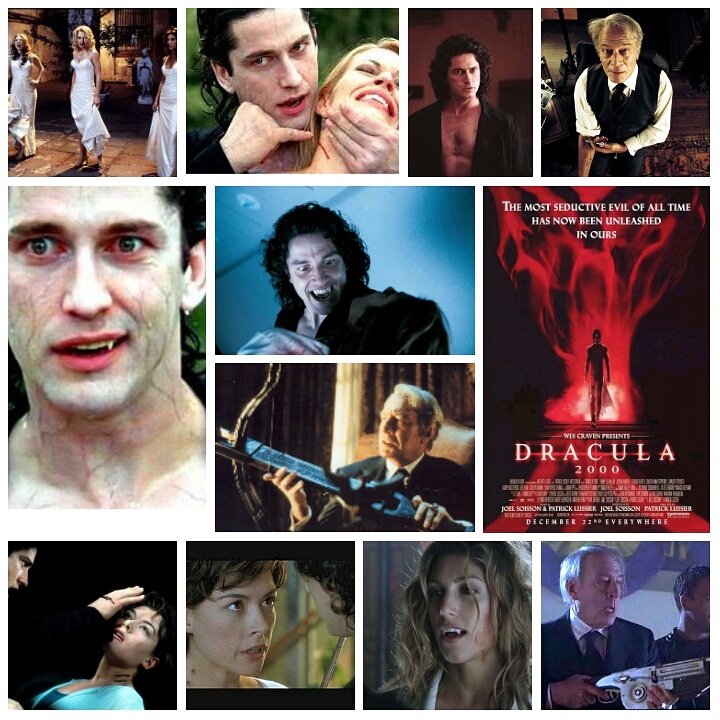
Wes Craven’s Dracula 2000 is one of those horror flicks that proudly slaps his name over the title like he runs the show, when in fact he’s only participating under a vague executive producer credit. Now that we’ve got that little detail out of the way we can talk about what a thoroughly awesome movie it is, and how the haters can go suck it. It’s a high concept slice of bloody fun and has easily one of the best pairings of an actor with the Dracula mythos ever: Gerard Butler. He’s young and lean here, before he turned into a tank later in his career, and he makes one hell of a kick ass Dracula. The story is too good to be true: a team of arch criminals, led by Omar Epps and also including Hyde from That 70’s Show (lol) break into the European mansion of Dr. Abraham Van Helsing (Christopher Plummer) and steal the heavy duty coffin which he has stashed in his basement and used to contain Vladdy for over a hundred years. Helsing has always used a compound derived from his blood to keep himself alive all that time and ensure that he never gets loose. The burglars have no idea what they’re on for, and pretty soon Butler is loose and ready to get freaky, tearing apart their getaway plane and running off into the chaotic streets of New Orleans during Mardi Gras. He’s searching for a girl (Justine Waddell) to have sex with her and fulfill some horrific prophecy (nice little nod to End Of Days there). Dracula, Mardi Gras, Gerard Butler, Christopher Plummer; four ingredients to pretty much ensure your movie is gonna rock. Plummer makes one of the best onscreen Van Helsings in my books, rivaled only perhaps  by Anthony Hopkins. Butler is a sleek, hip and sensual Dracula, playing the role to the bloody hilt and sedimenting a really cool rendition of the character, with a surprising twist ending that adds some depth to the guy. Watch for work from Jennifer Esposito, Sean Patrick Thomas, Shane West, Lochlyn Munro and Nathan Fillion as well.
Great retelling, or rather addition to the legend, held up by Butler.