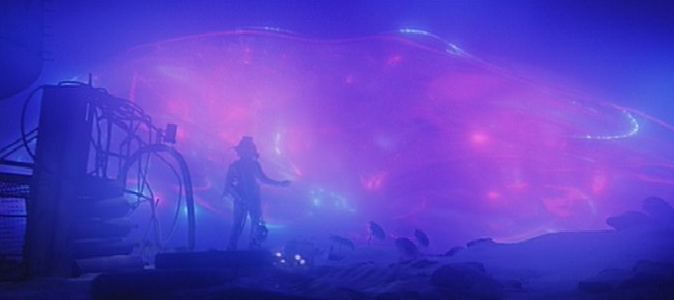
The more times I see The Abyss (1989), the more I am convinced that it is James Cameron’s best film to date. Wedged between megahits, Aliens (1988), and Terminator 2: Judgment Day (1991), The Abyss was unfortunately lost in the shuffle. This may also have been due to the flood of leaky underwater films like Leviathan (1989) and Deep Star Six (1989) that were released around the same time. Even though The Abyss came out after these financial and critical failures, it was dismissed by most critics as yet another underwater disaster. Most reviewers were clearly tired of this string of underwater themed films and assumed that Cameron’s motion picture was no better than the rest. However, this is simply not the case with The Abyss, which, like many of Cameron’s films, is filled with stunning visuals, a strong ensemble cast, and a solid story that is never sacrificed at the expense of the movie’s special effects.
As the film opens, a United States nuclear submarine is accidentally sunk by a mysterious, unidentified source under 2,000 feet of water off the coast of Cuba. Nearby, a corporate owned underwater oil-drilling rig commandeered by Virgil “Bud” Brigman (Ed Harris) is subsequently ordered to aid a group of Navy SEALs, led by the no-nonsense Lt. Coffey (Michael Biehn), to salvage the downed sub and search for survivors, if any. To make the situation even more interesting is the surprise arrival of Bud’s soon-to-be ex-wife, Liz (Mary Elizabeth Mastrantonio), who designed the rig and rejoins the crew to ensure that everything goes smoothly. As the mission progresses, a storm rages topside causing many problems for the rig and its crew. Add to this the growing tensions of nearby U.S. and Russian naval fleets and you have a potentially volatile situation. But this is only the beginning of a string of dilemmas that beset Bud and his cohorts who gradually realize that there is something else down there with them, and it may not be human.
The Abyss was a project that James Cameron had dreamed of making ever since he was 17 years old. He wrote a “very, very crude and simple story dealing with the idea of being in the very deep ocean and doing fluid breathing and making a descent to the bottom from a staging submersible laboratory that was on the edge.” His original short story concerned the adventures of a group of scientists in a laboratory at the bottom of the ocean, “which is the sort of sci-fi idea that appeals to all kids, I suppose,” he said. Over the years, Cameron became involved in numerous other projects but he never forgot about this underwater adventure and wrote several drafts that changed radically over time but the original idea that started it all remained intact. When Terminator (1984) and Aliens became bonafide box office hits, Cameron was in a position to make his dream project a reality. He had no idea the problems that he would face trying to realize this dream.
The bulk of The Abyss was shot in and around Gaffney, South Carolina. At first, this seems like a rather unlikely place to shoot an underwater epic, but it turned out to be the best place after their decision to shoot on-location became unrealistic. Cameron had originally planned to try filming in the Bahamas where the story is set, but soon realized that he had to have a totally controlled environment because of the stunts and special FX involved. To this end, Cameron found the Cherokee Nuclear Power Station, an abandoned site that proved to be ideal for what they needed. The film crew ended up shooting all of the underwater sequences (this comprised 40% of all live action principal photography) in two specially constructed concrete containment tanks: one holding 7.5 million gallons of water, and the other holding 2.5 million gallons.
As if this wasn’t enough of a challenge, the actual shoot consisted of a grueling six month, six-day, 70-hour a week schedule that took its toll on cast and crew alike. “I knew this was going to be a hard shoot, but even I had no idea just how hard. I don’t ever want to go through this again,” Cameron remarked at the time. And yet, the sense that what they were making was groundbreaking and worth doing was the glue that kept everything together. The film’s producer, Gale Anne Hurd clearly viewed The Abyss in this fashion. “No one has attempted this before, and we had to solve everything from how to keep the water clear enough to shoot, to how to keep it dark enough to look realistic at 2,000 feet where it’s pitch black.” By all accounts, the cast and crew thrived on this challenge, and as the final results demonstrate, succeeded in producing a truly stunning work.
Cameron’s production company had to design and build experimental equipment and develop a state-of-the-art communications system that allowed the director to talk underwater to the actors and dialogue to be recorded directly onto tape for the first time. For all of the underwater scenes they used three cameras in watertight housings specially designed by underwater cinematographer expert Al Giddings, known for his incredible work on The Deep (1977). Another special housing was designed for scenes that went from above-water dialogue to below-water dialogue. Underwater visibility was a major concern for Cameron as he wanted to see the actors’ faces and hear their dialogue. Western Space and Marine built ten experimental diving units for the film. They engineered helmets which would remain optically clear underwater and installed innovative aircraft quality microphones in each helmet.
In addition, Cameron was also breaking new ground in the area of special visual effects, which were divided up among seven FX divisions with motion control work by Dream Quest Images and computer graphics and opticals by Industrial Light & Magic. ILM was brought on board to create the amazing water pseudopod and spent six months to create 75 seconds of computer graphics needed for the creature. However, this work caused the film’s release to be delayed from July 4, 1989 to August of the same year.
The production difficulties that plagued The Abyss have become the stuff of Hollywood legend. There were reports from South Carolina that Ed Harris was so upset by the physical demands of the film and Cameron’s dictatorial style that he said he would refuse to help promote the picture. The actor later denied it and did press for the film. He did admit that the daily mental and physical strain was very intense. He recalled, “One day we were all in our dressing rooms and people began throwing couches out the windows and smashing the walls. We just had to get our frustrations out.” The actors were not happy about the slow pace of filming. Mary Elizabeth Mastrantonio remembered, “We never started and finished any one scene in any one day.” Michael Biehn was frustrated by the waiting. He claims that he was in South Carolina for five months and only acted for the three to four weeks. Cameron responded to these complaints by saying, “For every hour they spent trying to figure out what magazine to read, we spent an hour at the bottom of the tank breathing compressed air.”
Like all of Cameron’s other films the action plays a secondary role to the central love story — whether it was between Kyle Reese and Sarah Connor in Terminator or Ripley and Newt in Aliens. In The Abyss we are presented with a disintegrating relationship between Bud and Liz. And yet, as the film progresses and we spend more time with these two people, we begin to realize that they still love each other and that this is what adds a real element of humanity to the special effects-laden film. But The Abyss is much more than that. It mixes elements of an exciting thriller, action film, and science fiction story together in one great package. The way the film is structured, we are presented with several small movies that, when linked together, comprise a larger whole. It is this wonderful structure that makes one realize that there is more going on than a search for a missing submarine.
As Cameron demonstrated with Terminator, he has a real eye for action sequences and The Abyss is no different. One scene, in particular, demonstrates Cameron’s ability to create moments of white knuckle intensity. Several compartments of the underwater rig begin flooding, while crew members try frantically to escape to a safer area. Cameron’s hand-held camera follows these men through the claustrophobic hold at such a breakneck pace, via a compelling first person point-of-view angle, that one can’t help but get caught up in the feeling of urgency brought on by this dangerous situation. At times, it feels like you are actually bouncing through the tight corridors of the rig alongside the characters and this enhances the thrill and excitement of such adrenaline-fueled sequences.
The Abyss is also similar to Cameron’s previous film, Aliens in the sense that both have a top rate ensemble cast. The crew of the rig all have their own distinctive personalities, which are each given their own moment to shine and never detract from the larger story. The interaction between these people has a ring of honesty and authenticity, which suggests that every character is important and crucial to the film’s outcome. But these colorful characters never obscure the three main principles that are also fully-fleshed characters each with his or her own agenda. Ed Harris portrays Bud as a man dedicated to his rig and his people, but he cannot balance his work life with his personal life. Mary Elizabeth Mastrantonio’s Liz is, as she later admits, “a cast-iron bitch,” but underneath the hard, tough exterior there are occasional glimpses of a sensitive dreamer fighting to get out. Cameron regular, Michael Biehn (an underused actor also seen in Terminator and Aliens, respectively) personifies intensity as the leader of the Navy SEALs who slowly loses his grip on reality and his priorities, posing a threat to the safety of everyone on the rig. Each of these characters has their own inner conflicts as well as the larger conflict that threatens everyone. One of the pleasures of watching The Abyss is seeing how these personal conflicts play out and resolve themselves by the end of the film.
The Abyss deviates from Cameron’s other features in the sense that it stresses the idea of settling disputes through non-violent means. Violence in the film is not the solution to the problem, but the source. This idea is illustrated through Lt. Coffey, the main instigator of violence in the film. His violent acts create the many problems that the protagonists face and this ultimately results in his demise. On the other hand, Liz personifies the peaceful alternative. Where the selfish Coffey sees anger and hatred, Liz is willing to sacrifice herself for others. She is the calming effect on everyone and her presence on the rig is pivotal in resolving many of the story’s conflicts. It’s a refreshing view that you don’t often see in films nowadays where everything is solved at the end of a gun. Unfortunately, this viewpoint seemed to have disappeared from Cameron’s subsequent work, which regressed to the usual violent antics. Whether it was because of the film’s failure to connect and succeed on a mass level or the departure of long time partner, Gale Anne Hurd, is unknown, but with a film like True Lies (1994), Cameron abandoned a strong, independently minded female character for one that is objectified by the camera and on the receiving end of a lot of misogynistic behavior. It’s too bad because The Abyss contains none of this and instead points the way for a new kind of action-oriented film that stresses problem solving over violence, while still providing the requisite amount of thrills. This is a much-needed antidote to the mindless violence and anger that is problematic in so many films today.
The Abyss is a truly special film that never lags in pace or interest thanks to the many stunning visuals courtesy of breathtaking computer animation from Industrial Lights and Magic (effects that were the precursor to ones used in Terminator 2). There are also fascinating characters and exciting, often intense situations that keeps the viewer involved in the story. The Abyss is one of those rare films that you wish wouldn’t end because the world and the characters that inhabit it are so compelling and exciting. This film demonstrates, yet again, that James Cameron is one the few directors who can make good science fiction films, with a strong story, a solid cast, and exceptional images that help elevate it above the usual Hollywood dreck and straight-to-video sci-fi clunkers. And that is truly something special at a time of militaristic, flag-waving propaganda like Independence Day (1996), which purports to be entertainment, but is just another mindless special effects workout.

Podcasting Them Softly is beyond thrilled to present a discussion with veteran film editor Mark Goldblatt! Mark‘s credits are beyond amazing, and feature some of the greatest action adventure films of our lifetimes — The Terminator, Terminator 2, True Lies, Bad Boys 2, Pearl Harbor, Armageddon, Commando, Rambo: First Blood Part 2, Starship Troopers, Predator 2 and Tony Scott’s immortal action masterpiece The Last Boy Scout. He’s worked with absolute titans of industry, including James Cameron, Michael Bay, Paul Verhoeven, and Joe Dante, all of whom Mark has worked with multiple times. Other amazing credits include Rise of the Planet of the Apes, Hollow Man, Showgirls, The Ambassador, Halloween II, and Piranha. He also had multiple collaborations with Cannon Films head honcho Menahem Golan, which is always a subject that fascinates us at PTS! Mark‘s directorial debut was the wild and crazy Dead Heat with Treat Williams and Joe Piscopo, which he then followed up with the absolutely awesome The Punisher with Dolph Lundgren. We were overwhelmed by his resume and are so excited to share this exciting chat!



 Podcasting Them Softly is beyond excited to present a chat with screenwriter and producer
 Podcasting Them Softly is thrilled to present a chat with screenwriter and director
 STEPHEN LANG is an award-winning actor known for his work on TV, film and stage. Lang has been cast in a recurring role as Waldo in the upcoming AMC genre-bending material arts series INTO THE BADLAND. He will also be reprising his role as Colonel Miles Quaritch from James Cameron’s AVATAR in the three upcoming sequels. Lang can be seen starring in WGN America’s hit series SALEM as Increase Mathers. Recently, Lang took his acclaimed stage production of BEYOND GLORY on the road to eight cities nationwide. You can also watch Lang in the documentary BEYOND GLORY which the actor as he tracks the ten year odyssey behind his one-man show about eight medal of honor recipients.
 Podcasting Them Softly