JACK DETH IS BACK . . . AND HE’S NEVER BEEN HERE BEFORE: An Interview with Tim Thomerson by Kent Hill

Cherry-2000-31

I was mid-way through my interview with C. Courtney Joyner when Tim Thomerson’s name came up. Joyner of course, had directed Tim in Trancers 3, and cooler still, he had just had him round for breakfast earlier that day. You might call it an imposition, but I mentioned that if there was even a remote possibility that he could put me in touch with Tim, I would be forever grateful. Courtney told me he was seeing Tim again on the weekend and would put forward my proposition. Soon after, I received a message with a phone number.

Now, I’m usually in the habit of arranging an appropriate time and day to call, but Courtney had left it open. I remember for the first time, in a long time, being nervous to make the call. After all this was Tim Thomerson who was going to be picking up the phone; a guy, a legend that I had watched for years. So I summoned my moxy and dialled the number. The familiar international ring-cycle began and then . . . “Thomerson,” the voice on the other end of the line said.

I’m going to come off as an idiot here, but I.D.G.A.R.A. “Damn,” I remember thinking. “He sounds exactly like he does in the movies.” Stupid, I’m well aware. But the moment was profound, and I was instantly transported to that time when I sat in the theatre watching Metalstorm, and that glorious afternoon I first sat down to watch Future Cop (aka Trancers). Here was Jack Deth now, on the end of the line and talking to me like we had been buddies since forever.

I did kinda wish we could have jumped into our chat right there. Tim was at once disarming, candid and as cool as i had expected him to be. He was off to his retreat in the desert to do “old man shit” as he put it, and, while I realize he is an aged gentleman now, that voice, the larger than life character that he is still packed all of the vitality, swagger and youthful exuberance that very much belies his years.

I didn’t have to wait long before we would talk again, and when we did, the conversation picked up right where it left off. I would take a significant amount of time to go through the length and breadth of his career, so I restricted myself to personal favourites among his credits. We talked about his beginnings, his great friendships, his bumping into Mel Gibson at the doctor’s office, him working with his idols, Australian Cinema and his meeting with the legend that was Sam Peckinpah.

For those of you who regularly check out my stuff here on the site (God bless you), I fear I might be starting to sound like a cracked record. A number of times in the past I have found myself gushing about the opportunities I have enjoyed whilst writing for PTS, and how humbled and indeed awe-struck I have been as a result of these encounters with the folks who make the movies. Sadly I’m now going to do it again. Tim Thomerson is a hero of mine and it was at once spellbinding and an indescribable treasure to have had the chance to shoot the breeze with an actor I have long held in high regard . . .

. . . and an equal pleasure it is, to now share it with you.

Enjoy.

Gore Verbinski’s Pirates Of The Caribbean: Dead Man’s Chest

Pirates Of The Caribbean: Dead Man’s Chest is so good it almost gives the first one a run for it’s money in terms of visual effects, imagination, swash and buckle. It does have it’s issues with letting some of the action set pieces run on literally forever (that rolling windmill sword fight tho) until you seriously start to question the limits of cardio in those involved, but director Gore Verbinski has always been an advocate for cheeky excess, so who can complain. In preparing a sequel to Black Pearl, they no doubt had a daunting task in equaling, and if possible outdoing the sheer bliss that came before, and they kind of succeeded and then some. Jack Sparrow, Will Turner, Elizabeth Swann and a whole circus sideshow of others are propelled on a dazzling adventure that spans past the isle of Tortuga, beyond the waters of Port Royal and to the far ends of the Caribbean, not to mention amping up the supernatural aspects of the first to dizzying heights. In Captain Barbossa’s absence (well, almost;), they also had to find a villain to match his adorable theatrics, and Bill Nighy’s moody Davy Jones, a hentai tentacled tyrant cursed by the ocean’s magic, doomed to sail the baroque galleon The Flying Dutchman forever, fits the bill. His crew are a gnarly, barnacled bunch of miscreants adorned in enough wicked cool marine biology and detailed special effects to get an Oscar nomination, which they did. Other new character additions include mopey Stellan Skarsgard’s bedraggled Bootstrap Bill, Naomie Harris’s spooky voodoo babe Tia Dalma, as well as familiar faces like Commodore Norrington (Jack Davenport), who gets a lot more to do here than twiddle the stick up his ass as he does in the first one, Governor Swann (Jonathan Pryce), Gibbs (Kevin R. McNally, deadpan as ever) and the whole motley crew. Depp takes what made Sparrow so charismatic and weird in Black Pearl and soars over the rainbow with it, he really and truly carries these films with his presence and it may just be the best characters created by him. A worthy sequel, kickass adventure and one for the books.

-Nate Hill

David Koepp’s Mortdecai

So… I don’t quite get… how this film ever got green-lit, aside from Johnny Depp pulling a few strings. It’s like the most unfunny, painful thing to see unfold, like a Pink Panther flick with all the wit, heart and humour sucked out of it by dementors, leaving nothing but an acrid, soulless shell. That may sound harsh, but give David Koepp’s Mortdechai a day in court yourself and you’ll probably have similar things to say of it, or worse. Depp plays the titular buffoon, an aristocratic, borderline senile art dealer with a plummy British accent and a silly moustache that becomes the butt of a tiresome running joke involving the gag reflex of his wife (Gwyneth Paltrow, barely even trying with her accent). Mortdechai becomes involved in some overwrought global art-hunt that makes little sense and drags on for an interminable length, with his trusty lusty manservant Jock Strapp, ha ha, (Paul Bettany miscast in a role better suited for someone like Jason Statham or Vinnie Jones). Ewan McGregor and his sunny disposition show up for a while as a detective with the hots for Paltrow, as well as Olivia Munn embarrassing herself in a role that’s well beneath her, and an unforgivably underused Jeff Goldblum, showing up so briefly that it’s a wonder he agreed to waste his time here at all. This is junk of the highest order, not even fit for vague background noise as one immediately just tunes into tallying up the many ways in which it blows. You’d think Depp would know better, but he’s still in the preening dress-up quagmire phase of his career that he hasn’t been able to wade out of yet. He tries hard here, but every effort waddles forth like a lame duck, every comic beat royally missed. Don’t bother.

-Nate Hill

Freddy’s Dead: The ‘Final’ Nightmare 


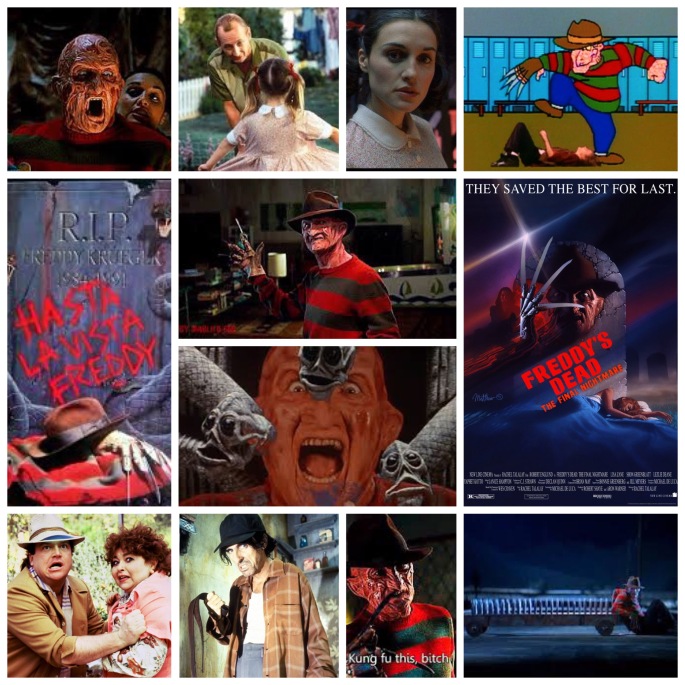
I’m not sure what they were going for with Freddy’s Dead: The Final Nightmare, but the summation of what they produced is simply… bizarre. Of course it’s not the final round, they never can resist churning out meta reworking, crossovers and remakes, rendering the ‘final’ titles hilariously redundant (the ‘final’ Friday The 13th chapter is only the fourth entry in a franchise that soared into double digits). It’s silly more than anything else, like the New Line Cinema boardroom passed around the laughing gas and spit-balled out this cartoonish, random, cameo stuffed looney bin of a flick. Actually, writing credit goes to director Rachel Talalay, who also helped the equally silly rumpus cult classic Tank Girl, which is lovable in it’s own right. Speaking of silly, Robert Englund’s Freddy Krueger has never been more buffoonish than here, the culmination of every one line and quip throughout the franchise. He’s back, hunting down the last remaining Springwood teenager, as well as a woman (Lisa Zane) whose connection to his past could be dicy for him. There’s also a weird backstory angle involving dream demons that look like sentient tadpoles who apparently are responsible for Freddy’s initial resurrection and powers. Hmm. The cameos seem like they just made a celebrity collage on a dartboard, blindfolded each other and flung them all over. Alice Cooper shows up in flashbacks as Freddy’s sadistic stepfather, Roseanne Barr and Tom Arnold are around, plus Breckin Meyer and Yaphet Kotto. The rule of randoms is excepting Johnny Depp of course, an Elm Street veteran who has a quick bit as a TV advertisement dude. The dream sequences are wild and wacky, but never really frightening or as atmospheric as they used to be, the one springing to mind being a video game themed thing where pixelated Freddy chases a victim Super Mario style, not exactly the most bone chilling setting, but oh well. This does mark the last of the initial franchise before they moved on to deluxe entries like the super meta New Nightmare and the gong show that was Freddy Vs. Jason. If you’re looking for the weirdest Elm Street flick, you’ve found it, and if you’re looking for a scary, coherent one then you’ll have to backtrack earlier in the franchise, or skip ahead to Wes Craven’s excellent next one. 

-Nate Hill

Problem Children with Big Eyes who make Biopics that’ll give you Goosebumps: An Interview with Larry Karaszewski by Kent Hill

As the child from a working class family in South Bend, Indiana, Larry was introduced to the movies by his father. He was not restricted as to what he could watch, so he watched it all. After high school he debated between pursuing either a career in comedy or a life in pictures.

453172736

Larry opted for the movies, and soon found himself at USC. It was there that he would meet Scott Alexander, and together they would form not only a friendship, but also the foundation of a prolific career as a successful screenwriting duo.

After (and though it launched a trilogy of films and even an animated series) Problem Child, the screenwriters struggled to find work. It seemed as though they had been typecast buy their work and so looked to independently produce a biopic they were working on about the notoriously bad filmmaker Ed Wood.

As fate would have it, word of the project reached director Tim Burton. After expressing interest, the boys would have to hammer out a screenplay in double-quick fashion. They succeeded, and this, the first in a string of biographical efforts, would re-establish them in Hollywood and from it they would carve out their place in the genre and become, in many ways, its ‘go-to guys.’

Biopics of Larry Flynt and Andy Kaufman would follow, seeing the boys team up with Academy Award winner Milos Forman. They would go on to re-team with Tim Burton as well as dabble in a variety on different genres including everything from a kid-friendly version of James Bond to horrific hotel rooms were you’ll spend a night or perhaps even an eternity.

Larry and Scott have garnered the highest accolades the industry has to offer and continue to deliver. While trying to get a hold of Larry for this interview I caught him riding high on his recent wave of success, so I would just have to wait for the tide to turn. I am however, glad that I did. It was, as it is ever, a privilege to chat with a man whose work I heartily admire. I love the films he has written and I look forward to the projects that he and Scott have in the pipeline.

Without further ado I present, the award-winning screenwriter and all-round nice guy . . . the one, the only, Larry Karaszewski.

Terry Gillian’s The Imaginarium Of Dr. Parnassus


Terry Gilliam films almost always feel a bit slapdash and chaotic, it’s just the guy’s calling card to have a modicum of organized mayhem filling the fringes of whatever project he delivers. With The Imaginarum Of Dr. Parnassus, that is probably the case more so than any other film he’s made, and despite letting the clutter run away with itself a bit too much, it’s still a dazzling piece. Of course, your movie will always have a disjointed undercurrent when your lead actor passes away halfway through production, but that’s just the way it goes, and Gilliam finds a fascinating solution to that issue here. Imaginarium is in many ways a companion piece, in spirit, to The Adventures Of Baron Munchausen, a film he made decades earlier, both containing a sort of baroque, Da Vinci-esque splendour and sense of fantastical wonder. Christopher Plummer hides behind a gigantic Dumbledore beard as Parnassus, a magician extraordinaire who travels the land with his daughter (Lily Cole, that bodacious Botticelli bimbo) and circus troupe, including Verne ‘Mini Me’ Troyer. Years earlier he made a pact with the devil (Tom Waits, an inspired choice) using his daughter as collateral, and now Old Nick has come to reap the debt, causing quite the situation. The story is a hot mess of phantasmagoria and kaleidoscope surrealism thanks to the Imaginarium itself, a multi layered dimension-in-a-box that accompanies them on their travels. Things get complicated when they rescue dying lad Tony (Heath Ledger) who somehow ties into the tale as well. Now, this was Ledger’s very last film, its future left uncertain after his passing, but help arrived in the form of Johnny Depp, Jude Law and Colin Farrell, swooping in to play doppelgänger versions of Tony as he bounced from one plane of the imaginarium to another with Cole in tow, always one step ahead of Waits, who is a rockin’ choice to play the devil, smarming and charming in equal doses. It’s kind of a huge melting pot of images and ideas hurled into creation, but it’s a lovable one, the fun you’ll have watching it reasonably eclipses lapses in logic, plotting and pacing. 

-Nate Hill

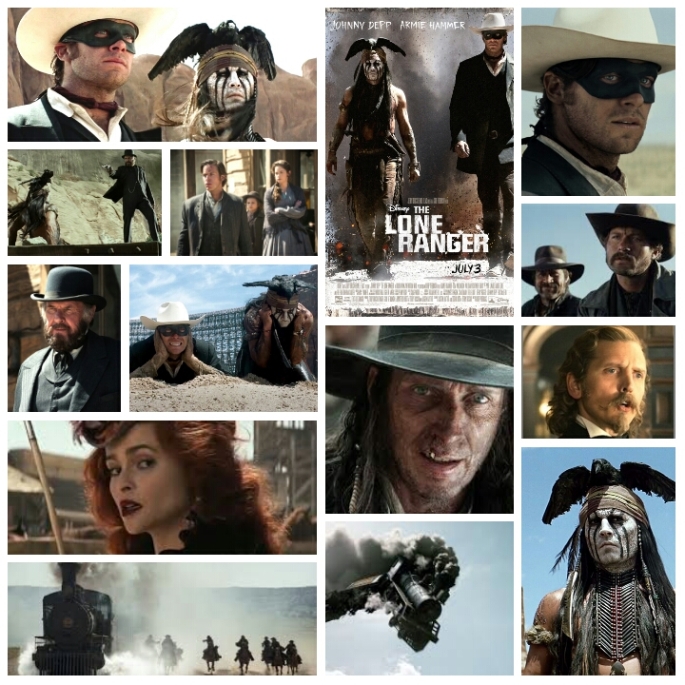
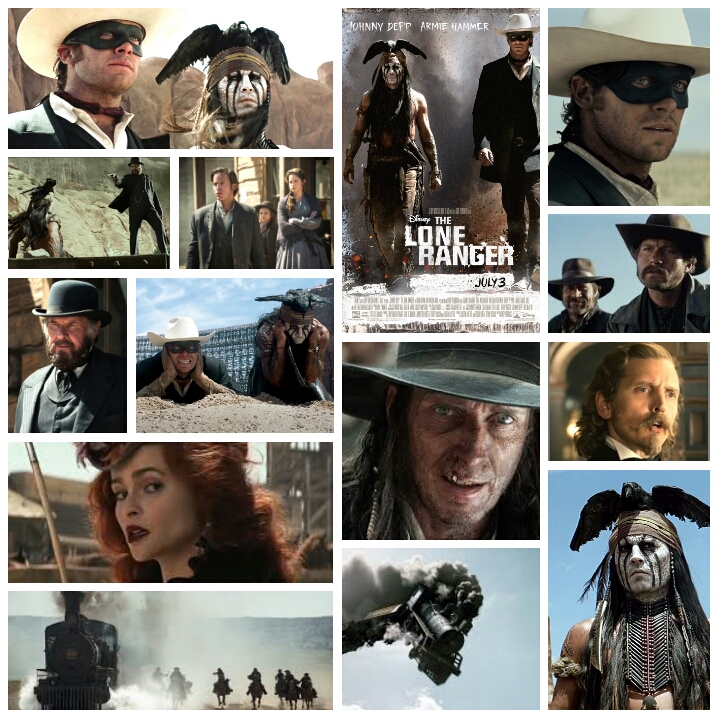
Gore Verbinski’s The Lone Ranger: A Review by Nate Hill 

There’s always those films that get buried under a landslide of terrible reviews upon release, prompting me to avoid seeing them, and to wait a while down the line, sometimes years, to take a peek. I was so excited for Disney’s The Lone Ranger, being a die hard fan of both Gore Verbinski and Johnny Depp’s monolithic work on Pirates Of The Caribbean, and just a lover of all this western, as well as the old television serial. The film came out, was met with an uproar of negative buzz, I went “well, shit”, and swiftly forgot it even existed. The other day I give it a watch, and would now like to pull a Jay and Silent Bob, save up cash for flights and tour the continent beating up every critic I can find in the phone book. I was whisked away like it was the first Pirates film all over again, the swash, buckle and spectacle needed for a rousing adventure picture all firmly present and hurtling along like the numerous speeding locomotives populating the action set pieces. Obviously the material has been vividly revamped from the fairly benign black and white stories of the tv show, especially when you have a circus ringmaster like Verbinski at the reigns, the guy just loves to throw everything he has into the action, packed with dense choreography and fluid camerawork that never ceases to amaze. Johnny Depp loves to steal the show with theatrical prancing and garish, peacock like costumes, and he kind of takes center stage as Tonto, the loyal sidekick to the Lone Ranger, who is given a decidedly roguish, unstable and altogether eccentric edge that the series never had, but I consider it a welcome addition to a character who always seemed one note in the past. Armie Hammer has a rock solid visage with two electric blue eyes peeking out of that iconic leather strap mask. It’s an origin story of sorts, chronicling Reid’s journey to visit his legendary lawman brother (James Badge Dale) and family in the small town West. Also arriving, however, is ruthless butcher and psychopathic outlaw Butch Cavendish (William Fichtner) at the behest of opportunistic railroad tycoon Latham Cole (Tom Wilkinson). Tempers flare and violence erupts, and before you know it Reid is without a family, left for dead in the desert and befriended by Tonto, who himself is a tragic loner in a way. Revenge is on the minds of both, as they venture on a journey to find Cavendish and his men, discover what slimy Cole is up to and bring order to the west, one silver bullet at a time (actually there’s only one silver bullet used in the entire film, but let’s not get technical). Now, I’ll admit that the middle of the film meanders and drags quite a bit, half losing my interest until the intrigue steps up a notch. A sequence where the pair visit a circus brothel run by a take no shit Helena Bonham Carter seems like unnecessary dead weight and could have been heavily trimmed, as could other scenes in that area that just aren’t needed and might have been excised to make the film more streamlined. It’s no matter though, because soon we are back in the saddle for a jaw dropping third act full of gunfights, train destruction and unreal stunts that seem like the sister story to Pirates, some of the action often directly mimicing parts from those films. Depp is like fifty, and still scampers around like a squirrel, it’s a sight to see. Fichtner is a world class act, his mouth permanently gashed into a gruesome snarl, the threat of violence oozing from his pores and following him like a cloud. Wilkinson can take on any role, period, and he’s in full on asshole mode, Cole is a solid gold prick and a villain of the highest order. Barry Pepper has a nice bit as a cavalry honcho who never seems to quite know what’s going on (it’s perpetual chaos), watch for Stephen Root and Ruth Wilson as Reid’s sister in law who ends up… well you’ll see. It’s fairly dark and bloody for a Disney film as well, there’s a grisly Temple Of Doom style moment and attention is paid towards America’s very dark past with the indigenous people, which is strong stuff indeed for a kid orientated film. Nothing compares to the flat out blissful adrenaline during the final action sequence though. That classic William Tell overture thunders up alongside two careening trains and your tv will struggle to keep up with such spectacle, it’s really the most fun the film has and a dizzyingly crowd pleasing sequence. All of this is told by an elderly Tonto in a museum exhibit, to a young boy who dreams of the west. A ghost from the past, part comic relief and part noble warrior, Tonto is a strange character indeed, and the old version of him has a glassy eyed reverence for his adventures before, the last one alive to remember. Many a review will tell you how bad this film is, but not mine. I found myself in pure enjoyment for the better part of it, and would gladly watch again.

THE NINTH GATE – A REVIEW BY J.D. LAFRANCE

The-9th-Gate-the-ninth-gate-16058196-960-414

Critical and commercial reaction to Roman Polanski’s films has always been mixed at best. To say that they are an acquired taste is an understatement. The Ninth Gate (1999) is no exception. Despite what the film’s misleading trailer promoted at the time of its initial release, it is not a straight-forward supernatural thriller but rather showcases the auteur in a darkly humorous mood as he plays around with the conventions of the genre.

Dean Corso (Johnny Depp) is an unscrupulous book dealer whose motivation is purely for financial gain. He swindles a naïve couple from a set of rare and priceless books in an amusing scene that sets up his character beautifully. A very rich book collector by the name of Boris Balkan (Frank Langella) hires Corso to validate his recently purchased copy of The Nine Gates of the Kingdom of Shadows, one of only three copies that exist in the world. The book contains nine engravings which, when correctly deciphered and the interpretations properly spoken, are supposed to conjure the Devil. Balkan believes that only one book is authentic so he hires Corso to track down each copy and verify their authenticity. It seems like a simple enough task but as Corso soon finds out, someone does not want him to complete the job. He crosses paths with an odd assortment of characters, from a mysterious woman (Emmanuelle Seigner) who seems to help him in his quest, to another, more obviously evil woman, Laina Telfer (Lena Olin) intent on impeding his progress and quite possibly trying to kill him.

Polanski received the screenplay by Enrique Urbizu and was so taken by it that he read the book it was based on, El Club Dumas by Arturo Perez-Reverte. He liked the novel because, “I saw so many elements that seemed good for a movie. It was suspenseful, funny, and there were a great number of secondary characters that are tremendously cinematic.” The novel featured several intertwined plots and so Polanski decided to write his own draft with long-time screenwriting partner, John Brownjohn (they had collaborated previously on Tess, Pirates and Bitter Moon). Perez-Reverte’s book contains numerous literary references and a subplot concerning Corso’s investigation into an unpublished chapter of The Three Musketeers. Polanski and Brownjohn jettisoned these elements and focused on one particular plot line: Corso’s pursuit of the authentic copy of The Nine Gates. For Polanski, the story had “all the ingredients that I like. It’s a great dose of a certain kind of irony and humor, and a bit of the supernatural or metaphysical or whatever you call it. Suspense and a central character, which I found very appealing.”

Johnny Depp became attached to the project as early as 1997 when he met Polanski at the Cannes Film Festival promoting his directorial debut The Brave (1997) that was in competition. Initially, the veteran filmmaker did not think that Depp was right for the role of Corso because the character was 40-years-old. Polanski was thinking of casting an older actor but Depp was persistent and wanted to work with him. According to the director, Corso’s disheveled look was modeled after Raymond Chandler’s famous sleuth, Philip Marlowe and there is a hint of that rumpled cynical vibe that is the trademark of that character. Hints of friction between Depp and Polanski while working on the film surfaced in the press around the time of its North American release. The actor said, “It’s the director’s job to push, to provoke things out of an actor.” Polanski told one interviewer, “He [Depp] decided to play it rather flat which wasn’t how I envisioned it. And I didn’t tell him it wasn’t how I saw it.”

Polanski cast Frank Langella as Balkan after seeing him in Adrian Lyne’s version of Lolita (1997). The director liked how the actor could be “charming and disturbing at the same time.” Polanski cast Lena Olin as Liana Telfer because he needed “an actress who could give the impression that she’s an intellectual and, at the same time, a very sensuous woman capable of great bursts of violence.” Barbara Jefford was a last minute casting decision because the German actress originally chosen was struck with pneumonia and another actress could not learn the lines. Jefford came in with only a few days notice, learned her lines, and affected a German accent. Casting Jefford was a nice nod to her role in the Hammer Horror film, Lust for a Vampire (1971), where she played a countess who conducts a satanic ceremony to resurrect the body of her daughter.

Polanski admired the work of director of cinematography, Darius Khondji. “I love his lighting, because he knows how to make it both sophisticated and realistic. It keeps you on the fringe of fantasy so when you tip over into the supernatural, it doesn’t feel artificial at all,” he remarked in an interview. Khondji was also keen to work with the director. “I’ve always wanted to make a movie with a witchcraft or supernatural subtext – I love those kinds of stories. Roman is obviously one of the best directors in the world to work with in that genre.” Filming took place in France, Portugal and Spain during the summer of 1998.

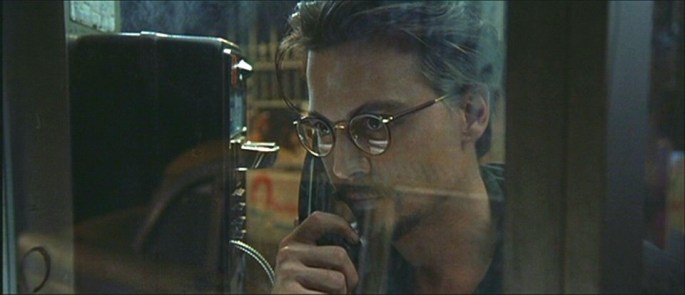
While the film’s slow, deliberate pacing turned off many, there is a method to Polanski’s madness. The gradual pacing draws one into this engaging world. Perhaps it is the European setting but The Ninth Gate has an otherworldly atmosphere that is well done. The attention to detail and Khondji’s richly textured cinematography is exquisite and contributes to the overall mood of this vivid world. For example, the New York City scenes have a very 1940s vibe to them, utilizing brown and blacks with a warm gold glow from the street lamps. This is, in turn, contrasted with the green and red in the phone booth when Corso is trying to contact Balkan.

hQFD1However, The Ninth Gate does not just have atmosphere going for it. Johnny Depp adds yet another intriguing character to his roster of unconventional roles. Corso is an unethical cheat who would do anything to make a buck. A rival describes him as a “vulture” and “unscrupulous” to which he freely admits to as he swindles four volumes of a rare edition of Don Quixote. He really does not care about others and yet, despite all of his reprehensible qualities, Depp’s natural charisma and charm make him kind of an endearing character that you care more about as he delves deeper into dangerous waters.

Balkan is a pompous windbag filled with self-importance but Frank Langella stops just short of being a cliched, moustache-twirling villain. He’s melodramatic and his presence is a nod to horror fans who recall his most famous role in Dracula (1979). Lena Olin’s dangerous Telfer widow evokes her femme fatale character from Romeo is Bleeding (1993). She smokes and even flashes a suggestive shot of her black garter-clad thighs in an attempt to seduce Corso and draw him into her web. She uses sex to get what she wants and when that fails she resorts to violence, attacking him in an animalistic frenzy.

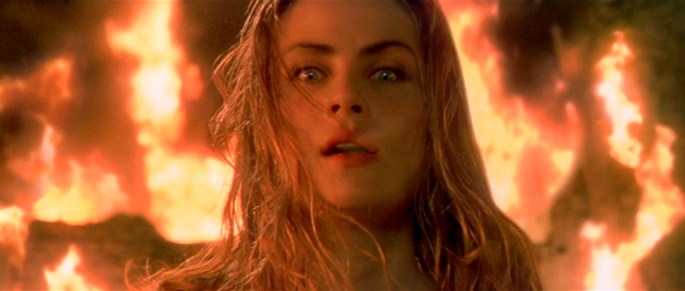
Emmanuelle Seigner plays a mysterious woman who constantly shadows Corso and sometimes helps him out when gets in dangerous situations. Her motives do not become fully apparent until the end and even then it is open to interpretation. She helps him get inside the Fargas house and flies with him to France. Who or what is she? At one point, she literally glides down a flight of stairs and saves Corso from getting a beating at the hands of Telfer’s henchman.

This movie is ample with clues, a puzzle waiting to be solved. For example, in Balkan’s lecture at the beginning of the movie, he suggests that all witches are evil and in league with Satan. The irony is that Corso sleeps through this important clue to Balkan’s real intentions. There is also the odd, disregard for The Book of Shadows, a book worth an estimated $1 million. It is placed in constant peril and is even flicked with ash when the Ceniza brothers analyze it.

As for the cliché aspects of the film, one should be less concerned at anticipating plot twists and predictable elements in favor of simply enjoying the ride. Polanski probably was aware of this and decided to have fun with them. There is Balkan’s “666” password, Corso’s perchance for getting the crap kicked out of him, and the one-armed woman book dealer that all contribute to a playful mood that punctuates the film whenever it runs dangerously close to being too pretentious or self-important.

Polanski approached the subject matter with a certain amount of skepticism as he said in an interview, “I don’t believe in the occult. I don’t believe. Period.” He wanted to have fun with the genre. “There is a great number of clichés of this type in The Ninth Gate which I tried to turn around a bit. You can make them appear serious on the surface, but you cannot help but laugh at them.” For Polanski, the appeal of the film was that it featured “a mystery in which a book is the leading character” and its illustrations “are also essential clues.” The film has a playful tone but Polanski knows when to reign things in. As the horror is heightened so is the film’s dark comedy during the climactic moments. The screenplay is in perfect synchronicity with the direction.

For a film supposedly steeped in literature, the text, and by that I mean the story, is irrelevant. There are many clues scattered throughout the film that suggest this to be the case. One has to understand that among the characters there is a hierarchy. At the bottom level is the Frenchman that Corso meets early on. He owns one of The Nine Gates but is not all that interested in it except for the craftsmanship of its binding. Then, there is the Baroness who has spent her life writing about The Devil but never considered the meaning behind the images in her copy of The Nine Gates. And, if you take her word, she had the best clue because she claimed to see the Devil when she was a child. At the next level is Laina who is aware that the book has some power but is still focused on the words and not the images. Above her is Balkan who knows that the text is irrelevant and that the pictures are crucial but incorrectly thinks that the key to summoning the Devil lies in them.

The Ceniza brothers have the ability to tinker with the power of the pictures. They are allusive figures that seem whimsical when Corso first meets them and then are gone when he visits their now defunct store at the film’s end but thanks to the movers who are disassembling the store he gets the final piece of the puzzle. Corso starts off at the bottom because the value of books are neither in the text nor in the pictures but in their binding and availability. By the film’s end he realizes that the power is not in the pictures but the quest itself. There is the mysterious woman who resembles one of the figures in the engravings and actually provides the final clue for Corso to reach the end of the quest. The final layer is the viewer. That makes nine players and eight levels of consciousness created by Polanski.
fhd999TNG_Emmanuelle_Seigner_037The Ninth Gate
was a refreshing change from the trend of mundane Hollywood supernatural schlock at the time (i.e. The Bone Collector, Stigmata, End of Days, et al.) that took itself way too seriously and tried too hard. Unlike those films, The Ninth Gate never falls into that trap. It contains some truly vintage Polanski black humor that, alas, North American audiences and critics alike did not appreciate. They wanted meat and potatoes filmmaking that he has always resisted in favor of subversive thrills and following his own muse come hell or high water.

PUBLIC ENEMIES – A REVIEW BY J.D. LAFRANCE

Public-Enemies-4-790022

Public Enemies (2009) marked Michael Mann’s fourth foray into American history with The Last of the Mohicans (1992), The Insider (1999), and Ali (2001) being his previous efforts. The director got his start making documentaries and always been interested in achieving absolute authenticity in the depiction of the professions that his protagonists practice, be it safecracking in Thief (1981) or serial killer profiling in Manhunter (1986). Born and raised in Chicago, it is easy to see what drew Mann to the story of John Dillinger, a famous bank robber during the 1930s. He and his crew were the best of the best at the time and so, he certainly fits the kind of protagonist Mann is drawn to.

Public Enemies begins in 1933 during the golden age of bank robbery and Mann wastes no time getting into it as he opens the film with an exciting escape from an Ohio prison orchestrated by Dillinger (Johnny Depp) and his crew. Soon after, we meet FBI agent Melvin Purvis (Christian Bale) in action as he takes down Pretty Boy Floyd (Channing Tatum) with a hunting rifle from an impressive distance. In no time at all, Mann has established the film’s protagonist and antagonist. They are smart, super efficient men of action that are single-minded in their respective goals.

Unable to get funding and criticized by his superiors, FBI Director J. Edgar Hoover (Billy Crudup) needs high-profile busts and enlists Purvis to find and stop the country’s Public Enemy No. 1 – John Dillinger. The more notorious he becomes the more this angers not just the FBI but also the Chicago mob because his actions put extra heat on them. There is a nice scene where he meets with a mob representative who basically tells him that he is a dying breed. The money he makes knocking over one bank, they make in one day through illegal gambling.

Mann demonstrates that he is a master at orchestrating action sequences. They are cleanly photographed and edited so that there is no confusion. You can always tell what is going on and who everyone is instead of the kamikaze, headache-inducing editing and slapdash camerawork in films by the likes of Michael Bay and McG. The shoot-out at Dillinger’s hide-out in Little Bohemia is the film’s show-stopping action sequence much like the bank heist in Heat (1995) and the nightclub shoot-out in Collateral (2004). It is powerfully executed and full of tension and excitement as well as an impressive display of firepower with the deafening blasts of tommy guns and shotguns.

Public Enemies reunited Mann with key collaborators, chief among them cinematographer Dante Spinotti who has shot his most memorable films (including Manhunter, The Last of the Mohicans, Heat, and The Insider). Mann has come under considerable criticism for making the move to digital cameras and even more so with Public Enemies because it is a period film and audiences are used to seeing them done on traditional film stock. However, it looks great with crisp, clear images, especially at night where there is an impressive depth of field. Certain scenes have a graininess to them inherent with digital cameras but, in this case, it gives a tangible, gritty texture that works. There are some truly beautiful shots in this film, like one in which a car carrying Dillinger and his crew hurtle down a road surrounded by a vast forest of trees that tower over them.

Mann is also reunited with composer Elliot Goldenthal who worked on Heat. Since The Last of the Mohicans (1992), Mann has relied on soundtracks comprised mostly of disparate tracks from various sources. Being a period piece, obviously Public Enemies really doesn’t lend itself to that kind of a soundtrack and Goldenthal expertly augments the drama that unfolds in various scenes, creating one of the best scores in a Mann film to date.

The attention to period detail is fantastic with classic trains, cars, and classic gangster iconography like tommy guns, fedoras and trenchcoats permeating the film. Mann really immerses us in the time period but not in a way that calls undo attention to itself. It’s just there in the background of every scene with vintage period architecture. Ever the perfectionist, Mann shot on location, often at the actual locations that Dillinger and his gang frequented. Whether you are consciously aware of this or not, the film just oozes authenticity.

Dillinger certainly enjoys the fruits of his labor but is always planning his next job. He follows his own personal code: he doesn’t kill unless absolutely necessary and doesn’t think about the future, living only in the present because he could easily end up in jail or dead. He is also very conscious of how he’s perceived by the public, enjoying the notoriety his exploits create. Johnny Depp portrays him as a very confident guy who is always in control. There is often this mischievous glint in his eye like he’s in on a private joke. Depp plays Dillinger with a lot of charm, like when he addresses the media while being booked in an Indiana jail. He knows how to work the crowd and the charismatic actor is excellent in this scene. However, Public Enemies is not afraid to point out that Dillinger is no hero. The man has no problem with killing someone if they got in his way but the film goes to great lengths to point out that he did so only when there was no other option. Dillinger was clearly a man who didn’t believe in wasting time, much like Frank, the safecracker in Thief. Depp inhabits the role with his customary dedication, adopting a specific voice, accent and effortless delivery of period lingo that sounds natural and genuine.

Christian Bale is quite good as the very determined Purvis. While Mann doesn’t create the balance of cop vs. robber as he did in Heat, Bale has a significant amount of screen-time in the film. Like other law enforcement figures in Mann’s films, Purvis uses state-of-the-art technology, for the time, to track Dillinger and his crew. As determined as Purvis is, Mann allows some humanity to seep in, like when he stops the brutal interrogation of Dillinger’s girlfriend Billie Frechette (Marion Cotillard) and personally helps her get cleaned up. It is this small moment that adds a welcome layer to his character.

There are all kinds of parallels between Public Enemies and Heat. In both films we are meant to sympathize with the bank robber. Also, the two leads only meet face-to-face in one scene. There is a climactic gun-battle where both sides take on significant casualties that alter the conclusion of the story. And, like McCauley in Heat, there is an inevitability to Dillinger’s life; that he will run out of time and luck; that Purvis and the FBI will close the net around him. That being said, Public Enemies is not a carbon copy of Heat. Personality-wise, Dillinger and McCauley are very different people with the former being a risk-taker and the latter being overly cautious. The same goes for the lawmen. Purvis is not the larger-than-life extrovert that Hanna is, but rather a no-nonsense man who gets the job done and that’s it. There’s even a loose cannon in the form of Baby Face Nelson (Stephen Graham) who is to Public Enemies what Waingro was to Heat. A psychopath that the bank robbers initially ally themselves with but end up cutting loose when he proves to be too unstable. Structurally, both films couldn’t be different as Mann continues to experiment with narrative structure in a fascinating way. This isn’t your typical, cookie-cutter A to B to C plotting, which may frustrate some (see Ali or Miami Vice) but if you the patience and can get into it, watching Public Enemies is a very rewarding experience.

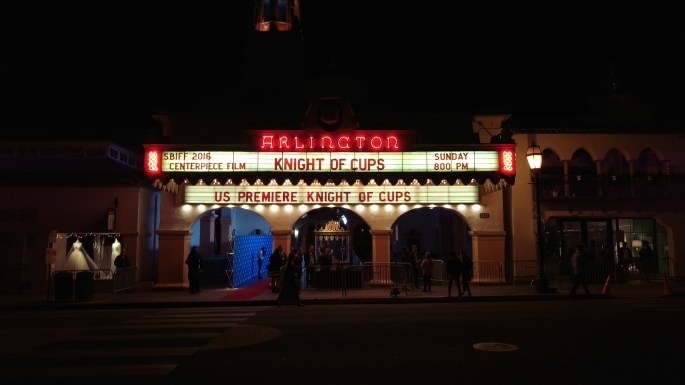
Episode 24: Coverage of the 31st Santa Barbara International Film Festival and Terrence Malick’s KNIGHT OF CUPS

SBIFF episode

Our coverage of the 31st Santa Barbara International Film Festival is up!  This has been our first red carpet coverage, and included are interviews with actors James Morrison, Michael Keaton, Rachel McAdams, Carl Weathers,  film historian Leonard Maltin, filmmakers Benjamin Cox of STEREOTYPICALLY YOU and Tom McCarthy of SPOTLIGHT, producers Marcia Nasatir (THE BIG CHILL, COMING HOME, IRONWEED) and Sarah Green (THE NEW WORLD, THE TREE OF LIFE, TO THE WONDER, KNIGHT OF CUPS) and executive director of the Santa Barbara International Film Festival Roger Durling.  We then dive in, head first, into Terrence Malick’s new film KNIGHT OF CUPS which had it’s US Premiere, and was the Centerpiece film at this years fest.  We would like to thank Roger Durling and the staff of the SBIFF for accommodating Podcasting Them Softly at the festival this year.  To find out more about the SBIFF please click here.