Doom: A Review by Nate Hill 

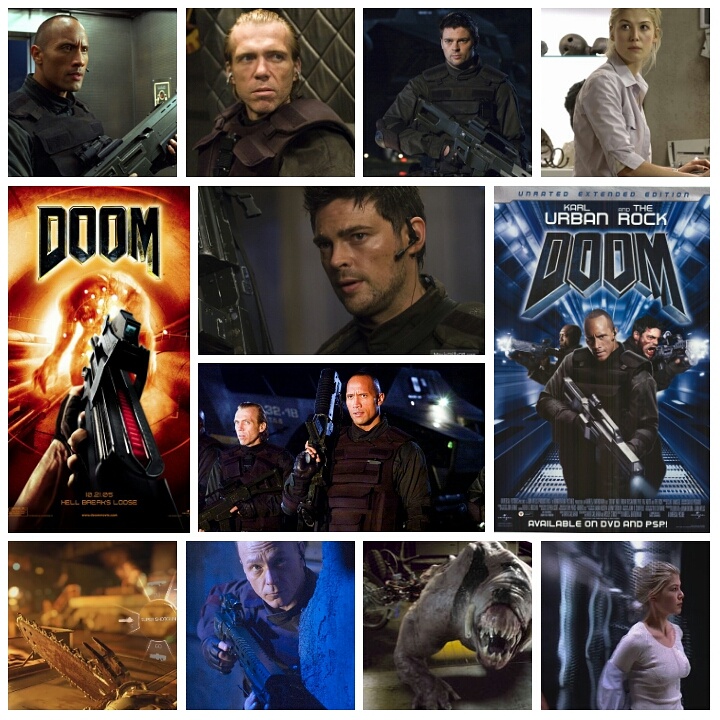
Despite not having a whole lot to do with the video games, Doom is still a rush of schlock and awe silliness, getting more fun and ridiculous in equal amounts near it’s nonsensical ending. Karl Urban and The Rock are the tough guys for the job when it comes to scoping out a Martian research base that’s accidentally opened up a portal to hell, unleashing all kinds of lovely things. Rock is Sarge, stoic commander of this unit, and Urban is John Grimm (he lives up to his last name) a battle scarred badass who has personal stake in fighting these monsters. His sister (Rosamund Pike) is a scientist on the base, and is now in a great deal of danger. After a neat Google Earth type zoom in on the Martian surface (ironically the only shot in the film that suggests they’re even on the red planet), it’s off to dank corridors, vast bunkers and beeping control panels, an Aliens-esgue siege on horrors of the dark that quickly goes sideways on them. It’s run of the mill stuff save for one stroke of brilliance: a pulse racing first person shooter sequence that showcases a POV of Urban shooting, slashing and chain-sawing his way through alien flesh. It’s a bold move that pays off immensely and is quite fun. The rest of their team is forgettable except for Richard Brake as Portman, the loudmouth A Hole of the bunch, a refreshingly animated performance in a roomful of muted, grim characters. The monster from the game shows up, a hulking hell pig nicknamed Pinky that tirades it’s way through everything until Urban gives it what for. This ain’t no great flick, but as far as video game movies go, you could do way worse. There’s definitely enough gore for the hounds, and it’s adequately stylish in presentation. 

Priest: A Review by Nate Hill 

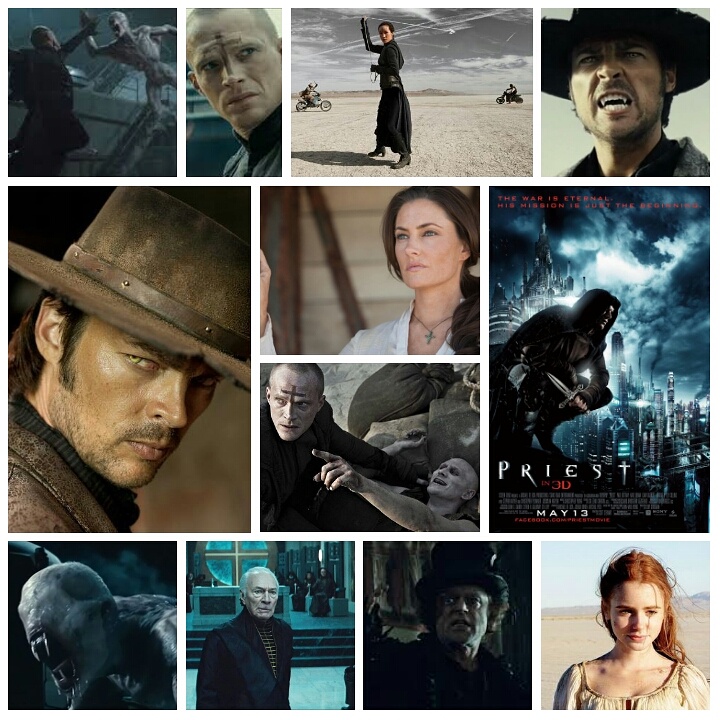
Priest is one of those flashy missed opportunities, a visually stimulating comic book flick that just couldn’t amp the substance metre up enough til it’s flush with style, and ultimately feels somewhat hollow. It’s still a gorgeous Blu Ray that will give your system a workout though, with some neat vampires and a great cast. Sometime in a murky post apocalyptic future, humanity lives in a giant gloomy city on the edge of oblivion, walled in for fear of vampires who have preyed upon them in the past. An order of warrior priests protects citizens and keeps order, until one rogue from their sect (Paul Bettany) discovers that the creatures may be back when an outsider couple (Stephen Moyer and Madchen Amick) have their daughter (Lily Collins) kidnapped from their desert dwelling outside the city. They come to Bettany for help, but the leader of his priesthood (a smug Christopher Plummer) is an obstinate son of a bitch and refuses to act. Bettany goes renegade along with Priestess (Maggie Q) and ventures into the wasteland to rescue Collins and fight these baddies. It’s frustrating because the look and design of this world is brilliant, like a dark opulant jewel that clearly has some thought put into it. But then… the dialogue and story are so numbingly pedestrian, straying not a kilometer into uncharted narrative waters to give us something even a little bit exciting or unpredictable. Quality jumps with Karl Urban’s dapper villain Black Hat, a vampire cowboy outlaw who oddly resembles what I’d imagine Stephen King’s Roland Deschain would look like if the powers that be took their heads out of their ass and recasted Idris Elba. But I digress. Like I said, terrific cast; Brad Dourif has a great cameo as a snide hustler peddling trinkets to superstitious townsfolk, and watch for  the great Alan Dale too. Bettany always makes for a solid action hero, he just has a bit of trouble finding the right projects (have you seen that turd Legion? Good lord) that deserve bis talents. This one falls just short. It could have really used a few rounds of defibrillation from another screenwriter, and perhaps a hard R rating to take advantage of the horror aspects. Still, the vampires are creepy enough (echoes of Blade II are always welcome), the actors keep it going and there’s no shortage of style. 

Riddick: A Review by Nate Hill 

Being a huge fan of the two previous Riddick films, I was overjoyed to hear that Vin Diesel would be raiding his own couch for change to save up in order to make this R rated follow up, still helmed by David Twohy. It’s reassuring that in a franchise with more than a few haters, Diesel has the passion and ambition for his character to go out of his way in bringing this to fans. Not to mention what a kick ass, gnarly little space yarn it turned out to be. Pitch Black was a claustrophobic horror fest set on a single harsh world, and The Chronicles Of Riddick opened up into a vast galactic space opera. This one reigns it in closer again (partly because of budget, I would imagine) and gets back to the roots established in Pitch Black. After defeating the Necromongers and becoming their King, Riddick is betrayed and sent into exile by the treacherous Lord Vaako (Karl Urban in a brief but memorable reprisal). Cast out into the stars with a ship running low on fuel, he finds himself marooned on a small, deadly planet that’s more challenging than any other he has found himself on (and if you remember, he has been to some hellish little nooks in the past). This world is a dry, acrid rock where every form of wildlife seems to be incredibly lethal, and out to get him. The first half of the film is pure genius, and consists of Riddick playing Survivorman with his environment, battling aliens and elements and befriending a small hell-pup type doggo that grows up into a teeth and claw ridden killing machine that is at one point referred to as a ‘dingo dango thing’. This is where it’s at for the film, and as soon as the more generic second half arrives, the air gets a bit stale, but it’s still heaps of fun. After mastering the terrain and ingeniously dispatching a snakelike alien that seems to have wandered right in from Wolfgang Petersen’s Enemy Mine (practical effects POWER), he encounters trouble of the human variety, in the form of bounty hunters. Two teams of outlaws have arrived to claim him: the stern Boss Johns (Matt Nable) who has an old bone to pick with Riddick, and the psychotic A-hole Santana (Jordi Molla, who I think of as the Latin Gary Oldman). They bicker a whole bunch on who gets the prize, unknowingly being infiltrated and messed up by the guy before they’ve barely landed. Katee Sackhoff is nutso awesome as Dahl, a lesbo tough chick who legit has the line “I don’t fuck guys, but occasionally I fuck them up.” Soon there’s more charming wildlife, this time in droves of shrieking reptilian predators who intend to see each of them, Riddick included, dead. This forces an amusingly unstable team-up from all forces to battle the uglies and escape this godforsaken place. It’s giddy sci-fi pulp good times, and benefits from its hard R rating, something which the other two films never had on their side. Diesel was born to play Riddick, the growling teddy bear, and I hope he gets to continue wearing the goggles for more of these movies, indefinitely if possible. A hell of a great time. 

Broken Lizard’s The Slammin Salmon: A Review by Nate Hill 

The hype surrounding comedy troupe Broken Lizard quieted down somewhat after the hullabaloo of both Super Troopers and Beerfest, but that didn’t mean they halted their output. In 2009 they released the insanely funny screwball romp The Slammin Salmon, which nobody seems to have seen and garnered nowhere near as much buzz as their previous films. It’s just as much of a riot, this time landing the gang into a Miami seafood restaurant, after their jaunts in rural law enforcement and extreme competitive alcohol consumption. The restaurant they all ‘work’ at is owned by a hulking bull in a china shop named Cleon ‘Slammin’ Salmon, a gigantic ex pro boxer played by the late great Michael Clarke Duncan in one of his last, and best, appearances. Cleon runs the restaurant with an obnoxious iron fist, a giant petulant brat with a penchant for beating up his staff and the social skills of a grizzly bear. On a busy night he announces to his staff that they must sell enough deceased marine life on plates to come up with a ten grand debt he owes to the Asian mob. This sets off a chain of reliably hilarious shenanigans involving the whole Broken Lizard crew, and a few cameos from salty hollywood veterans, a welcome trend that is commonplace among their films. The pushover manager Rich (Kevin Hefferman) attempts to keep the order. The lunatic head chef (Paul Soter) and his dimbulb busboy brother (also Soter) create trouble for everyone. Douchey waiter Guy (Eric Stolhanske) plays dirty to boost his sales. Ditzy server Mia (April Bowlby) dolls up her smile and smart one Tara (Cobie Smulders) plays it crafty to get ahead. Funniest by far is Jay Chandrasekhar as Nuts, a weirdo whose alter ego Zongo makes insane appearances whenever he forgets to take his meds. Clarke Duncan is the bellowing life of the party though, in an untethered romp through the comedic corn that clearly has been improvised a lot and shows the actor having some of the most fun I’ve ever seen onscreen. It’s a chaotic flick that captures the mania of restaurant life perfectly, with nods to everything from Monty Python to Blake Edward’s The Party, while still retaining a contemporary personality of it’s own. Broken Lizard has a knack for making every joke land in their films, and it’s laugh city all the way through this one. From engagement rings in fecal matter, third degree burns from scalding soup, endless situational fisacos and satirical characters, it’s just wild. Watch for Lance Henriksen, Carla Gallo, Olivia Munn, Jim Gaffigan, Sendhil Ramamurthy, Morgan Fairchild, Vivica A. Fox as a pop star named Nutella (lol) and a priceless Will Forte. On par with Troopers and Beerfest, funny in spades and so damn re-watchable. An essential for comedy fans. 

Dredd: A Review By Nate Hill


After the floundering absurdity that was 1995’s Judge Dredd left a nasty taste in the collective mouths of fans, all wen quiet on the cinematic front of Dredd for nearly two decades (I call it the Batman & Robin effect). The clouds parted though, and we finally got one streamlined masterpiece of a flick with 2013’s Dredd. Not only is it achingly faithful to the comics right down to Dredd never removing his helmet, but it stands as one of the ballsiest and well made action pictures in recent years. It’s never overstuffed or busy, takes the violence seriously, has genuine suspense, a bone deep and super tough performance from a grizzled Karl Urban, a sexy, no nonsense villain and the best original score of 2013 by a country mile. Not too mention it’s atmospherics, which are helped by said score of course, to create a sonic mood board of post apocalyptic ruin and urban rot. Dredd is part of an elite department called the Judges, who roam the smoky desolation of Mega City One and act as judge, jury and executioner wherever they see fit. Dredd is a trigger happy juggernaut with no use for scum or criminals and has not a qualm with taking them out like the trash they are, often in brutal, bloody and uncompromising ways. On day he’s partnered up with judge in training Cassandra (Olivia Thirlby, perfect), a rookie with blossoming telepathic abilities. A routine call leads them to a gargantuan Mega Block tower called Peach Trees, a sting irony once we see the rampant squalor inside. This tower happens to be controlled by the fiercest criminal overlord in town, Ma Ma, played by a purring, lethal and altogether terrifying Lena Headey. Her tactics go beyond barbaric and she’s sitting on the manufacturing of a drug called Slo Mo, which makes the users feel like time is passing at one percent it’s normal rate (a gold mine for setting up a scene visually). Ma Ma locks down the tower as the two judges arrive, and decrees that she wants them dead. Now it’s a visceral fight for survival against her armies of thugs and miscreants, and a slow ascent towards her penthouse lair, for Dredd to finish her off. The whole film takes place in Peach Trees, so it’s a self contained, one location affair, and a goddamn knockout of a movie. There are R rated films that dabble in violence a bit and barely earn their stripes, and then there are R rated films that leap at the chance to show people dying six ways to Sunday. Dredd absolutely decimates Ma Ma’s armies in high style and often in super slow motion as they face him while they’re high. The slo mo never feels tacky, but has a tactile richness and fluidity that makes the inflicted carnage so satisfying as it unfolds. The score by Paul Leonard Morgan is an uproarious rallying call that drives forward constantly, charging out of the gate in the opening minute as Dredd pursues a van down the highway on his thundering motorbike, and pummelling each scene with heart stopping force until it mellows out for an eerie passage called ‘Ma Ma’s Requiem’ which is my favourite piece in the film and can be listened to on repeat. Pure genius. Thirlby is the voice of reason and the eyes of the audience, experiencing for the first time how ugly this crime fighting business is, and holding her own wickedly. There’s a dark sense of danger to the whole thing, a frank and outright lawlessness to the villains, as it’s just another day on the job for them. No overacting, no histrionics. Just mellowed out murder and meanness all round. This is the Dredd film that we’ve been waiting for, and have long deserved after that other mess. Low box office returns means we may never see a sequel (wtf is wrong with people, like, who didn’t go see this??), but we’ll always have this little blitzkrieg of a flick to re watch time and again. I know I will.

Tony Scott’s Man On Fire: A Review by Nate Hill 

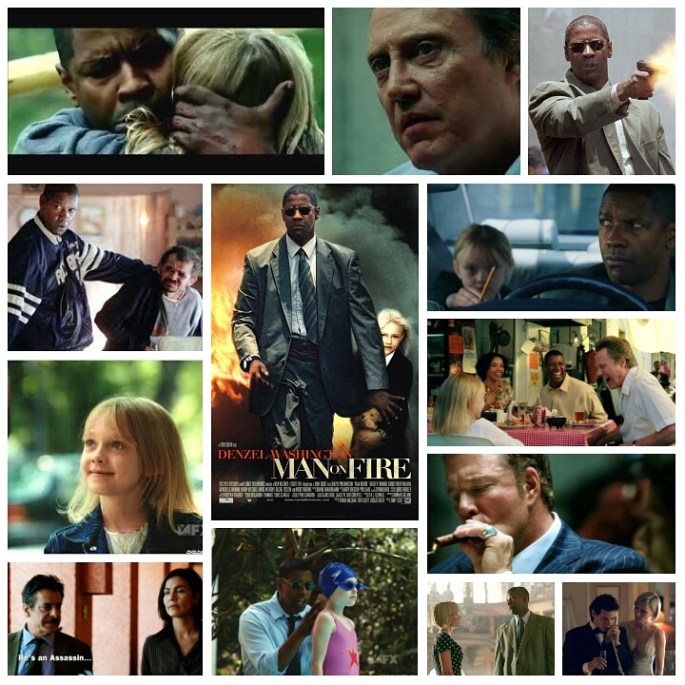
Tony Scott’s Man On Fire is one of those films I can watch time and time again and never tire of, a magnificently melancholy tale of South of the border justice, criminal intrigue and a tequila shot of pulpy, blood soaked style that gets me every time. It’s loosely based on a 1987 film of the same name starring Scott Glenn, Jonathan Pryce, Danny Aiello and Joe Pecshi (there’s a random lineup, no?), but Scott intrepidly branches off into his own territory, and thank god for his vision. This was the first film in which he really explored his sketchy smokehouse of an aesthetic that he would later take to angelic heights with Domino. Colors blur and saturate, editing rockets by with the force of a bullet in a storm, subtitles appear arbitrarily and seemingly of their own volition. It’s a jarring tool set that he employs, and many abhor it. I’m as in love with it as he was though, and whether to throw us right into the protagonist’s psyche or simply because he felt the need to paint his pictures this way, the rest of the films in his remaining career carried the DNA, in varying doses. Fire is the key word for this film, in many of it’s forms. There’s a smoldering ember in Denzel Washington’s John Creasy that is fed by the winds of corruption as the film progresses, erupting into a blazing inferno of violence and fury. Creasy is a broken man, haunted by the questionable, never fully revealed actions of his military past. “Do you think God will ever forgive us for what we’ve done” he grimly asks his old war buddy Rayburn (a scene stealing Christopher Walken). “No” Rayburn ushers back curtly. It’s at this heavy nadir we join Creasy, lost in a sea of alcohol and guilt, an unmooored ship with a shattered hull looking for both anchorage and repair. Rayburn hooks him up with a bodyguard gig in Mexico City, keeping the young daughter of a rich businessman (Marc Anthony, terrific) safe from the very real threat of kidnapping. Dakota Fanning is compassionate, precocious and endearing as young Pita, who spies the wounded animal in Creasy right off the bat and tries to make friends. Creasy draws back in reluctance, but eventually warms up. I love the pace of this film to bits. It spends nearly half of its hefty running time simply getting to know these two characters, forging a bond between them before the inciting incident even looms on the horizon. And when the kidnapping occurs, as it must, the stakes are high as can be and our investment level in the situation is paramount. Setting up character is so key, and Scott nails it with scene after scene of quiet and careful interaction. Then he yanks the lid off the pot, as Pita is snatched in broad daylight, Creasy is injured and the kidnappers vanish into thin air. Pita’s mother (a soulful Radha Mitchell) works with the dodgy Mexican authorities and her husband’s lawyer Jordan (a sleazy Mickey Rourke). Creasy has other plans. Once healed, he embarks on a mission of fury and vengeance, knocking down doors, removing body parts, inflicting gratuitous bodily harm and using every technique in his training (believe me, there are some interesting ones) to track down those responsible and get Pita back. Washington does all this with a calm and cool exterior, letting the heat emanate from every calculated syllable and intense glare. The descent into Mexico City’s poverty stricken criminal underworld is a grisly affair, and all sorts of ugliness is exposed, shredded through the caffeinated prism of Scott’s lens. Two cops do what they can to help Creasy, idealistic Guerrero (Rachel Ticotin) and battle hardened Manzano (the always awesome Giancarlo Gianninni). It’s Creasy’s show though, and he blasts through it like a righteous hurricane of blood and bullets. Scott’s films have a knack for ending in over the top, Mexican standoff style shootouts, but the man subverts that here, going for something far more sorrowful and atmospheric, ending an intense tale on notes of sadness and resolute calm, gilded by the aching tones of songstress Lisa Gerrard and composer Harry Gregson Williams. Walken provides both comfort and catharsis, the only beacon of hope for Creasy other than Pita. Unlike John, Rayburn has moved on from the horrors of their past, but one still sees the trauma in his soul when he looks John in the eye and gets hit with what is reflected back. Tough stuff to get right, but hey, it’s Walken we’re looking at here, and he’s brilliant. Rourke has little more than an extended cameo, but his flavor is always appreciated, and he’s great too. I had no idea Anthony had the chops he exhibits here, but I loved his arc as well as his performance and he holds his own in a blistering scene with Washington. Washington is an elemental beast, shadowing what’s left of his humanity under a cloak of booze and brooding contemplation, until he’s coaxed out by the life saver Pita. Then he’s a lion, riding guns out into a ferocious swan song of a sunset that may just hold rays of redemption for him. This is Scott at his best, his unique brand of storytelling at its height, his creative juices a canister of lighter fluid set aflame with genius and innovation. A masterpiece.
Tony Scott’s Crimson Tide: A Review by Nate Hill 

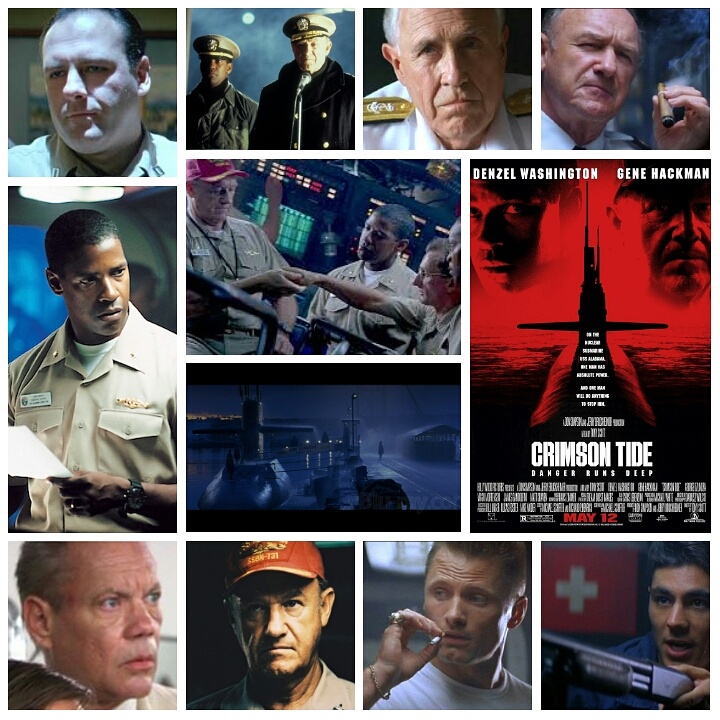
In terms of submarine movies, nothing will light your fire or get your pulse racing quite like Tony Scott’s Crimson Tide (well maybe Das Boot, but that’s another story). Scott just has this way with hyper kinetic tension and a knack for causing whirlwinds of propulsive energy in his work, and even when the material is more melancholy there is still a rousing climate to every frame. Pair his visual skill with Quentin Tarantino’s sterling (and uncredited) ear for dialogue and you’ve got one simmering package. Not too mention the actors and the blood stirring score from Hans Zimmer which is one of the composer’s best and richly orchestrated works. This is the second time Tarantino and Scott have done the writer director duo, albeit the lesser of the two films, it’s still a stunner. When lunatic Russian extremist Vladimir Radchenko (Daniel Von Bargen, RIP) goes off in a huff and threatens nuclear warfare, the Yanks get nervous and send in an ace in the hole submarine loaded with warheads of it’s own, cause, you know, ‘just in case.’ The vessel is captained by an intense and corrosive Gene Hackman, backed by a more reserved and introverted Denzel Washington. The two clash right off the bat and its obvious that fireworks of conflict will erupt between them once the shit hits the propeller. It soon does, in the form of a command order that is partly lost in translation. It could mean go ahead and fire the nukes on Radchenko. It also could not. Hackman, that spitfire, wants to engage and eradicate any chance of action on the extremist’s part. Washington insists on holding back, terrified by uncertainty. This troublesome personal disagreement eventually leads to flat out mutiny amongst the crew, in more ways than one. The crew has no concrete leader to direct their devotion to, and that’s a dangerous thing aboard a military vessel. Hackman and Washington are pure electricity as opposite sides of the same coin, facing off in a claustrophobic arena where one wrong move could end up in cataclysm. Along with internal disruption concerning the crew, there’s also the fact that they’re on a submarine miles below the surface to contend with, and it’s one whopper of a suspense cocktail. Viggo Mortensen is terrific in a conflicted supporting role, and watch for solid turns from Danny Nucci, George Dzunda, Matt Craven, Ryan Phillipe, Steve Zahn, Chris Ellis and a fiery James Gandolfini. Ooo and Jason Robards in an uncredited cameo, which he’s also done for Scott in Enemy Of The State. It’s pure movie bliss, but what can you expect from Scott other than the cream of the crop? The guy gave us pure gold for decades, bless his soul, and this is one of his best.

Antoine Fuqua’s Training Day: A Review by Nate Hill 

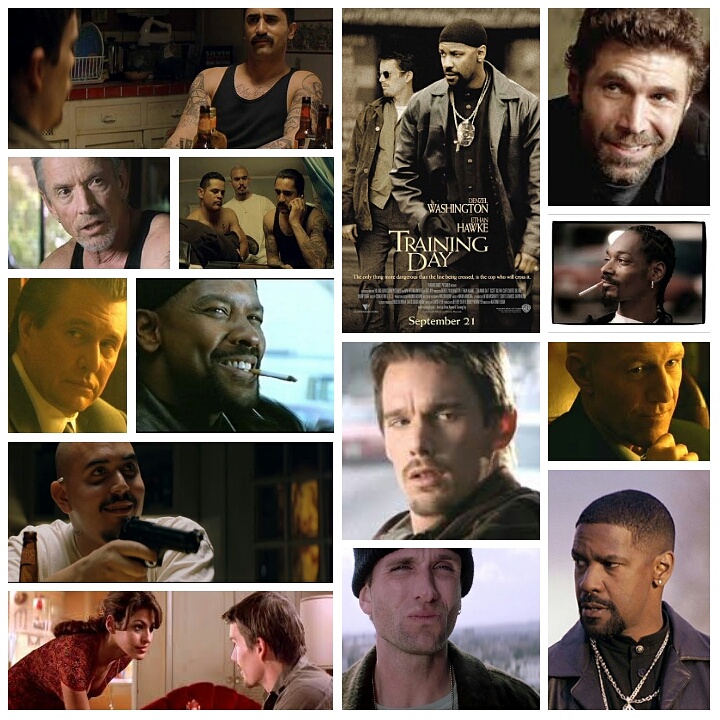
“To protect the sheep, you gotta catch the wolf, and it takes a wolf to catch a wolf.” This questionable sentiment is how rogue LAPD detective Alonzo Harris (Denzel Washington) justifies a heavy laundry list of dirty deeds, scary volatility, sociopathic backstabbing and a complete disregard for the badge that he wears on a chain like dog tags. And indeed, inner city Los Angeles can seem like a war zone, but its like he’s in fact more part of the problem than the dark angel of justice he sees in himself. Antoine Fuqua’s combustible crime drama Training Day rightly won Washington an Oscar for his unsettling runaway train of a performance, and he owns it down to the last maniacal mannerism and manipulative tactic. The film takes place over one smoggy L.A. day (hence the title) that feels like an eternity for its two leads, as well as all the colorful and often terrifying people they meet along the yellow brick road that’s paved with used needles and shell casings. Harris is tasked with showing rookie cop Jake Hoyt (Ethan Hawke) the ropes in his neighborhood, in the hopes that he’ll pass the test and achieve Narc status. Jake is prepared for a run of the mill crash course, but as soon as he’s treated to a verbal beatdown from Harris in the diner they meet at, he has a feeling it ain’t gonna be anywhere close to a normal day. This is just another day for Harris though, as he drags Hoyt by the scruff through drug busts, gang warfare, the worst neighborhood in town and pulls him deeper into his very dangerous world. Fuqua has a knack for getting the atmosphere of his settings just pitch perfect, and the feverish nightmare of the inner city comes alive, seemingly possessing the characters themselves until the atrocities just seem like a way of life. The trouble really starts when they run across Harris’s old drug lord buddy Roger (a wicked Scott Glenn in a role originally intended for Mickey Rourke), who proves a valuable asset later, though not in the way you might think. Harris introduces Jake to his equally crooked and scary team, including Peter Greene, Nick Chinlund and Dr. Dre who struggles in the acting department, especially in a room full of such heavy hitters. Jake is aghast at the horrors he sees and cannot believe the streets are like this. Harris devilishly assures him that this is the job, mutilating the symbol of his badge even more by justifying such behaviour as necessary. Tension reaches unbearable heights during a visit to a Latino gang household run by Cliff Curtis, Raymond Cruz and the eternally scary Noel Gugliemi. This is the heart of darkness fpr the film, a story beat from which there is seemingly no escape, until it becomes clear that Jake has somehow evolved a step up the food chain as far as LA goes, and is now ready to put down the dog who taught him, a dog who has long been  rabid. People complain that the final act degenerates into a routine action sequence. Couldn’t disagree more. With a setup so primed with explosive conflict, it can’t end up anywhere else but an all out man to man scrap, which when followed by no flat out action sequences earlier in the film, hits hard. Their inevitable confrontation is a powerhouse, especially from Washington, who finally loses his composure and yowls like a trapped coyote, his actions caught up to him. In a role originally intended for Tom Sizemore (who would have rocked it in his own way) I’m glad Denzel got a crack at it, for he’s absolute dynamite. Watch for Harris Yulin, Raymond J. Barry and Tom Berenger as the three senior LAPD dick heads, Eva Mendes as Alonzo’s girlfriend, Macy Gray as a screeching banshee of a ghetto whore and Snoop Dogg as your friendly neighborhood wheelchair bound crack dealer. Fuqua keeps attention rooted on the dynamic between Washington and Hawke, who is excellent in as role that could have easily been swallowed up by Washington’s monster of of a performance. Hawke holds his own, and the film is really about how two very different guys view a difficult area of town, how it changes them both, and ultimately how their moral compasses end up on a collision course. One of the best crime framas out there, and quickly becoming timeless.

Robert Zemeckis’s Flight: A Review by Nate Hill 

When I saw the marketing and trailer hype for Robert Zemeckis’s Flight, I was strongly under the impression that when I got around to seeing it I’d get a conspiracy style thriller. Some aviation intrigue, maybe a little government corruption, valiantly unveiled by Denzel Washington’s hotshot pilot protagonist. How very wrong I was. To my credit, it wasn’t my fault, but that of the severely misleading marketing. But then, how do you market a film like this? Hell, it’s a wonder it even made it past the pitching stage! The airplane related fiasco one sees in the previews is but a tiny segment that acts as at catalyst for one of the most searing and honest portraits of addiction I’ve ever seen. Washington is Whip Whittaker, senior pilot, ladies man, assured professional and severe drug and alcohol user. Whip snorts and guzzles day and night, including during the job. He’s functional and hides it well, but thats just another facet of his problem. When an onboard malfunction causes crisis on one of his flights, he takes a giant leap of faith, spectacularly landing the airplane upside down and essentially saving every passenger’s life. End of story? Not really. From there the film throws a curveball, as we dig deeper into Whip’s life, habits and history. An inquiry is launched into his mental state during the event, led by a stern and silky voiced Melissa Leo. His superiors do everything to defend him, but it becomes clear that he has been coming apart at the seams for sometime now, and the incident was one of the final rips. It’s a journey into one man’s refusal to admit his problems, and the often extreme ways in which life holds up a mirror in front of us and demands acceptance. Kelly Reilly is superb as a damaged girl he meets who tries to take his hand and lead down the way to fixing what is broken, but he’s pretty damn far off the path. John Goodman is his charismatic self as Whip’s groovy drug dealer, and Bruce Greenwood reliably steals scenes as an airline official determind to defend Whip to the bitter end. Washington is heartbreaking, especially in the scenes of alcohol abuse, which are tough to watch. He’s never had a character arc quite like this, and it’s one of the most special, vital gifts of acting he has ever given us. The look, feel and tone of the film is anything but gritty or depressing. It has a glossy, aesthetic sheen to it that barely hints at the commotion and strife which befalls it’s lead character. Perhaps this was Zemeckis’s intention: dazzle us out of the gate with crisp frames and bright cinematography and then blindside us with the darker elements, showing us in the process that such issues can befall any one of us in society, no matter how outwardly successful, confident or in control we seem. The film is as complex as it’s protagonist and begs the audience to empathize with him on his journey, despite the glaring shortcomings we observe. It’s one of the most human stories I’ve ever seen; two hours spent with a realistic person who is assured, broken, confused, scared, stubborn, strong willed, weak and deeply wounded all at the same time. Washington paints the picture for us momentously, and it’s the best work he’s ever done. You don’t get too many films like this released by the studio system, and this one is some kind of miracle.  

The Art Of The Steal: A Review by Nate Hill 

Heist flicks are sneaky affairs, but that doesn’t mean that awesome ones like The Art Of The Steal should just tiptoe past everyone’s radar with no hubbub. When subpar stuff like Now You See Me is breaking waves and this one collects dust before a year since it’s release, you know somethin ain’t right. It’s actually probably just budgeting and marketing, to chalk it up simply. Despite the cast (what a lineup) this one barely made a blip on the sonar when it came out a couple years ago. It’s great fun, with a crusty lead performance from Kurt Russell as Crunch Calhoun, an ageing motorcycle daredevil who used to moonlight as an art thief. He is lured out of ‘retirement’ by his sleazy brother Nicky (Matt Dillon crosses off another notch on the old scumbag belt with this role) with the proposition of one last score, involving his old crew and the theft of a historical artifact owned by a hilarious Terence Stamp. Other members of their crew include a crafty Jay Baruchel and Kenneth Welsh as salty ladies man Uncle Paddy. Twists and turns lace the plot, as they should in these types of films, but it’s the bawdy sense of humour that won me over. More than anything else this is a comedy, situational in nature and willing to give each weirdo of the bunch their own demented moment to shine. It’s Russel’s show though, a burnt out Evel Knievel type of dude who gets a face full of nonsense from his brother, edging him to the end of his rope. Russell owns it, egged on by the raucous chorus of characters accompanying him, and the nasty arc from Dillon that is the only piece which subverts the mostly lighthearted tone. Fun, little seen stuff that deserves a wider audience.