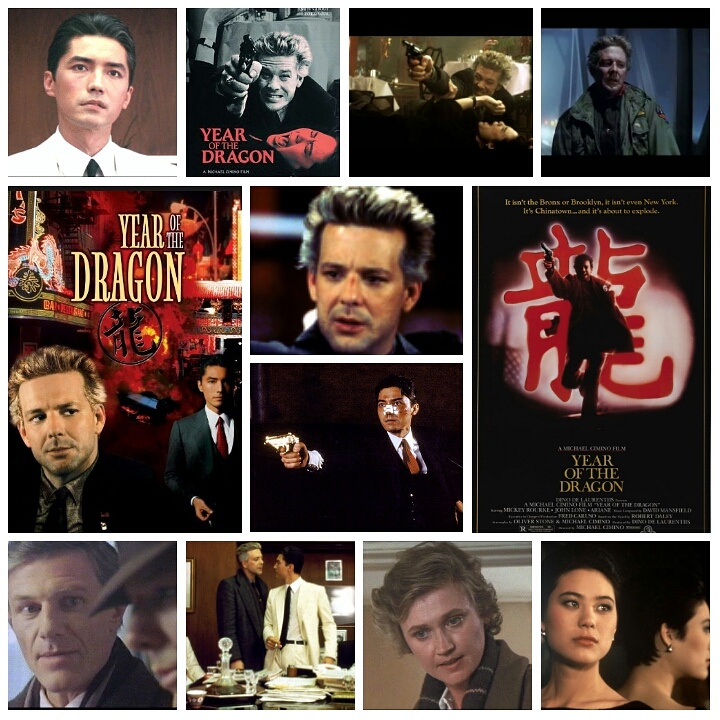
Michael Cimino’s Year Of The Dragon: A Review by Nate Hill

image

Michael Cimino’s Year Of The Dragon is a visceral blast of pure Americana as only the man could bring us. It kills me that he suffered through that whole Heaven’s Gate fiasco (which is actually a really good movie, but that’s another story and argument entirely) because it extinguished any hopes of him making future films, and in doing so the studios effectively committed genocide against their own. Sure the guy was crazy as hell, but damn could he ever make a great film. This one is one of the most criminally overlooked cop flicks of all time, partly due to Cimino’s scorching direction and partly due to a a performance of monolithic grittiness from Mickey Rourke as Captain Stanley White, the cop who won’t stop. White is fresh out of Nam and mad as hell, launching a unilateral crusade of racist violence and self righteous fury against the Chinese crime syndicate in New York City, particularly a young upstart in their organization named Joey Thai (John Lone). Thai is as ruthless as White is determind, and the two clash in ugly spectacle, causing leagues of collateral damage on either side and inciting them both to roar towards an inevitable, bloody conclusion. Thai’s elderly superiors warn him of men like White, men who are fuelled purely by anger, bitterness and nothing else, smelling the fire and brimstone in the air and wisely stepping out of the way. Thai is of a younger, more petulant generation and foolishly decides to meet the beast head on by essentially kicking the hornet’s nest. White is warned by his caring wife (Caroline Kava) and fellow cop and friend Lou (Raymond J. Barry is excellent, firing Rourke up further with his work) not to mess with such a dangerous crowd. He has a volatile relationship with a beautiful Chinese American reporter (Arianne is the only weak link in the acting chain) who puts herself on the line for him by digging around in dangerous corners. The intensity level of this film is something straight from the adrenal gland; even in episodic scenes of introspect we feel the hum of the character’s emotions, and when the conflict starts again, which it does in fast and furious amounts, the actors are simply in overdrive. Rourke has never been better than he was in the 80’s, it was just his zenith of power. This isn’t a role that gets a lot of recognition, but along with Angel Heart, Rumble Fish and Pope Of Greenwich Village, I think it’s his best. He puts so much of himself into Stanley White that the edges which separate performer from performance begin to blur and waver, until we are locked into his work on a level that goes beyond passive consumption of art and elicits something reflective in us. Not to sound too hippie dippy about it, but the guy is just that fucking good. On the calmer side of the coin, John Lone brings both evil and elegance to Joey, a slick surface charm that’s constantly disturbed by Rourke’s hostility, leading to an eventual meltdown that’s very cool to see in Lone’s expert hands. This is one for the ages and should be in the same pantheon with all timers like Heat, Serpico, The French Connection and others. Rourke fires on all cylinders, as do his colleagues of the craft, and Cimino sits cackling at the switchboard with a mad calm, yanking all the right levers in a frenzy of unhinged genius. Not to be missed.
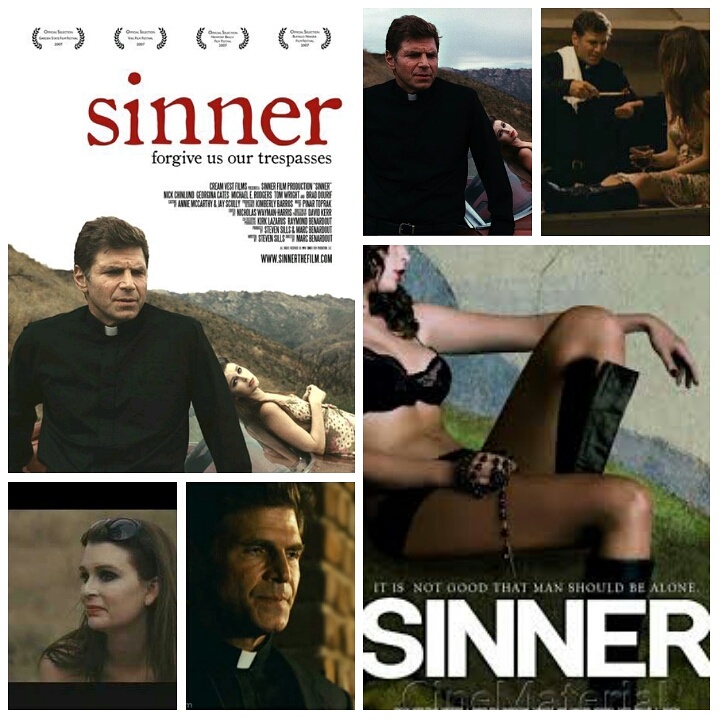
Sinner: A Review by Nate Hill

image

Sinner is a 2007 indie buried in the depths of obscurity, and defined by its very bold choice to cast an actor in the lead role whose career so far has been so different from the type of character he plays here, it’s a true blessing for fans to see him in this new light. The actor in question is Nick Chinlund, a rough looking bruiser with a filmography almost entirely made up of villainous creeps, grizzled detectives and other assorted hardcases (see Con Air, Training Day, The X Files and The Chronicles Of Riddick for his most critically celebrated work). Here he drops every trait he’s been known for, playing small town catholic priest Anthony Romano, a man with a troubled past and an almost bankrupt parish who is facing an internal crisis, only made worse by the arrival of skanky grifter Lil (Georgina Cates) who preys on celibate priests, amongst other bottom-feeding life choices. After an incident involving Romano’s lecherous fellow preacher, he allows Lil to take refuge from the police in his rectory, against better judgment. She’s a nasty piece of work at first and Cates’s performance is far too over the top, only simmering down to meet the character arc in the script long after it calls for action, making her work too little, too late, yet still rather affecting. Chinlund is nothing short of mesmerizing, giving Romano the internal conflict and vulnerability the character deserves, which is not an easy task when one considers the complex nature of the writing. Underrated doesn’t begin to describe this actor, and lately I’ve been sad to see he hasn’t been given many roles that are worthy of his talent. I’ve searched far and wide for Sinner many years, finally finding an amazon seller who would send me a copy. I loved it, and it made me so happy to see Chinlund get the kind of role that goes against the grain of much of his work. Romano uses the sort of golf as a release from priestly and personal hardships, the script using lots of golfer’s lingo as sly similes for his personal issues. Tagging along with him is his scrappy and seemingly imaginary Caddy, played by Brad Dourif. Dourif can make any role, and I mean any, into pure magic with his dedication to the craft. Seeing him and Chinlund share a few wonderful scenes with bushels of chemistry was a nerd’s dream come true for me, and part of the reason I searched so long for a copy of this film. For casuals this may be a bit offbeat to really sink into, but for fans of the actors and idiosyncratic indie flicks, this is a bona fide goldmine.

Clay Pigeons: A Review by Nate Hill

image

Clay Pigeons is one of the odder films floating around out there, but it’s a damn good time at the movies. It fits into a subgenre that I have lovingly dub as ‘desert noir’, other prime examples being Oliver Stone’s U Turn and John Dahl’s Red Rock West. Intrigue and murder abound under a sun soaked, parchment dry landscape in these types of films, always with a healthy helping of dark humour and unsettling, psychopathic characters running around, perpetually up to no good. Joaquin Phoenix (adding to the U Turn vibe) plays Clay, a good guy who seems to have a real problem with bad luck. He finds out his friend has killed himself, which seems to be the first swirl in a spooky spiral of trouble that veers towards him like a dust devil. Soon nosy FBI agent Dale Shelby (reliably perky Janeane Garofalo) comes to town, turning her attention towards him. Dan Mooney (ever great Scott Wilson stealing scenes with perched stealth) is Clay’s friend and the town Sheriff, also on the lookout for clues. These two are the least of his worries though, as the worst is yet to come with the arrival of charming serial killer Lester Long (Vince Vaughn). This is my favourite Vince Vaughn performance because he shows his versatility with the brittle, lightning quick turns of personality injected into Lester. One minute he’s your best buddy and a lovable loudmouth, the next a coiled viper with untold violence beneath the jovial exterior. They always say serial killers are charmers, and Vince Vaughn takes that sentiment, dances around you in circles with it and then proceeds to strangle you with it when you least expect it. So yeah. The bodies pile up and no one seems to be able to tie them to anyone. Lester treats everyone like his best friend until they’re too comfortable to see the blind side coming, and poor Phoenix wanders around looking disshvelled and stressed out. It’s good fun all the way through, doing a nice see-saw rhythm between quaint, cartoonish antics and a grim, scary turn of events. Underrated and more than worth your time.

B Movie Glory With Nate: Oblivion

  
“It’s high noon at the far end of the universe”, the dvd poster of Oblivion states. Years before the underrated Cowboys & Aliens came out, Oblivion came along, and it’s definitely gives the concept a better, and quirkier run for its money. Granted it’s essentially a B movie, and it’s meagre budget shows to the point where it looks like a grade school play. But therein lies it’s charm. It’s got a cast of supremely wacky old west stereotypes played by some surprising, familiar genre faces who you’d never thought to be seen rough housing together in the same flick. It also has some lovingly crafted, creaky stop motion animation that calls Harryhausen to mind and brings to life some super weird alien hybrid thingies that look almost Henson-esque as well. When a lone spaceship lands on the outskirts of an intergalactic desert town, it’s occupant brings trouble along with him. He’s a nasty, one eyed reptilian alien gunslinger named RedEye, played by the inimitable Andrew Divoff. He growling, bad tempered son of a bitch, and his first order of business is to ruthlessly slay the town’s sheriff, and claim it for himself. What he doesn’t count on is the Sheriff’s son (Richard Joseph Paul), a prospector who soon returns to Oblivion looking for answers, along with his Native friend Buteo (the late great Jimmie F. Skaggs). All kinds of townsfolk end up in the crossfire, including drunken Doc Valentine (a priceless George Takei), slinky brothel owner Miss Kitty (Julie Newmar), a cyborg police deputy (Meg Foster), a pawnbroker (Isaac Hayes) and the town’s elegant undertaker, played by Carol Struckyen who some may remember as the giant from Twin Peaks. RedEye has a smoking hot henchwoman and girlfriend named Lash, played by B movie scream queen Musetta Vander, who gets the vibe they’re going for here and sinks her teeth into the material with admirable abandon. The film sticks to its guns despite being obviously silly and somewhat falling apart in a climax that oddly is too darkly shot to make out properly. What it lacks in resources it makes up for in imagination, which it has in spades. Alien scorpions, cyborg deputies, leather clad babes are but a few of the genre mashing treats to be found here. Great stuff. Oh and check out the sequel as well, called Oblivion 2: Backlash, it’s a nice companion piece. 

Denis Villeneuve’s Enemy: A Review By Nate Hill

  
Denis Villeneuve’s Enemy is one of the most unsettling film experiences you will ever sit through, and the damn thing is only 90 minutes. It’s disconcerting, ambiguous and seems to exist simply to spin the viewer’s anxiety reflex into a storm and make our stomach turn loops. It’s a trim entry into the psychological upset sub genre, and puts a frazzled looking Jake Gyllenhaal through a wringer as he pursues a mysterious doppelgänger through the streets of Toronto, a bustling city that feels oddly desolate as glanced upon by Villeneuve’s camera, adding to the themes of paranoia and mental unrest. Gyllenhaal plays a twitchy college professor who is stuck in a closed loop routine: he gives lectures at the local university, drives home to his emotionally inaccessible girlfriend (Melanie Laurant), rinse and repeat. A chink appears in the chain when he becomes aware of another man in the city who appears to be his identical twin. The other man is a small time actor with a pregnant wife (Sarah Gadon) and a decidedly more nasty approach to the situation than the professor. The two of the, circle each other in a disturbing game of not so much cat and mouse, but Jake and Jake, both of them having not a clue as to what is going on, the edges of madness inching closer to both of their perception. Are they twins? Are there even two? Is it just one of them, losing their mind? There’s very freaky dream sequences with the constant imagery of spiders, both large and small, and what do they mean? Who’s to tell? Denis has stated in interviews that there is both rhyme and reason to his creation here, but whether he will ever divulge them remains to be seen. Perhaps it’s better left illusory, a formula for entrancing audiences that has already proved to work well for David Lynch. The moment that the man behind the curtain reveals the conscious meaning of his very subconscious efforts, the spell is no doubt broken. In any case, it’s a very hard film to process or focus on, our nerves jittering constantly and sabotaging any modicum of rational though that we might employ in deciphering the piece. This may be called style and atmosphere over substance by some, but even in not comprehending what’s going on, we feel deeply that there is some sort of cryptic cohesion if we are able to feel between the lines, maybe coming up empty handed ultimately, but knowing within us that we’ve attained wealth to our soul simply by bearing witness. I can’t say it’s a film that I love, or that I would watch again, but it’s certainly one that won’t leave my memories any time soon, and that is an achievement no matter how you look at it. It’s also got one of the scariest and most unexpected endings to any film I’ve ever seen, taking you so off guard that you feel like you’re going to have a coronary. It’s filmed in sickening piss yellow saturation which adds to the overall disconcerting nature, and quite the striking colour choice as well. I can see why this one was released with little fanfare or marketing, despite the presence of heavyweights Villeneuve and Gylenhaal. It’s difficult stuff, a movie that frustratingly soars above your head, onward towards its intensely personal and psychological destination. It’s up to us to jump, grasp and attempt to reach as high as the piece in order to get what we will out of it. Good luck. 

Victor Nunoz’s Coastlines: A Review by Nate Hill


Victor Nunoz’s Coastlines is a nice small town drama with some top players all giving fine work, causing me to wonder why more people haven’t heard of it, and how come it didn’t get a wider release. In any case, it’s low key and really captures the quaint rural vibe of less densely populated areas in the states. The cast is absolutely to die for, consisting mainly of very distinct, frequently garish actors who all play it dead straight and relaxed, which is a huge switch up for most of them. Timothy Olyphant plays Sonny Mann, an ex convict recently released from prison, quietly arriving back to his Florida hometown, and the dregs of the life he left behind. His Pa (the ever awesome Scott Wilson) is conflicted by long simmering resentment, and the love for his son buried just beneath. Sonny reconnects with his best friend Dave Lockhart (Josh Brolin), who has become the town’s sheriff in the years gone by. Sparks fly between Dave’s wife (Sarah Wynter) and Sonny, creating a rift between the two and illustrating Sonny’s unavoidable knack for creating trouble for himself, and those around him. Further tension comes along when the town’s local crime lord Fred Vance (William Forsythe at his most genial and sedated) tries to strong-arm Sonny into assisting with nefarious deeds, using his younger brother Eddie (Josh Lucas) to convince him. Even when tragedy strikes and these characters go head to head, it’s in the most relaxed, laconic way that permeates southern life. Robert Wisdom has a nice bit, Angela Bettis shows up as a girl with a thing for bad boys, and watch for the late great Daniel Von Bargen as the local Sheriff. This one fits nicely into a niche that leans heavily on small town drama, dips its toes ever so slightly into thriller territory, and is a charming little piece that’s worth a look to see these actors on an acting sabbatical.  

Girl, Interrupted: A Review by Nate Hill

image

James Mangold is a director who takes nothing but top shelf scripts and spins them into gold, and Girl Interrupted is a shining example of this. It’s based on a book by Susannah Kayson in which she outlines an 18 month stay at a mental ward sometime during the 60’s. Mangold adapts her book for the screen, gathers an excellent cast of talented gals and a couple guys, and makes a film that holds up today like it was still it’s release week in 1999. Winona Ryder plays Susanna, a reckless girl who is labeled wayward and unstable by her parents, committed to a facility by her stern psychiatrist (Red Forman himself, Kurtwood Smith). She’s a little rough around the edges, but one senses the innate sensibility to her that perhaps has been buried under turbulent behaviour not by anything within her, but by the constricting nature of the time period she has been born into. In any case, she finds herself thrown into an environment she didn’t expect, with many other girls, some of which she clashes with, some of which she ends up befriending, and one that.. well, defies classification, really. The girl in question is Lisa, played by a fantastically fired up Angelina Jolie who nearly combusts upon herself in her furious performance. Lisa has been dubbed nearly unable to treat, yet simply has the kind of soul that doesn’t fit into a box, let alone lend itself to scholarly dissection. Ice cool one moment, a raging typhoon the next, and holding a dense riot shield over any trace of her true emotions every second, she’s an enigmatic, elemental wild card. It’s the best work I’ve ever seen from Jolie, getting her a well earned oscar nod. She teaches Susanna some lessons that only people on that side of the glass can comprehend, confounding the facility’s head doctor (Vanessa Redgrave) and puzzling a kind orderly (Whoopi Goldberg), two rational people who simply can’t understand the kind resolution and companionship that often comes out of irrational, unconventional interaction that almost always is seen as ‘unstable’. Ryder is pitch perfect and carries her share of the load, but despite being the protagonist, it’s Jolie’s show all the way. She’s unbelievably good and will break the heart of both first time viewers and veterans who put the dvd in every so often for a tearful revisit. The late Brittany Murphy is great as Daisy, another complicated girl, and Clea Duvall scores points as Georgina, the shy and reserved one. There’s also work from Jared Leto Elizabeth Moss, Angela Bettis, Bruce Altman, Mary Kay Place, Kadee Strickland, Misha Collins and Jeffrey Tambor. Tender, patient and non judgmental are qualities which are essential in films of this subject matter, as well as empathy from both viewer and filmmaker, to take a look at these girls and even though we may not understand what is going on with them or their beaviour, to simply bear witness, and be there for them. Mangold knows this and acts accordingly, leading to a beautiful film of the highest order. Viewers are sure to do the same, completing the artistic ring full circle.

Conviction: A Review By Nate Hill


Tony Goldwyn’s Conviction is a searing dramatic tale that’s heavily based on true events, and is essentially the underdog story boiled down to its most effective elements, with inspiration running throughout its truly remarkable storyline. Hilary Swank can be a force of nature in her work, and she’s dynamite here as Betty Anne Waters, a small town girl who is very close with her rambunctious sibling Kenny (Sam Rockwell), who grows up as the troublemaker of the two, running afoul of a nasty local police officer (Melissa Leo). When his next door neighbour is found stabbed to death, Leo sees it as her opportunity to get rid him for good, and tampers with evidence, until he is convicted. Guilty until proven innocent is the mantra with this difficult tale, and because it’s based on a true story that happened in real life, it unfolds at a snails pace of tragic events in which a satisfying outcome sometimes just seems out of reach. With Kenny in wrongfully convicted and rotting in prison while his wife and daughters edge towards moving on, Betty does the unthinkable: with no previous experience in college, let alone law, she decides to study for the bar exam, in order to eventually represent Kenny in court, and prove his innocence. It seems like something from a movie, and here we see it, but this is something that really, really happened, which to me is extraordinary and essential to make known. She persists through many obstacles both great and small, and with the help of a dapper senior colleague (Peter Gallagher), and a perky fellow law student (Minnie Driver) she passes the exam and sets out to defend her brother. It’s a rocky road, beset with the decayed and deliberately lost memories of years before, and the police officer’s longstanding belligerence. Unreliable witnesses, uncooperative testimonials and all sorts of stuff get in her way, but Betty ain’t a girl to quit or back down, a character trait which Swank seems to have been born to play, and is the lighthouse which guides this fantastic film along its track. Rockwell exudes burrowing frustration as a man in a position of incomprehensible sadness, hopeful yet resigned to his fate which has been orchestrated by evil, targeting him in wanton cruelty. Painful is the word for him here, and when Rockwell sets out for a mood in his work, you damn well feel it. Juliette Lewis briefly rears her head as a dimbulb witness who plays a part in Betty’s quest, as does Clea Duvall very briefly as another witness who seems to have no idea what she actually saw. Melissa Leo is an actress who is utterly and totally convincing whether she’s on the good or the evil side of the coin, holding the audience in rapturous awe with seemingly little effort. Here she’s so nasty it radiates off the screen, providing a core incentive for Betty’s struggle, whether or not the events actually played out like that. Director Tony Goldwyn is an actor himself and uses that experience to forge a film with respect and sympathy for its two leads. One of the more underrated films of 2010.

The Jungle Book: A Review by Nate Hill

image

Prepare your eyes for maximum bogglement, work out your abs so you don’t bust a gut laughing, and most importantly, dust off that childlike sense of wonder before going to see Rudyard Kipling’s The Jungle Book, boldly and lovingly retold by Jon Favreau in what is the most flat out exciting, adventurous film of the year thus far. The director pulls  off a balancing act between palpable tension, character interactions that come straight from the heart and land squarely in ours, and some of the most believable, jaw dropping CGI I have ever seen on screen. The animals look so impressive and lifelike that after seeing them I shelved away some of my inherent reservations about computer generated effects as a dominant force in a piece, and simply gave in. The atmosphere is lush, intoxicating and deeply detailed, with a naturalistic feel and tone. Young Neel Sethi is tasked with being the only fully human component, and is perfect. His interactions seem real and rehearsed, immersing the viewer further into the visuals. Mowgli is a young man cub, found on the edge of the jungle by the panther Bagheera (stately, compassionate Ben Kingsley) and given to a wolf pack to be raised by alpha Akela (Giancarlo Esposito) and Raksha (Lupita Nyong’o). Not all in the animal kingdom are receiving of this man cub, especially a terrifying Bengal tiger called Shere Khan, given the rumbling tones of Idris Elba, inspiring fear in animals and audience alike. He has a rocky relationship with man, and wants Mowgli dead. Bagheera takes him far into the jungle, where they are separated and Mowgli’s adventure truly begins. He wanders into the path of Kaa (a slithery Scarlett Johansson) a monstrous, seductive python, and is taken under the wing of Baloo, an adult Winnie the poo voiced by Bill Murray. Murray is one of the film’s great delights, and as soon as he shows up we forget about all the menace and threat which preceded his arrival, and are swept up into his affable, lounging lifestyle and brightly colored neck of the woods. Murray clearly ad libbed a lot of Baloo’s dialogue, and anything he didn’t he still gives that unmistakable, winking ‘Murray’ twinge that I so love. Mowgli’s adventure continues, as he stays one step ahead of Shere Khan and is visited by the king of the monkeys, a twenty foot tall, lumbering orangutan named Louie, voiced with demented, pithy glee by Christopher Walken. As soon as he showed up the laughs erupted from within me, and reached a manic peak as he belts out the ‘Oobie Doo’ song in priceless Walken fashion, his monkey mannerisms uncannily starting to resemble Walken’s own distinct visage. Many of the animals serve as differing parental figures to Mowgli, representing elemental factions of raising one’s young. Bagheera is cautious, doubting and skeptical. Baloo is the fun loving, lenient one. Even Shere Khan has a curdled paternal feel to him, like the brutal stepfather who is damaging to his offspring. Raksha is the unconditional mother, and that devotion comes out wonderfully in Nyong’o’s souful performance. The vocal performances are aided by the stunning effects; the CGI of facial features allow the actors work to truly extend into the realm of what’s visible, with real emotions displayed by the creatures, and not a single rendering that’s anything short of lifelike. The film evokes true wonder and primal excitement, escapism that takes itself seriously yet knows when and how to play, a dazzling technical marvel, a timeless story well told, all in one cinematic package that is not to be missed. Oh, and stick around for the credits, instead of Walken out of the theatre and missing a final musical treat.

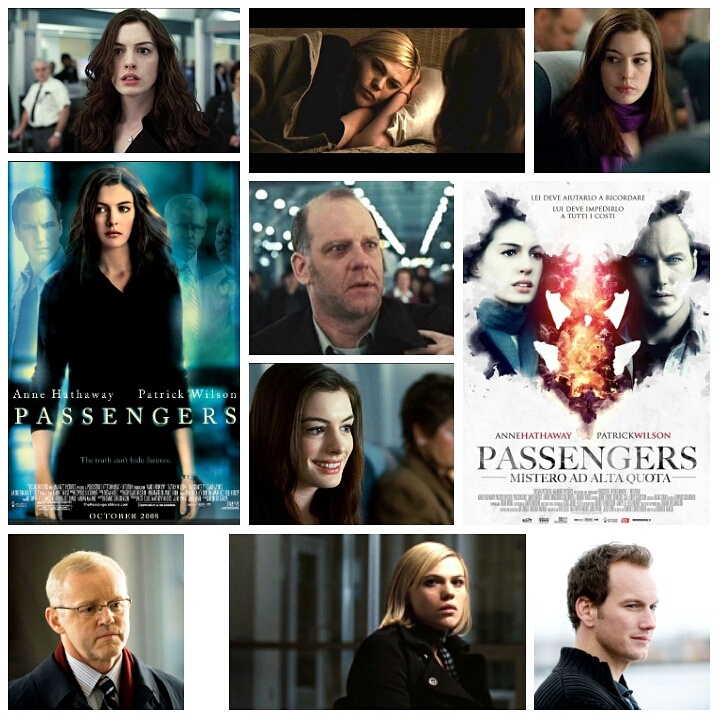
Passengers: A Review by Nate Hill

image

Passengers is a low key supernatural drama that came and went with little fanfare or attention back in 2008. Part of the reason for that could have been that it was marketed as a thriller, which is not so much the case. There is an eerie vibe to it, and certainly a paranormal component, but it’s quieter and much closer to the chest than advertising might suggest. It wasn’t reviewed very well, branded as predictable and derivitive. Some of its plot devices have been used before in the past, to be sure, but I greatly enjoyed the film and loved the way in which it’s story unfolds, told very well by its sturdy cast. Like Mark Pellington says, fuck the people, that’s why there’s 31 flavors. Anne Hathaway is excellent as Claire, a grief counselor who is tasked with looking out for a handful of people who have survived a catastrophic plane crash. She’s new to her profession, her eagerness laced with self doubt, yet she remains hopeful. All of a sudden, the patients in her cate begin to disappear mysteriously, and she starts to question the situation, as well as her own reality. The survivors are damaged and not fully willing to open up to her, collectively scared of some unseen threat. Claire has repeated run ins with a unknown and very distressed man (Andrew Wheeler, local vancouver actor and former teacher of mine) who has ties to the accident. It’s all hush hush and quietly unsettling, until we slowly begin to realize what’s actually happening, and the it changes gears and becomes very touching and thoughtful. Clea Duvall is great as one of the skeptical survivors, Patrick Wilson solid as always, and there’s work from Dianne Wiest, William B. Davis, Andre Braugher and briefly David Morse. Sure, this type of story has been done to death time and time again, draining new efforts of some of their effect, but if one comes along that gets it right, tells it’s story in a way that holds both my emotion and interest in its spell, I’m all ears. This one did just that.