Playing Cowboys and Aliens: An Interview with Scott Mitchell Rosenberg by Kent Hill


The dreams we have when we are children don’t often materialize into reality. We make-believe we are the heroes of the books, comic books, films that we hold dear. They inspire us to move forward; to go on and build new worlds. We stand on the shoulders of those giants so that we might become gods – the creators of fantastic realms and legendary heroes. That flame we carry within us during those early years, often falls prey to the winds of change. It is ever whipping across the fabric of our dreams, trying to collapse that once impenetrable shield of our imaginations.


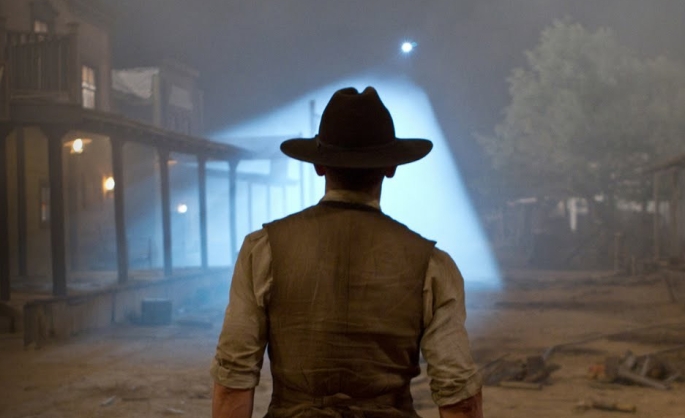
Now, there are many who simply let that flame flicker in the wind until it finally sputters out. They put aside childhood wonder and move on. But, then there is the few, the happy few, the small band of us that for whom such a notion is not only unacceptable, but impossible. Our dreams are that which fuels us. Our dreams are our lives. Scott Mitchell Rosenberg is one of these dreamers. His childhood games of cowboys and aliens have become so much more than fun and plastic ray-guns. He told me he ‘stumbled’ into the movie business, and the journey to bring Cowboys & Aliens to the big screen was not unlike pushing a boulder up a hill using only your nose.


Lucky for us his nose held up, otherwise he might not have been there for the gathering of such illustrious talent, both in front and behind the camera, that would merge to bring Scott’s graphic novel creation to life. With the likes of Ron Howard, Brian Grazer, Steven Spielberg, Robert Orci, Alex Kurtzman, Damon Lindelof and John Favreau, it makes me think of the fabled Dream Team of ’92 that boasted Jordan, Bird and Magic. Combine those ingredients with Han Solo (Harrison Ford) and the new Bond (Daniel Craig) – along with an impressive supporting cast which featured Dano, Brown, Carradine, Rockwell and Wilde – the live-action treatment Cowboys & Aliens would receive is something of a marvel.


I told Scott that my initial viewing had been sullied by a bad day, but subsequently I was able to go back and re-watch it with fresh eyes. I admit that I prefer the extended cut to the theatrical release, but really,  when you break it down, I just really love Cowboys & Aliens and have done so since I read the comic when it first came out. It was a real thrill to finally sit down and chat with its creator, a great gentleman and I feel in some ways a kindred ‘creative’ spirit. For this movie speaks to those out there that of course (A), love a really cool movie but also (B), those creative few, those happy few, that band of dreamers still reaching for the stars. Let the journey of Scott Rosenberg be an example to you. Don’t quit, toughen up your nose and give that boulder hell!

Enjoy…


Fantastic Beasts and the Man who made them: An Interview with Chris Walas by Kent Hill

77594-10-maghi-degli-effetti-speciali-da-oscar-11

When I think of the work of Chris Walas, a few things pop into my head.

The first is how much I loved Dragonslayer when I saw it at the cinema as a kid. It like The Black Hole was a dark, different Disney movie. This was the era when Disney was trying to be more like a studio and not purely focused on the animation that had garnered it so much love.  I remember waiting for the moment when the dragon would finally be revealed and I was not disappointed. I was becoming aware of how movies were made at that time, so the prospect of any giant creature on screen, knowing that it was actually there, that it had to be built was incredible.

The second is Enemy Mine. A movie for the longest time I had only seen the last twenty minutes of. During the heyday of video piracy, it was not uncommon to borrow a tape from friends or family and find the tail ends of stuff that had been taped over. Ironically I can’t remember the film that was taped over it, but those final scenes from Enemy had me intrigued. I think it was one of my cousins who I borrowed the tape from, so I asked him about the clip at the end. “Oh I taped over that ‘cause it was kinda boring. Some dude and an alien have a baby together.” Yes folks, I have some really classy relatives, and that was how he pitched Enemy Mine to me. Still, undaunted, I sought it out and it is a whole lot more than that; indeed another great film from Wolfgang Petersen who had blown my mind prior with The Neverending Story.

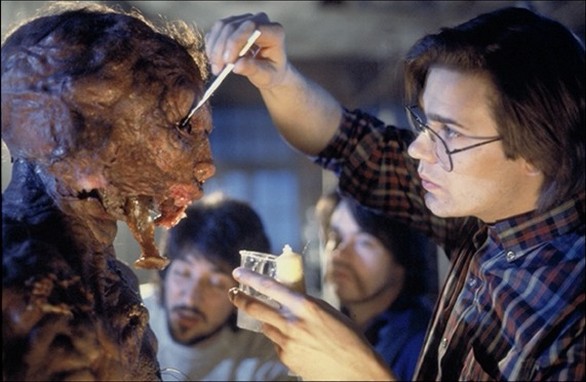
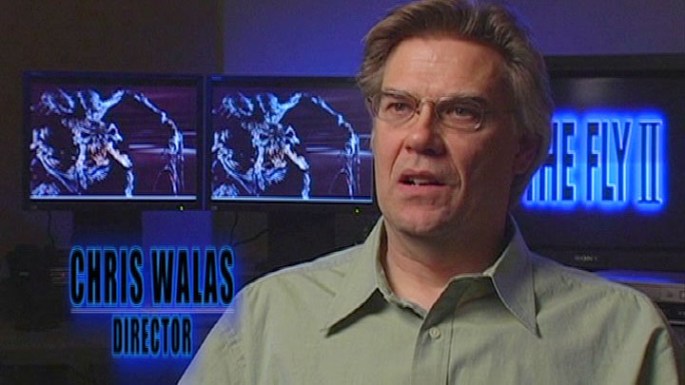
Finally I reflect on The Fly 2. One of two films I have literally lost my lunch watching. And, let me be clear, up to that point, I had seen gruesome stuff before so it wasn’t so much the imagery as it was the visceral qualities of the imagery. As the years go by, and because I haven’t seen it in a long time, so it’s sketchy at best, but one thing that I recall was Daphne Zuniga wiping away Eric Stoltz’s slimy coating from this one scene and giving him a kiss. I remember that or something like that, like I said, it’s been a long time between drinks, but that scene and a few others helped my lunch get its own sequel that day.
fly2_shot5l

But enough about me, let’s talk about Chris.

Chris Walas has worked on a handful of truly iconic films. You can see is work in Raiders of the Lost Ark, Return of the Jedi, Gremlins. He is an Academy Award winner – that Oscar being for The Fly and part of a terrific association with David Cronenberg who he would go on to work with on other films like Scanners and Naked Lunch.

He has sat in the director’s chair on (of course) The Fly 2, The Vagrant and “Til Death”, an episode of Tales from the Crypt. He was part of the Roger Corman stable; he worked on Airplane!, Galaxina, Caveman and Virtuosity – he is a very talented man who has had a hand in the truly grand cinematic experiences of my youth and it was an utter delight to interview him, and subsequently, to present said interview to you. Ladies and Gentlemen . . . I give you . . . Chris Walas
gremlins chris walas tony mcvey

KH: Sir, it is truly an honour to make your acquaintance. You have the distinction of being the first Oscar winner I have interviewed for podcastingthemsoftly.com

CW: That’s hard to believe with all the Oscar winners out there these days, but I’m happy to be here.

KH: Before we get into the meat of things, I was wondering if working in the picture business has be a lifelong pursuit, and if so, what were the films that lit the fire, so to speak?

CW: You know, it’s interesting because so many interviewers ask “What was the film that made you want to do what you do?”  I don’t think it’s a simple as that. It’s like asking painter what painting made them want to be a painter. It’s not about a single event; it’s about an artform that creates the magic in the imagination. I was a movie fan as far back as I can remember. I loved all films. I loved what the medium could do. I didn’t understand any of it, but I loved “Citizen Kane” as a little kid. It was riveting to me. I grew up on the old Universal Horror Classics and still love them. The Sci Fi films of the 50’s hold a special place in my heart for sure. But I can definitively say that the single film that made me DECIDE that movies were where I wanted to be was Ray Harryhausen’s , “Jason and the Argonauts”. It was the first film I ever saw in a theatre and I was transfixed by the experience. I knew at that moment (even though I understood nothing about it) that that was what I needed to be a part of in my life.

KH: You have worked on some truly iconic movies, many of which are my personal favourites. But, how did you get into the business after your schooling ended?

CW: I wanted to get into films somehow. At that time I was on the East Coast and the film business was pretty dead just then. So I left for Hollywood with a couple hundred bucks in my wallet and a sublime ignorance of the realities of LA.  I was lucky enough to get a job shipping film for Disney, which was magical for a naive kid from New Jersey. Discount tickets to Disneyland, and I could spend all my lunch hours on the back lot talking to the original animators of Snow White or the wire rigger for the Squid tentacles from 20,000 Leagues Under the Sea. They all brought their lunches and sat out in the backlot relaxing or practicing their watercolours. And they loved to talk. It was my introduction to the world of movies. Wonderful. I then took filmmaking classes for a year until my money ran out and I took a job at Don Post Studios, a company that made high quality Halloween masks and occasionally did some film and TV work. I was there a year and started out painting a gross of masks a day on the cheap line to being a member of the lab crew, developing new product and working on the occasional outside project. It was an education I would have paid for. I learned more in that year than in four years of college. But I was antsy and impatient, and one of the other Lab guys (Bob Short) and I left and started a little partnership doing odd projects. We both started to get good reputations, but each doing different things, so we split up and went our separate ways. And it just grew from there.

KH: Tell us, if you will, about working on some of your early credits like Island of the Fishmen (Screamers), Humanoids from the Deep and Piranha?

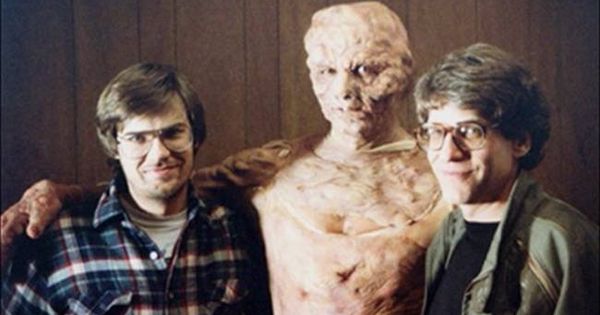
CW: Piranha was my first on set film experience. Jon Berg, who was in charge of the effects on the film, had been to Don Post to see about them running some of the rubber piranhas. That didn’t work out, but the connection had been made and when the FX shoot needed more people, Bob Short got pulled on board and then through Bob, I got pulled in. That was my entry into the crazy world of Roger Corman films. It was wild and desperate filmmaking in those days; no money, no time. The only good part was that IF you could actually make something to get in front of the camera within the meagre time and budget, you were a hero. It was a process that very quickly filtered out those who could from those who couldn’t. But it was exhilarating and magic at the same time. Isle of the Fishmen was a bit of a mess. The original Italian production had been purchased by some fly by night LA outfit and they wanted to “beef it up” for the American audience. We had almost nothing as far as a budget, but it was with some people that I felt comfortable with.  Miller Drake and (unofficially) Joe Dante. It was a small and relatively close group in those days at New World Pictures. We shot out at the beach in the middle of the night in January and nearly froze to death soaking wet in the Fishman costume. Other inserts were shot in Joe’s garage; it was that kind of filmmaking.  But Humanoids was a different story. New World had asked me to do it, but I was busy on GALAXINA and a couple of other films at the time, so I suggested Rob Bottin. But the schedule was a tough one on that show and Rob asked me to come in and do a bunch of the sculpting and running on the Humanoid costumes. As well as those absurdly huge arm extensions! It was an extremely intense time for me as there was way too much work and not enough people in town to do it all.
a1d5fa5869ca270b31756deb87e5a5b7

KH: I know you probably get a lot of “Fly” questions and I think that if people really want a good insight into the making of that film they should watch the comprehensive Fear the Flesh. But, you worked on a few movies with Cronenberg (The Fly, Scanners and Naked Lunch). What was making pictures with David like?

CW: This is a great question, if for no other reason than it lets me applaud one of my very favourite directors I’ve had the honour to work with.  David Cronenberg is an amazing filmmaker. He’s not just a director. His films truly belong to him. They are his vision. He’s an astonishing writer. When I was first approached for The FLY, I turned it down. I didn’t want to do a remake, etc. Stuart Cornfeld, the producer, said, ” I know,  I agree. Just read the script”. I read the script and it was superb. David had redone the original script and made it his own. I couldn’t say no to that script.  And David is an astonishing director because he really understands the process that everyone is going through. A lot of directors are absolutists; it has to be a certain way. David understands that production is about compromises and that a good director only makes compromises that don’t hurt the film. He was demanding and understanding at the same time. Very unique qualities in a film director and I feel very fortunate to have worked with him.

KH: I have vivid memories of The Fly 2. I remember watching it on video with some cousins and felt my lunch coming back on me a couple of times during that flick. How was it to finally sit in the director’s chair on Fly 2 and the other films you directed?

CW: Somehow, we hold the director’s chair as some ethereal pinnacle in filmmaking. And in some ways it is. It is the ultimate decisive position, historically. But I had already been directing teams of dozens of artists at my company, coordinating large operations and such, so I don’t think I was as intimidated as a lot of first time directors. I was quite comfortable directing, especially as I had such a wonderful crew of true talents on the FLY II. I never actually wanted to be an effects person. It was just the easiest way for me to get into the business.  Besides, it’s ALL filmmaking. All of it. From craft service to timing final prints. Directing is just the most focused, exhausting position. But I loved it.

galax14

KH: I interviewed William Sachs recently, director of Galaxina. Can you tell us about your work on that film?

CW: I’ve only lost money on two films. GALAXINA was the first one. At that time there were a lot of productions trying to cash in on the STAR WARS phenomenon. So there were a lot of over-ambitious, under-funded films being made. GALAXINA was right smack in the middle of those. Bill (Sachs) had his hands full on that film. He really did. And for me, it was a really, really tough show as there was a lot of stuff and very little money. We had to make a couple of the alien costumes overnight; the schedule kept changing wildly. I don’t know how Bill dealt with it all, honestly. It was furious alien making, to be sure. We had Angelo Rossito as the little alien creature. Little Angie, as he had been known, was a dwarf who had worked on countless films. The schedule changed dramatically and the three weeks we had scheduled to make his suit turned into 18 hours. But he was a total pro. He showed up with some of his old clothes for us to use as the base for the suit! We built the suit right on him and he never had a word of complaint at all. Total pro. Everything we did for Galaxina was done scraping the bottom of the barrel because there was so much work.


KH: I have a great fondness for both Dragonslayer and Enemy Mine, they speak to my youth. Tell us about working on those pictures; especially Enemy Mine, it’s one of my all-time favourites?

CW: Phil Tippet brought me up to ILM to work on the team for Dragonslayer. And that was a wonderful experience working with some of the absolute top talent in the field. Every day was an education for me. I was strictly on the in-house FX team and didn’t go over to England for the shoot. I made most of the molds for the dragons and baby dragons as well as running most of the rubber pieces.  I rigged the puppets for the baby dragons and built a few odds and ends pieces for individual shots; smaller scale grabbing legs, a bit of wing, etc. The biggest thing I was involved with was the close up Vermithrax puppet. It wasn’t part of the original plan, but they just couldn’t get the footage they wanted out of the full size head and neck that Disney had done, so I designed and built, and operated an animatronic puppet head. That was exhausting because the puppet had to be dripping water all the time, so the puppet became supersaturated and just kept getting heavier and heavier. But I think it worked in the end and helped the picture.

Enemy Mine was basically problem after problem. I started out working with the first director, Richard Loncraine, who I really liked and admired. We shot for six weeks on lava fields in Iceland before 20th Century Fox closed the picture down and hired Wolfgang Peterson to direct. We were supposed to be closed down for two weeks for the restart, but it was a full six months before we got going again.  I think, for us, the production got bogged down in a lot of committee decision making, which slowed everything down.  But in the end I was happy with the designs. We had an opportunity to do quite a lot of different effects for the film between the Dracs and all the odd creatures. The newborn Zammis puppet was one of my favourite rigs on that show.
toht chris walas raiders of the lost ark strange tales1

KH: You worked with Joe Dante on Gremlins which was produced by Steve Spielberg whom you worked with on Raiders which was produced by George who brought us Return of the Jedi which you are also credited as having worked on. In retrospect, what was it like working on these milestones of cinema?

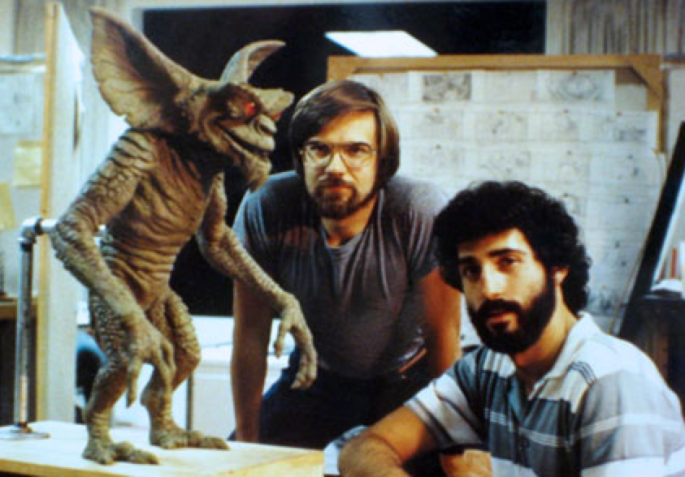
CW: Every once in a while you get lucky. Gremlins was a true milestone for me in both my life and my career. It was the first time I was in charge of running such a big crew on a studio picture. It was truly an insane experience for me as the picture just kept changing and growing, with new gags being developed for the Gremlins almost daily.  I don’t think I’ve ever been worn out so completely on any other film. But at the same time it was great fun, like a bunch of grown up kids playing. We had no idea we were working on a film that would be so successful and impacting.

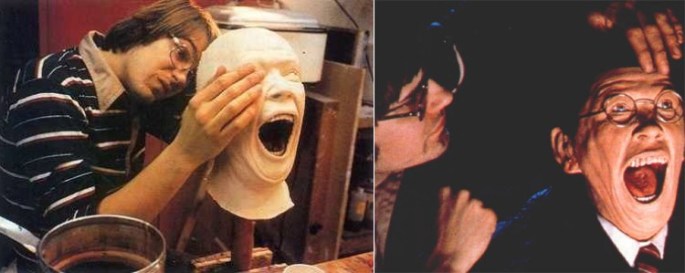
Working on Raiders of the Lost Ark was great. Challenging. But it was at ILM, which was then the absolute pinnacle of FX houses in the entire world. I really wasn’t used to being able to say, “I sure could use one of these…” and then having someone order it right up or just get it from another department. So I had options available to me that I hadn’t really had up to that time.  Richard Edlund was in charge of the FX on the show and he was great about making sure that I had what I needed for the melting head and the other shots. I didn’t get to see the film until just before it opened and I was blown away. It’s such an amazing film. I feel so lucky to have been a small part of it.

For Jedi, I really only did design maquettes for some of the alien races in the film. I set up the creature shop for ILM, but then I left to pursue other projects. It was very nice to be included in the credits on that one!


KH: You have a number of diverse entries among your credits like Deep Star Six, Arachnophobia, Hot Shots and Virtuosity. Were these genres you sought after or were the film’s concepts interesting or was it simply the want to be constantly working that brought you to these projects?

CW: After Gremlins, I had set up a genuine facility with a great crew who knew what they were doing and so I had to take what projects I could to keep the shop going. But some of the projects were favours; Deep Star Six was for Jim Isaac, who was striking out on his own after being on my crew for a number of years. House II was for Ethan Wiley, who had also been a member of my crew on Gremlins and others. Some films were projects I really wanted to do; ANYTHING David Cronenberg was doing. Anything for Amblin, Spielberg’s company. But in between those projects it was a matter of trying to choose what projects seemed like they might be good films as well as keeping the shop going as long as possible.

KH: You’ve been a writer, director and producer having a film you co-wrote come out in 2016. Did you ever want to make more of your own pictures and do you, like so many people in the industry, have dream projects that might have come close but never saw the flickering light of the silver screen?

CW: I would have loved to have done more directing.  But it just wasn’t in the cards. I have a number of projects I would love to see resurrected someday. One of my favourites is a project called “Dathulgon”, which is a steampunk combination of characters and plot lines from Jules Verne and other early steampunk writers mixed with the cosmic horror of H.P. Lovecraft. That project was humming along nicely when the big market crash ruined a lot of financing for films.  I have a whole list of projects I would still like to see happen!

KH: Well sir, as a long-time fan this has been a very large pleasure, and though we were not able to conduct this interview via recording I care not, for as I said I am honoured to have met you and am humbled that you have taken this time to be interviewed for podcastingthemsoftly?

CW: It’s been a pleasure. It’s fun to reminisce and I really appreciate knowing that there are people out there who look back fondly and remember the work kindly. Thanks!

scanners 1981 movie pic2

So there you have it. Chris Walas folks. Applause is totally necessary for this talented man and his amazing career.


I’ll just take a moment to let you know some other interviews I have coming up. I’ll be bring you chats with Mike Marvin (director of The Wraith), Chris Olen Ray (Two & Three-Headed Shark Attack), The Outlaw film critic VERN, Scott Rosenberg (creator of Cowboys and Aliens). Prior to the release of SHARKNADO 5 (because that’s the kind of nerd I am) I’ll be presenting a double feature that week prior to August 6th of my interviews with Steve Alten (we discuss the long cinematic gestation of Meg) and the man himself Anthony C. Ferrante (director of the SHARKNADO series). So as ever, thank you for checking out podcastingthemsoftly.com, and watch this space…

Cheers

Kent
Galactic Beauties & Melting Men: An Interview with William Sachs by Kent Hill

Movies are a lot like songs. You hear a song and you rekindle a feeling, a moment, a memory. And films work in exactly the same way. As I often reflect on my life, I have come to realize how many great moments have been marked by the good, the bad and the ugly movies that a town called Hollywood has unleashed upon the world.

I flashback to the third grade. This was still in the era of the massive video stores. I distinctly remember overhearing a conversation among a group of my peers about wandering through the ‘horror’ section one fine day. At this point in history, some of these stores were really decked out and ‘themed.’ The kids section had cartoon characters on the walls, the adult section was contained in a tiny house that had red curtains covering the door and two small windows (this was affectionately known in our local store as the ‘smut hut’). Then their was the horror section, set in a cave filled with black light, with fluorescent ‘scary’ eyes painted on black brick walls.

These kids that I overheard were talking about a particular horror film that had both fascinated and horrified them, though, none of them had seen it. All of their talk and speculation they were basing purely on the cover. And we all know that old chestnut. So, I became king for a day in my class when I summoned the moxie to go rent this video that had aroused so much interest. It was called The Incredible Melting Man.

The director of the movie was William Sachs. As was my custom of the day, I then proceeded to seek out any and all of the other films he had directed. I was fascinated with the movies that I uncovered.

I recently had the very large pleasure of chatting with Bill about his career, not solely as a filmmaker, but as a legendary Hollywood ‘fixer.’ I’m a fan of the Leprechaun movies, and Bill had a hand in the first installment which, to his surprise, has gone on to become a much-loved, ongoing series.

He is a great gentleman of the old school and it was a real treat indeed, for this fan, to hang out and talk movies with him. As ever, it is awesome to present, yet another interview with one of the great cult filmmakers and a stalwart independent spirit.

Dear listeners . . . I give you . . . William Sachs.

Conceptually Speaking: An Interview with Sylvain Despretz by Kent Hill


Sylvain Despretz really is the personification of honnête homme. And he has been a man of the world since an early age. Travel was a part of his life; the other constant being his love of the cinema.

He is an artist of great style and skill and after his schooling he worked as an art director for a top Madison Avenue agency then moved on to illustrating Graphic Novels in California under the mentoring of the internationally famed artist Moebius. From there he would set out upon what would become and astonishing career as a story board artist and conceptual designer.


This slideshow requires JavaScript.

His work you’ll have seen, gracing the screen in a myriad of films in a variety of genres. Movies like Gladiator, Alien Resurrection, Panic Room, The Fountain, (Tim Burton’s) Planet of the Apes and The Fifth Element. These including work on Don’t tell Mom the Babysitter’s Dead and the coming Luc Besson sci-fi extravaganza: Valerian. He has worked with  and on films directed by the true masters of the screen including Ridley Scott, Stanley Kubrick, David Fincher and Jean-Pierre Jeunet.

But, as you will hear, Sylvain has become disenchanted by the current repetitive nature of Hollywood’s cookie-cutter output. He is now driven by the notion that the only way to usher in change, is to be part of a creative revolution that places an emphasis on original voices instead of corporate responsibility.


This slideshow requires JavaScript.

To this end he is now embarking on a journey that will see him stepping away from the drawing board and moving behind the camera; bringing his own visions to life using that mysterious blending of industrial light and storytelling magic.

He is a learned Hollywood veteran who has seen the Dream Factory from the inside, and his stories and wealth of knowledge and experience was and is fascinating to experience.

The designer behind the scenes and the future man in the director’s chair, proud am I ladies and gentlemen to present this interview with the one and only, Sylvain Despretz.

VISIT SYLVAIN’S OFFICIAL SITE:

http://www.metaprogram.net/

Out of the Shallows: An Interview with Sandy Collora by Kent Hill
Error
This video doesn’t exist

“Why weren’t you in the pros making stacks of cash and getting your toes licked by beautiful women?”

This line of dialogue from Shyamalan’s Signs always springs to mind when I think of the man and the career of Sandy Collora – and I told him as much. I have watched as filmmakers of lesser skill, passion and moxie rise and rise again with relative ease through the ranks of the Hollywood system.

But, while it boggles the mind as to why a man of Sandy’s talent has thus far been denied a shot to bring his truly awesome visions to fruition – his career has not been without triumphs. He has worked on some truly cool pictures like The Abyss, The Crow and Men in Black; along the way enjoying the benefits and encouraging tutelage of such luminaries like Stan Winston and Henri Alvarez.

Then came that little fan film you may have heard of, Batman: Dead End. Not only was it a game-changer, but it was also a life-changer, propelling Sandy into a league of his own and catapulting him toward the attention of the Hollywood players.

I referred to this period as Sandy being romanced by the industry. He refers to it differently. But he concedes that mistakes where made, and what might have been is anyone’s guess had he played the game by their rules.

Still the testament of all great artists that we applaud still, no matter the length of time it has been since they delivered unto the world their masterworks, is a resolve born of (in some ways) uncompromising vision and unshakable self-confidence. And, while Sandy freely admits the art of compromise will be necessary, if he hopes to realize his works on a larger scale, he (I hope) shall not lower his standards below that which work of his quality richly deserves.

Hunter Prey gave us a taste of feature-length Collora, and now he is at it again with his dynamic and compelling short, Shallow Water.

A new beast emerges, and with it comes the prospect of the reawakening of a genre made famous by its creatures like Alien and the Predator. It also marks the opening of another door for Sandy to, at last, the big time – a place in which he has fought hard to attain and worked tirelessly to offer some exuberance and, no doubt, something extraordinary.

There are so many great stories of great stories that have been a part of the life and cinema of Sandy Collora. I encourage you to check out the link below; find yourself a copy of, not only his incredible art books, movies and merchandise, but also the inspiring documentary: Behind the Mask.

Grand adventures, heartbreaking turmoil; this is the agony and the ecstasy, but also the the wisdom and the wonderment of the Collora cinematic universe. Dear listeners, it is my pleasure to present . . . Sandy Collora.

VISIT SANDY’S OFFICIAL SITE:

http://montaukstudios.com/

AND DON’T FORGET:

https://www.youtube.com/watch?v=TBSm6ZDY7n0

“I’m gonna do something far worse than kill you”: Remembering Ricochet with Russell Mulcahy by Kent Hill
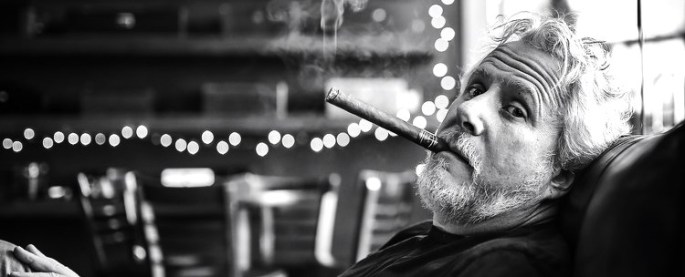
Among the flurry of big action movies that graced our screens from the late 80’s and into the 90’s, it was easy to see how some lost their way to an audience. But thanks to video, these movies that did not enjoy a successful theatrical release were quickly rediscovered on VHS, and some might say because of it, they have endured long after they could have so easily vanished.

They say all a movie cheerfully needs is a man with a vision, and the talented former music video genius turned Hollywood go-to guy for stunning visuals and artful storytelling was looking for exactly that – another story to tell. Russell Mulcahy had made a name for himself long before he directed a little movie called Highlander, but he had just come off of an unpleasant experience directing that film’s sequel when the script for an action/thriller, Ricochet, came across his desk.

The film was being produced by the legendary, machine gun-mouthed Joel Silver and was fixed by the man, Steven E. de Souza, who would eventually pen Die Hard. It would be headlined by the talented John Lithgow and future Academy Award winner Denzel Washington.

Washington plays Nick Styles, a cop on the L.A.P.D. At a carnival, criminal Earl Talbot (Lithgow) takes a hostage after a botched drug deal. Styles and Blake confront each other, during which Blake is wounded by Styles and is  imprisoned. Seven years later, Blake escapes and begins to carry out his revenge against Styles, which centers predominantly around destroying his life and career.

It’s a fast-paced, fun ride as Lithgow turns Washington’s world upside down. It is also a film of excellent performances from the whole cast. Lithgow is such a delicious villain and the ever solid Washington exudes the charisma which would see his career skyrocket over the following years.
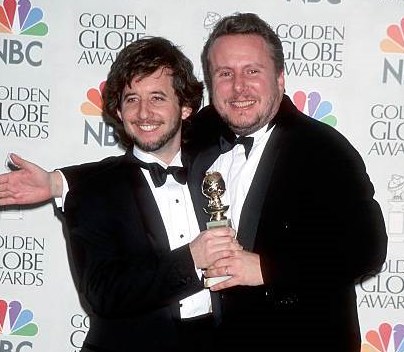
Russell’s direction, as ever, is stunning, fluid, and he captures action like few other directors. It was really cool to sit down and have a chat with him while taking a break from working on his new film here, in the great down under; and, I’m happy to report, like most of the cool filmmakers I’ve had the pleasure of speaking to, you always get more than you hoped for. Russell told me about an upcoming re-release of his debut feature Razorback and it’s hard not to touch on the subject of his cult classic Highlander. You’ve probably heard all the stories by now – but it is a far different experience when they are recalled for you by the man himself.

I really love Ricochet and I always enjoy talking to Russell, so this one was a real pleasure to bring to you. If you’ve not seen Ricochet then go to it, you won’t be disappointed. It is out there on DVD, but if you can, check out the Blu-Ray for the film in all its true visual splendor.

Mulcahy on Ricochet. Press Play…

If they look ninjas, and they’re dressed like ninjas, and they fight like ninjas…they’re ninjas: An Interview with Doug Taylor by Kent Hill

Doug Taylor began wanting to be and architect and dreamed of being like the dad in The Brady Bunch, ’cause he worked from home. But he soon became disillusioned with this notion and eventually found his way into film.

Like most of us, after learning the fundamentals, it then becomes a question of what next? Fortunately for Doug, a friend and fellow film student had made contact with a couple of producers who were in Canada making low-budget horror films. Thus the screenwriting career of Doug Taylor began.

What would begin with a small horror film would spawn a career that would see the talented Mr. Taylor rub shoulders with both the famous and the infamous of the industry. He worked with visionaries like Vincenzo Natali and the so-labeled Ed Wood of the age Uwe Boll. He has written for both film and television and those early seeds in the horror genre have seen him work on modern classics within it such as Natali’s brilliant and terrifying  depiction of the dysfunctional family in Splice.

So sue me. I am a fan of the films of Uwe Boll; thus I was most eager to hear Doug’s account of the making of In the Name of the King, and I was not disappointed. Like the storyteller he is, Doug gave me all the behind the scenes goodies that a film nerd craves. So much so I now re-watch the film with new eyes.

Anyhow. You’re just going to have to kick back and have a listen. Doug Taylor is great screenwriter who has lived a rich and varied life and enjoyed all success one can at the Hollywood heights. Yet he still lives in the city he grew up in and ultimately he accomplished his dream of being just like Mr. Brady, and working from home.

I really great gentleman, full of fascinating tales both on screen and off. Ladies and Gentlemen I give you . . . Doug Taylor.

Dark Cities, Dark Futures, Dark Caves: An Interview with Bruce Hunt by Kent Hill

Young Bruce Hunt loved movies and blowing things up. This love, and learning the basics of the craft from film magazines of the period, would firmly cement in his mind the path on which he would travel. As it was said in a film that Bruce would later work on, “Fate it seems, is not without a sense of irony,” a teenage Bruce would encounter Academy Award winning special-effects artist Dennis Muren in a cafe in London.

1475781640944

It was Muren that would advise the dreamer to seek out an effects house in his native Australia for possible future employment and, after art school, that is what the talented Mr. Hunt would do. Working with small production houses on commercials his work would soon catch the eye of the founder of one of these companies, a man named Andrew Mason. It would be Mason, producing a film directed by Alex Proyas called Dark City, that would call on Hunt to bring his passion, and by then, professional eye for effects photography to his first big screen gig.

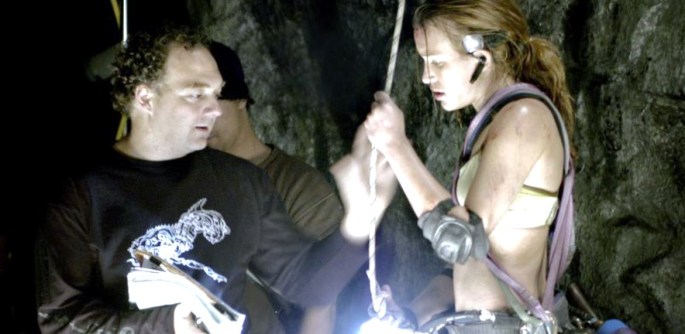
Work on another big flick would follow, as Mason would again tap Bruce and bring him to work on the Wachowski’s cinematic masterpiece The Matrix. There would be work on the film’s sequels before, at last, Bruce would sit in the director’s chair for The Cave, an adventure in deep terror. He would emerge from the darkness to work on Baz Luhrmann’s Australia only to descend again soon after for Guillermo del Toro’s Don’t be afraid of the Dark.

Through it all his love of the movies continues to drive him and, as you will hear, he has plans to get his visions back on that big screen, just as soon as he can. It was great to sit down with Bruce. Not only is he a filmmaker I admire, but it was great to just talk about movies with him.

If you don’t know his work then now is the time to check it out. But, if you already have and you’re a fan like me – then kick back and enjoy.

Ladies and gentlemen, I give you my good mate . . . Bruce Hunt

Problem Children with Big Eyes who make Biopics that’ll give you Goosebumps: An Interview with Larry Karaszewski by Kent Hill

As the child from a working class family in South Bend, Indiana, Larry was introduced to the movies by his father. He was not restricted as to what he could watch, so he watched it all. After high school he debated between pursuing either a career in comedy or a life in pictures.

453172736

Larry opted for the movies, and soon found himself at USC. It was there that he would meet Scott Alexander, and together they would form not only a friendship, but also the foundation of a prolific career as a successful screenwriting duo.

After (and though it launched a trilogy of films and even an animated series) Problem Child, the screenwriters struggled to find work. It seemed as though they had been typecast buy their work and so looked to independently produce a biopic they were working on about the notoriously bad filmmaker Ed Wood.

As fate would have it, word of the project reached director Tim Burton. After expressing interest, the boys would have to hammer out a screenplay in double-quick fashion. They succeeded, and this, the first in a string of biographical efforts, would re-establish them in Hollywood and from it they would carve out their place in the genre and become, in many ways, its ‘go-to guys.’

Biopics of Larry Flynt and Andy Kaufman would follow, seeing the boys team up with Academy Award winner Milos Forman. They would go on to re-team with Tim Burton as well as dabble in a variety on different genres including everything from a kid-friendly version of James Bond to horrific hotel rooms were you’ll spend a night or perhaps even an eternity.

Larry and Scott have garnered the highest accolades the industry has to offer and continue to deliver. While trying to get a hold of Larry for this interview I caught him riding high on his recent wave of success, so I would just have to wait for the tide to turn. I am however, glad that I did. It was, as it is ever, a privilege to chat with a man whose work I heartily admire. I love the films he has written and I look forward to the projects that he and Scott have in the pipeline.

Without further ado I present, the award-winning screenwriter and all-round nice guy . . . the one, the only, Larry Karaszewski.

Lunch with the Equalizer: A Conversation with Richard Norton by Kent Hill

Richard was a young lad from Melbourne, Australia plagued by asthma who loved martial arts.

richard_norton

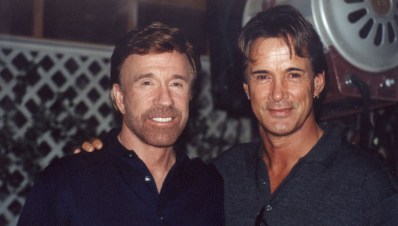
As he grew in skill, he would eventually catch the eye of the legendary Chuck Norris, who extended an invitation to the young Norton to come and train with him. It was while working as a celebrity bodyguard that he finally found his way round to the home of Norris, and from there he was offered a part in The Octagon as the masked ninja, Kyo.

Richard-and-Chuck-Norris-1024x584 norton-3

This would be the first of more than sixty screen appearances for the action film star, stuntman, stunt/fight coordinator/choreographer and martial arts trainer. He has worked on fights for “Stone Cold” Steve Austin, joined Suicide Squads, trained Scarlett Johansson  for the Manga turned motion picture Ghost in the Shell. He even braved the heat, dust and high-octane insanity on George Miller’s Fury Road.

rn2 13407327_10209910321620622_4980755475872849681_n tumblr_nl5h2gLpW11qe5f96o1_500

As a respected member of the martial arts community, Norton has remained close friends and has shared the screen with fellow industry luminaries such as Jackie Chan, Don “The Dragon”  Wilson and Cynthia Rothrock.

When I spoke with him, Richard was on his way to train the X-Men for another big screen outing, so there is no sign that the humble 67 year old from Melbourne is slowing down.

Richard Norton is a man who remembers well his origins and what it took to climb the mountain of success, upon which he stands, victorious. It was really cool to chat with him. I hope you’ll enjoy it.

So, here he is folks, the ‘real’ action man . . .  Richard Norton.

richardnorton06