Elizabeth Chomko’s What They Had

Alzheimer’s disease is a tricky subject in film; it can often sink into distracting melodrama or be used as a plot device instead of an actual ailment to the character, as they conveniently collect themselves when the narrative requires it and then get all confused again when needed. First time director Elizabeth Chomko handles it wonderfully in her debut What They Had, letting the sad realities of this affliction play out realistically for one Chicago family whose matriarch approaches stage 6. Blythe Danner playfully, sadly and intuitively embodies this woman, fleetingly letting us see glimpses of the woman that once was, now lost to inexorable mental fog as she approaches the end. Her husband of four odd decades (Robert Forster) refuses to put her into a home, out of both stubbornness and just plain love. Their two children (Hilary Swank and Michael Shannon) return home to deliberate the situation, and a superbly acted, quietly honest family drama ensues. Chomko also wrote the script and her dialogue has the stinging bite and dynamic depth of someone who is drawing from somewhere personal, and indeed I read that this film is based on her own experience. She shows surefire talent in writing as well as behind the camera and I wish her all the best in a career that will hopefully be something really special. Shannon is perfect as the scrappy, diamond-in-the-rough bar owner who uses gruff bluster to mask his heartbreak. Swank is emotionally resonant as the more distant and reserved of the two siblings, trying to deal with both her mom and daughter (Taissa Farmiga, excellent). Forster has seldom been better as the obstinate family man who just won’t let his girl go, he handles the guy with a stern resolve that begins to crack as he realizes that one day she will forget him entirely. Danner has the most difficult role, but nails it. There’s a befuddled remoteness to people with this disease, a near constant confusion that I’ve seen in real life but that doesn’t dim the warmth of their personality, at least for a while anyways, and the actress never over or underplays it. This is a terrific debut for Chomko and demo reel worthy material for all the major players, a small scale drama that wins big and elicits well earned empathy from us. Highly recommended.

-Nate Hill

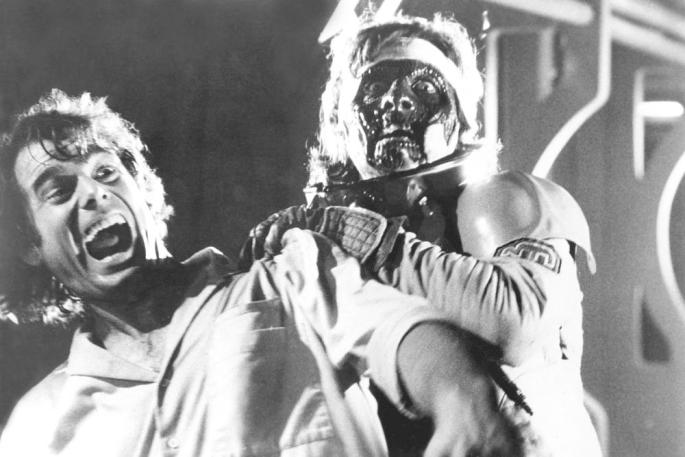
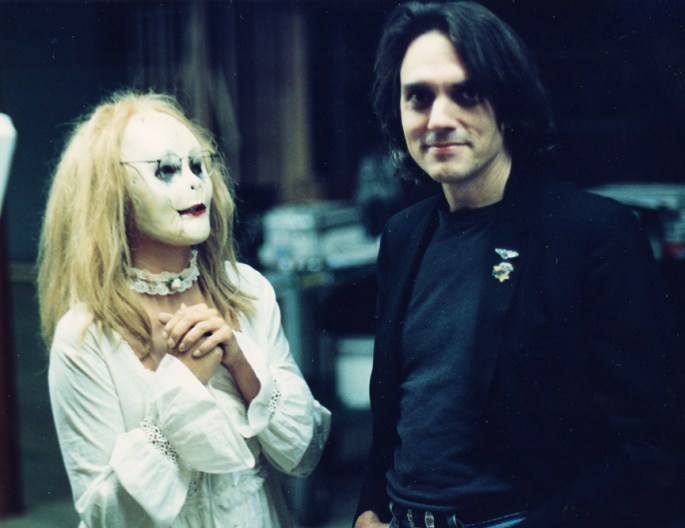
Creepy Creatures and Haunted Houses: An Interview with William Malone by Kent Hill

tumblr_nk83l2GdSs1svv6bpo1_500

I first became aware of the work of William Malone when I saw his movie CREATURE. For most, all they see is just some cheap imitation of Scott’s ALIEN – but there is much on offer if you give the flick more than a sideways glance. There exists the same thrilling, eerisome mood generated that marks all of his movies and which culminated in his remake of HOUSE ON HAUNTED HILL.

Growing up in Lansing, Michigan and going to the same high school as NBA legend Magic Johnson, it would be music and not sport that would eventually see the young Malone make his way west to Los Angeles. But the music soon died and William found himself looking for work. He took a job at Don Post Studios doing make-up and costume duties before attending film school at UCLA.

His first film would soon follow, the cult classic SCARED TO DEATH. This was the beginning of a storied career of other great features like FEARDOTCOM and PARASOMNIA as well as work on the small screen in series like TALES FROM THE CRYPT, MASTERS OF HORROR and FREDDY’S NIGHTMARES.

MV5BZjFlNjVkNDEtZjg1YS00ZjZhLWE2NTMtZWJjYTZjNjM5ZjgzXkEyXkFqcGdeQXVyNTM4NTAxOTQ@._V1_

It was great talking with William about everything from directing Klaus Kinski, his non-existent role of TV’s THE INCREDIBLE HULK, having one of his scripts become a sequel to UNIVERSAL SOLDIER and the (I find it intriguing) story behind the making of the troubled SUPERNOVA, of which Francis Coppola mentioned to him that they should have stuck with Malone’s original script Dead Star.

MPW-91740

Aside from being the world’s foremost collector of FORBIDDEN PLANET props and paraphernalia, William Malone is a fascinating movie-maker and a delight to chat with. I trust you’ll feel the same . . .

. . . ladies and gentlemen . . . William Malone.


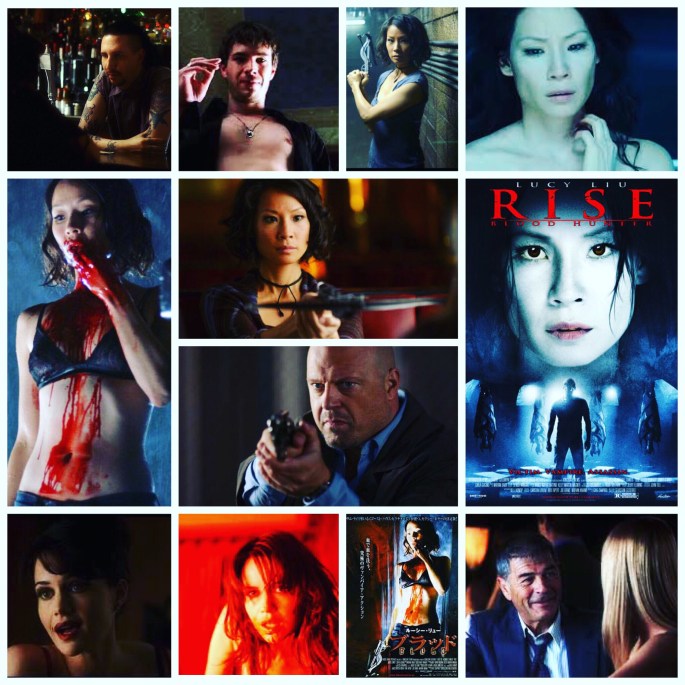
B Movie Glory- Rise: Blood Hunter

Rise: Blood Hunter is what you get when you take the sexy female vampire Underworld shtick and suck all the moody, gothic stylistics out of it, leaving something that doesn’t quite have an aesthetic it’s own at all, and feels awkward. It does have one thing going for it though: Lucy Liu. She gives Kate Beckinsale a run for her money in terms of physicality, sex appeal and stunt work, but it’s too bad she wasn’t given a film that rose up to meet her talent. She plays a reporter here who wakes up on a morgue slab one day and realizes she’s been turned into a vampire by the very same satanic cult that she had prior been investigating. Loaded with souped up powers, she begins a bloody journey to exact revenge on them one by one and put a stop to their nocturnal shenanigans. There’s a subplot involving a cop (Michael Chicklis) who’s looking for his missing sister, but ultimately it’s a series of violent, dimly lit confrontations as Liu hunts the cult down to their nasty leader (James D’Arcy is a bit too pretty boy for such a built up villain. There’s supporting work from Holt Mccallany, Carla Gugino and random cameos from Nick Lachey, Marilyn Manson and the great Robert Forster who’s talent is wasted on a bit part that any extra could have done in their sleep. You’ve gotta hand it to Liu, she’s a fountain of star-power and presence, but not even she could carry this beyond SyFy’s movie of the week syndrome.

-Nate Hill

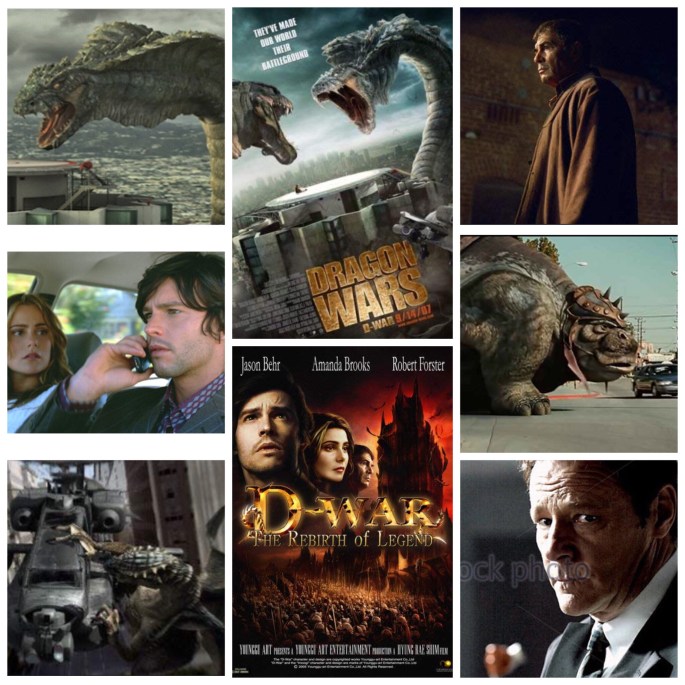
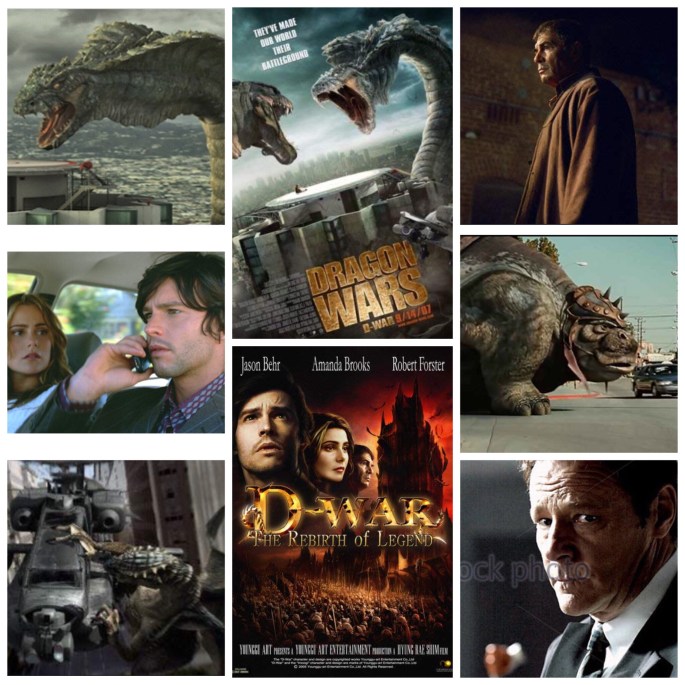
B Movie Glory: D-War aka Dragon Wars

D-War, aka Dragon Wars if the obnoxious CGI cover art wasn’t obvious enough, is a slovenly, sorry ass piece of pseudo sci-fi wannabe Godzilla garbage that manages to take a concept ripe with silly Corman-esque potential and turn it into something so boring it will melt your frontal lobe before the ‘dragons’ even show up. Apparently based on a Korean legend, I’d be fascinated to snoop around and see just what liberties were taken with the lore, because this plays out more like a Transformers movie but if the Autobots were giant Pokémon. An investigative reporter (Jason Behr) spends most of the time staring vacuously into the horizon as he and a hot chick (Amanda Brooks) race towards LA to try and stop a race of giant monsters from destroying everything. Where did they come from? Couldn’t say, and neither could the film from what I remember. What do they want? To smash and break things. Poor Robert Forster slums it up as an old mentor to Behr who has some vague sagely knowledge about the dragons, while Twin Peaks’s Chris Mulkey plays a corrupt FBI agent with his own agenda who hunts them down. The whole thing reeks of rushed, scattered production values and the shared knowledge among cast and crew that this wasn’t ever going anywhere but straight to DVD, no matter how prolific a legend it’s based on. Blech.

-Nate Hill

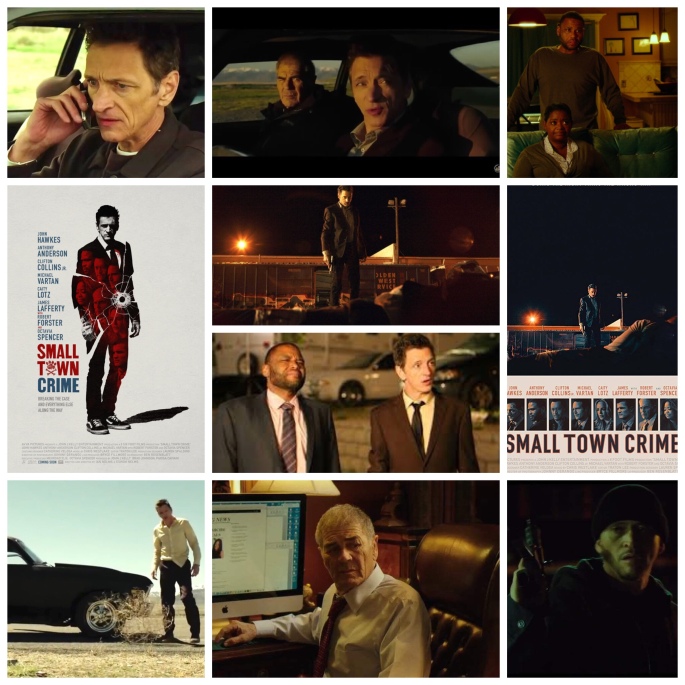
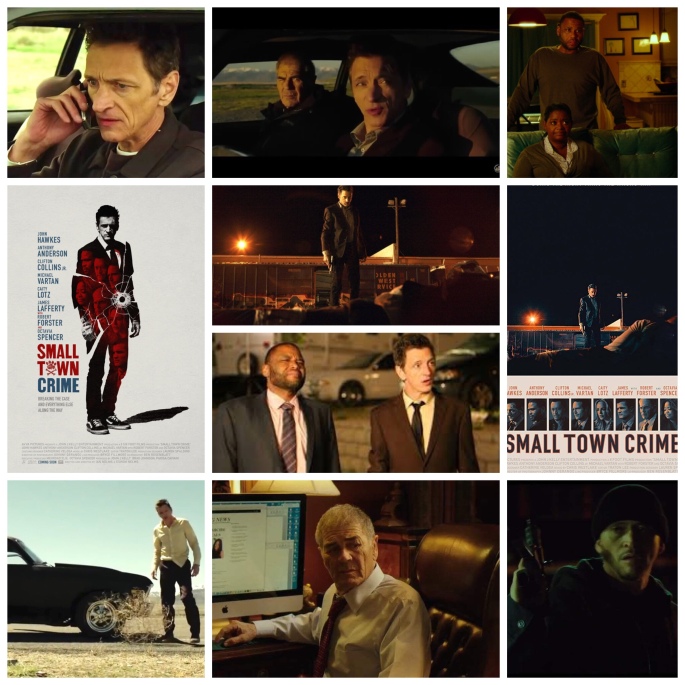
The Nelms Brother’s Small Town Crime

Looking for your annual rural crime/drama/black comedy/character study fix? Well, Three Billboards, which I reviewed the other day, provides that with something more illusory and profound. If you’re after one that’s a bit more old school and straightforward, check out the Nelms Brother’s Small Town Crime, a brutal, breezy thriller starring John Hawkes, an actor I remember from the fringes of the 90’s who seems to have gone newly platinum these days thanks to an Oscar nomination for 2010’s Winter’s Bone. He’s hilariously sympathetic here as a raging alcoholic ex-cop who stumbles right into the middle of a murder ring with the crosshairs latched onto a group of local underage prostitutes. Never one to back down once he gets a few cold ones in him before noon, he’s on the case between sessions at the dive bar and inebriated joyrides in his souped up muscle car. There’s a slightly off kilter, surreal quality to his story and that of those around him, a coming and going sense that these are a cartoonish series of events that aren’t really happening, when one looks at the supporting characters. Robert Forster has never been more deadpan or watchable as the tycoon grandfather of one of the slain hookers, a hands-on gent who isn’t afraid to dust off his giant scoped rifle to help out. He’s joined by outlandish Latino pimp Mood (Clifton Collins Jr., who needs way more roles), both of them assisting Hawkes in his crusade. Even the psychotic hitman (Jeremy Ratchford) dispatched to kill everyone in sight has a distinctly ‘out there’, roadrunner vibe. But Hawkes anchors the whole deal with the mopey, sad-sack realism of his character, a loser who’s dead-end existence has been given a new lease on legacy. His best buddy Anthony Anderson and wife Octavia Spencer give the plot some gravity too, a neat seesaw effect that sits opposite Forster and Collins exaggerated antics. The film has a funny way of both ambling along at it’s own pace and jumping out at you with warp speed jump cuts and brazen, bloody violence. The dialogue is pure poetry in areas and knowing camp in others, neatly balanced. Don Harvey and veteran tough gal Dale Dickey have great bits as salty bartenders, while Daniel Sunjata and haggard looking ex-pretty boy (remember him in Monster In Law with Jane Fonda and J-Lo?) Michael Vartan play two local detectives who are always frustrated to be a step behind Hawkes, who plays off the grid and close to the chest. Small Town Crime is a small time film, but the craft gone into bringing it to our screens couldn’t be bigger or more commendable from all angles. Highly recommended.

-Nate Hill

Just wild about Larry: An Interview with Steve Mitchell by Kent Hill

Error
This video doesn’t exist

Steve Mitchell has been on quite a ride. Having begun in the world of comics, he has the distinction of inking the very first book by a guy you might have heard of . . . Frank Miller. But being in New York with all his friends heading west, Steve, after forging an impressive beginning to his career, took a phone call one night from his another friend and filmmaker Jim Wynorski. Jim wanted an opinion on an idea that, if he could make it work, they might be able to get the picture made. From that conversation a film would be born. It was the cult classic Chopping Mall.

Steve-Mitchell-1-600x671

So like Horatio Alger before him, he went west and continued writing for both the worlds of film and television. The fateful moment would come one day while looking over the credits of the legendary maverick auteur, Larry Cohen, on IMDB.  Astounded by the length and breadth of Cohen’s career, Steve saw an opportunity to possibly make a documentary that would chronicle the life and exploits of the successful filmmaker.

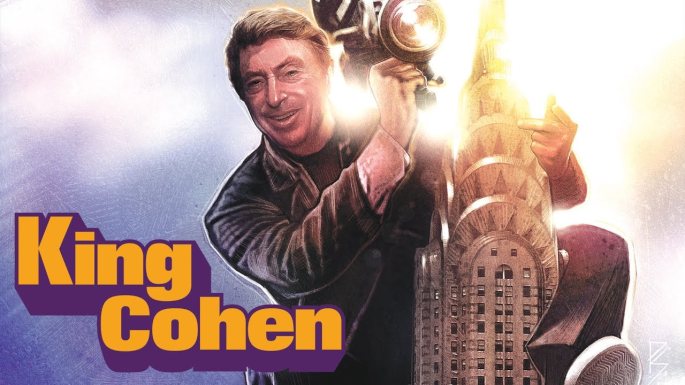
kingcohenposterB

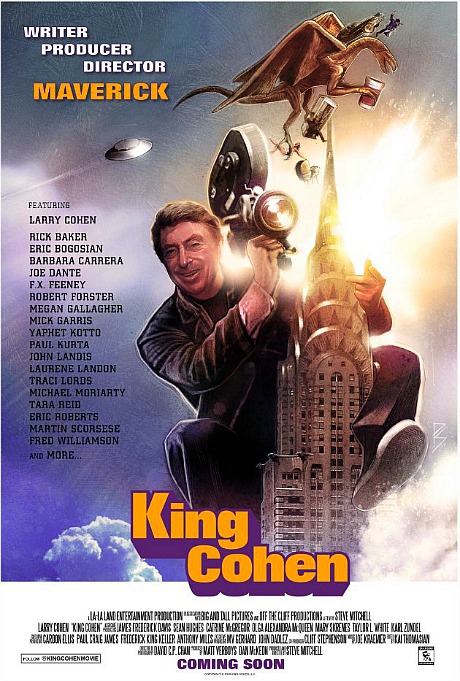
After receiving a blessing from the man (Larry) himself, Steve set about the mammoth undertaking of  not only pulling together the interviews with Cohen’s many collaborators, all of the footage of his many works , but also the financing to bring these and the countless other elements together to form KING COHEN: The Wild World of Filmmaker Larry Cohen.

This truly insightful and utterly entertaining look at the, thus far continuing, career of Cohen is the passion project of a man with whom I share a kinship. Not only for the stories behind the men who make the movies, but also how the films we know and love were pieced together with money, dreams, light, shadow and the technical tools which help capture and refine the many wondrous adventures we as cinema goers have been relishing since our very first experiences.

King Cohen Fantasia 2017-thumb-430xauto-67916

KING COHEN is a great film made by a really great guy, and it is my hope, as it is Steve’s hope, that you enjoy the story of Larry Cohen, but also come away from watching the film wishing to then seek out and discover the movies contained within that you may have only experienced for the first time as part of the documentary. The films of the filmmaker that inspired Steve’s film in the first place. (that’s a lot films)

Enjoy…

It’s good to be the King: An interview with Larry Cohen by Kent Hill

There is a quote attributed to Robert Rodriguez (another independent maverick filmmaker) that states:

“If you are doing it because you love it you can succeed because you will work harder than anyone else around you, take on challenges no one else would dare take, and come up with methods no one else would discover, especially when their prime drive is fame and fortune. All that will follow later if you really love what you do. Because the work will speak for itself.”

It is the always interesting, ever-changing, always inventive, ever professional life and work of Larry Cohen that really personifies the above quotation. King Cohen has been out there in one form or another in an impressive career spanning multiple decades. He has been the director of cult classics; he has been the writer of hot scripts that have incited Hollywood bidding wars. His work has been remade, imitated, venerated.

These are the hallmarks of a man and his movies whose personal voice rings out loud and clear, high above the commercial ocean of mainstream cinema that carries, beneath its shiny surface, schools of biodegradable blockbusters that are usually forgotten about only moments after having left the cinema.

This is not true of the films of Larry Cohen. For his work is the stuff (pardon the pun) that came before, the stuff the imitators latch on to, the stuff from which remakes and re-imaginations are conceived. This is the fate of the masters. The innovators come and bring forth art through trial and error. They are followed by the masters who take the lessons learned from the innovators and make them, shape them by sheer force of will. But, then there comes the imitators who stand on the shoulders of these giants and take home the glory.

Still, when there is an artist that is in equal parts innovator and master; this causes the imitators to stand baffled.

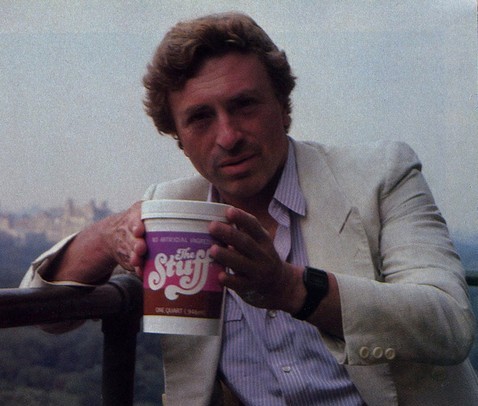
behind-the-scenes-the-stuff-larry-cohen-1985-2

Rather than accepting my humble oration, I urge you to seek out Steve Mitchell’s most excellent documentary KING COHEN. Watch it, marvel, rejoice, and remember that there are great filmmakers out there. They may not be coming soon to a theatre near you, but they did once, and their work still stands, silently, waiting to be discovered.

Until you get to see KING COHEN please, feel free to bask in my little chat with the king himself, Larry Cohen, a gentleman of many parts, many stories and of course . . . many movies.

Ladies and Gentlemen . . . Larry Cohen.

IMG_0691

Two Wolves, a snake eating its tail and a secret- A review of Twin Peaks: The Return by Nate Hill 


Twin Peaks: The Return has come full circle, and I mean that quite literally. Carefully, lovingly and maddeningly orchestrated by David Lynch, who has proven himself to be nothing short of a brilliant mad scientist of the cinematic arts, this is an endlessly deep, fiercely creative vision that refuses to compromise or meet anyone halfway, and it’s all the better for it. Showtime gave the man full and total control over every aspect, a decision they most likely didn’t fully understand at the time, but one which will have a beautiful ripple effect upon the landscape of serialized television and art itself in the decades to come, just as the original series did until now. 
  As the show unwinds in elliptical, rhythmic kaleidoscope fashion, it arrives at what can be called an ending only for the fact that there must be a last episode, but it’s not really an ending at all, there never was one in Twin Peaks, and likely never will be, a quality that has given it it’s vitality since day one. Many are having trouble accepting Lynch’s open ended, haunting finale, and that’s alright, considering human beings are simply wired to seek answers, and engineered to get frustrated, hostile even, when they aren’t provided. If one sits at a table with a jigsaw puzzle spread out, how would it be if the puzzle were quickly, neatly solved? The very quality that makes it a puzzle evaporates, the mystery gone, and one would simply lose interest, get up from the table and walk away. Now, if a handful of pieces are missing and never found, if the puzzle remains unsolved indefinitely, it feeds the observer with the fuel to pour thought, attention and care into continuously pondering how they might fit the pieces together, if ever at all. In short, the mystery lives on, and on. Lynch understands this, and it’s a wondrous gift to give fans, who no doubt will have Twin Peaks on the brain until the day they move on to the white lodge. It is quite literally the gift that keeps on giving. Like a snake eating it’s own tail, like the never ending, billowy curtains of the labyrinthine Red Room, like the portentous infinity symbol that the Philip Jeffries teapot warns Cooper with, this is a story that has ends, beginnings, middles, alternate timelines, repetition and, thanks to the intangible forces constantly at work, will never truly be at rest, at least not in any way that we can comprehend. 
  The themes which have fascinated Lynch his whole career are in full bloom here like never before, but one that takes centre stage after being deftly touched upon in the show and Fire Walk With Me is that of duality, light versus dark and the uneasy realization that the line between them isn’t as stark as we’d like it to be. Leland Palmer was always thought to be possessed by Bob, unbeknownst of his heinous atrocities, a babe in the very dark woods. Fire Walk With Me blew that comforting certainty right out of the water with some very dodgy scenes implicating Palmer himself, blurring the lines to show that although good and evil may indeed occupy opposite sides of the fence, they most certainly hop over and tread on each other’s lawn, a truth that has been shied away from in cinema quite often, but one which Lynch won’t let you tune out so easy. As we see a mullet adorned doppelgänger version of Cooper engage in a tirade of crime and violence across the states, the real Agent Cooper, or at least that part of his soul that’s trapped in the embryonic limbo of a pastel phantasmagoria Vegas, seems lost in a sea of characters we’ve never met before the Return. When it comes time for that inevitable showdown, it’s quick, and the surface level battle is skimmed over so Lynch can dive into a disorienting rabbit hole in which Cooper is stoic, uncharacteristically violent, a concentrated prism of all the qualities that were separate in the worlds that came before, his psyche in narrative nursery school until Lynch hurtles past that 430 mile marker into territories with ugly truths and revelations that are hard to swallow. Two wolves fight inside every one of us, one light and one dark, but they’re only two sides of the same coin, rival essences within a single beast, and although they run along side by side, tussle occasionally and appear to be separate entities, they’re one and the same when they look in each other’s eyes, as we see in the mirror, or when we come face to face with our doppelgänger against the backdrop of a shimmering red curtain. 
Twin Peaks has always been about secrets, from the very moment that Laura Palmer’s body washed up on those shores, wrapped in plastic (or did it?). Who killed her? That one secret lead to many, and as a story unfolds that’s scope vastly captures realms far beyond the sleepy little northwestern town it began in, we see a story at play that’s so much more, one that is very much filled with secrets, a motif we were warned about almost right off the bat. “She’s filled with secrets”, the Arm gleefully imparts to Cooper. That she is. The hollow screams of a shell shocked Sarah Palmer. The haunted, weary eyes of trailer park supervisor Carl (the beloved Harry Dean Stanton). Audrey Horne sharply awakening in the frightening unknown. Cooper and Laura being foiled yet again by the powers that be (those darn Chalfonts). An empty glass box that isn’t so empty. Coordinates that nestle between shrouded mountain glades. Heartbreakingly gorgeous melodies from the maestro Angelo Badalamenti. Pages from a secret diary that document horror, madness, joy, bravery, vulnerability and an odyssey through time, space, love, evil and of course good, the secrets that keep us coming back for more each time. Lynch has spun his magnum opus here, a tale where every piece is important, even the ones we may likely never find. A testament to the power of storytelling, a treatise on the mystery genre, everything I could have hoped for in a return to the town of coffee and cherry pie, and a full on bona-fide masterwork. See you in the trees, and whatever kingdoms lie beyond them in the glow of the red curtain, the purple seas, the hum of electricity in the dreams of a homecoming queen and a lone FBI Agent on a road trip to…


Gabe Ibáñez’s Automata 


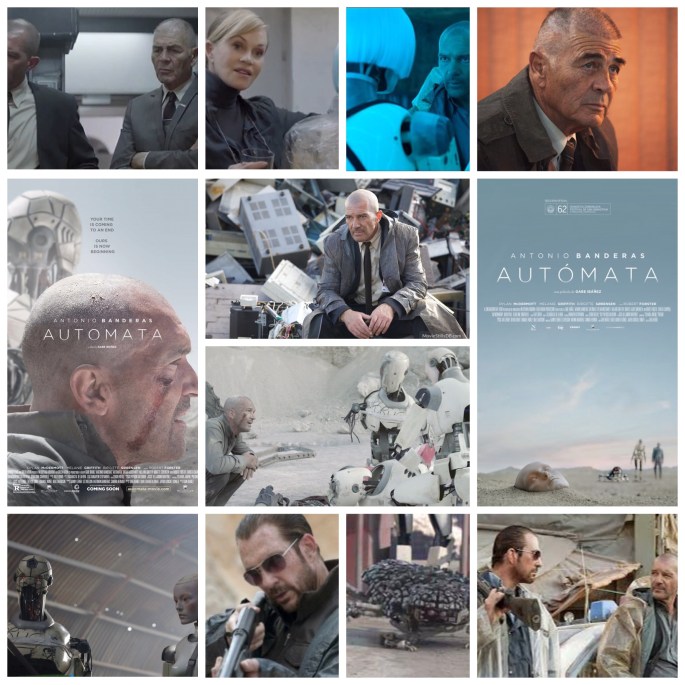
Gabe Ibáñez’s Automata had the misfortune of being released in the shadow of another film concerning robotics and artificial intelligence, Ex Machina. It’s hard to compete with the kind of hype that film generated back in 2015, and as such it kind of slipped through the cracks. It’s a shame because there’s much about that’s striking, stylized and fascinating, despite being a bit too elaborate for it’s own good. Drenched in a rainy neon Blade Runner atmosphere, it follows a bleak story involving insurance investigator Jacq Vaucan (a bald, somber Antonio Banderas) as he navigates a broken world ravaged by solar storms that have whittled down the human populace to around twenty million. Robots have been employed to rebuild the dying infrastructure, and Jacq keeps tabs in case any of them violate their primary directive, under the stewardship of his boss (Robert Forster). When rogue police officer Wallace (Dylan McDermott is dynamite) shoots a robot he claims was trying to alter itself, Jacq surmises that there’s a ‘clocksmith’ out there trying to give them minds of their own. It’s all very vague and we never really have anything more than illusory whispers or half explained concepts to go on, but these matters find him and the company’s nasty head of security (Tim McInnerney) venturing far out into the desert where a faction of robots, led by Javier Bardem no less, have grossly deviated their protocol and are evolving into… something else. Banders’s once wife Melanie Griffith does double duties as a creepy liaison in their case and the voice of a sympathetic sex slave-bot who plays a key role. I’m not entirely sure what the story arc is supposed to be, as it’s often muddled and dense, but it seems confident that it has one, and isn’t just flying blind into Euro experimental abstract mode as some scenes suggest. It has a point to make, it’s just wrapped that up in enigmatic fashion and cloaked any sense of linear exposition in blankets of atmospheric ambient sound, deliberately indistinct story beats and strangeness. I’m okay with that to an extant, as there’s plenty to enjoy visually, especially with the robots and their design, but many won’t be and will want more than just machine dreams without a manual to guide them. I for one enjoyed the memorable image of bald, parka clad Banderas hunting primordial androids in a washed out, used up wasteland. All that’s missing is a score by Vangelis or Tangerine Dream.  

-Nate Hill

Indie Gems: American Perfekt


American Perfekt is a disjointed yet darkly compelling little nightmare of a road movie, a dusty ode to bowers of the American southwest left unchecked and decayed, populated by wayward souls with perpetual heat delirium, vixens, psychopaths and hustlers alike, who saunter through lurid storylines that often end in bloodshed and madness. In the vein of stuff like Oliver Stone’s U-Turn and Kalifornia, we once again pair up with some extremely off colour characters as they navigate both the tangled web of highways that lace the States as well as the human capacity for greed, lust and heinous physical violence. The characters, and actors for that matter, who populate this stretch of highway are an especially bizarre bunch, starting with Robert Forster’s vacationing criminal psychologist Jake Nyman. Forster is quite the unpredictable guy, usually found in calmly benign protagonist roles, yet just as capable of stirring the pot with evil antics. Here’s he’s opaqueness incarnate, driving from one place to another until he runs into two sisters played by another couple of acting hellcats, Amanda Plummer and Fairuza Balk. Jake is basing each decision of his trip upon the flip of a coin a-lá Harvey Dent, a tactic which simultaneously causes trouble and indicates how unhinged he might really be.

Plummer is weird and Balk is weirder, but neither as weird as David ‘Professor Lupin’ Thewlis as an awkwardly placed character who seems to exist just to jump into a scene and throw the mood off kilter. There’s others running amok too, including Geoffrey Lewis, as well as Paul Sorvino and Chris Sarandon as a pair of state troopers who serve as comic relief. Forster is scary here, playing a guy who is psychologically hard to pin down or get a read on, and he’s got some dynamite scenes with Balk in the third act, the two talents lighting up the frame. It’s pretty far south of coherent though, mostly just these freaks terrorizing each other and engaging in puzzling romantic flings that only make sense to them, I suppose. If feverish, borderline abstract, sun-stroked neo noir is your thing, go for it. You can certainly do worse than spend a certifiably bonkers ninety minutes with this terrific bunch of actors. 

-Nate Hill