Gothika: A Review by Nate Hill


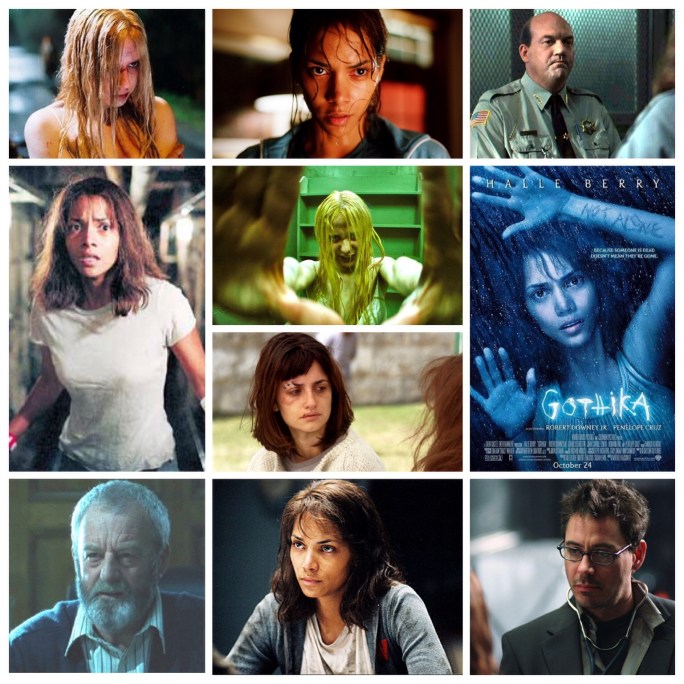
Matthieu Kassovitz’s underrated chiller Gothika is thick with a horror atmosphere that goes straight for the jugular in terms of scares, a psychological ghost story that actually raises hairs a frightens, or at least did for me. It sometimes sacrifices logic for style, but what style it’s got! Any horror flick set in an asylum just has to to be cloaked in workable atmosphere to be effective, and this one is positively dripping with it, hence the evocative title. Halle Berry plays a laid back psychiatrist who wakes up one day in the asylum she works at, only now a patient. She’s told she brutally murdered her husband (Charles S. Dutton) yet has no memory of the act. As if that weren’t a terrifying enough situation for her to be in, she starts having waking nightmares, haunted by a gnarly ghost of a girl (Kathleen Mackey) with mysterious ties to the facility’s past. Her colleague and friend (Robert Downey Jr. gives the dour proceedings his usual chipper pep) seems unable to help her. A guard (John Carroll Lynch) is hostile towards her, angry at the loss of her husband who was his friend. An erratic fellow patient (a de-glammed Penelope Cruz) seems to know more than her vacuous babbling would suggest. The asylum Director (Bernard Hill, excellent) is perplexed by the whole situation. It’s a twisty funhouse of a plot that probably piles on one stark plot turn too many, they’re nevertheless fun to be left aghast by as the rattle by with little regard for plausibility. Berry is convincing in her tormenting position, radiating desperation and resilience that claws at the cobwebs of insanity. Kassovitz piles on the gothic atmosphere relentlessly, and it really works, until we have a visual palette that looks like the dark underside of Tim Burton’s unconscious mind. The ghostly scenes have a threatening, intense edge to them and feel unnervingly realistic, putting us right in the hot seat with wide eyed Berry. Style over substance? Maybe. Okay, probably. But I care not. If the style, composition and palette are enough to draw me into a story, I can roll with it. This one imprints troubling negatives on the celluloid which latch themselves onto your psyche. Maybe it works well because it’s got a European director, and they’re more in tune with the supernatural in general. Maybe it just does a nice job at being effective horror. Either way, I enjoyed. 

OCEAN’S THIRTEEN – A REVIEW BY J.D. LAFRANCE

Ocean_s_Thirteen_2007_BRRip2

Despite its impressive box office returns, Ocean’s Twelve (2004) was considered something of a disappointment by its director Steven Soderbergh who felt that the plot was too complicated. While not quite as fun as Ocean’s Eleven (2001), it was a fine film in its own right – one that had a more satisfying emotional pay-off and doesn’t deserve the lousy reputation that it seems to have. Ocean’s Thirteen (2007) was seen as a return to the fun, breezy vibe of the first film by bringing it back to Las Vegas with style. The result was a very satisfying conclusion to the Ocean’s films.

As the revenge picture cliché goes, this time it’s personal. When Reuben Tishkoff (Elliott Gould) is muscled out of a business deal by slick businessman Willy Bank (Al Pacino), resulting in a heart attack, Danny Ocean (George Clooney) and his crew reunite for one last job: to ruin the opening night of Bank’s casino, The Bank, by making sure he loses a huge amount of money, which involves rigging all the games and slot machines. Bank wants the Five Diamond Award – the top accolade for hotels and will do anything to get it. Danny and the boys use this as a way to get at Bank. To this end, they devise an elaborate plan with the help of their arch-nemesis Terry Benedict (Andy Garcia) who bankrolls the operation. They also bring in Roman Nagel (Eddie Izzard) from Ocean’s Twelve to crack a state-of-the-art artificial intelligence security system.

Soderbergh kicks things off rather stylishly as we get a beautiful shot of Rusty Ryan (Brad Pitt) walking across a runaway tarmac to an awaiting plane at dusk with the sky an impossibly deep dark blue that, accompanied by David Holmes’ groovy score, is absolutely breathtaking. Once again, the director shoots the hell out of the film by employing all sorts of zoom ins and outs, pans and split-screens that, along with a saturated color scheme, keeps things visually interesting.

This time out, Matt Damon gets a juicy subplot where he goes undercover as Lenny Pepperidge, the assistant to a Mr. Weng (Shaobo Qin as The Amazing Yen, also undercover), a very high roller, in order to get close to Bank’s lovely assistant, Abigail Sponder (Ellen Barkin). Part of his disguise involves wearing a ridiculous fake long nose – a sly fuck you to Harvey Weinstein who wouldn’t let Damon wear said nose for his character in Terry Gilliam’s The Brother’s Grimm (2005) because he felt it would obscure the actor’s good looks and hurt the film’s box office potential. Well, it didn’t hurt Ocean’s Thirteen box office as the film went on to gross a very respectable $311 million worldwide.

It is also a lot of fun to see Ellen Barkin reunited with her Sea of Love (1989) co-star Al Pacino. She appears to be having a good time playing a confident businesswoman succumbing to Damon’s “seductive” charms. It is also fun to see Pacino go off autopilot for a change and sink his teeth into a juicy bad guy role. Who else could Soderbergh get to pose as a credible threat to the likes of George Clooney and Brad Pitt but someone of the legendary star caliber like Pacino? He plays Bank like the offspring of his take on Ricky Roma from Glengarry Glen Ross (1992) and Gordon Gekko from Wall Street (1987) – a smooth-talking unscrupulous bastard. In another nice bit of casting, the inventor of the artificial intelligence security system is played by none other than Julian Sands, an actor whose big break through came in A Room with A View (1985), but whose career settled into mostly direct-to-home video fare so it was a pleasant surprise to see him appear in a big mainstream film like Ocean’s Thirteen.

Another amusing subplot involves Virgil Malloy (Casey Affleck, sporting a ridiculous-looking mustache) organizing a revolution/strike among the workers at a dice-making factory in Mexico. He goes from complaining about a lack of air conditioning to tossing Molotov cocktails on the strike lines. At one point, he and his fellow co-workers drown their sorrows at a local bar and Virgil asks them, “Have all of you forgotten Zapata?” He goes on to offer inspirational words that fire them up. How this whole subplot plays out is quite funny. In another nice twist, Terry Benedict is helping Danny out albeit with all kinds of conditions. After all, he resents Bank’s lack of taste and the competition he represents. There can only be on top dog in Vegas and Benedict clearly feels that he is the one. Andy Garcia looks like he relished the opportunity to be in on the joke instead of being the target as he was in the last two films.

While working on Ocean’s Twelve, Steven Soderbergh began thinking about Ocean’s Thirteen. He thought about how fun it would be to set it back in Las Vegas. The motivation to make the film was a desire to work with everyone again but all eleven cast members had to want to do it. Producer Jerry Weintraub contacted them 18 months before hand and told them filming would take place during the summer of 2006 and to clear their schedules. He was able to find a way to juggle all these movie stars’ busy lives and add Al Pacino and Ellen Barkin into the mix.

For the film’s story, Soderbergh felt that Danny and his crew weren’t driven entirely by money and that they would reunite for friendship and revenge. The director came up with the notion of Reuben being betrayed and his friends helping him out. Weintraub hired Brian Koppelman and David Levien to write the screenplay. They had written the script for Rounders (1998) and created the gambling television cable show Tilt, and so they were familiar with the world of con men and gamblers. Soderbergh and Weintraub were both big admirers of Rounders and the director met with the screenwriters in New York City over lunch. They talked about great con movies, the nature of heists, and how the characters had evolved since Ocean’s Eleven. Within minutes, Soderbergh knew they were who he wanted to write the script and were working on it within minutes: “There was not a long list of people that we thought could step into this specific universe and pick up the language and the sense of humor.”

Koppelman and Levien had spent years exploring Vegas culture and the gambling lifestyle. They had every book they could find about con artists and thieves. Early on, Soderbergh told them that he wanted the film’s focus to be on the friendship between Danny and his crew. They understood that getting revenge on Willy Bank was what drove the entire story of Ocean’s Thirteen. They also wanted to “’flip’ the casino so that the patrons would win every time, which would spell disaster for Bank.” Soderbergh also told them that the bad guy should be a casino owner and they imagined Al Pacino and wrote Bank with him in mind. George Clooney also offered some ideas, mostly things to do with the revenge scheme that reunited the crew.

Some exterior scenes were shot in Las Vegas, but the casino interiors were mostly shot on one of the largest soundstages on the Warner Bros. lot in Los Angeles because it would have taken too long to film in actual casinos as they had done with Ocean’s Eleven. Soderbergh said, “In order to get the shots that I wanted, I needed to completely control the environment.” He instructed production designer Philip Messina to build a hotel and casino that would reflect Bank and his huge ego. Messina decided to go with a quasi-Asian theme and make it visually overwhelming. He purposely broke the rules in Vegas by designing a multi-level gaming floor because the production didn’t have a lot of horizontal space to work with.

Like Ocean’s Eleven, Ocean’s Thirteen pays tribute to the classic era of Vegas as Danny and co. restore Reuben’s honor. He’s an old school player who still believes in following a code and prides himself in being part of a select group of insiders that got to shake Frank Sinatra’s hand back in the day. Like Benedict, Bank represents the current corporate mentality of making money over the personal touch that the Mob-run casinos used to provide. If the first two films were about Danny and Rusty’s respective relationships with the loves of their lives, then Ocean’s Thirteen is about their friendship with Reuben. He mentored them when they were just starting out and taught them about respecting history as well as those who came before them. Like with the previous films, going after the bad guy is a matter of personal honor and hitting them where it hurts – in Bank’s case it’s his monster ego. Ocean’s Thirteen ends much like Ocean’s Eleven did thus bringing the trilogy full circle and with a truly satisfying conclusion as the bad guy gets what’s coming to him and Reuben’s honor is restored. Likewise, the film did very well at the box office and garnered fairly positive reviews going out on a well-deserved high note. It serves as an example of a star-studded big budget Hollywood film that entertains without insulting your intelligence.

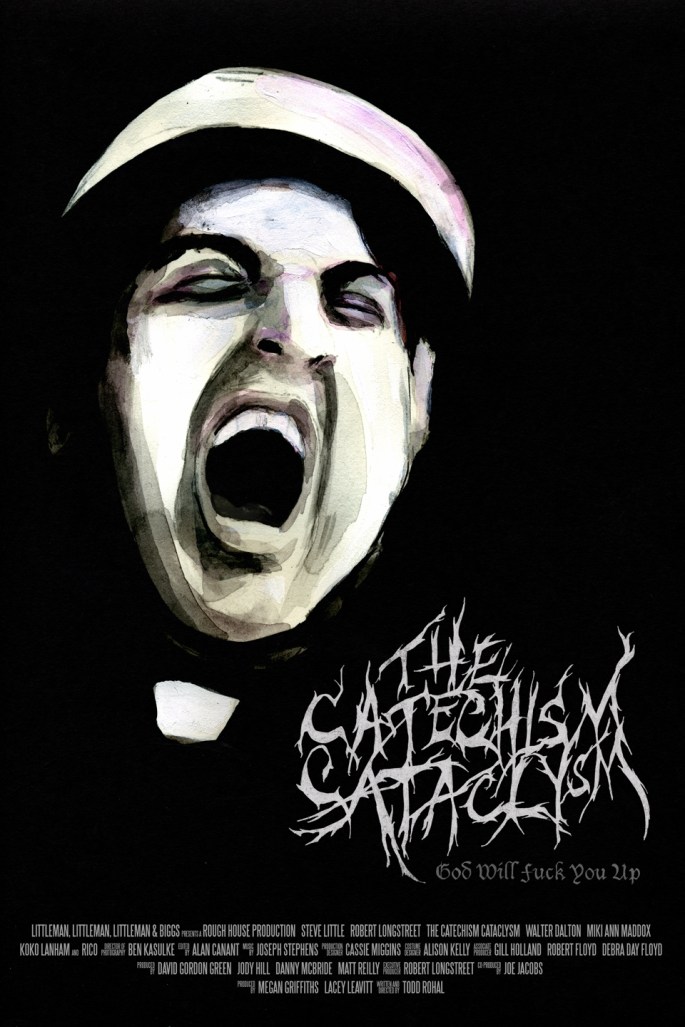
TODD ROHAL’S THE CATECHISM CATACLYSM — A REVIEW BY NICK CLEMENT

catecism

The Catechism Cataclysm is a totally messed up film on multiple levels. Unless the odd charms and surreal twists of this bizarre effort have been spoiled for you, there’s close to no chance that you’ll ever see where this unexpectedly creepy narrative is headed. The tonal switches in this film are beyond surprising, and the last 15 minutes of the slender 75 minute running time are some of the sketchiest, most weirdly hilarious cinematic moments I’ve seen in a while. What starts as a goofy and amiable two-hander between two very different temperments ferments into something close to Cronenbergian in its bodily horror and pyschological questioning. You’ve definitely got to be up for a film that isn’t interested in providing concrete answers to some of the more provocative and heady questions that the story raises, as it’s clear that the witty and quirky writer/director Todd Rohal wants the audience to fill in the gaps. By the end, you’re left with something that is beyond strange yet undeniably intriguing.

Feeling like a tall tale told by campfire through a haze of bong smoke, this 2011 independent effort has an impressive list of creative credits, including producers Danny McBride, Jody Hill, Megan Griffiths, and David Gordon Green, with the versatile cinematographer Ben Kasulke calling the shots behind the camera. The story involves a sub-mental priest named Father Billy (Eastbound and Down’s Steve Little) who takes a weirdly timed camping trip with an old childhood buddy named Robbie (Robert Longstreet). Rohal’s film bounces back and forth between the odd couple pairing, with Robbie’s increasing hostility brimming to the surface after having to repeatedly suffer Father Billy’s numerous idiocies. This movie is just flat-out silly and funny and then very dark and odd; I can’t really compare it to much else. And then, before you know it, the movie swtiches gears and becomes something surreal and potentially sinsiter. I’d like to give credit to whoever created certain props during the “big sequence.” Crazy stuff indeed. Lynn Shelton cameos. Available to rent via DVD on Netflix, and currently streaming on Amazon.

2

Tony Scott’s The Last Boy Scout: A Review by Nate Hill

image

Tony Scott’s The Last Boy Scout is pure stylistic grime, an exercise in early 90’s action with the blackest of humour. The tone is set with a square jaw early on: a star quarterback for a hotshot NFL team is under a lot of underground pressure to make that perfect play and in turn please the loan sharks. He buckles under the heat, ends up pulling a gun on the field and murdering a score of opponents before turning the gun on himself. Now horrifying as that is, if you have a sick sense of humor like me it conjures a dark chuckle of the most guilty variety, because.. well, it’s funny! Albeit in the darkest way possible, which is the arena this one skates in, love it or leave it. Upon closer examination of the script we discover it’s penned by that wonderful man Shane Black, who gave us Kiss Kiss Bang Bang and the upcoming The Nice Guys. No one can produce such heinous mayhem with a cavalier attitude and actually get away with it as well as Black does. The guy is a prodigy of dark humour, and who better to embody his protagonist here than a sheepish Bruce Willis as Joe Hallenbeck, a jaded ex detective who is so sullen and cynical he’s almost comatose. He’s paired with equally slummy former quarterback Jimmy Six (Damon Wayons), lazily trying g to solve a case involving the murderous quarterback and some shady politicians. Along the way that’s paved with many a sarcastic, beleaguered exchange they cross seedy paths with shady villains (Taylor Negron, RIP, and a  youthful Kim Coates), a beautiful working girl with ties to the case (Halle Berry) and Willis’s spitfire of a dysfunctional daughter (Danielle Harris). There’s a wonderfully bloated supporting cast including Noble Willingham, Chelsea Field, Joe Santos, Bruce McGill and more. It’s got a bite that stings, mainly thanks to Black’s frighteningly stinging screenplay which give the film it’s sardonic, put – upon aesthetic. This meshes together nicely with Scott’s trademark sun soaked, pulpy, picturesque tone and provides one hell of an action movie rode.  Nasty in all the right places, funny when the story begs for it, and build to last.

Batman Vs Superman: Dawn Of Justice – A Review by Nate Hill

image

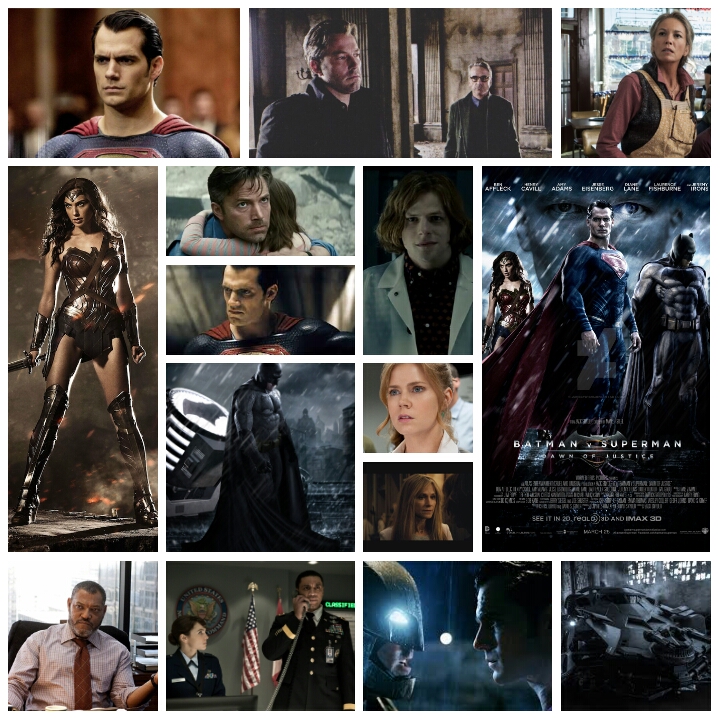
Batman Vs. Superman: Dawn Of Justice. Wow. Where to even start. What a symphony of scorched earth heroics, a two and a half hour maelstrom of thundering action, introspective gloom and very current vibes of apocalyptic dread. I’m not sure if I was watching an entirely different film from some of these bitter bottomed critics who are maiming it with inaccurately nasty reviews. Balls to them. Zach Snyder should be proud of this achievment, for in the face of both ruthless odds and rabid fans who would make any one of us piss down our legs at the thought of ‘getting it right’, he has mounted a titanic epic of a superhero flick, hitting all the right notes and fuelling both casual moviegoers and salivating super fans with a rekindled love for comic book films. A much welcomed grit and violent edge creeps into the proceedings here, a tone which Snyder has a passion for and is incredibly deft with. We begin with a visually arresting opening credit sequence, which Snyder previously perfected to hair raising brilliance in Watchmen, a ten minute opus set to Bob Dylan. Here he inter cuts shots of young Bruce Wayne, both discovering the prophetic swarm of bats and on the fateful night of his parents murder, a sequence done over a thousand times in film, but never quite with the inventive flair used here. We then arrive with adult Bruce (Ben Affleck) in Metropolis right as it’s being ripped to shreds by the Def Jam smackdown match of Superman (Henry Cavill) and Zod (Michael Shannon). There’s eerie shades of 9/11 as Bruce darts through the ashen rubble, attempting to save the employees in one of his towers. One senses the fear and rage in Wayne right off the bat (pun intended). He glowers in seething fury at the man of steel, primally threatened and haunted all over again by loved ones he couldn’t save a second time around. This film addresses the ludicrous amount of destruction that Superman wrought upon Metropolis in several ways. Political nerve endings are fried as Senate and State alike get hostile towards the god in the red cape. No one is more aggressive than Batman, though. This brings me to Affleck as Batman. Without a doubt my favourite cinematic incarnation of the caped crusader, and his debonair counterpart to date. Yes, even more so than Bale. Nolan’s The Dark Knight is still tops for me, but the  portrayal of Batman by Bale didn’t strike as harmonious a chord with me as Affleck. It just didn’t feel like pure Batman, it was real world Batman. Affleck feels much more rooted in the comics, and God damn it all if he isn’t the most savage, violent Bats to come our way, well… ever. I’ve always been bothered by the nagging fact that Batman refuses to kill. Even in in a beatdown he could easily inadvertently cause death, so why bother trying? Here, he doesn’t go out of his way to deliberatly kill, but he sure has no problem brutally breaking bones and stabbing his adversaries without an iota of faux-noble hesitation. That’s the kind of Batman I want to see. Fuming, fired up and full of rage demons that erupt into fantastic action scenes. One sequence involving a room full of thugs is just jaw dropping and probably my favourite sequence of the film, even over the titular smackdown with Superman. There’s an earthy, simplistic take to him as well, with a modest suit that gives nods to Frank Miller and even Batman: The Animated Series. He is by far the elemental force that the character should be, and the part of the film that I connected with most. I hope he gets his standalone film real soon. Henry Cavill has grace and intuition as Superman, and a surprisingly earthly aura as Clark Kent, in a fit about Batman’s vigilante tactics. He’s the outsider here, an orphaned deity truly trying to do his best in a world that often shuns him in fear. He was never my favourite superhero, or even on the list, but Cavill combined with Snyder make him a force to be reckoned with, and a hero I can get behind. The two eventually meet in a remarkably choreographed clash of the titans, a duel that really only lasts a few minutes and isn’t central theme, which raises questions in my head about the first part of that title. Their fight is composed of Batman’s hard hitting, blunt force physicality pitted against Superman’s fluid, elegent invincibility which is satisfyingly put to the test by the appearance of a certain green mineral we all know about. The James Cameron-esque suit Batman wears for the fight is a grinding wonder that looks like it weighs a metric ton and could level buildings alongside the man of steel. The combat feels urgent, from the gut and roars into action perfectly. Of course, that isn’t where the fireworks stop, but I ain’t sayin any more than that. Gal Gadot is truly wonderful as Wonder Woman, I also can’t wait for her solo outing, and wish she’d been in the film more. Her much talked about entrance is the definition of crowd pleasing, and will make you cheer in approval, which I did out loud. She’s  endlessly gorgeous, and has the toughness to go along with it, a great casting decision by anyone’s tally. Jesse Eisenberg wowed me as a young, jittery Lex Luthor, in what is probably the most clinically insane portrayal thus far. Forget bumbling Gene Hackman and hammy Kevin Spacey, this guy seals it for me. There’s a true madness to his Lex, which when given enough money and resources can have cataclysmic results. It’s a villain  to remember, and Eisenberg exudes palpable danger from every pore, his psychopathic sheen of logic barely shrouding the mania beneath. Jeremy Irons is a more restrained, jaded Alfred who is still unconditionally supportive of Wayne, but is reaching the end of his rope which is tethered to pure world weariness. He gets some of the only humerous bits of the film, albeit of dry, brittle variety. Amy Adams is reliably terrific, her eyes pools of perception that mirror the horror and spectacle of the events through the mind of a human, with every ounce of nerve and courage as those around her that have superpowers, or expensive toys. Diane Lane is weathered wisdom and maternal compassion as Martha Kent, nailing her scenes with the small town, kindhearted patience that a film this noisy deserves, tipping the scales to provide occasional serenity in the eye of the hurricane. Kevin Costner makes a brief appearance in one of the films numerous and often confusing dream sequences. He was a highlight in Man Of Steel, and brings the same baleful, gruff adoration here, in a wonderful but brief scene with Clark. Laurence Fishburne is another source of rare humour as the perpetually exasperated Perry, CEO of the Daily Planet. Aggravated and cheeky, he commands every frame he’s in and had me chuckling no end. Holly Hunter has forged a career of playing no nonsense hard asses, here a ballbreaking US Senator here who shares a moment of distilled intensity with Luthor proving that Superhero films can have some of the best written dialogue. Harry Lennix makes great use of said writing too as the steely Secretary Of Defense. Callan Mulvey and Scoot McNairy are memorable in supporting turns. Listen hard for Patrick Wilson and Carla Gugino, and look for a certain ocean dwelling dude in the briefest of moments. Jeffrey Dean Morgan also has a cameo that’s almost too good to be true. Hans Zimmer and Junkie XL, who was so top notch with Mad Max: Fury Road, combine efforts for a score that knocks it out of the park and several miles further. Batman has a soul rousing battle cry of an overture, with subtle shades of Zimmer’s work on the Nolan films, built upon to give us something truly unique and fitting for the character. Lex Luthor is accompanied by a fitful cacophony of strings that sound like the Arkham Asylum charity orchestra having a collectively unnerving seizure. My favourite riff though I think is for Wonder Woman, a deviously disarming jaunt that strays from the grandiose, baroque theme and feels wickedly subversive, getting you just so pumped for her character. Zimmer’s work on Interstellar made it my top score of 2014, because he leapt out of the box of his usual tricks and gave us something we’d never heard from him before. Here he shreds that box with ingenuity and creative output, a varied, explosive piece that assaults your ears splendidly. My one concern with the film was a dream sequence midway through concerning Batman, and anyone who’s seen the film knows what I’m talking about. I’m sure comic book fans have some point of reference or context regarding it, but the casual viewer doesn’t, and a little more explaining would have been nice. I will say though it showcases Batman in an entirely new light which took me off guard nicely. This is what a superhero movie should be, plain and simple. Big, bold, audacious, stirring and full of high flying action, dastardly villains, conflicted heroes clashing like the ocean tides and a sense of pure adventure. Forget what the critics are saying, this one comes up aces in all categories and is a perfectly wonderful start to the stories of a group of characters that I look forward to seeing in many a film to come. Especially Affleck’s Batman.

PTS PRESENTS: 10 QUESTIONS WITH ACTOR MOE DUNFORD

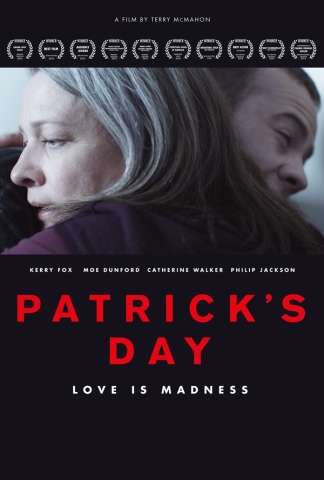
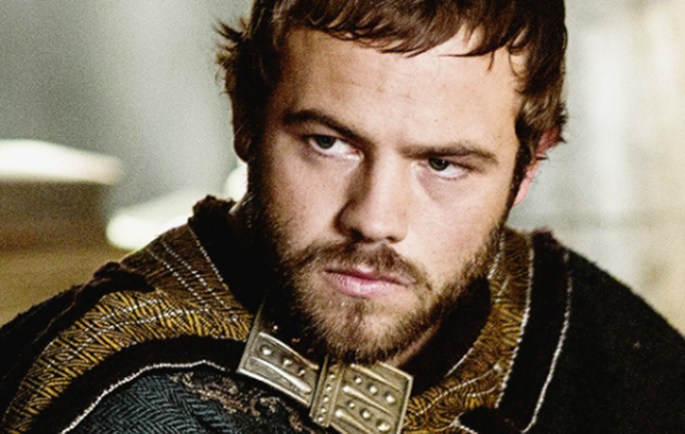
IFTA nominated actor  Moe Dunford (Supporting Actor for the TV series Vikings) is fast becoming a talent to look out for. He’s an integral part of the hit medieval series and recently set the big screen ablaze with his searing performance in Terry McMahon’s hard-hitting mental health drama Patrick’s Day, which is now available to stream via ITunes and Amazon and various Cable VOD platforms, with a DVD release set for April 5th. He’s got a slew of unique projects on the horizon, and Nick had the chance to chat with him while on break from shooting Vikings in Ireland. We hope you enjoy!
Moe Dunford Banner

How did you get your start as an actor, and what do you consider to be your first “big break” in the industry?

I got my first paid acting gig on the TV series The Tudors, running up and down trenches for a week in a field in Kilruddery, Co. Wicklow, in the summer of 2009. I’d graduated from Dublin’s Gaiety School of Acting, and I spent a few years going through the odd job, and then having no job, and then being mostly broke. Terry McMahon really gave me the first chance to play the type of role I really wanted to examine with Patrick’s Day. It’s a weird coincidence now, talking about my first job, as I’ve just come back from the same field in Kilruddery, as it’s the last day on Vikings Season 4 today. We’ve been filming a big battle scene here all week. Since it’s not summer in Ireland now, the field has turned to shite, and as the background actors will tell you, we never want to see the shaggin’ place again! It’s strange how things come full circle.

1.jpg

Who were some of your cinematic inspirations when you were younger? Did anything speak to you as a child?

I was interested in any kind of adventure movie growing up. My favourites were Ghostbusters, Spielberg’s filmography, and anything with Robin Williams. My folks ran a pub for a few years in Ladysbridge, Co. Cork and the talk at the time was that there was some Hollywood movie being made down the road in Ballycotton. My father told me that a big acting legend came into our pub for a drink one day except I didn’t know who it was. I’d never heard of him. Turned out it was Marlon Brando, and the movie was called Divine Rapture, which unfortunately never saw the light of day because it ran out of money! I was only around 8 or 9 but he would have been an inspiration to me for sure when I got into acting for sure.

2

How important is Irish cinema for you?

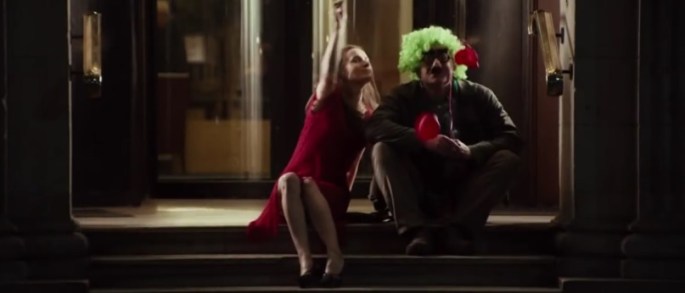
I believe there is something raw and very real to the stories coming out of Ireland right now, and I’m more invested in them emotionally when compared to a lot of the big budget studio movies. We’ve been kicked around and oppressed and repressed and told we can’t do things, yet out of that has come a deep rooted need to express ourselves. It’s the reason I was so hooked on the story of Patrick’s Day. Everything about it was raw, relatable and human. It had something to say and dispensed with stigmas. That’s what I find fulfilling about acting, and thankfully I get to work on stories that fight against Irish stereotypes. I feel like it’s a case of the fighting Irish in film and long may it continue.
4

What was it like shooting Patrick’s Day?

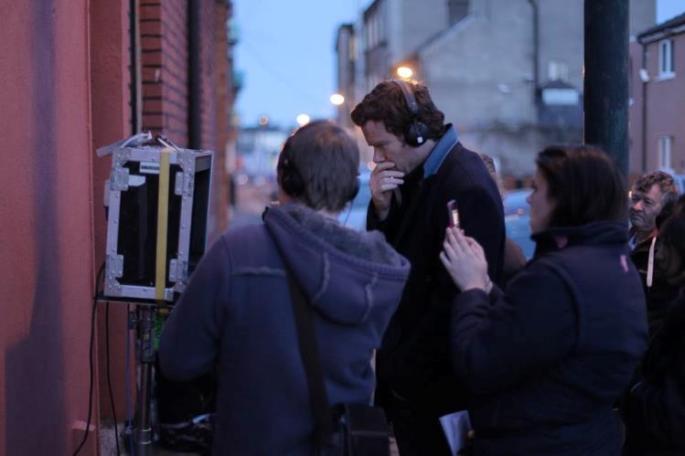
It certainly wasn’t without its tough days. And people seemed to have the assumption that it was really hard, because of the subject matter. Or a few times I was asked how taxing it was or how much personal attachment there was, as if that’s a bad thing when taking on a role. The truth is that it was a lot of fun. Working with Kerry, Catherine, Philip & Aaron, I love all of them. And then Tim Palmer, Michael Lavelle & Terry…three cock-blockin’ motherfuckers but I love them! The whole journey of Patrick’s Day was something I’ll never forget. Scenes were often almost like little games, it was a thrill working against the clock, trying to get the scenes the best they could be and do it efficiently. I’ll never forget the faces of Terry and cinematographer Michael Lavelle after getting certain scenes, things would just happen for us, like the shot with the plane going over our heads. Everyone was jumping around like little kids. It was pure joy.
5

Terry McMahon. He’s a force of nature. What’s it like collaborating with him?

As a filmmaker, Terry’s an inspiration. He understands the language of film, and the relationship between the audience and the actors. He’s not afraid to be outspoken and tackle issues about Ireland’s darker side. It’s in there, written into his scripts. We need that in our country. We need people who ask “Why not?” When working with Terry, I was also working with a very close friend who I trusted completely. I love the guy. He enables you in scenes to push that it further than you thought you could go. He’s a genius of a director. Probably his biggest strength is his sense of empathy, as he treats everyone equally on set and off. Unless you’re being a bollox.
6

Are you excited by the current boom of Irish cinematic talent?

I’m excited and optimistic. Look, we’re a small country, but we’re a nation of storytellers going way, way back, no matter what our country has been through. Irish film has been finding its voice for years, and now it seems that it’s really being heard. I’m excited and hopeful for any budding Irish actors, directors, or writers putting pen to paper for the first time, because for every success story like Saoirse Ronan, Lenny Abrahamson, or Emma O’ Donoghue, it shines a light back over here and I believe will create more opportunities for Irish film. We’ll need the continued support of our government to enable us to keep making films of quality and substance. Government funding dropped from €20m in 2008 to €11m in 2015. So I’d hope to see that on the rise.

7

What’s the general vibe in Ireland about the industry?

I asked a handful of my Vikings cast members from around the world, what stands out to them the most about being here and filming in Ireland, and they’ve all said that above all else, it’s the enthusiasm, and optimism from Irish crews that they haven’t encountered before. We’re making quality movies with good people behind them, and we’re in the best place we’ve been since Jim Sheridan and Neil Jordan came on the scene.

8

What are some of your favorite films, movies that you simply can’t live without?

Butch Cassidy and The Sundance Kid, Into The Wild, On The Waterfront, It’s A Wonderful Life, One Flew Over The Cuckoo’s Nest, The Deer Hunter, The Mission, Star Wars, Il Postino, and The Wrestler – these are all films I feel are great examples of cinema, and films I could watch at any point on any given day.

9

Has there been a recent Irish film that has considerably impressed you, or an Irish director who you’d be interested in working with?

I’m really looking forward to Brendan Muldowney’s Pilgrimage, the locations in it look amazing and there are great actors in it. Mark Noonan’s You’re Ugly Too, with Aidan Gillen, that was the best Irish movie I saw in all of last year. I loved the relationship between the uncle and niece, and how it was shot. My favourite Irish movie I have seen so far this year is without a doubt Viva, written by one of Ireland’s best talents, Mark O’Halloran, who also wrote Lenny Abrahamson’s first two movies. It tells the story of a young Cuban drag artist. I loved its heart and energy. It’s a beautiful movie and universally appealing.
10

What’s coming up for you?

I’m shooting Vikings season four now. That’s 20 episodes, which began airing this past February. It’s just been renewed for season 5 in June, another 20 episodes written by Michael Hirst. The show is shot entirely in Ireland which is wonderful, and the crew and background actors are the best in the business. I have three movies to film in 2016, the first being a comedy called The Flag which I’m doing now with Pat Shortt, directed by Declan Recks. We play two friends who go over to England and break into a British Army Barracks to take back the Flag that was put on top of the GPO in 1916. Fitting for the year that it’s in. It’s produced by Treasure Films (The Stag, Viva, Handsome Devil). In the autumn, I’m working on an Irish – Polish co-production, a medieval religious epic. I’ve just finished a movie called Handsome Devil, with Andrew Scott. It’s written and directed by John Butler, and produced by Treasure Films. Handsome Devil is set in an Irish secondary school and it’s a story of individuals in an environment where students are often forced to conform.
Moe Dunford Banner

BATMAN V SUPERMAN DAWN OF JUSTICE – A Review by Frank Mengarelli

“That’s how it starts. The fever, the rage, the feeling of powerlessness that turns good men cruel.”

Zack Snyder’s BATMAN V SUPERMAN DAWN OF JUSTICE is unlike any superhero film we’ve seen before. It is brazen and it is bold, it is disjointed and over packed with setting up the new DC Universe. When I say that this film is a complete mess, I mean it in the way of how APOCALYPSE NOW is a complete mess. BvS cannot be compared to any existing, non-universe, DC film that came prior, and it certainly cannot be compared to anything that Marvel has done. Marvel likes to follow a template. They know what works and what doesn’t, and they certainly do not take many risks at all. BvS takes risk after risk after risk, and by doing so Snyder has made a remarkable film.

BvS Alfred

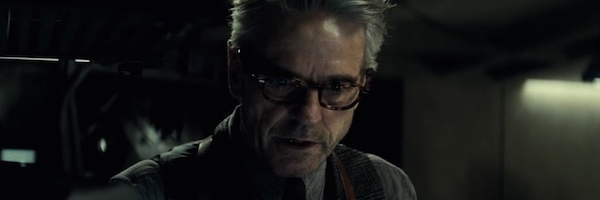
The casting of Ben Affleck as the fifty year old Bruce Wayne/Batman was a brilliant move by Snyder and Warner Brothers. We know who Batman is. We’ve seen Batman’s story countless times. There’s nothing more that can be said about him. Michael Keaton was perfect, Val Kilmer was admirable; George Clooney fully admits his turn almost killed Batman, and the Bale/Nolan trilogy was a godsend to the Batman’s onscreen presence. Now, we get to see the version of the Batman that some of us have always wanted, and a lot of people didn’t even know they wanted. We see what comes after everything we have seen prior. The Batman is older; he’s even more cynical and jaded. He’s given up on hope and resorted to his anger, his vengeance. He has become a killer.

Affleck’s take on Batman may just be the best one yet. He has resorted to his primal brutish instincts with one goal in mind. He doesn’t want to make Superman submit; he doesn’t want Superman to stand trial and have society serve justice for the atrocity he’s brought to the world. He wants to kill him, and if he can’t, he will die trying. Affleck transforms the Batman into a battle worn warrior. He is a man who doesn’t care about peace and justice, he is a man who has a blatant disregard for hope.

BvS Superman.jpg

Zack Snyder is the epitome of a polarizing filmmaker. He has a solid fanbase who are passionate about his films. Snyder has an equally loud echo chamber made up of people who strongly dislike him. Who refuse to give him credit for anything positive. There is not another filmmaker alive who could have made a Batman/Superman film that sets up not only the Justice League, but also an entire new universe to be explored. Zack Snyder, takes everything that was thrown at him: a follow up to MAN OF STEEL, introducing a new Batman without spending a film giving him an origin, introducing Wonder Woman, Cyborg, the Flash, and Aquaman. Snyder not only did all these things, but excelled in a remarkable way.

Yes, it’s another superhero film. Yes it’s another big budget blockbuster. Yes, it’s going to set up multiple franchises that we’ve already seen. But it has never been done in such a magnificent way. Affleck, along with Jeremy Irons as the new Alfred, and Jesse Eisenberg as the smoke screen for the real Lex Luthor, all bring pre-existing gravitas with them. Immediately adding validity to characters so we don’t need to spend a movie a piece building up backstory for them

BvS Knightmare.jpg
.
Film critics, whether professional or Facebookers/bloggers, who don’t like this film, who are relishing in the critical shitstorm this film received, already made their minds up that they were going to hate this film. Much like IndieWire and a few other websites tried their absolute hardest to sink TRUE DETECTIVE season 2 before it even aired, the way some critics approached the new Star Wars film in a highbrow, disregarding way – DAWN OF JUSTICE suffered much of the same fate, but none of that matters. The film is going to and already has broken box office records, and the dark and dreary foundation of the new DC Universe is set.

There is a striking moment in the film that was shown in the first trailer. The second Robins suit is displayed in the Batcave with spray paint on it: “The joke is on you, Batman!” Not only does this tell us, in part, of why the Batman is so angry and rage filled, but I can’t help but think that is also a way of Snyder saying that to his haters, those who rallied hard against this film: the joke is most certainly on you.

OCEAN’S TWELVE – A REVIEW BY J.D. LAFRANCE

Brad-Pitt-in-Ocean-s-Twelve-brad-pitt-15567639-853-480

After the commercial failures of Full Frontal and Solaris in 2002, there was pressure on Steven Soderbergh when he announced that his next film was to be the sequel to the wildly successful Ocean’s Eleven (2001), to not only come up with a box office hit but to also outperform the previous film. With big budget, star-studded casts like the one in Ocean’s Twelve (2004), there is always the danger of having them look too smug and self-indulgent instead of having fun along with the audience. Ocean’s Eleven managed to straddle this line quite well, resulting in an entertaining popcorn movie. Soderbergh kept his cast in check, never letting them go too far over-the-top and shooting it with a style that was always interesting to watch. The big question for the sequel was if he could pull off the same feat without repeating himself too much. Ocean’s Twelve ended making less than its predecessor (but still a lot of money) and cost more while also dividing critics but in some ways I find it a better film.

Danny Ocean (George Clooney) is supposed to be retired and enjoying domestic bliss with Tess (Julia Roberts). However, old habits die-hard and the lure of pulling heists is always calling. She catches him casing a jewelry story on their anniversary. To make matters worse, Terry Benedict (Andy Garcia) is still hot on their trail, tracking down all of the original eleven and letting them know, in his own casually menacing way, that he wants the $160 million, plus interest, that they stole from him in Ocean’s Eleven, and in two weeks time. The montage of him doing this mirrors the one in the first film where Danny and Rusty recruited their crew. If Benedict was an imposing figure in the first film, Andy Garcia makes him even more of a threatening presence in this montage by doing little except exude menace with his eyes and the all-business tone of his voice.

So, Danny gets everybody back together to figure out what to do. Obviously, they need to pull another job but they are too high profile in the United States, so they go to Europe and cross paths with a truly formidable opponent and rival master thief known as the Night Fox (Vincent Cassel), a bored French playboy. He’s jealous of Danny’s status as the world’s greatest thief and is out to prove that he’s the best by having the both of them go after the same thing: the Faberge Imperial Coronation egg. Vincent Cassel plays the Night Fox as an ultra-confident, cocky man in such a way that you want to see Danny and company knock him down a peg.

Ocean’s Twelve
ups the difficulty level for our heroes even more by having most of the crew neutralized leaving only Basher (Don Cheadle), Linus (Matt Damon) and Virgil (Scott Caan) left to pull off an impossible heist. So, they bring in Tess to pose as, well, Julia Roberts. Unfortunately, another major movie star is staying at the same hotel, which only adds to the meta aspect. Said movie star gamely plays a fictional version of himself. The scene where he meets Tess as Julia Roberts is very amusing as Damon and Roberts act all star-struck in front of him. It is also interesting in that the meta aspect that was present in Ocean’s Eleven is made even more explicit – something that turned off some critics and audiences but I think works extremely well because Soderbergh isn’t having a cutesy cameo of a movie star for the sake of it but actually incorporating them into the plot and making them an integral part of the scam.

If the first film was about Danny’s redemption by reconciling with Tess, then Ocean’s Twelve is about Rusty’s (Brad Pitt) redemption by reconciling with his past love, Isabel Lahiri (Catherine Zeta-Jones), a determined and quite beautiful Interpol agent. Like Danny’s feelings for Tess potentially compromising his involvement in the heist in Ocean’s Eleven, Rusty’s feelings for Isabel leaves him potentially vulnerable in Ocean’s Twelve. To her credit, Catherine Zeta-Jones fits right in with the European vibe, maintaining just the right mix of determination in nailing Danny and his crew and vulnerability when she’s with Rusty. Their relationship elevates the film ever so slightly above the standard heist story and the conclusion of her subplot is surprisingly emotional and poignant – the highpoint of the trilogy and something you don’t expect from a film like Ocean’s Twelve, which is essentially a feature-length lark.

Matt Damon demonstrates excellent comic timing in this film and is the real stand-out of this strong cast. Early on, Linus asks Rusty if he could have more to do this time out and this moment comes across as quite self-reflexive. It’s as if Damon were almost asking if he could have more screen time in the film itself. In some respects, he is the group’s stammering conscience. There is an amusing scene where Linus, Danny and Rusty meet a contact by the name of Matsui (Robbie Coltrane) for a potential job. Danny, Rusty and Matsui all speak cryptically, which leaves poor Linus totally confused. Damon plays the scene so well as he looks desperately to his cohorts for help or some sort of clue as to what he should say. Put on the spot, Linus finally responds by quoting lyrics from “Kashmir” by Led Zeppelin to hilarious effect.

While doing a press conference in Rome during the promotional tour for Ocean’s Eleven, Steven Soderbergh fell in love with the city and over dinner with producer Jerry Weintraub began thinking about the story and structure for a sequel. He got the idea to set it in Europe and was so inspired that he started writing down ideas. After returning to Los Angeles, Weintraub discovered George Nolfi’s screenplay, entitled Honor Among Thieves, about the greatest thief in America going up against his equal in Europe. It was originally developed for John Woo to direct but Weintraub sent the script to George Clooney, Brad Pitt and Soderbergh. The director came up with the basic idea for the film and thought that it “would be more fun if Twelve was the movie in which everything goes wrong from the get-go.” He ended up merging Nolfi’s script with his own ideas. Soderbergh saw this film as more emotional, character-driven and complicated on a narrative level than the first one.

Prior to the start of principal photography, which lasted 77 days, Julia Roberts found out that she was pregnant and Soderbergh incorporated it into the script. He also met with Vincent Cassel at the 2003 Cannes Film Festival and asked the actor if he would be interested in being in Ocean’s Twelve. He agreed without reading the script because he trusted someone with a reputation like Soderbergh’s. Once filming began, the production spent ten weeks globetrotting all over the world with stops in Chicago, Amsterdam, Paris, Monte Carlo, Lake Cuomo, and Rome. Principal photography concluded with four weeks on three Warner Brothers soundstages in L.A.

Once again Soderbergh keeps the pace brisk and breezy, making the two-hour running time fly by. Like its predecessor, Ocean’s Twelve is beautifully shot with atmospheric lighting and saturated color as evident in the bright yellow that permeates Isabel’s Europol lecture or the green lighting that illuminates the underwater sequence during a heist that Danny and his crew pull off, or the red lighting that dominates the nightclub where Rusty and Isabel meet. Most of the film takes place in Europe and Soderbergh adopts the look of a European film from the 1960s, which also applies to the eclectically groovy soundtrack from David Holmes that evokes a ‘60s Euro-lounge vibe. The director even described the film’s aesthetic as “the most expensive episode of a ‘60s television show ever.” He and Holmes agreed that the score would be completely different from Ocean’s Eleven in order to complement the different look and feel.

Soderbergh is an excellent visual storyteller and this is evident in several scenes that he depicts without any dialogue, instead resorting to music married to visuals that conveys exactly what’s going on. He understands the kind of movie he’s making and doesn’t try to be too cute or wink knowingly at the audience, instead focusing at the task at hand: making a confident, entertaining movie. Granted, Ocean’s Twelve is no Traffic (2000), and it’s not meant to be, but you could do a lot worse with two hours of your time.

STEVEN HILLIARD STERN’S THE PARK IS MINE — A REVIEW BY NICK CLEMENT

2

Don’t let this rather amazing one sheet fool you — this movie isn’t very good. In fact, it’s downright amateurish at times, crass all throughout, and totally not up to the psychological implications that the screenplay seems interested in exploring in the most juvenile of ways. But, due to the presence of a young Tommy Lee Jones and the central conceit of the narrative, there’s definitely enough to turn this into a bombastic and entertaining curiosity piece for some. This Canadian production was released as an HBO TV movie in 1985, and was directed by Steven Hilliard Stern, a guy with a laundry list of small screen credits, and basically plays like a riff on the First Blood scenario, but nowhere near as strong. Jones is a disillusioned Vietnam veteran who follows the meticulously laid out plans that have been left for him by his buddy who has recently committed suicide. It seems that his friend has rigged all of Central Park with explosives and booby-traps and has stashed heavy artillery all throughout, in an effort to take the park itself hostage, in order to raise awareness about the plight of the veteran and the horrors of war.

The over the top scenario is played straight, so as a result, the inherent ridiculousness shines through in nearly every scene. The action sequences do have a certain blunt effectiveness, but it’s just that the story is so absurd that none of it is ever remotely believable. And yet, it entertains in that “so-bad-it’s-good-when-it’s-late-at-night” fashion. Jones is commanding but the character is a total loose cannon and his decision to carry through with this daredevil plan happens so quickly as if to inspire chuckles. Throw in a macho mercenary subplot and evil city officials and you have all the ingredients for something that the Cannon Group mysteriously didn’t have their name attached to. Yaphet Kotto(!) is hilarious in a supporting role. Helen Shaver has a couple of ridiculous scenes as an aggressive reporter trying to score the story of a lifetime. Buried within the shoddy filmmaking lies a potentially potent allegory about battle stress and the challenging process of societal reintegration, but this was not a project to do any major emotional or thematic digging. Bizarrely enough, the film features the amazing sonic talents of Tangerine Dream. Based on a Stephen Peters novel. As I said upfront, the promotional artwork is better than the actual finished product.

1

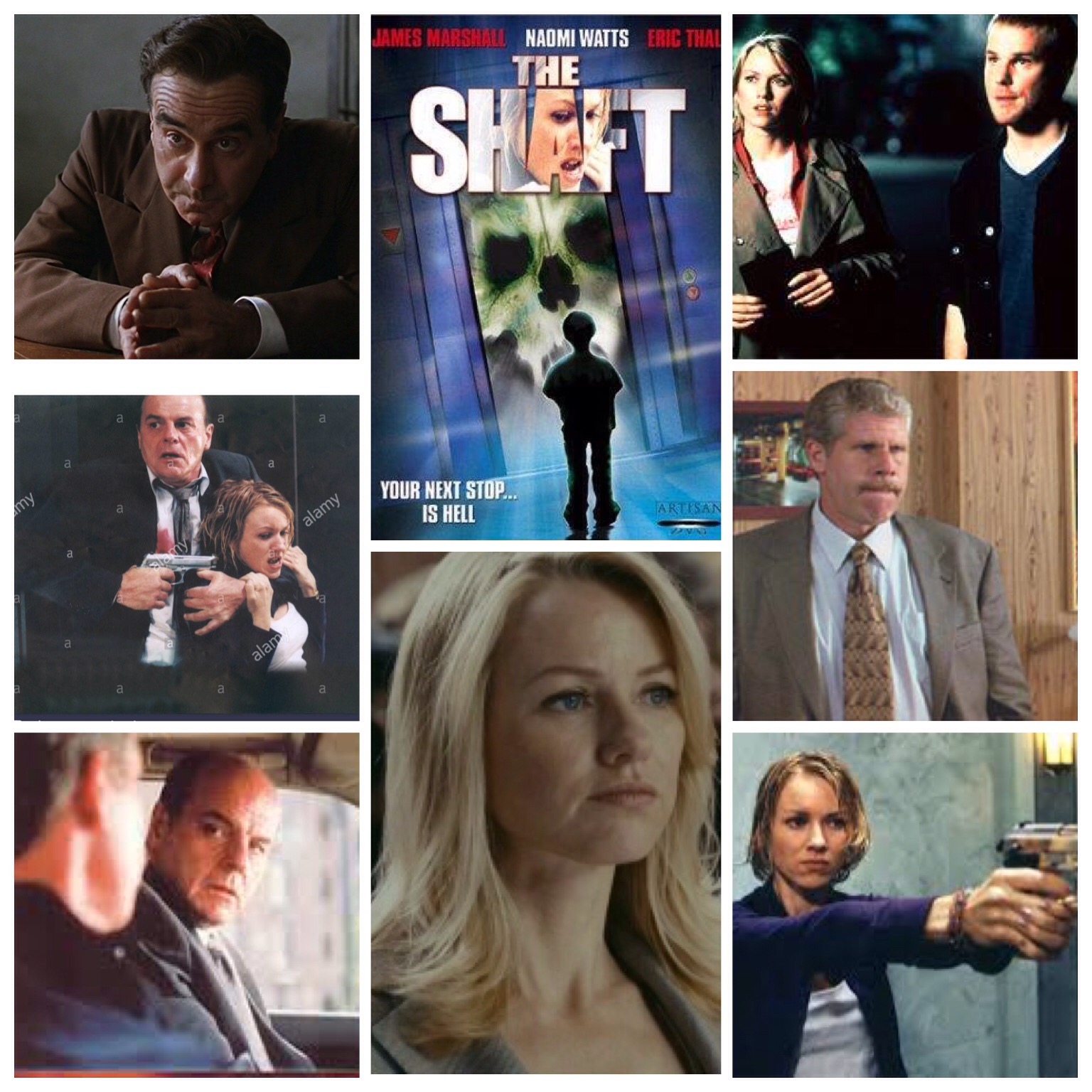
B Movie Glory with Nate: Down, aka The Shaft

  
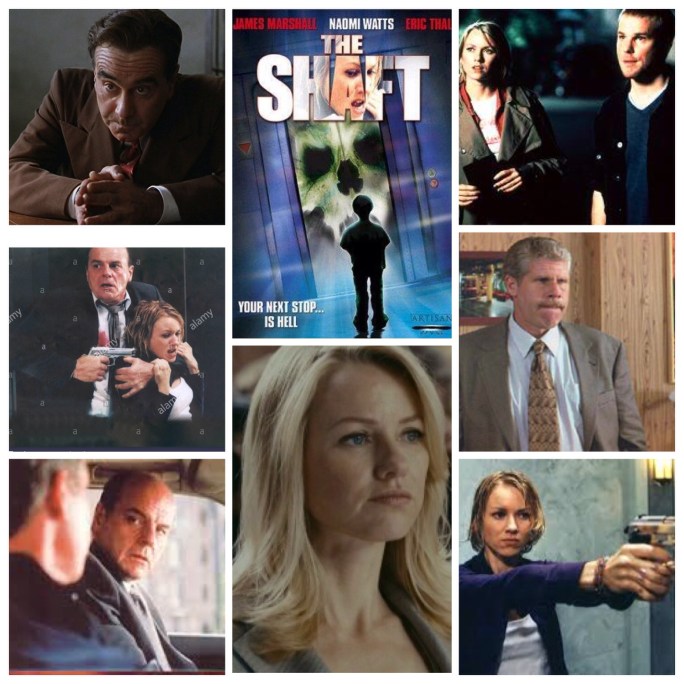
Ever briefly get stuck in an elevator thats messing with you, malfunctioning and seems to almost have a mischievous mind of its own? That’s the premise of Down, also known as The Shaft. It concerns an elevator in a huge residential/office building that has gone homicidally haywire. It traps, drops and tricks people no end, raising and lowering the interior temperature to dangerous effect and generally just being a great big meanie. No one seems so know what’s going on with it though, especially the mechanic who installed it (Twin Peak’s James Marshall). The incidents accumulate, attracting a perky tabloid reporter (Naomi Watts having a ball) who makes up all kinds of tall tales to explain the situation in sensationalistic terms. This infuriates the CEO of the elevator company (now there’s a job title) played by a snarky Ron Perlman who gets a rant towards Marshall that walked in from a way better script (which leads me to believe it was the spawn of Perlman’s legendary improv skills). There’s also a cop played by Dan Hedeya who can’t seem to figure it out wither. The truth is a lot more interesting than you might expect and has nothing to do with ghosts or spirits at all, but centers around a deranged research scientist (Michael Ironside, whacked out to kingdom come). It’s not the least bit scary, but it’s worth a watch simply for the fact that it’s a movie about a fucking elevator that kills people lol. Cujo and Christine ain’t got nothing on this bitch. The scene where a gaggle of pregnant ladies enter the thing is just priceless in its blatantly gross out manner. Fun, fun stuff and great research to embarrass Watts with sometime down the road if you ever find yourself interviewing her on the red carpet hehe.