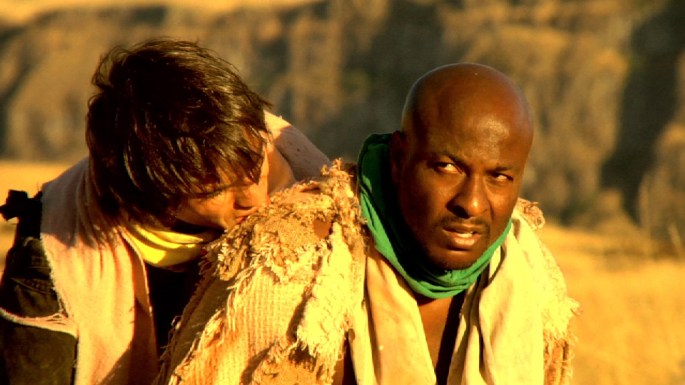
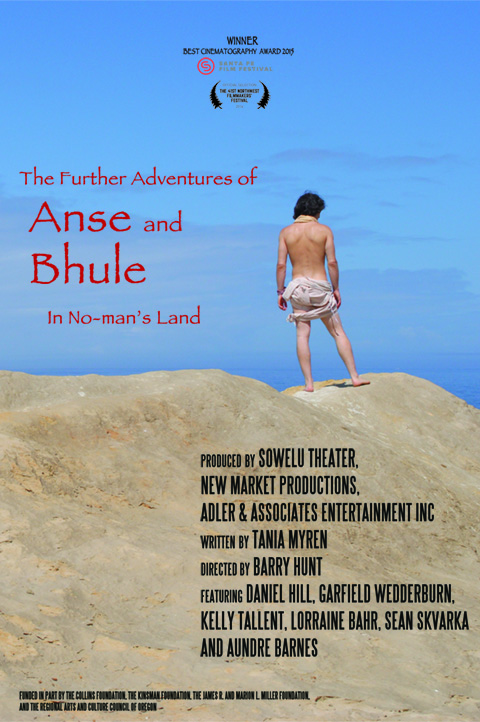
There are too few films in this day and age that leave you with something to ponder in the wake of experiencing them. But, The Further Adventures of Anse and Bhule in No-Man’s Land is, I’m pleased to report – does not fall into that category.
As I remarked to its gentleman director – Barry Hunt – I found myself thinking to the influences which drove his artistic choices and compositions. I found traces of Herzog, Annaud, Jodorowsky – even Samuel Beckett.
For you see, this ain’t your typical day in the wake of the devastation of the world as we know it. Mr. Hunt has crafted here a sublime and visual feast that is as deep as it is vast. I found myself recalling films like Quest for Fire, Aguirre and Holy Mountain – even the lost children scenes from Mad Max: Beyond Thunderdome.
One of the founders of the Sowelu Theatre in Portland , Oregon, Hunt has taken this intriguing, theatrical source material and constructed a film which is at once engaging and thought-provoking. And you can’t tell me there are too many films about which offer these sensations anymore. From the opening scene, to the world after the fall, Anse and Bhule also brought back to me the emotions evoked by McCarthy’s The Road. Both are absorbing journeys in which the characters we follow must shed, if you will, their emotional and even physical ties to all they have known. Then and only then can they truly become creatures of the new age, thrust upon them.
I urge you to seek this film out, and prepare yourself for a profound cinematic experience. The burgeoning cinema of Barry Hunt I eagerly anticipate. He has a new film in the spawning, and I have a feeling it will, just as Anse and Bhule did, exceed my expectations while completely stripping them away.
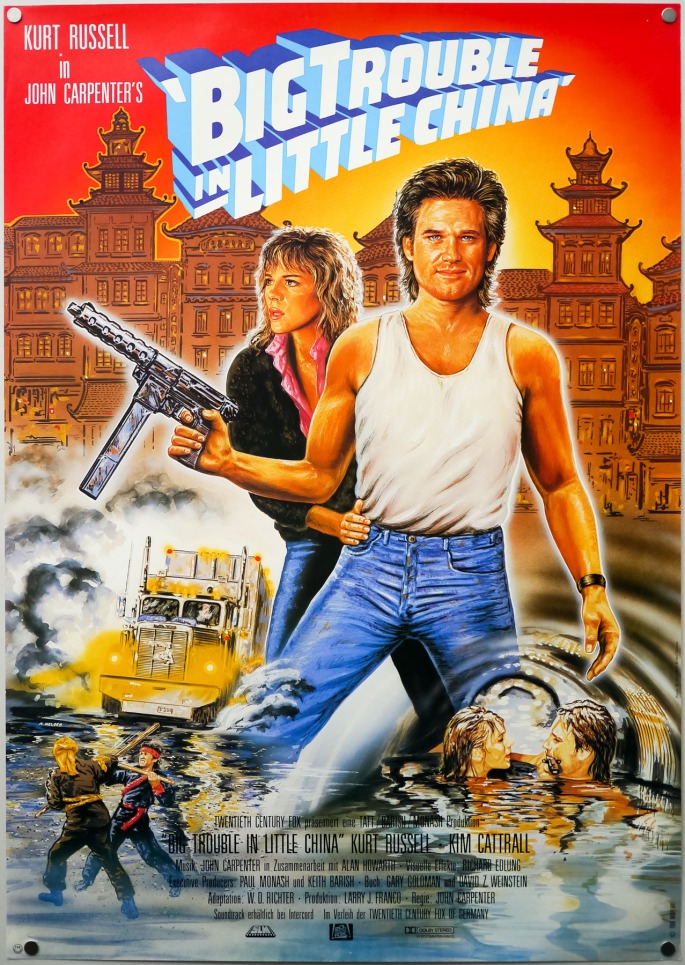
To talk about W.D. (Rick) Richter, is to talk about one of my all-time favorite films, Big Trouble in Little China. It is, to put it simply, one of those films that comes along (not so much anymore) once in a generation. As we know in this age of remakes, reboots and re-imaginations, there is a very good chance that this film, because of its staying power and built-in fan base, will more than likely resurface with Dwayne Johnson playing Jack Burton. Just like Hansel in Zoolander he is, as far as the Studios are concerned, so hot right now!
And you can be your bottom dollar that it will try like hell to recapture the magic of what was – and more than likely – crash ‘n’ burn in its attempt to do so. I might be wrong. Because, BTILC, was and is what is often referred to as a “happy accident”. What began as a seemingly awkward combination of a western with a plot that involved Chinese black magic became, thanks to my guest, a glorious blending of genres that there is really no recipe for.
I rarely get nervous doing interviews, but I was glad to be sitting down for this one. When the person on the other end of the line had a hand in creating a couple of the seminal film of one’s existence . . . it is tough to play it cool, plus for the first time in a long time, I found the need to have my questions written, rather than merely see what the conversation would provoke. Primarily because I knew I was only going to have a limited time, and secondly because during our email exchanges prior to the chat, I found Rick to be extremely matter-of-fact and, wishing not to have the interview published in audio form, he merely wanted to be concise and not ramble on as, he says, has happened in the past.
So I sat and pondered questions. Having read other interviews with him in the past, before he’d stepped away from the business, the focus was on the films he had released at the time and didn’t really get below the surface. Off the record, we spoke about a few of the things that were beneath the polished exterior of the press kits, but that was not all that interested me. There have been many books and articles on his films, as well as many having excellent special features and commentary tracks which mine their depths – so I wasn’t going to waste time there.
In the end I waited till the last minute and scribbled down the first questions that popped into my head. Some of course are elementary, but one or two I’ve had on my mind for a while.
Well, it took a long time, but sometimes, good things do. It was well worth the wait and the frustrating silences in between messages from Rick’s friend who very graciously made the introductions, and I, as a fan first, was humbled, honored and thrilled at the prospect of speaking to yet another film-making idol of mine.
While Rick, early in our email exchanges said, “I prefer to let he films, for better or worse, speak for themselves.” I am and will be forever grateful he took the time to talk a little about his work. In the end I wasn’t nervous or scared at all . . . I felt kind of invincible.
KH: Did you always want to work in movies and if so what were the films which influenced you?
WDR: First I wanted a paper route. Then I wanted to run a circus. Then I thought about pursuing a career as an English teacher. Then I thought, “Why not aspire to become an actual tenured English professor?” But, by the time I got to college, graduate film programs were springing up here and there. Having loved movies since childhood, but never imagining there was a route available into the business, I suddenly saw a way to pursue a career in film in a structured, sensible way.
I went to a lot of movies of all kinds as a kid, but mostly B horror films from the mid-fifties through the mid-sixties. In 1964, I saw DR. STRANGELOVE and in 1965 THE LOVED ONE. They suggested a new direction and deeply influenced me.
KH: How did you break in to the business?
WDR: I wrote screenplays at USC, and one of them secured me an agent. I then worked as a reader for Warners and wrote on the side and continued to do so when Warners and Irvin Kershner let me work as his assistant while he was prepping DIRTY HARRY for Sinatra. That project fell apart, but a spec script I’d written, SLITHER, got to the director Howard Zeiff, and he set it up, odd as it was, and we shot it. Presto! I was a produced screenwriter.
KH: Your early career was full of greats like Dracula,Body Snatchers and your Oscar nod for Brubaker. How much does momentum play a factor in one’s career (films coming out and performing well) as well as recognition for one’s talent?
WDR: Actually, none of those films did perform well, but they were respected, and, as a result, I was respected as a young writer with perceived potential. You must remember that during the seventies and eighties eccentric characters in unusual, small stories were nothing Hollywood ran screaming from. That came later.
KH: You are a part of two of my favourite films of all time withBanzai and BTILC. How do you feel as an artist to be remembered for singular works rather than your entire body of creativity?
WDR: I’ve never given much thought to being “remembered”. After all, sooner or later, this whole planet is going to be forgotten.
KH: If people want the skinny on Banzai, you have already provided an excellent commentary. What I would ask is, did you ever see Kevin Smith’sQ & A whose guests were Wellerand Lithgow, and how did you feel about possible versions of the continuing story of Banzai?
WDR: I thought Kevin did a spectacular job that evening, and it was nice to learn how much the movie shaped him. As long as Mac Rauch is involved, I feel quite confident that a “new” BUCKAROO could be as startling as the original.
KH: BTILC was ahead of its time, in my opinion. What I’ve always wanted to know is, what the “western version” was like prior to your work on the script, and how much of the finished film remains your work?
WDR: The “western version” just didn’t work for anybody, sad to say. It all seemed too distant…the Old West and the Asian occult, etc. So I proposed moving it to a modern, familiar setting and swapping the hero’s horse for a big rig. The pitch went over well, and, with a writers’ strike looming, I dug into the challenge of creating a contemporary script in about seven weeks, choosing to do that with a somewhat dim but hopefully lovable hero at the center. The finished film stayed absolutely true to my screenplay, apart from the inevitable ad libs here and there. Jack Burton’s John-Wayne cadences, though, are definitely nothing I wrote or endorsed. John and Kurt settled on that themselves.
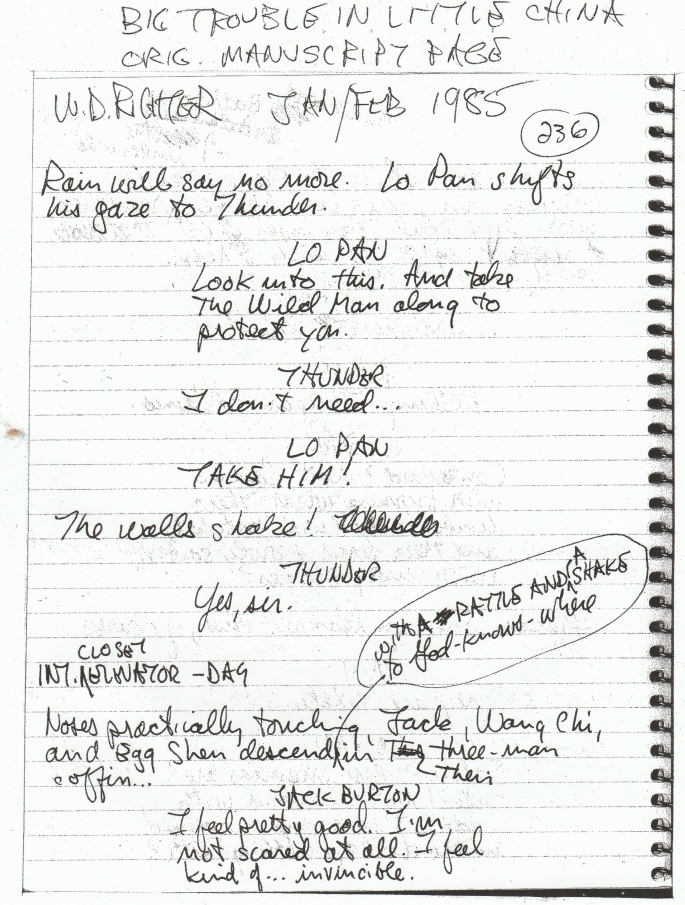
You asked me prior to this conversation: “Did you write the line or was it improvised: I feel pretty good. I’m not, uh, I’m not scared at all. I just feel kind of… feel kind of invincible?”
Turns out I did write it. I wrote the whole script furiously in longhand in several spiral notebooks, and a typist transcribed them into script format.
KH: There was a significant gap between Home for the Holidays and Stealth. I have interviewed many writers who talk of these periods. They say, it’s not that I wasn’t writing, it’s just my scripts weren’t getting made. Was that true of your career at the time?
WDR: Definitely. I had movies actually green-lighted then cancelled when directors went over budget in pre-production.
KH: I understand Stealth was a troubled production.
WDR: STEALTH was just a bizarre and massively unpleasant experience. Directors and location scouts shouldn’t rewrite writers, if you want my opinion. Kind of like Presidents shouldn’t tweet.
KH: Did your involvement end after the writing?
WDR: The “writing” never really stopped. I was removed from the picture several times when my revisions failed to please the director. But I was repeatedly brought back by the studio to pull the script back from the brink after the director (who shall remain nameless) had worked it over again in his spare time. It’s the only film I’ve had made that, with great care, I kept my distance from during production and through release.
KH: I also love Needful Things. What was it like to adapt King?
WDR: Crazy. The book is 690-pages of single-spaced prose. My script was 124 pages, and you know how much “air” there is on a script page. I figured that if one were to retype the novel in a crude screenplay format, it might easily hit 1000 pages. So I lost roughly 876 pages while trying to keep King’s story and mood intact. I have no sense of how that worked out because I’ve never reread the book, but I always imagined a looser, grittier, less-arch movie.
KH: Any advice you would give to a struggling screenwriter – not unlike myself?
WDR: Write. Write. Write. But always try to imagine the movie itself playing to paying strangers. Why would they — or you! — want to watch it?
KH: Sir it has been a profound honor to converse with you. I cherish the moment and humbly thank you.
Gale Anne Hurd, the producer of Aliens and The Terminator, headed the charge back in the early 90s toward the adaptation of a book written by Richard Herley titled, The Penal Colony.
Set in 1997, it tells the story of how the British Government runs island prison colonies as a means to stem the tide of an overflow in mainland jails. There are no guards, no cells, and the island is monitored via satellite surveillance.
We follow the a character named Anthony Routledge, who is brought to the island for a sex-crime that he did not commit. He soon discovers that under the guidance of a charismatic leader, a community on the island has evolved.
No Escape (1994)
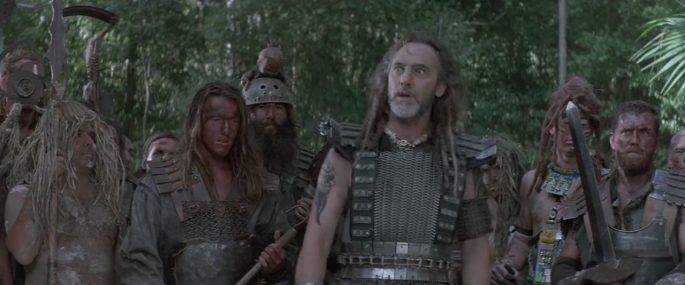
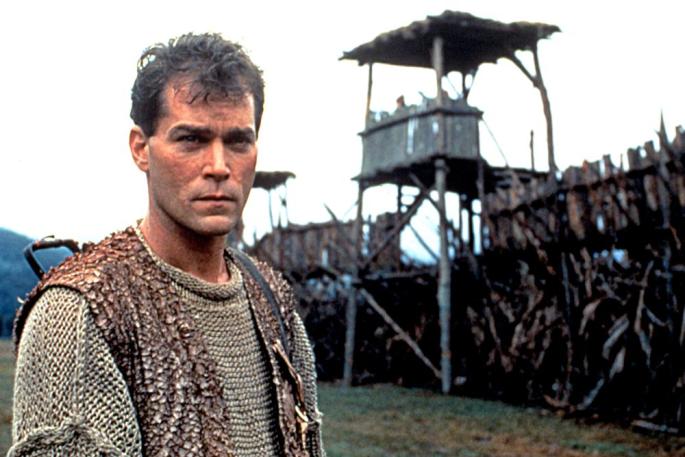
Now if that’s not the ideal film to make here in Australia, (if your are aware that it is pretty much how our nation began) then I don’t know what is. The production would hire future Bond director Martin Campbell, along with stars Ray Liotta, Lance Henriksen, Stuart Wilson and Ernie Hudson.
Then a screenwriter named Michael Gaylin, a man who had slaved away in obscurity in Hollywood for more than a decade, would come into contact with a colleague of Hurd’s. He went for a meeting and, finally, after a career of false starts and forgotten promises, he was going to be writing on a film that would eventually, make it to the big screen.
After a long wait, I finally had the opportunity to sit down and talk to Michael about his career and his experiences during the making of No Escape or Escape from Absolom (as it was released over here). What I discovered, during our conversation, was not merely an insight into a film I heartily enjoy, but also the story of a resilient writer who finally had one script break through. A real life story very much akin to the journey of the hero of the film; who would take on all conflicts and eventually overcome them . . . and escape.
It is a great film in the grand tradition of Franklin J. Schaffner’s Papillon.
Andrew David Barker was born in Derby, England in 1975. He grew up with a love of films and writing. I suppose this is a common thread among those of us who seek to express ourselves through these mediums. Hoping against hope that it will be either one or the other that strikes first – one or the other that shall propel us out of obscurity and into the stratosphere in which we are allowed to create for a living.
It was horror films (the Video Nasties), but also the bombastic, high concept and blockbuster works of the 80’s that further fueled the young Barker to carry on his quest. Spielberg, Lucas and Scorsese, but also Romero and Raimi fed him with images and blasted on the big screen the seemingly endless possibilities which lay in wait, destined to be unearthed by the daring dreamer.
Like all those that had come before, young Barker cut his teeth making short films and writing books and short stories – at times with friends. Then the time came – the time which calls to the fledgling auteurs and beckons them into the fray – time to put all accumulated knowledge to the test, and make that first film.
Thus A Reckoning was born. But through no fault of his own, young Barker was forced to sit by and see his film languish in obscurity. So, he took up the pen, and began to tell his stories on the printed page. Soon, he produced two fine works (see pictured above) and interest from the film industry power brokers soon came knocking.
Andrew is an eclectic storyteller whose visions are at once personal and profound. To talk to him about his journey, his influences and aspirations was a thrill. He is definitely a talent to watch, and, I for one, will be watching with great anticipation as to where his journey will take him next.
Steve is a top bloke, he’s an Aussie, he’s a top Aussie bloke. He hails from Western Australia but after spending some years on the road and gathering valuable life experience, he found his way over to Sydney where he took up his apprenticeship studying performing arts – an apprenticeship, Steve will tell you, is still going on.
Early in an acting career, beggars can’t be choosers, so Steve took a stab at just about anything that came his way. One of his launching pads was a, determined after the fact, rather sacrilegious commercial in which The Last Supper had, or was depicted as having, a rather different outcome from that set down in the biblical text.
It, though removed from television, got him some notice and a part in the Australian cult hit Two Hands in which Steve starred and began a friendship with fellow Perth-born actor, the late Heath Ledger. It was radically different from the films being made locally at the time and also launched the career of Rose Byrne (Troy, X-Men: First Class).
He was disgruntled and ready to throw in the towel on his career when, unexpectedly, a big Hollywood movie came knocking at his door. The film was Vertical Limit, directed by Bond and Zorro director Martin Campbell and starring Scott Glenn and the late Bill Paxton among others. Steve was one half of a two man comedic relief package in the film alongside Ben Mendelsohn who would go on to international fame and appear in Rogue One: A Star Wars Story and next year you’ll see him in Ernest Cline’s big screen version of Ready Player One, directed by Steven Spielberg.
From those high snowy mountains in New Zealand (where Vertical Limit was filmed), Steve has since enjoyed a long a fruitful career in film, television and his first stomping ground, the theatre. He remains a humble, salt-of -the-earth sort of fella who calls it like it is and won’t act in something that he himself wouldn’t be interesting in watching.
In an era when most of our country’s talent is swept across the pond with the promise of maximum exposure and ridiculous amounts of money, Steve has stayed, content to be an actor who is allowed the freedom to collaborate fully on the projects he chooses to be a part of.
He is a man of many parts, a teller of great and funny tales from a life and career spent being just what he is: A bloody good actor.
So, put your hands to together, for Steve Le Marquand…
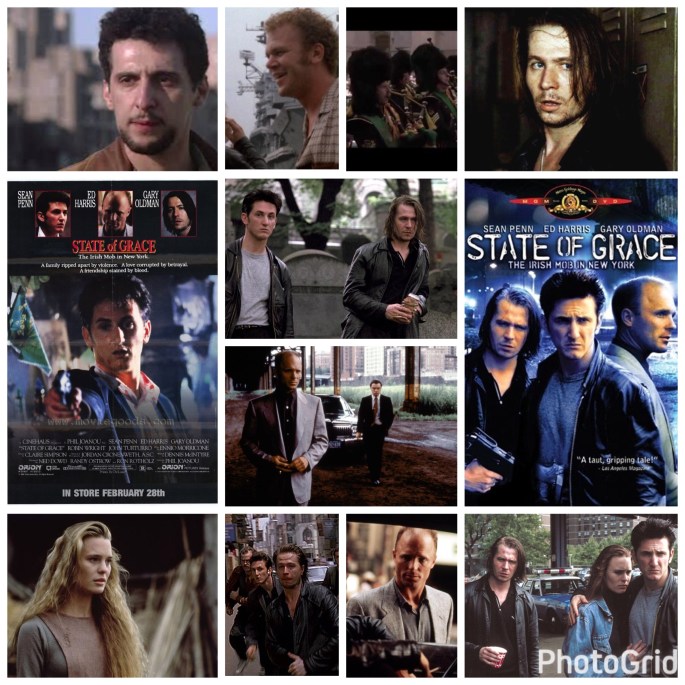
Phil Joanou’s State Of Grace had the unfortunate luck of being released in 1990, the same year that also saw Scorsese’s Goodfellas and the third Godfather film. It’s hard to gain your footing when that kind of momentum is surging about, but this film is as good as the others, and deserves recognition or at least some kind of re-release. Set in the blistering inferno of Hell’s Kitchen, NYC, it’s a violent tale of Irish Mobsters, undercover cops, betrayal and murder, set to a smoky, mournful Ennio Morricone score that lingers in the air like smog. Sean Penn is Terry Noonan, a deep cover operative who returns to his childhood neighbourhood to reconnect with old friends, and dig up buried grudges. Ed Harris is Frankie Flannery, ruthless gangster and former ally, while Gary Oldman plays his hotheaded brother Jackie with a tank full of nitrous and the kind of unpredictable, dynamite fuse
potency one expects to see from a David Lynch character. The three of them are on a collision course set in the grimy streets of New York, bound by old loyalties yet destined to clash and draw new blood. Penn shares the screen with his once wife Robin Wright here, looking lovely as ever. There’s also supporting turns from John Turturro, John C. Reilly, R.D. Call, a geriatric Burgess Meredith and an unbilled cameo from James Russo. Penn, Harris and especially Oldman are like flint sparks, a trio that won’t be stopped and light up the screen for a spellbinding, visceral two hours until their eventual confrontation, hauntingly shot by cinematographer ” in the midst of a bustling St. Patrick’s Day parade. This one has been somewhat lost to the ages, like a number of other stellar crime dramas I can think of from the nineties. The cast, score and Joanou’s thoughtful direction make it an unforgettable piece of work.
The deconstruction of the alpha male has never been so fierce as it is in GLENGARRY GLEN ROSS. The entire film is one pitfall after pitfall of brazen machoism being shed, and the true colors of all the characters are blatantly glowing by the end of the film. They are men who strive to be the best, without having any idea what that really means.
David Mamet is one of America’s most seminal playwrights, and James Foley has always been a filmmaking champion in regards to slow burning character studies. Mix both these auteurs with the greatest cinematic ensemble ever, and what we have is a masterclass of filmmaking in any and every aspect possible.
The blistering dialogue and fiery performances are so powerful that after each dialogue exchange we’re left completely gobsmacked by what we’ve just witnessed. Regardless of how many times you’ve seen the film, how many times you’ve quoted Alec Baldwin’s punchy lines; the film is still as fresh and potent as your first viewing.
The film strikes a very fine balance bewteen tearing down the archetypal 20th century man, yet shadows as a cautionary tale of how hollow and empty all these characters are. Beneath the ego and big talk, these are all men who have put up the ultimate eminence front (it’s a put on). They are all incredibly sad and broken people, who have lived lives of emptiness, regardless of the charade of their salesmen banter.
This film remains the benchmark for an acting ensemble. Jack Lemmon, Al Pacino, Alec Baldwin, Ed Harris, Alan Arkin, Kevin Spacey, and Jonathan Pryce all feed off each other so well, it is an awesome experience to absorb. There have been fantastic ensembles before this film and after this film, but there will never be an equivalent calibre of actors together on screen ever again.
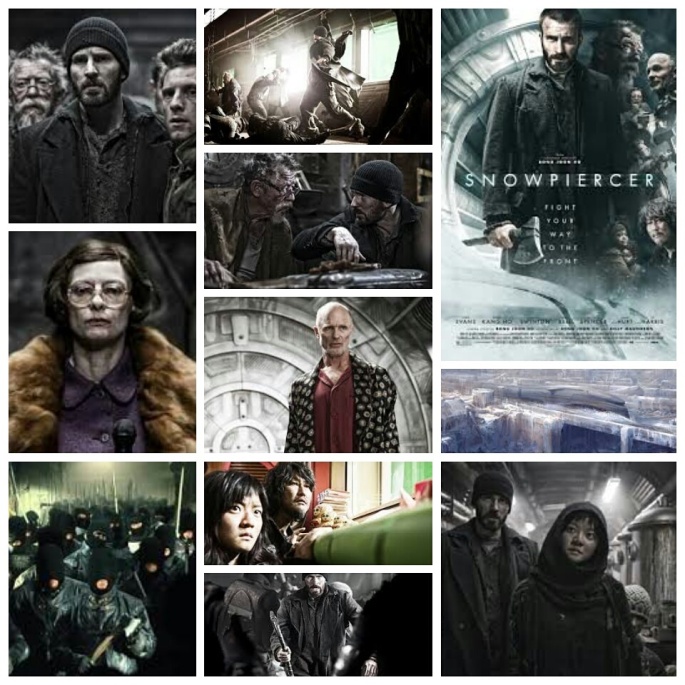
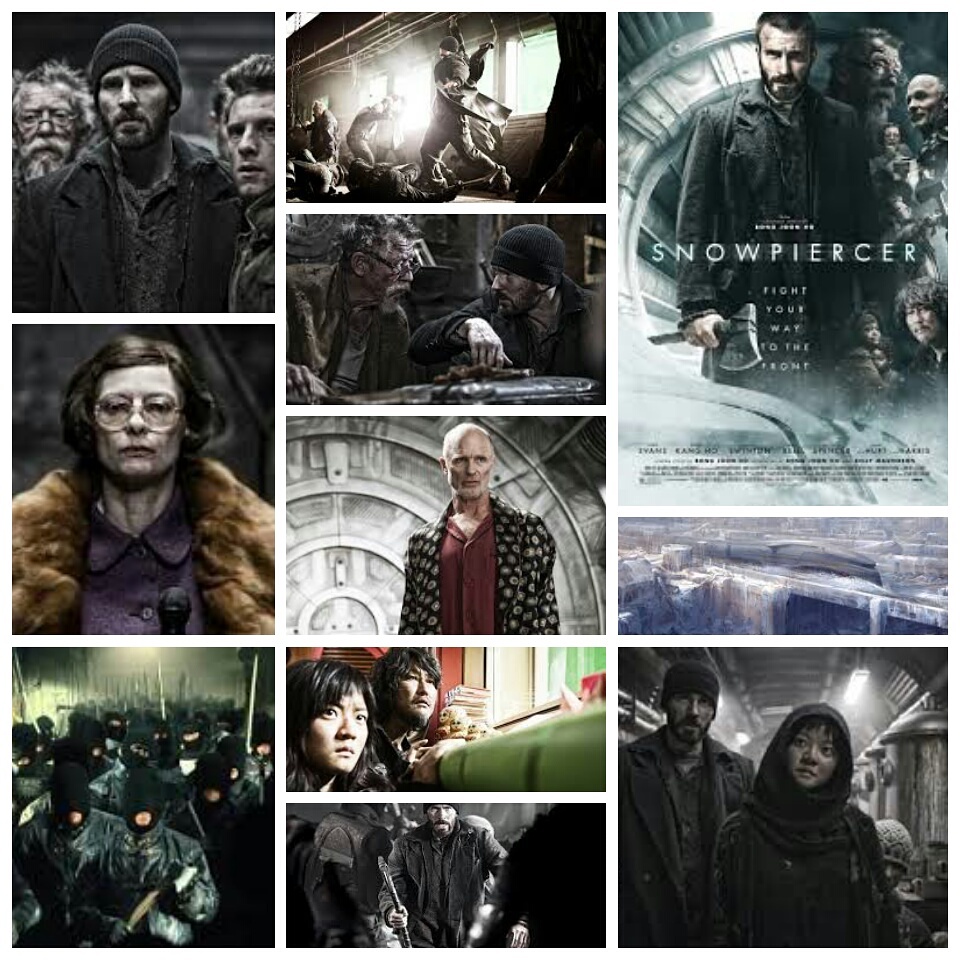
Bong Joon Ho’s Snowpiercer is a cold affair in more ways than one. It treats it’s characters with the same icy indifference as the storm which batters the few remaining people on the planet, confined to a locomotive that speeds around the globe in perpetual motion, humanity’s last ditch effort against a cataclysmic ice age of their own making. The train is designed to house the poor and disenfranchised folks in filthy barracks at the back end of the train, while the rich and privileged elite live in glamerous excess at the front. What better metaphor for brutal classism? A confined vehicle from which their is no escape, dwindling resources and rising tensions eerily serve to remind us of our own situation on this rock. Chris Evans grimes up his Captain America image as the ruthless leader of the poor, rebelling traincar by traincar and waging an ongoing war against the upper class and their minions, his sights set on reaching the engine. Unfortunately they’re up against some nasty security forces dispatched to end their rebellion at any cost, including axe wielding henchman, a J.T. Walsh lookalike who is tougher to kill than a terminator and an absolutely nutballs Tilda Swinton, unrecognizable under a dairy queen cake of makeup and a muddled northern England accent, dryly playing the tyrannical head of propaganda. Aside from the obvious social satire that hits home, the film is also a rollicking action slam dunk with some jaw dropping, delightfully implausible set pieces and truly inspired visual design. Each train car has a different theme and purpouse, from a self sufficient aquarium (anybody want some sushi?) to a terrifyingly cheerful classroom where kiddies are brainwashed by a crackhead of a school teacher (Alison Pill in overdrive), and eventually the engine itself, a technological marvel presided over by a lonely, twisted and miscast Ed Harris as the architect of the whole deal, a role better suited for a Patrick Stewart or a Malcolm McDowell type. John Hurt plays the other half of the brains, stuck in squalor at the caboose, and there’s work from Ewan Bremmer, Octavia Spencer, Jamie Bell, Ah Sung Ko and Kang Ho Song as a resourceful explosives expert with his own agenda. The themes of this film will be difficult for some to swallow, which is what I imagine led to it’s piss poor marketing, at least in North America. The topical, callous and icy blunt truths about society, sacrifice and oppression won’t be willingly received by many, least of all the powers that be, who don’t want such notions floating around freely. That’s what makes it important though, and sets it a step above most. It reaches near taboo levels of thought, displaying ugliness and outrage that seems scarily logical the more you think about it. Plus it’s a humdinger of an action adventure flick. Strong stuff, both in visual and narrative departments.
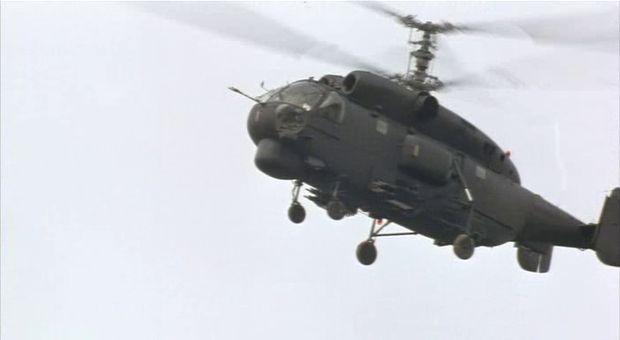
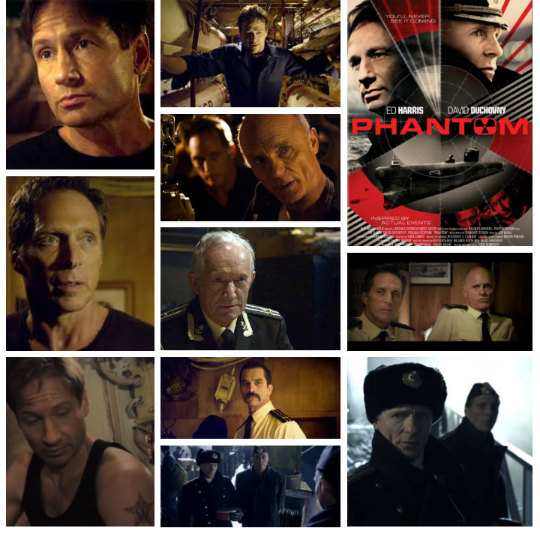
The submarine film seems to have died off a little bit since semi recent entries like Kathryn Bigelow’s K-19 and Tony Scott’s Crimson Tide, which is why it’s nice to see an effort like Phantom come along. Spare, streamlined and straight to the point, it chronicles the fate of a Soviet submarine crew tasked with transporting a deadly nuclear missile during the Cold War, and the dangerous KGB stowaway who will stop at nothing to gain control of the ship and hijack the warhead. Now, this is one of those films set in Russia but with an all American, English speaking cast, so as long as you can get past that without whining, you’ll enjoy it. What a cast it is though!! Ed Harris brings grizzled nobility to the role of the captain, handpicked for this mission by unseen forces who know of his disgraced past and are betting on him to fail. David Duchovny has always had a bit of slimy, subversive danger to his aura, and he’s in full blown wrecking ball mode as the ruthless rogue agent bent on seizing the vessel and no doubt causing all kinds of global problems in the process. William Fichtner is a supporting standout (when is he not?) as Harris’s resilient second in command, and the crew is populated recognizable faces including Jason Beghe, Jonathan Schaech, Dagmara Dominzyck, Kip Pardee and Sean Patrick Flanery. Throw in an intense cameo from Lance Henriksen and you’ve got one hell of a lineup of heavy hitters onscreen. The intrigue is somewhat cloaked, and the mutiny goes both ways, accented by plenty of palm sweating scenes of suspense, a mandatory staple in any submarine film. Lower budget, yes, but centered on story and character as opposed to action, and notable for a surprisingly esoteric end sequence that I did not expect. Recommended.
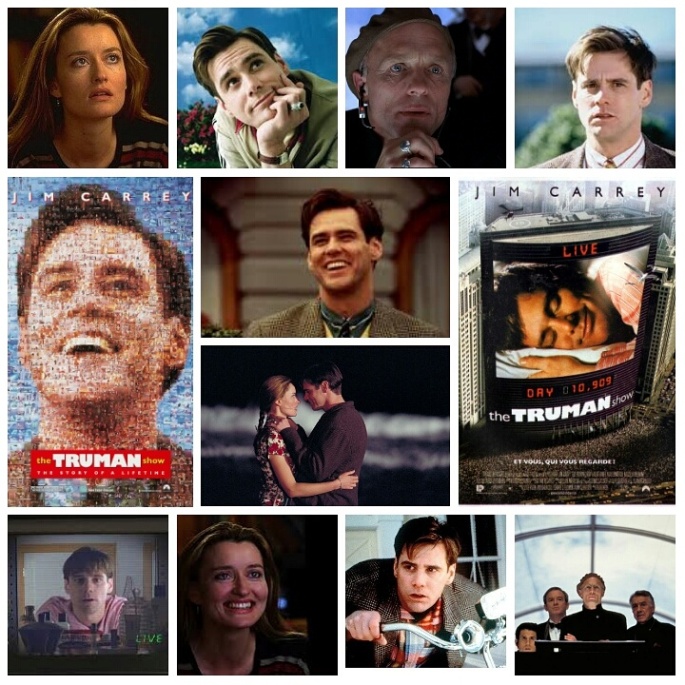
Everyone at some point in their lives has been bothered by the notion that their surroundings are all an elaborate prank, that somehow every single human being but them is in on some giant impossible joke, watching their every move for strange and unthinkable purposes. What if my life isn’t real? What if all my friends and family members aren’t who they say they are, and I’m just part of some ungodly social experiment? What if my life as I’ve known it just isn’t.. real? For Truman Burbank (Jim Carrey) these concerns are very pressing, as he discovers throughout one of the most thoughtful, touching, creative and insightful films ever made. Director Peter Weir works with a script by Andrew Niccol to bring us this now timeless tale of a man existing in a patented pastel world that was never his own and always destined for him. Truman is the unwitting star of his own television show, inducted into its gargantuan studio set since the day of his birth, and conditioned to believe all his life that the people, places and events around him are in fact his real life. Cruel? Perhaps, but the film never takes sides, instead favoring wonder over analytical dissection, a wise move. Even the conductor of this whole absurd symphony, a prolific filmmaker played by Ed Harris, gets his moment of sympathy which can be read as preening ego or the desire to connect with his leading actor beyond the pixelated jumbo-tron he sits behind, depending on how you view the situation. Truman has a lovely wife (Laura Linney), a salt of the earth best friend (Noah Emmerich) and the perfect little white picket fence life. But none of it is real, or at least organic in the sense that every person deserves out of the womb. Truman is a rat in a very elaborate maze, but like anyone who’s had the wool pulled over their eyes, eventually he begins to see lights of authenticity piercing the seams. Gradually he begins to sniff out the ruse, like a child losing their innocence, and questions the eerily idyllic life he has been given. The people, or rather, actors in his life react in different ways. Some panic, others stick to the script, and Harris sorrowfully watches his controversial creation awaken beyond his control. Carrey is a starry eyed revelation as Truman, in one of the most overlooked performances of the century. His arc is the stuff of dreams, spanning the lengths of naivete trapped in a bubble that bursts into affecting, starry eyed realization and wonder. Every moment is owned by him, every beat is resoundingly hit in flawless fashion. When a mysterious and beautiful defector (the luminous Natasha Mcelhone) enters his life to play the part of whistle-blower, it’s the first geniune and non-puppeteered interaction he’s had with a human being. Sparks fly high enough to reach the heavens, and it’s the catalyst for a journey to find the self, the reason for his predicament, a world beyond the Lego brick suburbia he has known and the next step in his impossibly unique life. There’s a piece of Truman embedded in every viewer beholding, and I believe that’s why the film has held up for so long, and been beloved by so many. Every human being has insecurities as large as the fake sound stage that raised him from a pup. Every one of us has at one point felt the alienation he must have gone through upon realizing the truth. In a story so larger than life, we find the answers, or at least a modicum of such, to what it means being a person in this world. Carrey’s Truman is an achingly relatable avatar of this and a direct conduit into the essential. Couldn’t have picked a better actor to bring all of this to life. Couldn’t have made a better film about it. A classic. Good morning, and in case I don’t see you: good afternoon, good evening and goodnight.
















 Podcasting Them Softly