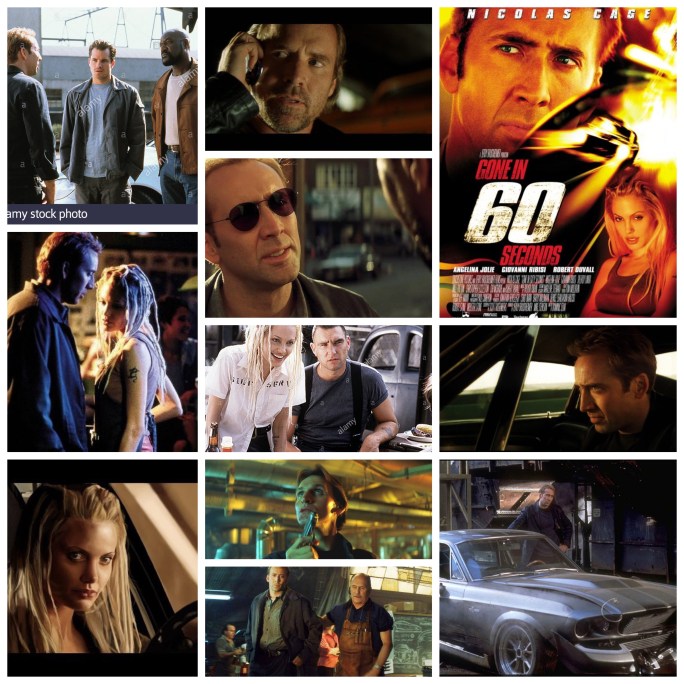
Dominic Sena’s Gone In 60 Seconds

I’ve always liked Gone In 60 Seconds, even if it is one of the more lukewarm notches in Jerry Bruckheimer’s belt. Helmed by Dominic Sena who comes from a music video background, you get what you’d expect from a craftsman like that in the way of a flashy, eye catching popcorn flick that sees an easygoing Nicolas Cage as Memphis Rhaines, a car thief guru culled out of retirement when his dipshit little brother (Giovanni Ribisi) gets in deep with a dangerous UK mobster (Doctor Who). It’s the perfect setup for one long night of auto boosting as the villain gives them a laundry list of sweet cars to steal and ship out of the port by sunup or they end up as fuel for his scary flame factory/junkyard thing that these guys always seem to own and live in. The real fun is in seeing Cage put together an eclectic team of fellow thieves to work their magic, including Will Patton’s slick veteran booster, Scott Caan playing yet another insufferable horn-dog, Robert Duvall as a sagely old fence, Vinnie Jones as the strong silent muscle and Angelina Jolie as the motor mouthed tomboy who inevitably ends up in the saddle with Cage. They’re all hunted by two detectives, one an intuitive veteran (Delroy Lindo) and the other a misguided rookie (Timothy Olyphant) who always are naturally one step behind them, and so the formula goes. The cars are indeed pretty cool, especially Eleanor, Rhaines’s fabled unicorn automobile that happens to be a gorgeous matte silver Shelby GT with a seriously sexy purr. The supporting cast is solid and includes William Lee Scott, James Duval, Chi McBride, Michael Pena, John Carroll Lynch, Master P ad Twin Peak’s Grace Zabriskie as Cages’s feisty mom. This isn’t a knock your socks off flick or anything revolutionary in the genre, but it cruises along with an easy swing, carefree urban vibe and the actors, as well as Sena’s sharp and snazzy visual editing make it fun enough. Oh and it doesn’t get much cooler than those wicked opening credits set to Moby’s Flower, that’s how you lay down a mood for the film to follow.

-Nate Hill

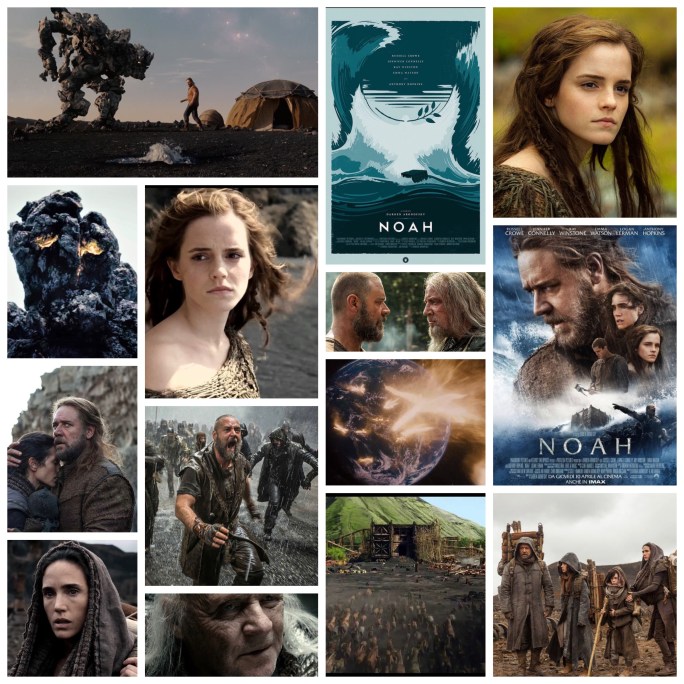
Darren Aronofsky’s Noah

Darren Aronofsky’s Noah is an odd one, a film that I enjoyed for the fact that it somewhat cuts ties to the biblical tale it bases itself on and does it’s own thing. The style and tone are so out of place and out of time that one could almost imagine this being set sometime far, far in the future instead of the distant past. Aronofsky introduced a very earthy, tactile and nature based aesthetic with his film The Fountain (which is my favourite film ever made), and he explores it further here, with time-lapse photography of plants growing, barren landscapes that suggest either a very young planet earth or a very old one and simple, elemental costumes that could be of both ancient ilk or post apocalyptic fashion. The story is quite literally as old as time, and given new life by a fantastic cast of actors starting with Russell Crowe as Noah, a man jaded by humanity and conflicted by forces beyond his own understanding. Jennifer Connelly, Douglas Booth, Logan Lerman and others play his family, one of whom knocks up Emma Watson, causing quite the controversy when the almighty creator commands Noah to build that ark before the monsoons come. Anthony Hopkins is the prophet Methuselah, and Ray Winstone’s Tubal Cain a rough hewn archetype of all of our worst qualities as a race. Coolest of all might are Frank Langhella, Mark Margolis, Frank Oz and Nick Nolte as some ancient looking stone golems who are actually angels sent down by the creator to shepherd humans when needed. It’s funny because Nolte is so grizzled and rugged in his old age these days he probably could have just played the role in person instead of voiceover, but as it stands the special effects used to bring them to life are spectacular, a standard that holds throughout the film from landscapes, props, wildlife and general visual mood. Now, I can never get behind Christian films or take them seriously, so it’s a good thing that Aronofsky remains at arm’s length from the religious stuff and takes a more mythological approach to the story in the sense that this could be happening in any world or universe, and isn’t tied down to one theology. Not a perfect film, but the arresting visuals, fantastic cast and overarching message of love and reverence for life in all forms make it something special.

-Nate Hill

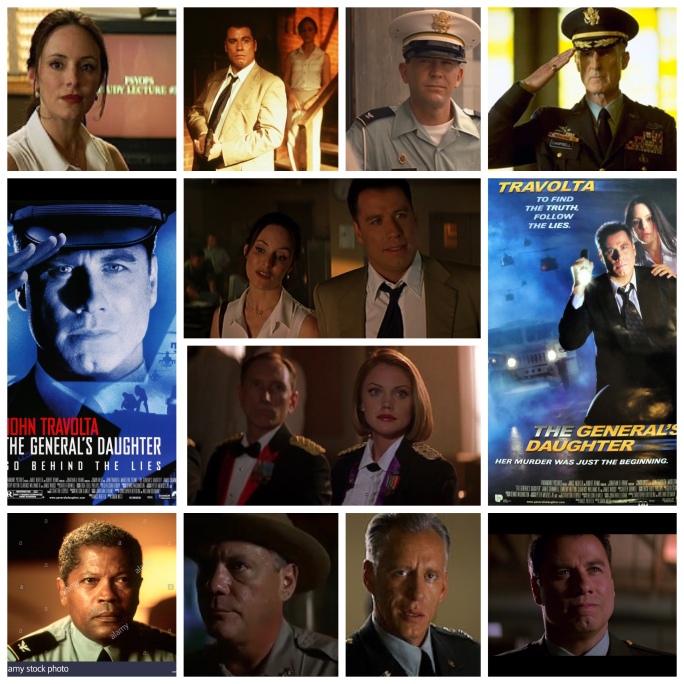
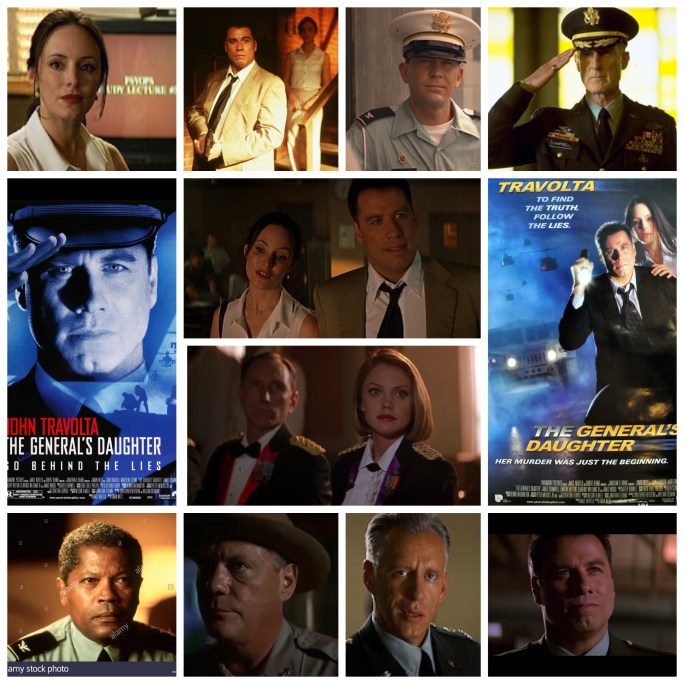
Simon West’s The General’s Daughter

The General’s Daughter is one of those films that’s well acted and staged enough from a technical standpoint that the excessive, overcooked script, self righteous snark and needlessly perverse plot could almost be forgiven. Almost. This is a lurid, sweaty southern gothic military murder mystery, and as amazing as that sounds, it’s actually quite an unpleasant piece to sit through. Based on a book by Nelson DeMille (crown prince of airport novel thrillers), and directed by Simon West (Con Air), it’s given the subtlety of a sledgehammer and the nuance of a rogue missile. At least the acting is decent, starting with jumped up John Travolta as a private investigator called to a military base after the daughter of a powerful General (James Cromwell) is found dead on the property in… a compromising way. The suspects are lined up neatly like ducklings and include the General’s faithful aide (Clarence Williams III), an arrogant high ranking officer (James Woods, practically assaulting the dialogue), another officer on base (Timothy Hutton) who went to Westpoint with her and naturally the General himself. Travolta is joined by another investigator (Madeleine Stowe) who he has a romantic history with, because of course he does. They’re threatened by unseen assailants here and there, and stalled by a local redneck Sheriff (the late Daniel Von Bargen) who has it in for him. The investigation gets so weird, convoluted and messed up that it’s a wonder the writers could even keep track of their own work when scotch taping the third act together. When the inevitable flashbacks show up to tell us just what happened to her, we wish we didn’t know. The poor girl, played by Leslie Stefanson, is humiliated, brutalized and murdered in a way that’s miles beyond bad taste, totally unnecessary to show in graphic detail other than for the film to reiterate what a miserable display of ‘too much’ it is in every category. The scene doesn’t even stand to serve her character arc either, as we’re informed she has a history in S&M type shit. The depravity is there simply to exist on its own and turns a relatively run of the mill thriller into something deranged. It’s a spectacle, you won’t be bored, it’s well mounted and acted by a solid cast, but is it a good film? Nowhere close.

-Nate Hill

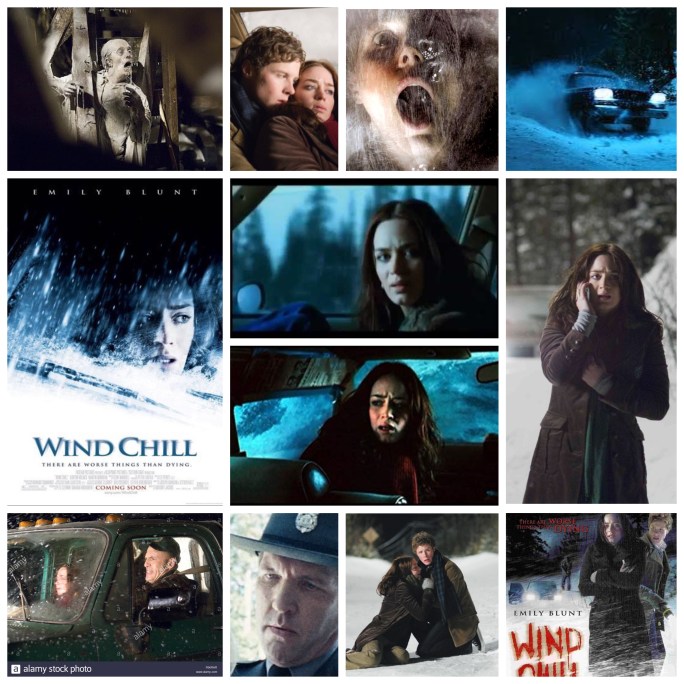
B Movie Glory: Wind Chill

Emily Blunt is at well earned mega star status these days and gets handpicked for all the prolific projects, but early on in her career she could be found in cheapies like Wind Chill, a spooky little snowbound ghost story that teeters right on the average line. She plays an awkward college girl who catches a ride with a fellow student (Ashton Holmes) home for the holidays, and their route happens to pass along a desolate, snowed in section of highway where something eerie is watching, following and messing with them relentlessly. The interaction between the two is odd, strained and tense, accented by two performances that are just somehow uncomfortably pitched, particularly Blunt’s. Things flow a bit more naturally when the car inevitably breaks down and she finds herself alone against the elements and whatever else is out there. It’s like a twilight zone episode a bit, the rules of time start to bend and she has strange encounters with an ominous highway patrolman (Martin Donovan) and a lone snowplow driver (Ned Bellamy), both of whom may or may not even be real. It works here and there and strives to focus on atmosphere, Blunt always has a presence and keeps us occupied as the supernatural occurrences reveal a freaky tale dating back decades. Nothing more than a distracting TV movie level horror flick, but watchable enough. Gotta give Blunt credit for climbing a tall ass telephone pole wearing heels though, even in cheaper films like this she gives it her all. The locations are also fantastic, kicking off at UBC here in Vancouver for the intro and moving to the gorgeous mountains of Manning Park for the snowy bits.

-Nate Hill

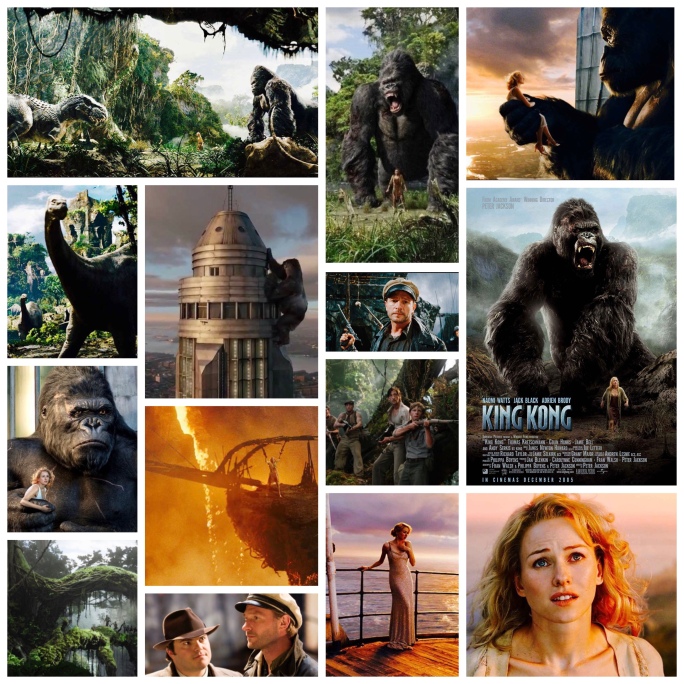
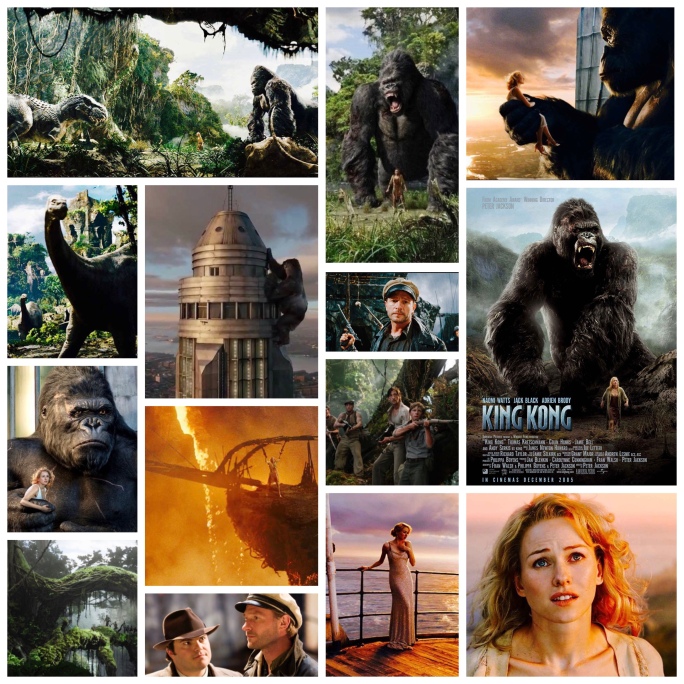
Peter Jackson’s King Kong

Peter Jackson has made a name for himself as one of the most ambitious, resourceful filmmakers out there, and his version of King Kong isn’t so much a film as it is literally a three hour trip to another world. The 1930’s Kong was a marvel of its time, admittedly now very dated, but this film is really something else, and for me is the minted definitive version of the story, brought to howling, lush, terrifying and affecting life by Jackson and his army of F/X wizards. The main beef people take up is its way too long, and I’m not even going to try and argue. Of course it’s too long. Of course. But I love it anyways, and part of what makes it so immersive and captivating is the length. We spend almost two hours in a New York prologue leading to oceanic escapades before the ship even finds the island! You almost get so tied up in smoke n’ soot vaudeville and scenic intrigue that you forget that there’s a giant gorilla on the way, among many, many other things. Jackson reaches for the stars here, sails off the edge of the map past the borders of the known world and awakens something dark, primal and enthralling in the viewer: a genuine sense of wonder, like films were always meant to since the beginning, and these days don’t often achieve. He also films in a way that you really feel scope, size and the tactile, spacial dynamics of his world, from the gorgeously foreboding mega forests of skull island to the vast expanse of an open ocean to the titanic skyscrapers of old world NYC. Naomi Watts makes a perfect Ann Darrow, her striking femininity harbouring a deeply intuitive courage that ultimately spells her survival and acts as a magnet to Kong, who is a wonder in himself and played right out of the park by Andy Serkis. Jack Black and Adrien Brody embody the hustling filmmaker Carl Denham and the wiry playwright turned adventurer Jack Driscoll neatly. Jackson takes time in getting to know the supporting characters as well, and in a film with this much breathing room, who wouldn’t? Thomas Kretschmann steals every scene as the intense, heroic Captain Englehorn, Evan Parke is implosive as the first mate and Jamie Bell does terror to a turn as a crew member. Skull island itself is the real star of the show here; along with the living, breathing and feeling vision of Kong, the primordial rock is home to all manner of threatening, awe inspiring ecological splendour including vicious T-Rex’s, graceful herbivores, cunning raptors and more. Two sequences in particular test the boundaries of comfort in the viewer and push into almost outright horror as the crew falls victim to an insect pit home to the kinds of spiders, worms and other creepers you wouldn’t want to find in your worst nightmares, as well as the scariest bunch of indigenous tribes-people I’ve ever seen in a film. Nothing quite compares to the otherworldly atmosphere Jackson infuses in the island, we really feel like we’re in a place that time forgot and the attention to detail is remarkable. In a film full of human characters, Kong wins us over as the most emotionally relatable, a rampaging beast whose softer side is brought out by Ann, until the harsh realities of the human world catch up with them in a flat out spectacular aerial smack down set atop the Empire State Building where we see how savage behaviour begets the same back tenfold when you mess with a creature of his size, it’s a heartbreaking sequence. This is a testament to what can be done in film, from effects to world building to period authentic detail to music (the score by James Newton Howard is brilliant) and more, all combined in a piece of adventure cinema for the ages, and one that reminds us why movies are so fun in the first place.

-Nate Hill

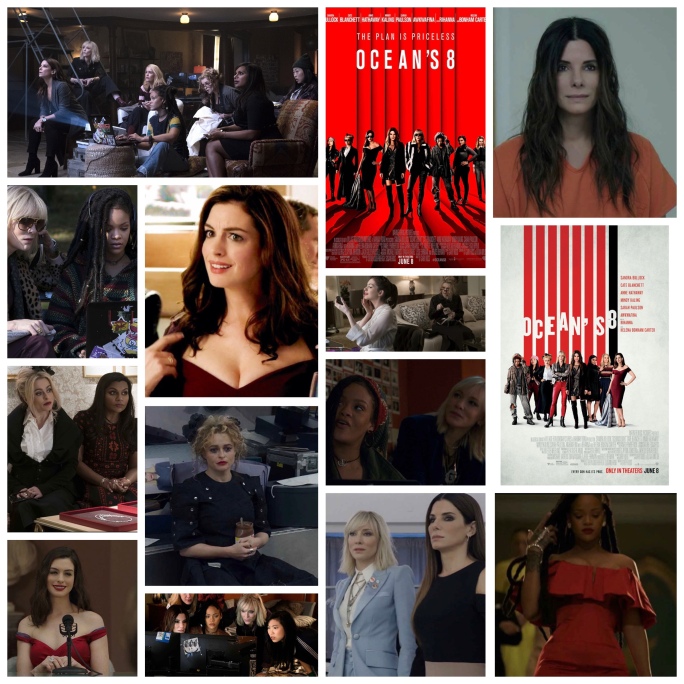
Ocean’s Eight

I had a lot of fun with Ocean’s 8. I mean it’s no Ocean’s 11 but that’s a hard plateau to breach. If anything though, the heist this time around is a little more fun, a bit more showy and humorous too, and every one of the girls headlining the all star blow out of a cast has a ball and does great. Some viewers bitch that it uses the same peppy split screen techniques and apes the laid back score and charm of Soderbergh, but hello people, this is in the same franchise and it stands to reason that it would feel like the others. Sandra Bullock plays Debbie Ocean, brother to George Clooney’s now deceased Danny, which is a shame because I would have loved to see a partner up flick. She’s no less the troublemaker, and the film follows the same beats of her being paroled and immediately planning an elaborate heist with many moving parts, all carried out by a crew of carefully picked, charismatic scoundrels, starting with Cate Blanchett’s Lou, a streetwise small time crook with sass and style. Instead of three giant Vegas casinos, the plan this time is to lift a priceless diamond necklace (actually it clocks in somewhere around the 150 million range) from the hilariously faux prestigious Met Gala. The piece will be worn on the neck of persnickety, ditzy mega star Daphne Kluger (Anne Hathaway), which requires a pickpocket (Awkwafina), a hacker (Rihanna), a fence (Sarah Paulsen), a fashionista (Helena Bonham Carter), a forger (Mindy Kaling), a few well placed cameos and plenty of hair-brained schemes within schemes along the way. Director Gary Ross keeps the mood light, fast paced but never too silly, letting each actress have their priceless moments. Hathaway was my favourite as the clueless diva who is exasperated by anyone in her orbit, and Bonham Carter nails an adorable Irish accent and scene steals the whole way through. I’ve heard complaints about originality and that it’s just a retread with chicks, and the may be so but it’s such a winning, fun formula! Who wouldn’t want more? They could do one with a bunch of dogs taking on a heist next and if the charm was there I’d be on-board because as it is, this is the perfect recipe for intelligent escapism and I enjoyed this one a lot.

-Nate Hill

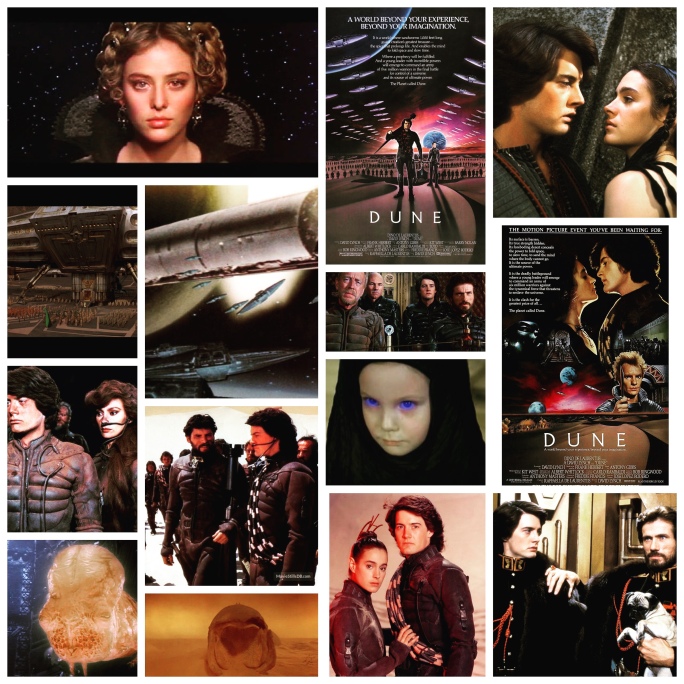
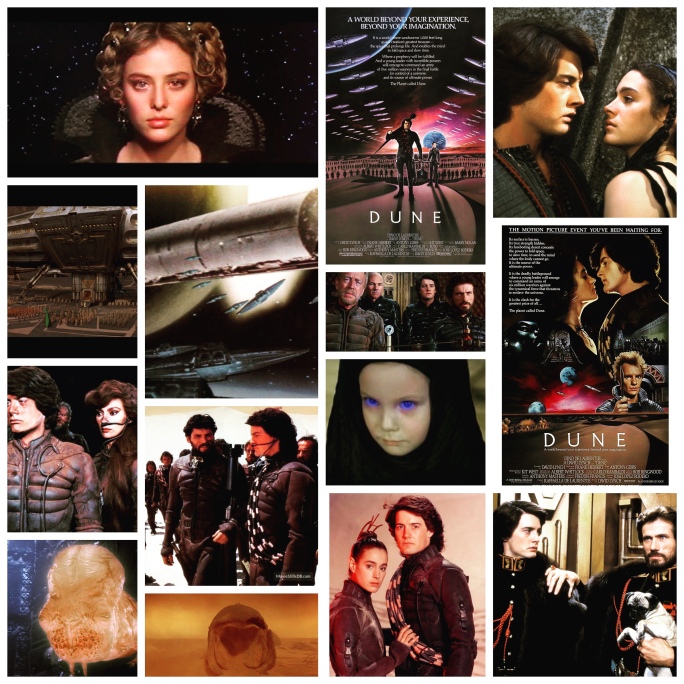
David Lynch’s Dune

David Lynch’s Dune is a great film despite what critics, moviegoers, the general consensus and Lynch himself would have you believe. It’s obvious that heavy editing turned it into something of a pacing quagmire, scenes are truncated, oddly conceived voiceovers are added, and yadda yadda. Doesn’t matter. This is still an exquisitely crafted, beautifully atmospheric space opera that takes full advantage of production design, casting, special effects and music, I loved every damn minute of it. I’ve recently been reading Lynch’s semi autobiography and it seems clear that that money shark producer Dino De Laurentiis had final cut and just couldn’t reconcile letting the runtime go past two and a quarter hours. Shame, as there was no doubt way more that we could have seen, but what’s left is still magnificent. I haven’t read the books so I can’t speak for any lapses as far as that goes, but what we have here is a sweeping science fiction fantasy saga about warring royal families, shifting alliances and metaphysical forces all revolving around the desert planet Arrakis, where an invaluable spice is mined and fought over by all. Duke Leto Atreides (Jurgen Prochnow), his wife Lady Jessica (Francesca Annis) and their son Paul (Kyle Maclachlan) travel far across the universe from their home world of Caladan to oversee Spice harvesting and production. Buoyant, herpes afflicted fatso Baron Harkonnen (the inimitable Kenneth McMillan takes scenery chewing to a whole new level) seeks to usurp and steal the operation for his house. So begins a series of wars, betrayals and no end of staggeringly staged set pieces and baroque, abstractly conceived production design that Lynch & Co. slaved over for years to bring us. The sand worms are a visual marvel, as are the gold and silver spaceships, the interiors of which feel both lushly industrial and gleamingly regal. Maclachlan and Lynch had their first team up here, the first of many, and the young actor is a magnetic lead, handling the arc well from a naive prince to a desert outlaw who wins over the leader (Everett McGill) of the indigenous tribe of Arrakis and falls in love with their princess (Sean Young, somehow *even* sexier here than she was in Blade Runner). Lynch has amassed an unbelievable cast here, an epic laundry list of names including Patrick Stewart, Max Von Sydow, Jose Ferrer, Linda Hunt, Virginia Madsen, Alicia Witt, Dean Stockwell, Brad Dourif, Freddie Jones, Jack Nance and more, all excellent. Sting is in it too and I have to say that his is the only performance that’s campy in a bad way instead of good, you should see him leering at the camera like he’s in a second grade play. One of the film’s greatest strengths is the original score by Toto, who dial back their trademark rock vibe and produce something atmospheric and elemental in the vein of Vangelis or Tangerine Dream. Their main theme is distinct and oddly melancholic and the rest is synthesis style, beautiful work. I don’t know what to tell you about the whole editing debacle, I mean I guess if De Laurentiis hadn’t have had to swing his dick around Lynch may have had his three plus hour cut, but would that really have been better, or would there have then been a complete lack of pacing and progression ? Who knows, but the way it is now, admittedly there’s a lack of complete coherency and one can tell certain scenes are missing while others languish and take up too much running time, but the issues are nowhere close to as disastrous as the swirling reputation around this film suggest. I’m just so stoked on it now because I avoided it for years thinking it was some giant cinematic mistake a lá Battlefield Earth. Not a chance, and I think many people are just being a bit dramatic, because this is a showstopper of a fantasy epic and I loved it to bits. Just bought the Blu Ray off Amazon a minute ago, excited for many revisits.

-Nate Hill

Elizabeth Chomko’s What They Had

Alzheimer’s disease is a tricky subject in film; it can often sink into distracting melodrama or be used as a plot device instead of an actual ailment to the character, as they conveniently collect themselves when the narrative requires it and then get all confused again when needed. First time director Elizabeth Chomko handles it wonderfully in her debut What They Had, letting the sad realities of this affliction play out realistically for one Chicago family whose matriarch approaches stage 6. Blythe Danner playfully, sadly and intuitively embodies this woman, fleetingly letting us see glimpses of the woman that once was, now lost to inexorable mental fog as she approaches the end. Her husband of four odd decades (Robert Forster) refuses to put her into a home, out of both stubbornness and just plain love. Their two children (Hilary Swank and Michael Shannon) return home to deliberate the situation, and a superbly acted, quietly honest family drama ensues. Chomko also wrote the script and her dialogue has the stinging bite and dynamic depth of someone who is drawing from somewhere personal, and indeed I read that this film is based on her own experience. She shows surefire talent in writing as well as behind the camera and I wish her all the best in a career that will hopefully be something really special. Shannon is perfect as the scrappy, diamond-in-the-rough bar owner who uses gruff bluster to mask his heartbreak. Swank is emotionally resonant as the more distant and reserved of the two siblings, trying to deal with both her mom and daughter (Taissa Farmiga, excellent). Forster has seldom been better as the obstinate family man who just won’t let his girl go, he handles the guy with a stern resolve that begins to crack as he realizes that one day she will forget him entirely. Danner has the most difficult role, but nails it. There’s a befuddled remoteness to people with this disease, a near constant confusion that I’ve seen in real life but that doesn’t dim the warmth of their personality, at least for a while anyways, and the actress never over or underplays it. This is a terrific debut for Chomko and demo reel worthy material for all the major players, a small scale drama that wins big and elicits well earned empathy from us. Highly recommended.

-Nate Hill

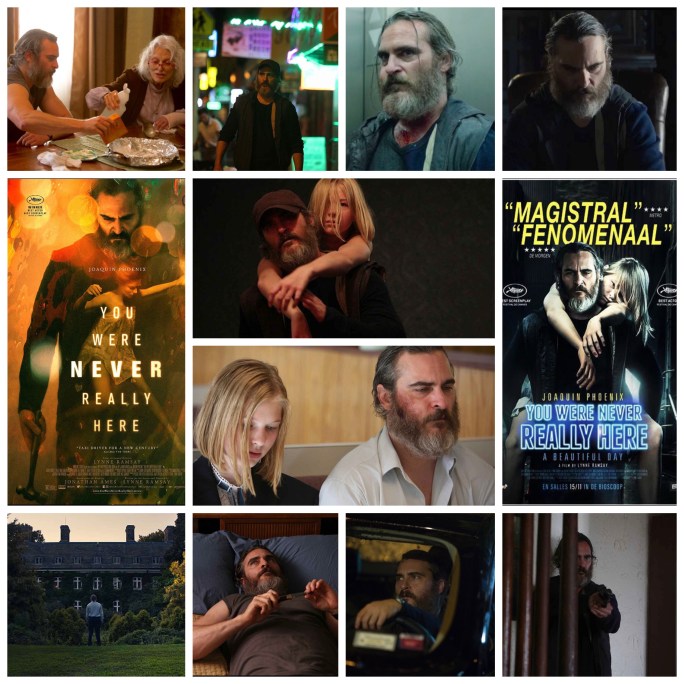
Lynne Ramsay’s You Were Never Really Here

It’s amazing to think of the impact felt by a film that runs just under ninety minutes, but Lynne Ramsay’s You Were Never Really Here lands with force like that of the hammer that Joaquin Phoenix wields here, the violence mostly implied and hardly seen. Right off the bat though: this is not your average vigilante revenge thriller. It isn’t even your average artsy psychological character study. Ramsay is a careful, precise and challenging filmmaker who doesn’t often take on projects (this is only her fourth feature in two decades) and the story she brings here is full of shadows, provocations, shades of grey, unreliable memories, contains a cubist narrative sensibility and is altogether something of a masterpiece. Phoenix gives a coiled, implosive, miraculous performance as Joe, a veteran and abuse victim suffering intensely from PTSD who works as an off the books contract killer to locate missing girls. Hired by his handler (John Doman) to find the daughter of a senator who has been taken, Joe’s mind-scape and internal climate start to clash with what’s going on around him until memory, reality and action start to blur. This is a complex, difficult film and I’ve read many wild interpretations on what’s actually going on, but Ramsay keeps it refreshingly opaque, leaving our intuitions to decide what happened. Ghosts from the past, violent encounters with disturbing individuals, the eventual rescue and protection of the senator’s daughter (Ekaterina Samsonov), caring for his elderly, unstable mother (Judith Roberts) and uncovering an unsettling conspiracy. It’s all there, but none of it is in plain daylight and the pieces are carefully scrambled to mirror Joe’s disintegrating psyche. We’ll probably never really know what was real and what wasn’t, but that’s not the point anyways, the point is that we feel Joe’s journey deeply, personally, viscerally and that is the genius of both Ramsay’s vision and Phoenix’s performance. The atmosphere is further thickened with a resplendent, layered original score from Radiohead’s Jonny Greenwood, who uses a varied kaleidoscope of auditory work to let us see through Joe’s eyes. Not a film to be missed.

-Nate Hill

Alfonso Cuarón’s Roma

Less a film than it is a two and a quarter hour slice of hyper realistic, deeply immersive life, Alfonso Cuarón’s Roma weaves a transfixing, masterful spell by imparting to us one year in the lives of a Mexican family circa early 70’s, through the eyes of their shy, courageous and compassionate maid, Cleo (Yalitza Aparicio). Cuarón is partial to lofty special effects, tricky camera work and experimental sensibilities, all of which make their appearances here but in quite a different capacity than expected. The shots (he served as his own cinematographer and it makes the film all the more personal) are used as living visual canvas for these characters to dwell in, the pace is languid yet never slacks, there is no score or soundtrack to speak of and the result is something so lifelike and authentic that I felt if I paused it to take a piss it would just continue on without me, free from the commonplace vibrations of what we are used to in cinema. There’s a remoteness to the storytelling here, but nothing in the way of warmth is lost; as anti-melodramatic as it is, the film meanders through the lives of these people with a fly-on-the-wall intimacy, remaining at arm’s length in terms of the drama yet stemming right from the heart as it shows the events unfold. All of the actors except for one are virtual unknowns, and there’s an organic cadence to their performing language that’s so unique, especially in the case of the children in the family, who take sort of a backseat to Cleo and the parents, despite the film being semi autobiographical. Aparicio too has one sole credit with this film, but her work as Cleo would have you believe she’s been at it for years. She’s a radiantly magnificent pillar of support for the family, surrogate mother and caretaker whose deep, soulful eyes harbour a fierce modesty. It’s when we start to see the heartbreak, struggle and triumph of her own personal life that the film truly takes hold, this is her story and from moment to moment, we are captivated as to where it will take us. Cuarón shoots in incisive, elemental black and white and after seeing the film it’s hard to imagine another choice of palette. The visual aura combined with shooting techniques and hyper realism make it seem like the closest we’ll get to a time machine in cinematic form, like a temporary window into his hazy memories of the past, accessible for an entrancing few hours and then gone again like the dream it is, culled straight from Cuarón’s potent memories of growing up as a child. I was unfortunately to busy to catch this in its theatrical run here, but on a large enough screen at home with every light switched off and the volume cranked, it still works it’s magic beautifully. A minimalistic tone poem that speaks volumes, a quiet masterpiece from Cuarón and one of the best films of the year.

-Nate Hill