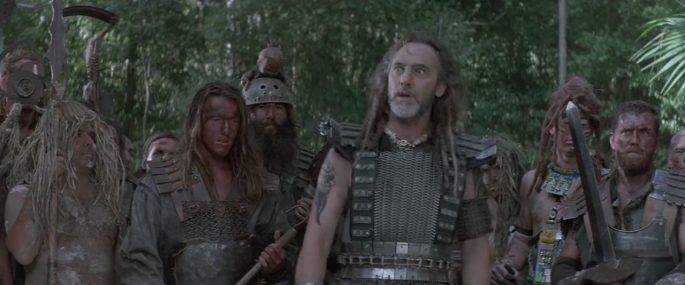
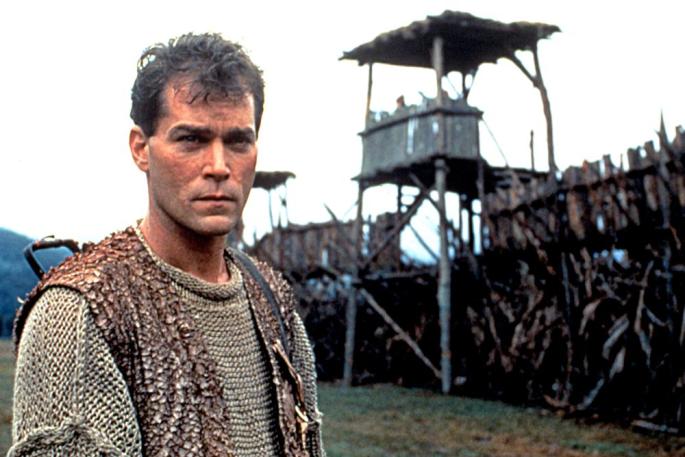
Gale Anne Hurd, the producer of Aliens and The Terminator, headed the charge back in the early 90s toward the adaptation of a book written by Richard Herley titled, The Penal Colony.
Set in 1997, it tells the story of how the British Government runs island prison colonies as a means to stem the tide of an overflow in mainland jails. There are no guards, no cells, and the island is monitored via satellite surveillance.
We follow the a character named Anthony Routledge, who is brought to the island for a sex-crime that he did not commit. He soon discovers that under the guidance of a charismatic leader, a community on the island has evolved.
No Escape (1994)
Now if that’s not the ideal film to make here in Australia, (if your are aware that it is pretty much how our nation began) then I don’t know what is. The production would hire future Bond director Martin Campbell, along with stars Ray Liotta, Lance Henriksen, Stuart Wilson and Ernie Hudson.
Then a screenwriter named Michael Gaylin, a man who had slaved away in obscurity in Hollywood for more than a decade, would come into contact with a colleague of Hurd’s. He went for a meeting and, finally, after a career of false starts and forgotten promises, he was going to be writing on a film that would eventually, make it to the big screen.
After a long wait, I finally had the opportunity to sit down and talk to Michael about his career and his experiences during the making of No Escape or Escape from Absolom (as it was released over here). What I discovered, during our conversation, was not merely an insight into a film I heartily enjoy, but also the story of a resilient writer who finally had one script break through. A real life story very much akin to the journey of the hero of the film; who would take on all conflicts and eventually overcome them . . . and escape.
It is a great film in the grand tradition of Franklin J. Schaffner’s Papillon.
Andrew David Barker was born in Derby, England in 1975. He grew up with a love of films and writing. I suppose this is a common thread among those of us who seek to express ourselves through these mediums. Hoping against hope that it will be either one or the other that strikes first – one or the other that shall propel us out of obscurity and into the stratosphere in which we are allowed to create for a living.
It was horror films (the Video Nasties), but also the bombastic, high concept and blockbuster works of the 80’s that further fueled the young Barker to carry on his quest. Spielberg, Lucas and Scorsese, but also Romero and Raimi fed him with images and blasted on the big screen the seemingly endless possibilities which lay in wait, destined to be unearthed by the daring dreamer.
Like all those that had come before, young Barker cut his teeth making short films and writing books and short stories – at times with friends. Then the time came – the time which calls to the fledgling auteurs and beckons them into the fray – time to put all accumulated knowledge to the test, and make that first film.
Thus A Reckoning was born. But through no fault of his own, young Barker was forced to sit by and see his film languish in obscurity. So, he took up the pen, and began to tell his stories on the printed page. Soon, he produced two fine works (see pictured above) and interest from the film industry power brokers soon came knocking.
Andrew is an eclectic storyteller whose visions are at once personal and profound. To talk to him about his journey, his influences and aspirations was a thrill. He is definitely a talent to watch, and, I for one, will be watching with great anticipation as to where his journey will take him next.
I remember a rainy evening long ago when I went with some friends to see The Rocketeer. This was a time when superhero movies were touch and go. We had Dolph Lundgren’s Punisher and Alec Baldwin’s Shadow, Billy Zane’s Phantom and Pamela Anderson’s Barbed Wire. The movie gods had spoiled us with Donner’s Superman and Burton’s Batman – but The Rocketeer, for my money, was a return to form.
Featuring solid direction from Joe Johnston (Alive, Congo, Captain America), a great cast featuring Billy Campbell, Jennifer Connolly, Alan Arkin and the delightfully villainous Timothy Dalton, combined with a beautiful and heroically-sumptuous score from the late/great James Horner – The Rocketeer stayed with me after that rainy night back in the early 90’s, and it’s an experience I find myself going back to again and again.
The film though, was not an easy gig for it’s writers. They began their comic book adaptation of The Rocketeer in 1985. Writing for Disney, the partners were hired and fired several times during the five years of the movie’s development. The two had a rough executive experience, in which scenes were deleted only to be restored years later. The film finally made it to theaters in 1991.
But The Rocketeer isn’t the only picture co-penned by Danny Bilson that I love. There is Eliminators, which he wrote with his career-long collaborator Paul DeMeo (They he met and graduated from California State University, San Bernardino and together formed Pet Fly Productions.) One great tale Danny offered is that Eliminators was a poster before it was a movie. I would kill to have worked like that for the Charles Band stable back in the day. Being handed a title or a poster and being told, “Now go write the movie.”
Eliminators, Zone Troopers, Arena and Trancers would be written by DeMeo and Bilson, who aside from being a writer, is also a director and producer of movies, television, video games, and comic books. They worked on the video game James Bond 007: Everything or Nothing (2003), the television series The Sentinel (1996), Viper (1994, 1996) and The Flash (1990), and issues of the comic book The Flash. Bilson also directed and produced The Sentinel and The Flash.
Danny Bilson was born into the industry, the son of Mona (Weichman) and the director Bruce Bilson (Bewitched, Get Smart, Hogan’s Heroes). But, after college, Danny struggled to break into the movie business, working as an extra while writing screenplays. Bilson and DeMeo produced their first script, Trancers (1985), a noir tale about a time-travelling detective from the future. Five sequels would follow. Bilson debuted as a director for Zone Troopers (1985), co-written by DeMeo, a tale of American World War II soldiers who find an alien spacecraft. Following this, the duo performed the same roles in The Wrong Guys (1988) a comedic spoof of boy scouting.
VIPER, Dorian Harewood, James McCaffrey, Joe Nipote, 1994
Danny and Paul, though the screen has seen their writing credit absent for some time, continue to work. I long for the hour when I see their names up there again, as their collaborative efforts will and always stand, for this cinephile anyway, as an invitation for adventure and excitement. While a Jedi is not meant to crave such things – of my cinema-going prerequisites they are high the list – bordering on essential.
There is a quote attributed to Robert Rodriguez (another independent maverick filmmaker) that states:
“If you are doing it because you love it you can succeed because you will work harder than anyone else around you, take on challenges no one else would dare take, and come up with methods no one else would discover, especially when their prime drive is fame and fortune. All that will follow later if you really love what you do. Because the work will speak for itself.”
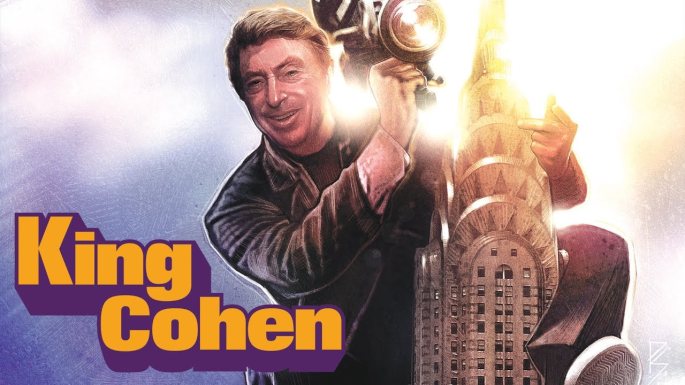
It is the always interesting, ever-changing, always inventive, ever professional life and work of Larry Cohen that really personifies the above quotation. King Cohen has been out there in one form or another in an impressive career spanning multiple decades. He has been the director of cult classics; he has been the writer of hot scripts that have incited Hollywood bidding wars. His work has been remade, imitated, venerated.
These are the hallmarks of a man and his movies whose personal voice rings out loud and clear, high above the commercial ocean of mainstream cinema that carries, beneath its shiny surface, schools of biodegradable blockbusters that are usually forgotten about only moments after having left the cinema.
God Told Me To (1976) aka Demon Directed by Larry Cohen Shown: Poster Art
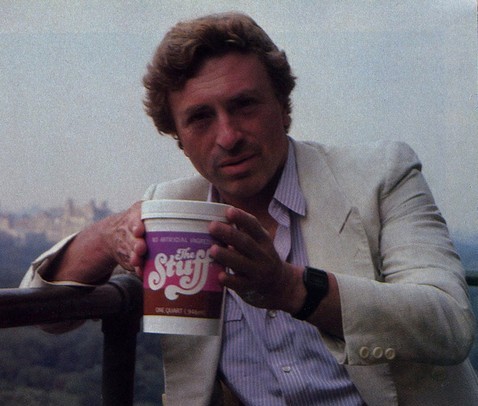
This is not true of the films of Larry Cohen. For his work is the stuff (pardon the pun) that came before, the stuff the imitators latch on to, the stuff from which remakes and re-imaginations are conceived. This is the fate of the masters. The innovators come and bring forth art through trial and error. They are followed by the masters who take the lessons learned from the innovators and make them, shape them by sheer force of will. But, then there comes the imitators who stand on the shoulders of these giants and take home the glory.
Still, when there is an artist that is in equal parts innovator and master; this causes the imitators to stand baffled.
Rather than accepting my humble oration, I urge you to seek out Steve Mitchell’s most excellent documentary KING COHEN. Watch it, marvel, rejoice, and remember that there are great filmmakers out there. They may not be coming soon to a theatre near you, but they did once, and their work still stands, silently, waiting to be discovered.
Until you get to see KING COHEN please, feel free to bask in my little chat with the king himself, Larry Cohen, a gentleman of many parts, many stories and of course . . . many movies.
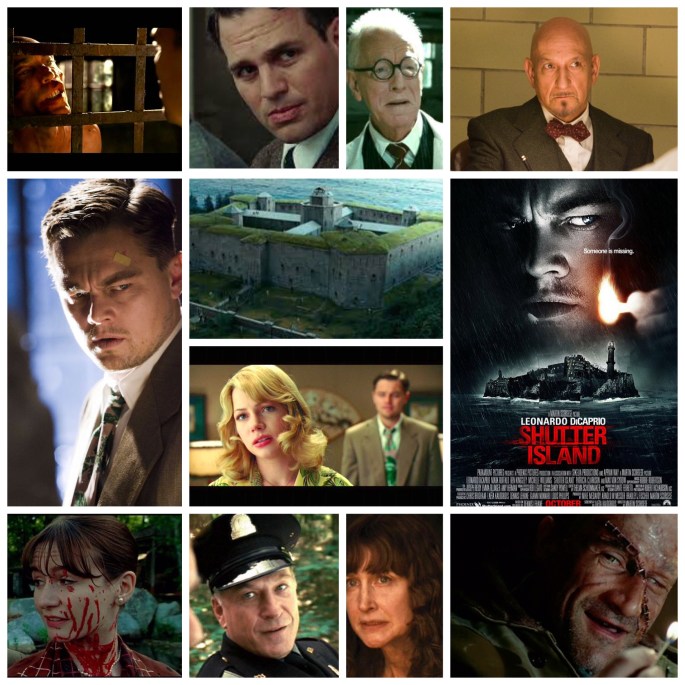
Shutter Island is my favourite film by Martin Scorsese. Now, keep in mind that I still have yet to see heralded classics like Goodfellas and Raging Bull, but that being said I still feel like this clammy psychological opus would remain at the top of the charts. I’m a genre guy at heart, and as such gravitate towards that when watching any director’s work, I just feel more at home wading into fictitious, stylized thrillers than I do with earnest biopics or urban crime dramas, which aren’t always my thing to begin with. Shutter is a brilliant piece, a deliberately dense and serpentine mystery that unfolds step by delicious step, a gift to anyone who loves a good twist and plenty of clues to keep them engaged along the way. Not to mention it’s wonderfully acted, cleverly written and primed with emotional trauma to keep us invested in the puzzle beyond base curiosity. Leonardo DiCaprio is best when portraying intense, tormented people, and his US Marshal Teddy Daniels here is no exception, a haunted man who feels like a caged animal as he investigates the disappearance of a mental patient from a secluded island sanitarium, a place that just doesn’t seem right, with a mood in the air so oppressive you can almost feel the fog, both mental and meteorological, weighing you down. The patient, Rachel Solando (Emily Mortimer will send shivers up and down your spine) seems to have vaporized into thin air, and Teddy’s investigation leads to closed doors, uncooperative staff and a heightened level of dread that lurks beneath every hushed exchange of dialogue and fleeting glimpse at things he, and we, aren’t even sure he really saw. The head doctor (Ben Kingsley, excellent) is clearly hiding something, as is the austere asylum director (Max Von Sydow). The freaky Warden (terrific cameo from Ted Levine, who gets to deliver the film’s best written and most perplexing dialogue) babbles to Teddy in biblical platitudes, and the patients have run amok following a storm that compromised security. Needless to say the plot is deviantly constructed to constantly mess with the audience until the third act revelations, which come as less of a melodramatic thunderclap and more like a quiet, burning sorrow of realization, a tonal choice from Scorsese that hits you way harder. Scorsese has assembled a cast for the ages here, and besides who I’ve mentioned so far we also have Michelle Williams in disconcerting flashbacks as Teddy’s wife, so perfectly played I wish she got a nomination, creepy Elias Koteas as another phantasm from his past, John Carrol Lynch, Mark Ruffalo, Jackie Earle Haley, Robin Bartlett and Patricia Clarkson. The score is a doom soaked death rattle courtesy of Robbie Robertson, not without it’s emotional interludes but thoroughly grievous. There’s also a beautifully slowed down version of ‘Cry’ by Johnnie Ray that accompanies the horrifying dream sequences within the film, adding to the already thick atmosphere nicely. This is a film built to last, both for dutiful rewatches from adoring veterans and discovery by lucky newcomers who get to experience it’s affecting story for the first time. All these boxer biopics, big city mafia ballads and heady stuff seems to have rolled off of me as far as Scorsese goes, I enjoy them, don’t get me wrong, but they’re a one-off as far as how many times I’ll watch them. Give me a well spun, emotionally rich psychological murder mystery with no shortage of style, character and tantalizing thriller elements, however, and I’ll pop that sucker back into the DVD player time and time again. Scorsese’s best effort by far.
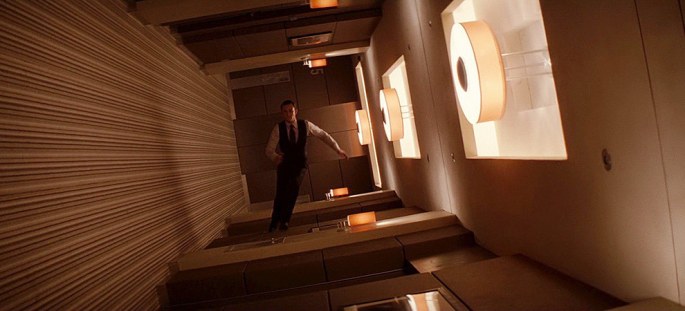
Ten years in the making, Inception (2010) was the culmination of Christopher Nolan’s career up to that point in time. This film mixed the ingenious plot twists of his independent film darling Memento (2000) with the epic scale of his Hollywood blockbuster The Dark Knight (2008). It took the heist genre to the next level by fusing it with the science fiction genre as a group of corporate raiders steal ideas by entering the dreams of their targets – think Dreamscape (1984) meets The Matrix (1999) as if made by Michael Mann. While Nolan and his films certainly wear their respective influences on their sleeve – and this one is no different (2001: A Space Odyssey, Blade Runner, Heat) – there is still enough of his own thematic preoccupations to make Inception distinctly his own. This film continues his fascination with the blurring of artifice with reality. With Inception, we are constantly questioning what is real right down to the last enigmatic image.
Dom Cobb (Leonardo DiCaprio) and his team extract thoughts of value from people as they dream. However, during his jobs, he is visited by his deceased wife Mal (Marion Cotillard), a beautiful femme fatale character that serves as an increasingly dangerous distraction from the task at hand. The film’s opening sequence does an excellent job establishing how Cobb and his team extract information from the dream of Saito (Ken Watanabe), a Japanese businessman, in a visually arresting sequence. He catches up with Cobb in the real world and offers him a new deal: plant an idea in Robert Fischer’s (Cillian Murphy) mind that will help break-up his father’s vast empire before it becomes too powerful, and do it in a way so that it seems like Fischer thought of it for it to work. This is something that has only been done once before and Cobb was the person that pulled it off but can he do it again? In exchange for completing the job, Saito will make the necessary arrangements so that Cobb can return home to the United States where his children live but where he is also wanted by the authorities in connection with his wife’s death. So, Cobb recruits a literal dream team of experts to help him pull off the most challenging job of his career.
Inception delves into all kinds of aspects of dreams as evident in a scene early on where Cobb explains how they work, how to design and then navigate them. While there is a lot of exposition dialogue to absorb during these scenes, Nolan also keeps things visually interesting at the same time. This is arguably the most cerebral part of the film as he explores all sorts of intriguing concepts and sets up the rules for what we’ll experience later on – pretty heady stuff for a Hollywood blockbuster. And when he isn’t examining fascinating ideas, he’s orchestrating exciting and intense action sequences. There’s an incredible sequence where Nolan juggles three different action sequences operating on three different levels of dreams that are all impressively staged while also a marvel of cross-cutting editing. He anchors Inception with the character of Cobb and his desire to return home to his children while also dealing with the death of his wife. It gives the film an emotional weight so that we care about what happens to him. It also raises the stakes on the Fischer job.
Cobb continues Nolan’s interest in tortured protagonists. With Memento, Leonard Shelby tried to figure out who murdered his wife while operating with no short-term memory. Insomnia (2002) featured a cop with a checkered past trying to solve a murder on very little sleep. The Batman films focused on a costumed vigilante that waged war on criminals as a way of dealing with the guilt of witnessing his parents being murdered when he was a child. With The Prestige (2006), magician Robert Angier is tormented by the death of his wife and an all-consuming passion to outdo a rival illusionist. Inception’s Cobb also has a checkered past and is haunted by the death of loved one. Leonardo DiCaprio delivers what may be his finest performance to date, playing a complex, and layered character with a rich emotional life. Cobb must come to terms with what happened to his wife and his culpability in what happened to her. DiCaprio conveys an emotional range that he has not tapped into to this degree before. There’s a captivating tragic dimension to Cobb that the actor does an excellent job of expressing so that we become invested in the dramatic arc of his character.
Nolan populates Inception with a stellar cast to support DiCaprio. The indie film world is represented by the likes of Joseph Gordon-Levitt and Tom Hardy while also drawing from international cinema with Ken Watanabe and Cillian Murphy. Gordon-Levitt and Hardy, in particular, are stand-outs and their banter provides several moments of enjoyable levity during the course of this intense, engrossing film. And it wouldn’t be a Nolan film without his good luck charm, Michael Caine, making an appearance. As he has done in the past, Nolan plucks a once dominant actor from the 1980s, now languishing in relative obscurity – think Rutger Hauer in Batman Begins (2005) or Eric Roberts in The Dark Knight – and gives them a high-profile role. Inception gives Tom Berenger some well-deserved mainstream exposure after languishing in direct-to-video hell, reminding everyone what a good actor he can be with the right material.
Regardless if whether you like Inception or not, you’ve got to admire Nolan for making a film that is not a remake, a reboot, a sequel or an adaptation of an existing work. It is an ideal blend of art house sensibilities, with its weighty themes, and commercial conventions, like exciting action sequences. Capitalizing on the massive success of The Dark Knight, Nolan wisely used his clout to push through his most personal and ambitious film up to that point. With Inception, he created a world on a scale that he never attempted before and was able to realize some truly astonishing visuals, like gravity-defying fight scenes and having characters encounter a location straight out of the mind of M.C. Escher. It has been said that the power of cinema is the ability to transport you to another world and to dream with our eyes open. Inception does this. Nolan created a cinematic anomaly: a summer blockbuster film with a brain.
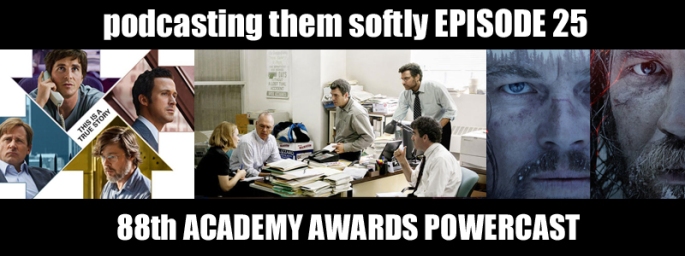
Join us for our Oscar podcast. We give our predictions in all the major categories, and we discuss what we think will win and what should win. Tune into the Oscar’s and see if we are geniuses or complete idiots!
Everyone was waiting. Leonard Maltin was waiting, Roger Durling was waiting, Scott Cooper was waiting, the press was waiting, and the giant mob of screaming fans were waiting. Johnny Depp was running late, and nobody cared. Depp arrived thirty minutes late. He was set to receive the Leonard Maltin Modern Master Award from BLACK MASS director, Scott Cooper as well as participating in a much anticipated Q&A with Leonard Maltin.
He arrived in a black Cadillac SUV and once he exited he instantly disobeyed his handlers and went directly to the vast mob of his fans. He took his time signing autographs, taking photographs, and shaking each hand he could. Depp then moved to the red carpet, timidly keeping away from the press yet posing for a gracious amount of time for photos against the sleek SBIFF backdrop. He posed with Scott Cooper and then he quickly was moved to the end of the press line, but I caught his attention:
“Mr. Depp, one quick question: DONNIE BRASCO, ONCE UPON A TIME IN MEXICO, and SWEENEY TODD. Which is your favorite role?”
He put his hand up to his mouth, held his chin, stared right at me through his blue Michael Mann tinted glasses and said,
“I don’t know. That’s difficult, man.”
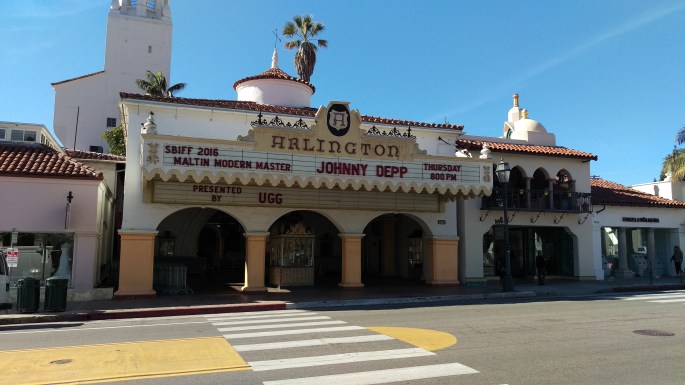
Depp was quickly moved into the Arlington Theatre and the floodgates opened and everyone rushed in. Once the gorgeous Arlington Theatre settled down, the dapper Roger Durling took the stage and he spoke graciously, thanking everyone for being there and thanked Johnny Depp for coming.
Maltin then took the stage and he introduced Depp and an excellently edited highlight reel played. Watching a brief highlight of Depp’s career doesn’t do it justice, yet you can’t help feeling overwhelmed by his truly epic career.
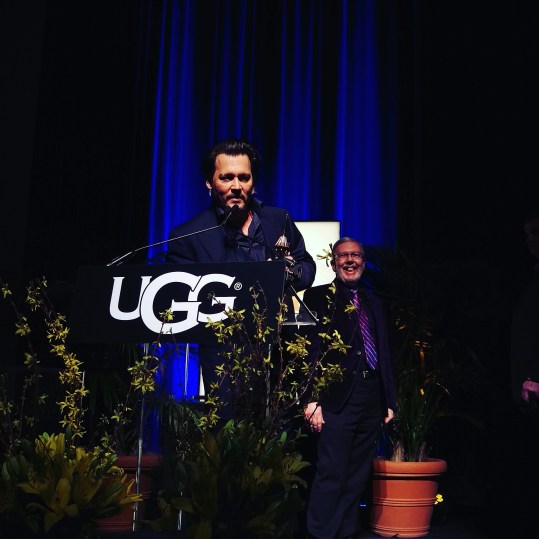
Depp walked out, and the theatre erupted with applause and screaming. Depp shyly smiled. To this day, Johnny Depp is the epitome of cool. He was wearing socks with hemp leaf patterns and for about the first hour and a half of the Q&A, he meticulously hand rolled a perfect cigarillo. He then lit it and took the rest of the Q&A slowly smoking it. In California, and pretty much anywhere else, it is illegal to smoke in a public venue, but who is going to tell Johnny Depp to stop smoking?
Depp is a very sweet guy, he’s incredibly humbled. Whenever Maltin would bring up a film, whether it was one of Depp’s blockbusters or a seminal undercard performance, the audience would clap and Depp would smile and thank the audience.
The Q&A with Leonard Maltin was almost three hours long and it was wonderful. I was able to ask Leonard Maltin two quick question on the red carpet, I asked him to pick between DONNIE BRASCO, ONCE UPON A TIME IN MEXICO and SWEENEY TODD. Maltin paused for a moment and said DONNIE BRASCO. I then asked him what his favorite underrated performance of Depp’s was and he said, without hesitation, DON JUAN DEMARCO.
It took about an hour for Depp to warm up and get comfortable. He was incredibly candid about his career. He spoke frankly about how he’s a musician, who happened to become an actor to pay the rent. He spoke in depth about what a horror he was, and sometimes still is, on film sets. Maltin asked him about his relationship with Leonardo DiCaprio on the set of WHAT’S EATING GILBERT GRAPE. Johnny Depp just started laughing.
“You know, I respect Leo a lot. He did so much work and research and preparation for that role,” and a sly smile arose on his face, “and I tortured him.”
The audience started laughing, and Depp stopped, and looked at the audience,
“No, really, I did. He liked video games. No Leo, I won’t give you a drag of my cigarette while you hide from your Mom.”
Depp briefly spoke about his work with John Waters, saying how Waters was the only filmmaker he knew who made a film based on a title. He said Waters came up with the idea of PECKER, solely for the fact that when it would be advertised it would be: John Waters’ PECKER Coming Soon.
When Depp was asked about his casting in EDWARD SCISSOR HANDS and his long and awesome collaboration with Tim Burton, Depp started laughing. He spoke about how he didn’t want to even meet with Burton, he knew he wouldn’t get the part, but his agent Tiffany talked him into it. Depp recalled walking into a diner to meet Burton. He had no idea what he looked like. He scanned the diner and saw a guy “whose hair looked like a hardware store exploded, and I knew I had to talk to him. Even if he wasn’t Tim, I still had to talk to him.” The man with the exploded hair was Tim Burton, and that was the beginning of one of the greatest collaborations in cinema history.
Leonard Maltin beamed as he showed a clip of DON JUAN DEMARCO and then asked him about that film, and working with Marlon Brando. Depp settled back in his chair and smiled, and spoke about his abundant love and admiration for Brando. He said he was a father, mentor, brother, essentially a gigantic blanket that meant the world to Depp. When Maltin asked Depp to describe what he learned from Brando, he paused looked down, and then back up at Maltin and said: justice.
Maltin asked Depp about the only film he directed, THE BRAVE that premiered at Cannes in 1997 and featured Marlon Brando in a prominent role. Maltin asked when we could see it. Depp asked the audience who wanted to buy it. He then went on to speak about the reason he shelved the film was because he didn’t want to play the distribution game, and he wanted to retain control over it.
In 2004, when Brando died, Depp was devastated and he was receiving offers about releasing THE BRAVE. He was told it was a prime time to release the film, it was an unseen Brando performance, and now was the time to release it. That’s the moment when Depp decided to put the film under lock and key. He was returning justice back to Marlon Brando. Maltin then said that releasing it now wouldn’t be an exploiting Brando’s death. Depp then said he would show THE BRAVE at the Santa Barbara International Film Festival next year, and shook Maltin’s hand on it.
So in theory, next year, Johnny Depp will be premiering his unicorn of a film, THE BRAVE, at the 32nd Santa Barbara International Film Festival. That remains to be seen, but seeing Depp speak, in depth, for three hours about his remarkable career was amazing. After the Q&A was over, Depp went back outside to all his screaming fans and took more photographs and signed as many autographs as he could. Johnny Depp is not only one of cinema’s best actors, but he’s truly a class act.
We returned to form with our first new recording together since the newest addition to Nick’s family, and the STAR WARS overload that Frank has been overwhelmed by. We go over our top ten films of the year, top five directors, actors, actresses, supporting actors, supporting actresses, screenplays, cinematographers, score, ensemble and television shows. We were both very excited to do this, and we hope you enjoy!
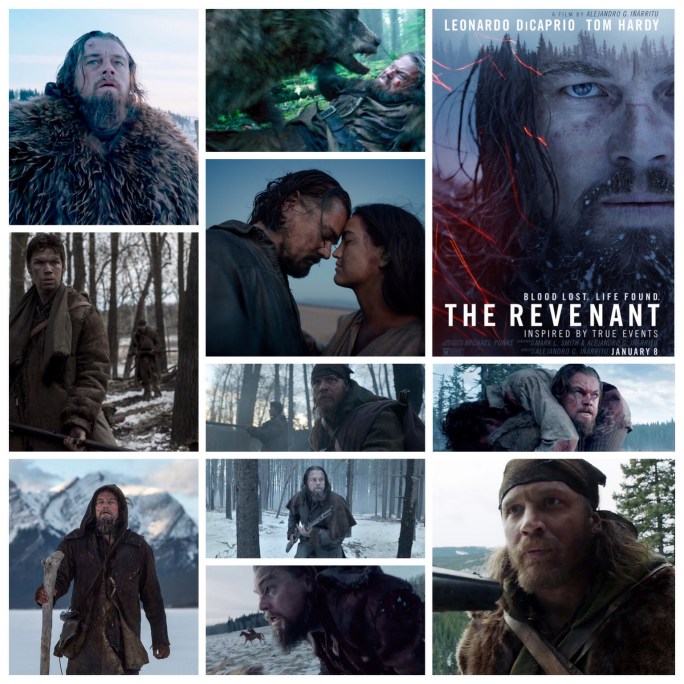
If the rumblings from director Alexander Gonzalez Inarritu and his intrepid cast and crew about The Revenant being the most tumultuous, challenging shoot of their lives, it’s all in service of the loftiest of causes one could achieve: to produce great art. I say that without pretension or monocle wagging patronization, and mark my words: The Revenant is by and far the greatest film this year, and possibly of the last decade. It is monumental in scale, meticulous in pacing and erects the fundamental pillars of the human condition so flawlessly that we feel we are watching actual history materialize before our eyes, untethered from the notion that it’s just a movie.
Let’s start with the ocular deity that is Emmanuel Lubezki: This film contains the best cinematography I have ever seen in my life. The bold location scouting is a catalyst for the prodigy of a DOP to work his ethereal magic. Time and time again throughout the film I found myself marvelling at the stunning patience and skill displayed by the man in attaining his precious shots, constantly chafed by what I imagine was an impossibly stressful environment, bogged down by time constraints and the pure, uncaring call of nature itself. He shot with natural light for all but one scene, an unimaginable achievement that plays out in endless beauty that rocks your soul to its foundation for the entire two and a half hour running time. The locations, lovingly culled from deep within northern Canada and briefly Argentina, are an unforgiving cacophony of serene snowfalls, cascading rivers and jagged, untamed mountain ranges. This is the landscape I have grown up in and call home and to such holy places captured with such reverence on film, gilding a story of such primordial importance had me next to tears.
Leonardo DiCaprio pulls out all the stops in his ferocious portrayal of Hugh Glass, a frontiersman who lives by his feral gut instinct alone, attempting to guide his fur trapping expedition through the terrain while looking out for his half Pawnee Native son who he already rescued from aching tragedy years before. After a harrowing raid in the dawning minutes of the film that makes it abundantly clear how serious the film intends to be, he and a small band of men are stranded and forced to contend with the land, and the threat of the natives finding them. Glass then gets attacked by a bear in a nerve shattering sequence that had my adrenal glands running a marathon. The frank, unapologetic nature in which the scene plays out reminds us all that nature isn’t our playground of opportunity and commerce, but a living organism that can bite the hand that it refuses to feed with alarming abandon. The sheer level of carnage inflicted upon Glass by both beast and man will shake you to your core, as will the excellent makeup and CGI effects that drive the point deep into your retinas. Tom Hardy disappears into his role better than Glass’s expedition blends into the treacherous blizzards, playing John Fitzgerald, a cowardly motherfucker who is content to leave Glass to the elements and seek fortune elsewhere, dragging sympathetic Jim Bridger (Will Poulter, excellent) along with him. The military component of their expedition (Domhall Gleeson, superb) suspects Fitzgerald and is wary. Hardy is the very definition of an acting chameleon, and disappears headlong into the role that had me riveted, and rooting for a best supporting actor win. The entire cast was subjected to a brutal nine weeks exposed to the elements, each other, and the raw, archetypal narrative of the piece that was being made, and each of them shows it in spades.
At its core it’s a revenge piece, spurred by aching character interaction involving Leo and his family in affecting flashbacks. Leo goes through somewhat of a transformation here.. He loses all he has left to an uncaring, cold faced world that would sooner see him tossed around a moss stained forest in pieces than avenged. But his Hugh Glass rages against the dying of the light right alongside Lubezki’s lens, creating in tandem the perfect voyage of a man who has become so consumed with the forces of nature in his quest to attain some semblance of his former self, that he has become somewhat of an element himself. Leo truly deserves gold this time around.
Adventure/survival epics are my favourite. This one stands out, and yet.. does more than that, if possible. It delves deep into the lush, echoing vastness of the past and pulls forth a story so human, so recognizable, in such a force of construction where the fruits of everyone’s labour are so obvious, it can’t help but be worshipped as a classic in the art form of cinema and a treatise on how to excel in every single area of the medium.










 Podcasting Them Softly