
Tim and Frank are back to discuss the latest Star Wars film, SOLO.
Tim and Frank are back to discuss the latest Star Wars film, SOLO.
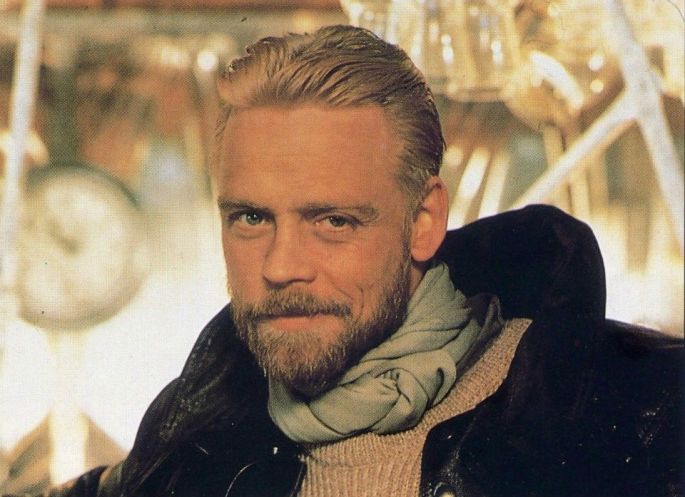
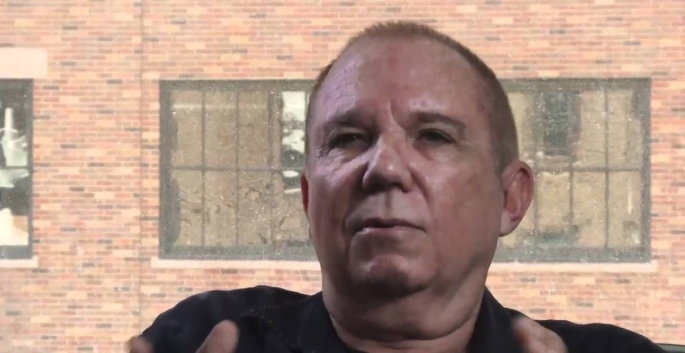
Slipstream was alluring from the moment I saw the poster in the front window of my local theater. From the producer of STAR WARS and the director of TRON was the proclamation, and I was sold. The film, even then, delivered, as far as I am concerned. It offered a different world, an intriguing premise, great performances and . . . yes, I’ll admit a disjointed viewing experience. Still, I love the movie and have always been curious as to the production and what elements combined to bring this fascinating story to the screen.
At length, I finally made contact with Tony Kayden, a veteran screenwriter and the credited scribe of the film (as well as a man with his own amazing set of adventures in the screen trade). And it didn’t take long to learn that the narrative irregularities of Slipstream were the result of no one really knowing what kind of film they wanted to make.
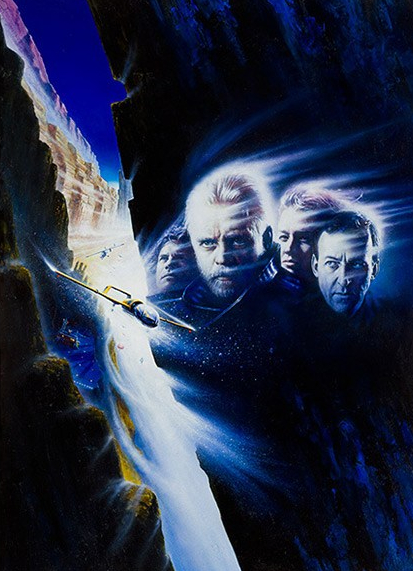
With the money in escrow, the movie was being made, that was definite. The script that Tony was brought on to rework was, at its heart, a stock-standard Star Wars rehash. Enter producer Gary Kurtz. After enjoying success serving alongside George Lucas and Jim Henson on the Dark Crystal, Kurtz came to the project seeing another unique film on a grand scale and an adventure born in the wind. The director tapped to steer the ship was Tron director Steve Lisberger. His work on Tron was extraordinary, original, and one could only imagine what he might do with a larger canvas combined with thrilling aerial action, accompanying a compelling human story. But then then problems began. The Producers wanted action and more sexual interaction where possible. Kurtz wanted something cleaner, no graphic violence and something more Star Wars. Lastly there was Lisberger, having just become a father, and wanting to make something for kids.
Then you have the poor writer. Only hired for four weeks, Tony ended up residing in England for three months, trying in vain to mix this maelstrom of indecisiveness into a cohesive plot. Kayden saw the movie as a kind of post-apocalyptic version of the The Last Detail. You can see the surviving elements of this in the interactions between Bill Paxton and Bob Peck’s characters of Matt and Byron. One a fugitive being taken in for the reward, the other an opportunist looking to make a quick buck. But, ultimately they become friends and seek to merely flow with the slipstream they are, for better or worse, traveling along.


These two are chased by Tasker, Mark Hamill, in a platinum performance as the mustache-twisting law man whose faith has been replaced by devotion to duty and routine whilst maintaining order here in this desolate society. He harbors a Javert/Valijean type relationship with Peck’s curiously, emotionally-distant accused killer – who just so happens to be an android.
The journey down the stream brings Matt and Bryon into contact with fellow adventurers/survivors Sir Ben Kingsley (who after a chat about the script in the commissary with Tony, sought out a part in the movie), and eventually, another Oscar winner in the person of F. Murray Abraham, the caretaker of one of the last sanctuaries – a literal museum to the past, complete with all its folly and decadence.
But the movie ends in tragedy and triumph. While the evil pursuer is vanquished, Bryon’s hopes for happiness are dashed. He is forced to leave his new found friend and seek out his own kind, wherever they may be.
That all might come across as a little confusing? Like I said before, the film is disjointed. This doesn’t prevent it, however, from being fun. The the actors give solid performances, the photography is brilliant, the locations amazing, Elmer Bernstein’s score magnificent – it is just a shame that the powers behind this movie couldn’t seem to agree.


As Tony told me, “the writer often takes the blame.” Though that is not the case here. If anything he should be commended for fighting the good fight in a losing battle.
Still, my fondness for Slipstream endures. In part for what it is, but also for the possibility of what it might have been. Like I said to Tony, in the age of the reboot, there might be a second life yet for Slipstream. Now all we need to do is get Dwayne Johnson on board…


I have always been a fan of underdog stories. They hold for the viewer a message of hope that – should one’s fortitude and perseverance be fixed to the sticking place – then there is nothing that can’t be accomplished or overcome.
Having enjoyed the first installment of the Martial Arts Kid, as well as having a chance to chat with two of its legendary cast, Don “The Dragon” Wilson and Cynthia Rothrock, I was thrilled at the prospect that, not only would the story continue, but that I would have a chance to meet the players from this exciting second chapter.
Of course, it is obvious, that there are parallels to be drawn with John G. Avildsen’s iconic The Karate Kid. Still this is a story onto itself – a story of the discipline it takes to rise to the challenge, and ultimately find redemption in the wake of defeat.
The Martial Arts Kid 2: Payback sees the return of Wilson and Rothrock, headlining an all-star cast of Martial Arts professionals in a tale of courage and honor in the face of adversity. My guests include Producer, Dr. Robert Goldman and stars T.J. Storm, Matthew Ziff and Brandon Russell – all returning from the MAK. I’m certain this shall be another inspirational story, combined with the finest Martial Arts action, and featuring the real life champions of the various styles. A pleasure it was to talk to each of them, and more exciting, the anticipation of the release of the MAK 2. I trust you will enjoy my guest’s insights along with the movie . . . upon its release.

{Courtesy of https://www.drbobgoldman.info/}
Dr. Goldman is a 6th degree Black Belt in Karate, Chinese weapons expert, and world champion athlete with over 20 world strength records and has been listed in the Guinness Book of World Records. Some of his past performance records include 13,500 consecutive straight leg situps and 321 consecutive handstand pushups. Dr. Goldman was an All-College athlete in four sports, a three-time winner of the John F. Kennedy (JFK) Physical Fitness Award, was voted Athlete of the Year, was the recipient of the Champions Award and was inducted into the World Hall of Fame of Physical Fitness, as well as induction into numerous Martial Arts Hall of Fames in North America, Europe, South America and Asia. He founded the International Sports Hall of Fame, recognizing the world’s greatest sports legends, with ceremonies held annually at the Arnold Schwarzenegger Sports Festival the largest sports festival in the world, with over 200,000 participants, 70+ sports represented and over 20,000 competing athletes, making it double the size of the Olympic Games.

{Courtesy of https://www.martialartsentertainment.com/t-j-storm/}
In high school Storm was shy and started break-dancing as a way of trying to “fit in”. Dance quickly became T.J.’s passion and he would win over 200 dance competitions in the genres of hip hop and break-dancing. He received a dance scholarship and this paved the way for his move to Los Angeles and dancing in music videos. Dance was his passion, but it only provided him with enough money for rent and a diet of Ramen Noodles and Pop Tarts, with little left for anything else. Devoted to the martial arts, Storm often found himself stopping by and observing an outdoor Northern Shaolin class on his way home from work. Eventually Storm was approached by the teacher and he was asked to join class, allowing him to add the knowledge of Northern Shaolin to his others arts. Using his talents for dance and martial arts, T.J. began to pursue acting. He graduated from the Joanne Baron/D.W. Brown Acting Academy. While playing the role of Bayu on the television series, Conan The Adventurer, Storm developed the unique action style that he is known for. His brand of action is a combination of martial arts, acrobatic skill, comedic timing, and an almost balletic grace. Storm has since gone on to work with Jet Li, Sammo Hung, Sir Ben Kingsley, Michael Madsen, Kelly Hu, Cary-Hiroyuki Tagawa, Michelle Rodriquez, Neal McDonough and Kristanna Loken. T.J. Storm made motion captures for Captain Josh Stone and Dave Johnson in Resident Evil 5. He is known for his roles as Criag Marduk in the Tekken Series, and Strider Hiryu in Ultimate Marvel vs. Capcom 3. Soon you will hear T.J. Storm in the video game Battlefield Hardline (2015), and see him in The Gold Rush Boogie (2015), Jonny Flytrap (2015) Bullets Blades and Blood (2015), Boone: The Bounty Hunter 2014 and as Coach Laurent Kaine in The Martial Arts Kid (2014).


{Courtesy of http://www.matthewziff.com/}
Matthew Ziff’s professional career started two months after he was born when he signed with the Wilhelmina Modeling Agency in New York. He has been featured in numerous print ads and campaigns including Glamour magazine. By age 10, due to his talent as well as his professionalism, not only was he considered a top child model, called upon constantly for magazines, clothes and toy boxes, as well as various commercials, he had already appeared in comedy skits on both the David Letterman and Conan O’Brien shows. During his high school years at The Blair Academy, Matthew kept active with acting classes, as well as performing in stage productions, not only as an actor, but also as a director. Once in college at the University of Miami, he signed with Stellar and Elite Talent agencies where he filmed multiple commercials and embarked more thoroughly on his film career. Matthew has worked in many genres in such films as Six Gun Savior (Eric Roberts, Martin Kove), Treachery (Michael Biehn, Sarah Butler, Jennifer Blanc), Hardflip (John Schneider, Randy Wayne), Online Abduction (Brooke Butler, David Chokachi), Mansion of Blood (Robert Picardo, Gary Busey), Safelight (Evan Peters, Juno Temple), Among Friends (Danielle Harris, Kane Hodder) and Searching for Bobby D (Paul Borghese, William DeMeo). In addition to acting, Matthew has his second degree Black Belt in Tae Kwon Do and has studied Hapkido as well as Kendo (swords). In July, 2012, he represented the USA in the International Quidditch Association’s Summer Games during the Olympic Torch Relay in England, where Team USA won the Gold medal. He is also a marksman with rifles and pistols and is a multi-instrumental musician specializing in guitar, bass and saxophone. Matthew has a Master’s of Science in Industrial Engineering from the University of Miami. He is a member of SAG, AFTRA, AEA and GIAA. He maintains homes in California, New York and Florida.


{Courtesy of https://www.imdb.com/name/nm2182241/bio }
Brandon expressed an interest in acting at the age of 3 and by 5 was already a member of SAG. His biggest role to date was his lead role in the feature film, Smitty (2012), which was released in April 2012. Brandon plays the lead role of Ben Barrett and worked alongside: Peter Fonda, Mira Sorvino, Louis Gossett Jr., Lolita Davidovich, Jason London, and Booboo Stewart. Since filming Smitty, he has gone on to film supporting roles in Wiener Dog Nationals (2013) and The Martial Arts Kid (2015). He also had a lead role in the UPtv holiday movie, Beverly Hills Christmas (2015). Brandon has also been seen on Tosh.0 (2009), Supah Ninjas (2011), and Instant Mom (2013). Later, he portrayed Peter Michaels in Fishes ‘n Loaves: Heaven Sent (2016) alongside Patrick Muldoon and Dina Meyer.


Frank and Tim are back with their latest Star Wars episode. And while their predictions of Max von Sydow being Boba Fett and who Rey’s parents are didn’t prove to be correct; everything you hear in this podcast is true…

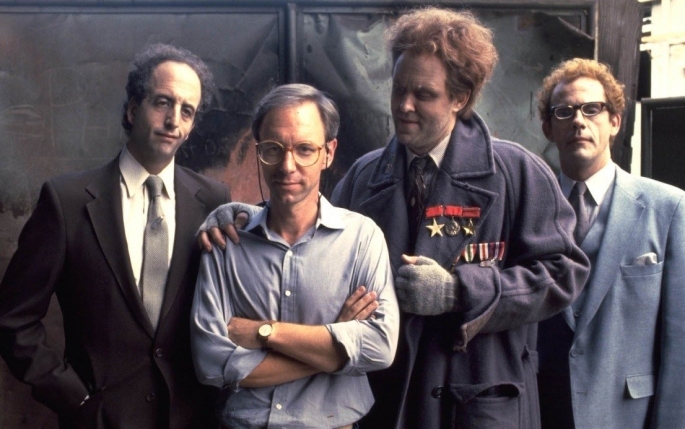
To talk about W.D. (Rick) Richter, is to talk about one of my all-time favorite films, Big Trouble in Little China. It is, to put it simply, one of those films that comes along (not so much anymore) once in a generation. As we know in this age of remakes, reboots and re-imaginations, there is a very good chance that this film, because of its staying power and built-in fan base, will more than likely resurface with Dwayne Johnson playing Jack Burton. Just like Hansel in Zoolander he is, as far as the Studios are concerned, so hot right now!
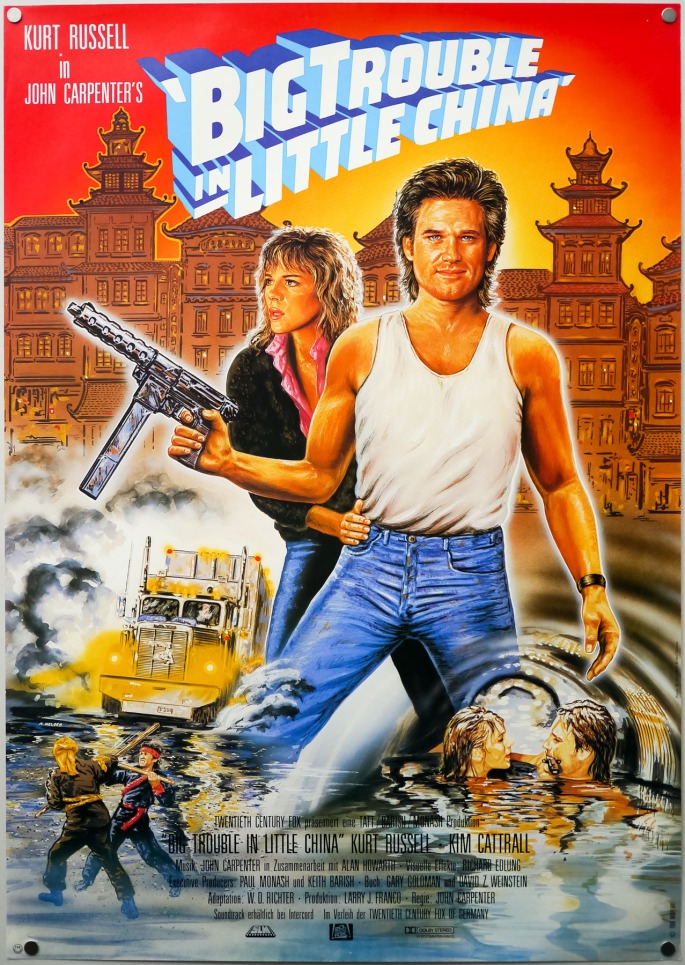
And you can be your bottom dollar that it will try like hell to recapture the magic of what was – and more than likely – crash ‘n’ burn in its attempt to do so. I might be wrong. Because, BTILC, was and is what is often referred to as a “happy accident”. What began as a seemingly awkward combination of a western with a plot that involved Chinese black magic became, thanks to my guest, a glorious blending of genres that there is really no recipe for.

I rarely get nervous doing interviews, but I was glad to be sitting down for this one. When the person on the other end of the line had a hand in creating a couple of the seminal film of one’s existence . . . it is tough to play it cool, plus for the first time in a long time, I found the need to have my questions written, rather than merely see what the conversation would provoke. Primarily because I knew I was only going to have a limited time, and secondly because during our email exchanges prior to the chat, I found Rick to be extremely matter-of-fact and, wishing not to have the interview published in audio form, he merely wanted to be concise and not ramble on as, he says, has happened in the past.
So I sat and pondered questions. Having read other interviews with him in the past, before he’d stepped away from the business, the focus was on the films he had released at the time and didn’t really get below the surface. Off the record, we spoke about a few of the things that were beneath the polished exterior of the press kits, but that was not all that interested me. There have been many books and articles on his films, as well as many having excellent special features and commentary tracks which mine their depths – so I wasn’t going to waste time there.

In the end I waited till the last minute and scribbled down the first questions that popped into my head. Some of course are elementary, but one or two I’ve had on my mind for a while.
Well, it took a long time, but sometimes, good things do. It was well worth the wait and the frustrating silences in between messages from Rick’s friend who very graciously made the introductions, and I, as a fan first, was humbled, honored and thrilled at the prospect of speaking to yet another film-making idol of mine.


While Rick, early in our email exchanges said, “I prefer to let he films, for better or worse, speak for themselves.” I am and will be forever grateful he took the time to talk a little about his work. In the end I wasn’t nervous or scared at all . . . I felt kind of invincible.
KH: Did you always want to work in movies and if so what were the films which influenced you?
WDR: First I wanted a paper route. Then I wanted to run a circus. Then I thought about pursuing a career as an English teacher. Then I thought, “Why not aspire to become an actual tenured English professor?” But, by the time I got to college, graduate film programs were springing up here and there. Having loved movies since childhood, but never imagining there was a route available into the business, I suddenly saw a way to pursue a career in film in a structured, sensible way.
I went to a lot of movies of all kinds as a kid, but mostly B horror films from the mid-fifties through the mid-sixties. In 1964, I saw DR. STRANGELOVE and in 1965 THE LOVED ONE. They suggested a new direction and deeply influenced me.
KH: How did you break in to the business?
WDR: I wrote screenplays at USC, and one of them secured me an agent. I then worked as a reader for Warners and wrote on the side and continued to do so when Warners and Irvin Kershner let me work as his assistant while he was prepping DIRTY HARRY for Sinatra. That project fell apart, but a spec script I’d written, SLITHER, got to the director Howard Zeiff, and he set it up, odd as it was, and we shot it. Presto! I was a produced screenwriter.
KH: Your early career was full of greats like Dracula, Body Snatchers and your Oscar nod for Brubaker. How much does momentum play a factor in one’s career (films coming out and performing well) as well as recognition for one’s talent?
WDR: Actually, none of those films did perform well, but they were respected, and, as a result, I was respected as a young writer with perceived potential. You must remember that during the seventies and eighties eccentric characters in unusual, small stories were nothing Hollywood ran screaming from. That came later.
KH: You are a part of two of my favourite films of all time with Banzai and BTILC. How do you feel as an artist to be remembered for singular works rather than your entire body of creativity?
WDR: I’ve never given much thought to being “remembered”. After all, sooner or later, this whole planet is going to be forgotten.
KH: If people want the skinny on Banzai, you have already provided an excellent commentary. What I would ask is, did you ever see Kevin Smith’s Q & A whose guests were Weller and Lithgow, and how did you feel about possible versions of the continuing story of Banzai?
WDR: I thought Kevin did a spectacular job that evening, and it was nice to learn how much the movie shaped him. As long as Mac Rauch is involved, I feel quite confident that a “new” BUCKAROO could be as startling as the original.
KH: BTILC was ahead of its time, in my opinion. What I’ve always wanted to know is, what the “western version” was like prior to your work on the script, and how much of the finished film remains your work?
WDR: The “western version” just didn’t work for anybody, sad to say. It all seemed too distant…the Old West and the Asian occult, etc. So I proposed moving it to a modern, familiar setting and swapping the hero’s horse for a big rig. The pitch went over well, and, with a writers’ strike looming, I dug into the challenge of creating a contemporary script in about seven weeks, choosing to do that with a somewhat dim but hopefully lovable hero at the center. The finished film stayed absolutely true to my screenplay, apart from the inevitable ad libs here and there. Jack Burton’s John-Wayne cadences, though, are definitely nothing I wrote or endorsed. John and Kurt settled on that themselves.
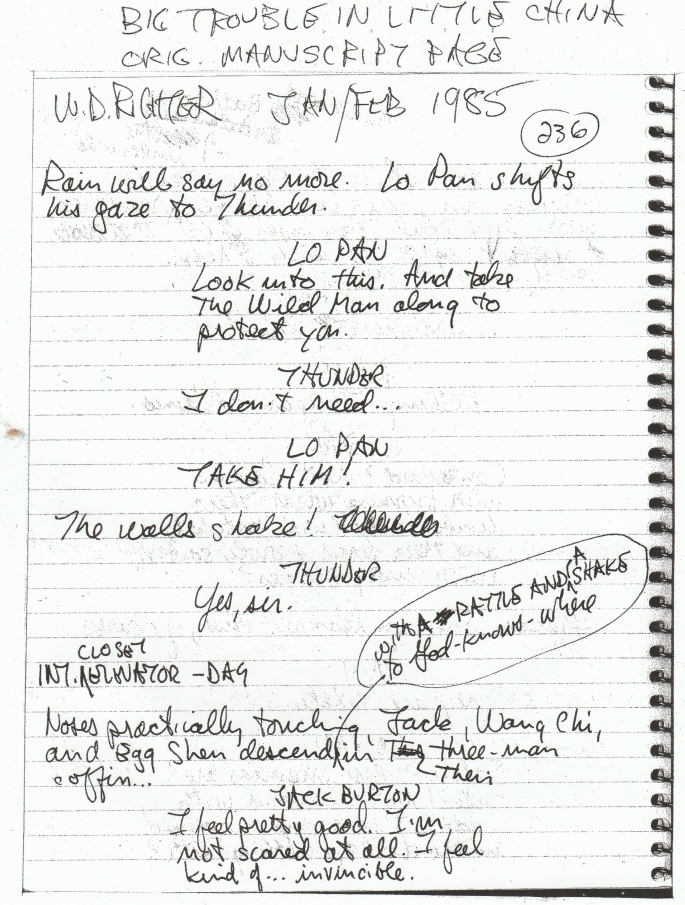
You asked me prior to this conversation: “Did you write the line or was it improvised: I feel pretty good. I’m not, uh, I’m not scared at all. I just feel kind of… feel kind of invincible?”
Turns out I did write it. I wrote the whole script furiously in longhand in several spiral notebooks, and a typist transcribed them into script format.
KH: There was a significant gap between Home for the Holidays and Stealth. I have interviewed many writers who talk of these periods. They say, it’s not that I wasn’t writing, it’s just my scripts weren’t getting made. Was that true of your career at the time?
WDR: Definitely. I had movies actually green-lighted then cancelled when directors went over budget in pre-production.
KH: I understand Stealth was a troubled production.
WDR: STEALTH was just a bizarre and massively unpleasant experience. Directors and location scouts shouldn’t rewrite writers, if you want my opinion. Kind of like Presidents shouldn’t tweet.
KH: Did your involvement end after the writing?
WDR: The “writing” never really stopped. I was removed from the picture several times when my revisions failed to please the director. But I was repeatedly brought back by the studio to pull the script back from the brink after the director (who shall remain nameless) had worked it over again in his spare time. It’s the only film I’ve had made that, with great care, I kept my distance from during production and through release.
KH: I also love Needful Things. What was it like to adapt King?
WDR: Crazy. The book is 690-pages of single-spaced prose. My script was 124 pages, and you know how much “air” there is on a script page. I figured that if one were to retype the novel in a crude screenplay format, it might easily hit 1000 pages. So I lost roughly 876 pages while trying to keep King’s story and mood intact. I have no sense of how that worked out because I’ve never reread the book, but I always imagined a looser, grittier, less-arch movie.
KH: Any advice you would give to a struggling screenwriter – not unlike myself?
WDR: Write. Write. Write. But always try to imagine the movie itself playing to paying strangers. Why would they — or you! — want to watch it?
KH: Sir it has been a profound honor to converse with you. I cherish the moment and humbly thank you.
WDR: Thank you, Kent. Take care.

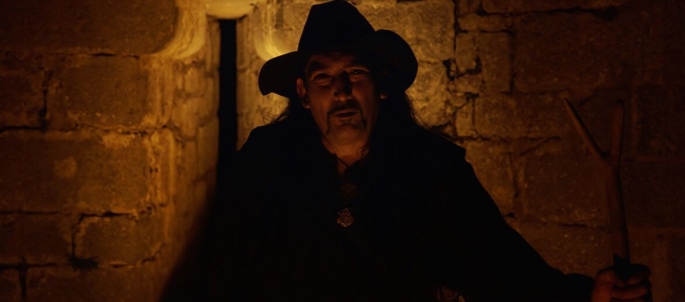
It’s always a fascinating experience to sit down with Richard. The man is such a natural storyteller, with a unique perspective relating not only to cinema, but also to the world around him.


We caught up this time in the midst of bad weather, a troubled connection and, last but not least, a turbulent time in Richard’s beloved Montsegur. While our conversation touched upon this, along with the whys and wherefores of the situation, we eventually turned to movies. At this time it had been documented that Richard was again a part of an attempt to bring Moreau back to the screen – as a TV series. Having been hired by the same people that fired him during the doomed journey of his initial attempt, there seems to be, thanks to David Gregory’s documentary, a renewed interest in Richard’s take on his long-suffering passion project.
I did also bring up The Otherworld, which I had finally seen at the time. Stanley’s absorbing documentary-slash-ghost-story, and the myths and misconceptions surrounding it and ‘The Zone’ which forms the backdrop. Richard is steeped in the history of Montsegur and, flavored with his supernatural encounters, it is indeed a tale of great intrigue.
Also to we touched on, and I must say I highly anticipate, the writing of Richard’s autobiography. A project that was going smoothly until it was insisted, and initially resisted by its author, that a chapter be included on the subject of the collapse of Richard’s vision of Moreau. As thrilling a read as it will be – like I said Richard is a fascinating character – it will be equally riveting to finally have a recounting of the story from the embattled man at the center of the controversy.
Still, the future is full of possibilities, and I for one wait with inordinate eagerness for any and all of Richard’s creative endeavors to finally emerge . . . in whatever form they shall take.


“How the hell do I relieve myself in this tin suit?”
Sword of the Valiant might come across as just another Cannon curiosity, especially for the uninitiated. For the casual observer it may simply look like another film in which another director managed to con Connery into yet another pair of strange/fancy duds?

But while Boorman managed to get Sean to into his Zardoz get-up, which for my money is more so in the strange/fancy category than SOTV, the film in total is both an elegant and joyful rendition of the days of Arthurian legend from my guest in this interview, Stephen Weeks.

Yes before Connery got to be the king himself in First Knight, before Clive Owen and way before Charlie Hunnam – in days of old, when knights were bold, there was the tale of Sir Gawain and the Green Knight, which as I discovered, is not the film I know it to be. Turns out I’ve no seen it in all its glory…
Working with Cannon was by no means a cakewalk, as Stephen shall tell you. And the subsequent release of the picture was grossly mishandled. Thus, the world has really not experienced this movie as the filmmaker’s intended, and that was one of many intriguing tales proffered me by the eloquent Mr. Weeks.

This was not his first rodeo, having made a version of the film some years earlier, Stephen saw this as an opportunity to expanded his canvas. Unfortunately for him and what no one knew, or knew well enough, at the time, was the grimy underbelly of the behemoth at the top which sat Golan and Globus.

Despite these trappings, and now knowing what I know, I still love the movie and feel privileged to have been gifted an audience with its director, who not only informed and enlightened, but also entertained.

Stephen Weeks is an impressive filmmaker and now is an accomplished author (please see the link to his work below). As a fan of his work and SOTV in particular, I enjoyed and hope you too shall enjoy, this little trip back into the mists of time – to a fantasy world, and a fantastic film…

Frank, Tim, and Nate gather together to discuss this year’s Oscar nominations and then get into what they thought should have been nominated, running down their own top ten best pictures, and also giving their top five in each category. We will taking a week off and then we’ll be back with a vengeance with our annual Santa Barbara International Film Festival podcast!

Thirty-seven years ago, The Empire Strikes Back subverted audience expectations by taking the story and characters in new directions that, for lack of better word, no one saw coming. Han Solo was frozen in carbonite late in the movie, and Luke Skywalker lost his right hand in the lightsaber duel with Darth Vader that revealed his biological connection to the man beneath the mask. Empire itself had a divided reaction, with some viewers angry that Darth Vader was Luke’s father, or that Han had been frozen, but thanks to the lack of internet in 1980, this division was nowhere near as caustic as it is now. Today, The Empire Strikes Back is lauded for the geoundbreaking risks it took in evolving the characters and story, and one would assume the risks involved in the storytelling of The Last Jedi would be received similarly. Oddly enough, it’s even more divisive than any if us could have expected, and thanks to the social media’s manner of letting every voice be heard no matter how asinine it may be, this division is infinitely more caustic.
I know a lot of my fellow Star Wars fans went into The Last Jedi with their own fan theories and fictions bouncing around in their minds, and their expectations understandably high. This is Star Wars after all. It’s okay if you didn’t like the movie for a variety of reasons, from the performances to the CGI to the score. It’s also perfectly okay if you loved this movie for the same reasons other seem to hate it. However, calling a movie “bad”, or claiming it has ruined your childhood because your fan theories didn’t pan out, isn’t well thought out, rationally minded criticism, and it doesn’t make a movie bad. That’s not how cinema works. This hyperbole laced tantruming makes me appreciate the rational conversations I’ve had with others who don’t like the movie, or don’t like it as much as I do, all the more. Remember folks, it’s just a movie.
I have seen The Last Jedi twice. Once for the experience of seeing the movie for the first time loud and writ large, the second to see if my reaction was strengthened or weakened by an additional viewing. After the second viewing, I came to the conclusion that most of the problems I had with the movie had dissappeared, and I was left with just one gaping problem that I simply can’t overlook. Thankfully, the rest of the movie built around that singular problem more than make up for the damages. I am happy to report that while it may not be my favourite entry in the series (I don’t know which one is, to be truthful), it is certainly beloved by me. Warts and all, I adore this motion picture.
By now you should may know the basic plot of the eighth film in the Skywalker saga. Poe Dameron (Oscar Isaac), and General Leia Organa (the late Carrie Fisher) are battling the First Order in wide open space. Finn (John Boyega) and newcomer Rose Tico (Kelly Marie Tran) head to a gorgeous new locale known as Canto Bight to acquire assistance in fighting the First Order. And Rey (Daisy Ridley) is confined to Ahch-To, trying desperately to persuade a reluctant Luke Skywalker (Mark Hamill) to join the battle against The First Order and put an end to Supreme Leader Snoke (Andy Serkis) and Kylo Ren’s (Adam Driver) reign. That’s not saying too much, is it?
The gaping problem I was referring to in an earlier paragraph comes in the form of the plot thread involving Finn and Rose and their adventure of sorts to Canto Bight. The events that unfold here are do not affect the main narrative of the movie, and only seem to affect the characters involved in this plot in the moment, or soonly. I appreciate being shown how rich war profiteers live, how their intense gambling and partying also seem second nature to them by the time we meet them. It’s a shame then that their modes of gambling are too Earth-like, lacking any real imagination or creativity.
I also took issue with the character of Rose, who I didn’t find to be a compelling character, and whose portrayal by Kelly Marie Tran lacked chemistry between herself and John Boyega (Finn). Had Rose’s arc ended shortly after she stuns Finn into a brief slumber, I would have been okay with it, but because Rian Johnson instead pairs her up with Finn, I felt like I was forced to suffer through watching a vaguely interesting character without a worthwhile character arc, who is as out of place in this movie as a Deadpool cameo would have in this year’s Logan. The forced and otherwise jarring and completely unnecessary romantic desire Rose holds for Finn (but he doesnt seem to reciprocate in the slightest), conjured up on the salty grounds of Crait that causes her to crash her speeder into his while he’s attempting a suicide run against a powerful First Order weapon, is as asinine as saying this movie ruined your childhood. It’s all fine entertainment, but this sole portion of the movie is its greatest weakness.
There’s plenty of greatness to be found elsewhere, but for my money’s worth, I found true greatness in three places. Firstly, the elongated opening scene, once the action kicks in after a couple of humourous gags, is a frontrunner for the best space battle in Star Wars film history, especially becausit contains a brilliant white knuckling sequence where Rose’s soon to be deceased sister Paige (Veronica Ngo) has to recover a device that will allow her to drop the enormous payload of bombs aboard the ship she’s on. Secondly, there is the popular throne room fight scene around three quarters of the way through the movie, wherein Rey and Kylo face off against Snoke’s well trained private guards. It’s a dazzling, inventive, and thrilling action scene, bound for iconic status in no time at all. And lastly, there’s the scene near the very end of the film in which Luke Force projects himself onto the battlefield of Crait to distract Kylo while the remaining Resistance fighters escape the clutches of the hell bent Sith, before Luke is revealed to still be on Ahch-To. He seemingly becomes one with the Force and peacefully vanishes into the air. That he does so to the tune of John Williams’ beautifully composed and iconic Binary Sunset track from Star Wars (Episode IV: A New Hope), made the moment all the more moving and powerful for this fan, whose favourite scene in Star Wars is in fact the original Binary Sunset, though this scene sure gives it a run for its money.
In the opening line of his review for Star Wars Episode I: The Phantom Menace, the late movie critic Roger Ebert offered up the following sentiment: “If it were the first “Star Wars” movie, “The Phantom Menace” would be hailed as a visionary breakthrough. But this is the fourth movie of the famous series, and we think we know the territory; many of the early reviews have been blase, paying lip service to the visuals and wondering why the characters aren’t better developed. How quickly do we grow accustomed to wonders,”. That quote has stuck with me like dirt under my fingernails, and I can’t help but apply its unwavering logic to Star Wars: The Last Jedi. My mind wanders to the finale of my favourite movie of last year, La La Land, which posed a delightful what-could-have-been sequence, an alternate timeline if you will. Perhaps in another timeline of our human history, The Last Jedi was the first of the Star Wars movies, lauded by many for generations to come, and praised for the risks it took in creating something new and unique. Perhaps not. Who knows what could have been.
 Podcasting Them Softly