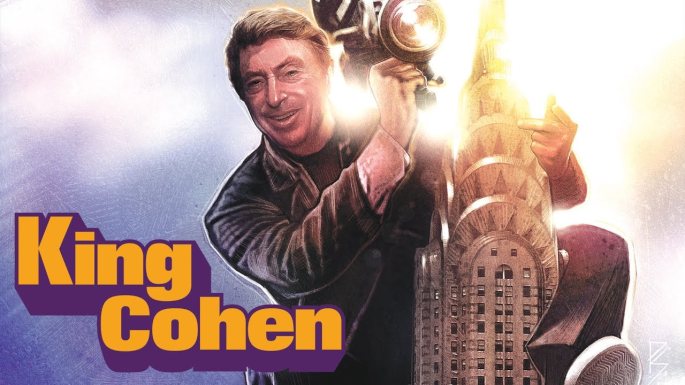
It’s good to be the King: An interview with Larry Cohen by Kent Hill

There is a quote attributed to Robert Rodriguez (another independent maverick filmmaker) that states:

“If you are doing it because you love it you can succeed because you will work harder than anyone else around you, take on challenges no one else would dare take, and come up with methods no one else would discover, especially when their prime drive is fame and fortune. All that will follow later if you really love what you do. Because the work will speak for itself.”

It is the always interesting, ever-changing, always inventive, ever professional life and work of Larry Cohen that really personifies the above quotation. King Cohen has been out there in one form or another in an impressive career spanning multiple decades. He has been the director of cult classics; he has been the writer of hot scripts that have incited Hollywood bidding wars. His work has been remade, imitated, venerated.

These are the hallmarks of a man and his movies whose personal voice rings out loud and clear, high above the commercial ocean of mainstream cinema that carries, beneath its shiny surface, schools of biodegradable blockbusters that are usually forgotten about only moments after having left the cinema.

This is not true of the films of Larry Cohen. For his work is the stuff (pardon the pun) that came before, the stuff the imitators latch on to, the stuff from which remakes and re-imaginations are conceived. This is the fate of the masters. The innovators come and bring forth art through trial and error. They are followed by the masters who take the lessons learned from the innovators and make them, shape them by sheer force of will. But, then there comes the imitators who stand on the shoulders of these giants and take home the glory.

Still, when there is an artist that is in equal parts innovator and master; this causes the imitators to stand baffled.
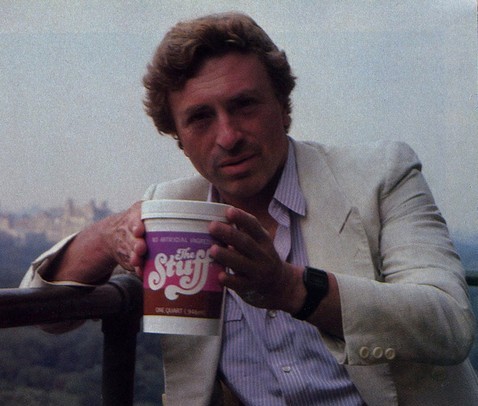
behind-the-scenes-the-stuff-larry-cohen-1985-2

Rather than accepting my humble oration, I urge you to seek out Steve Mitchell’s most excellent documentary KING COHEN. Watch it, marvel, rejoice, and remember that there are great filmmakers out there. They may not be coming soon to a theatre near you, but they did once, and their work still stands, silently, waiting to be discovered.

Until you get to see KING COHEN please, feel free to bask in my little chat with the king himself, Larry Cohen, a gentleman of many parts, many stories and of course . . . many movies.

Ladies and Gentlemen . . . Larry Cohen.
IMG_0691

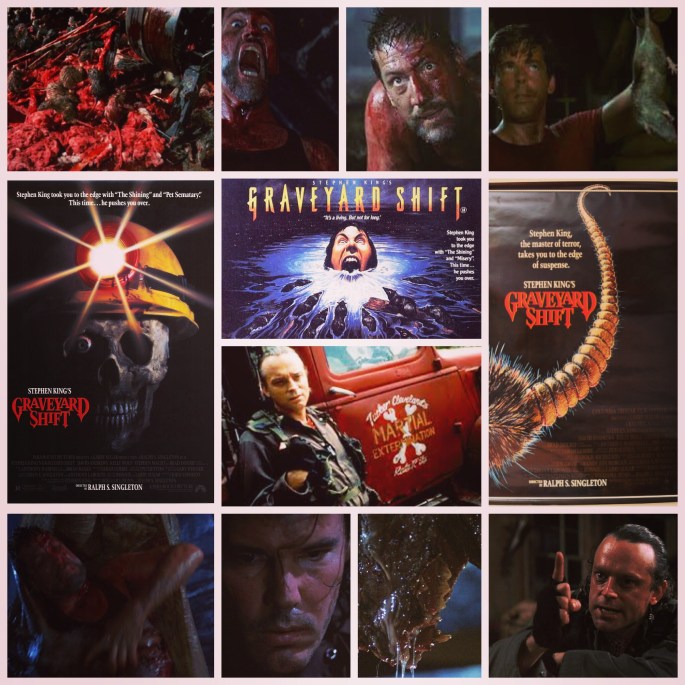
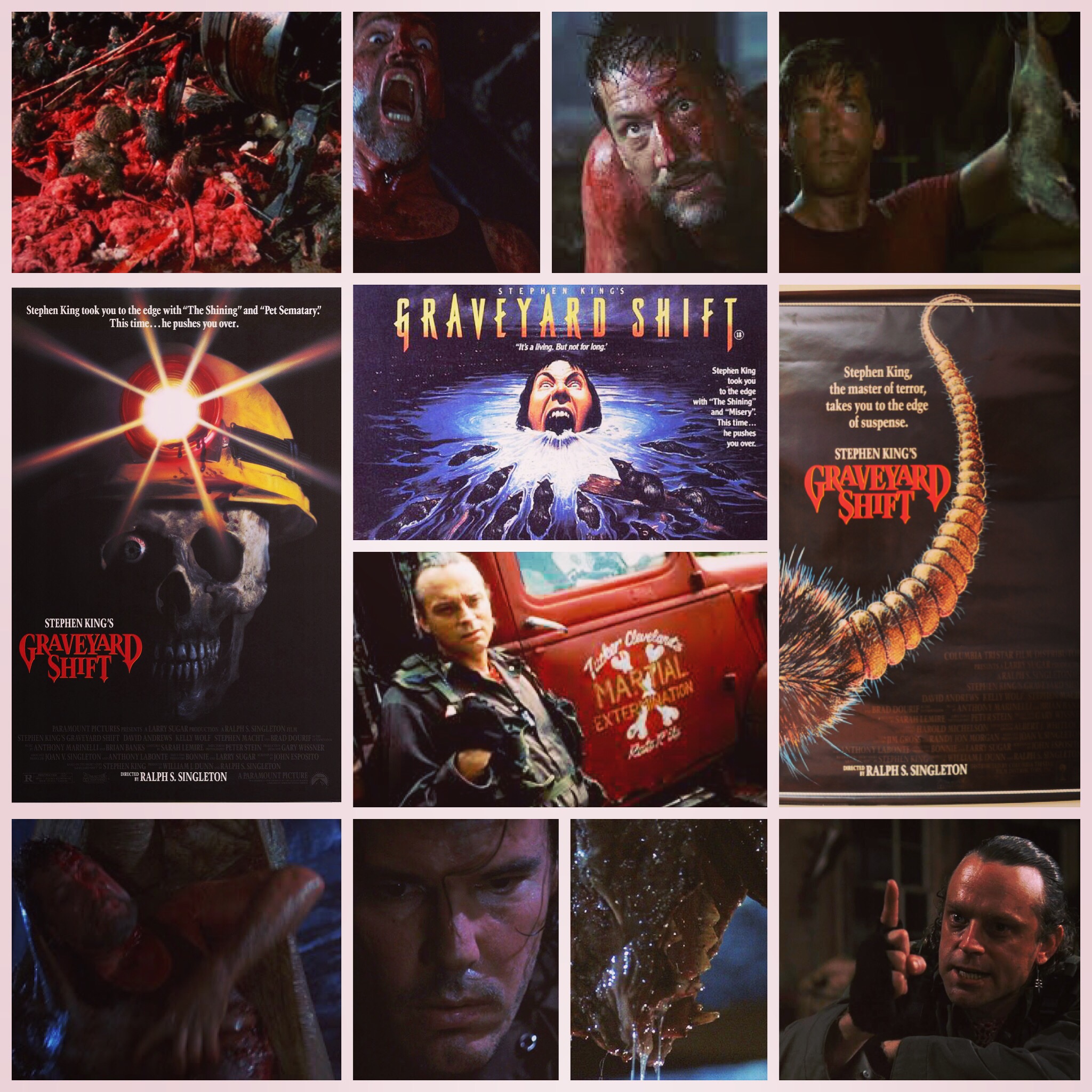
Stephen King’s Graveyard Shift


Stephen King’s Graveyard Shift is curiously one of my favourite adaptations of his work. I say curiously because it’s not a very tasteful film, let alone even a good one. It’s simple schlock and awe, goo and slime for 90 minutes straight, every human character either an unsettling nutcase or cardboard stock archetype. There’s just something so Midnite Movie-esque about it though, a sense of fun to its gigantic, hollowed out mess of a textile mill in which some kind of vile denizen stalks a night crew that pretty much deserves everything they get. People wander about, squabble and are picked off in ways that get steadily more gruesome until the final reveal of the monster in some overblown puss-palooza of a finale. What more do you need in your bottom feeder helping of horror? Steven Macht is the sleazebag who runs the mill at his tyrannical whim, while David Andrews is the closest thing you’ll find to a stoic protagonist. Andrew ‘Wishmaster’ Divoff shows up as a stock character, but it’s Brad Dourif who chews scenery and ends up the only memorable person as the world’s most simultaneously intense and incompetent exterminator, a bug eyed little weirdo who freaks people out with extended monologues about Viet Nam when he should be perusing corridors to find whatever’s lurking there. The monster itself, if I remember correctly, is one big pile of grossly misshappen, poopy prosthetic puppetry, as is often the case in early 90’s King fare. Would you want it any other way? Simple, efficient and impressively gory is what you’ll find on this shift. 

-Nate Hill

Virtually Speaking: An Interview with Brett Leonard by Kent Hill


My Grandmother was the avid cinema-goer in our family. She passed her love of movies down to my Mother who in turn, passed it on to me. Another little boy who learned about the wonders of the movies from his Mother was Brett Leonard.

This love would grow, forging a filmmaker whose career that has been eclectic, but always on the cutting edge. The man who was once a killer clown from outer space, has in many ways been one the pioneers in the eventually, all-compassing integration of the digital age into the celluloid art form. With his ground-breaking work in The Lawnmower Man, Leonard has since been blazing a trail  throughout the industry. His early concepts of combining virtual reality with the cinematic experience are still expanding, and his vision of where it is all going to go, is far from complete.

Yet I was fascinated with the journey this humble gentleman has taken. He has worked both independently and with the studios, he has directed some of the finest actors to grace the screen, he has bore the brunt of the dark politics that whirls below surface of the filmmaking process. Still, he manages to laugh it off and move on to the next project with an energy and optimism that has served him well.

I thrilled at the revelations Brett shared with me about his movies, which I admire greatly, but also about his personal adventures including something I was, I admit, grossly unaware of: he a spent a significant period of his life living and working here in Australia. To such an extent he even was labelled an Australian filmmaker by the local media. He said, in the great Down Under, he learned not only the true value of mateship, but also spent some of his most glorious days.

He was a pleasure to interview, a true gentleman, a fabulous filmmaker – ladies and gentlemen, I give you, Brett Leonard…

Writing with Fire: An Interview with Matthew Greenberg by Kent Hill

Chatting with Matt felt like getting together with a buddy you’d been out of touch with for too long. He is an explosion of wit and joy; even though he works in a town that can at times be a realm of foreboding dread.

“I failed at everything else,” he said, when I asked him how he came to be an adventurer in the screen trade. Matt has felt the highs and the lows – he has climbed up the mountain that is the film industry, slipped, and started climbing again. Yet, even with broken fingernails, he has managed to pen a wild array of movies. They’ve a little of everything in them that a growing boy needs as part of his complete breakfast: from faceless killers to fire-belching dragons to spooky hotel rooms. They may in part be “significantly different” from the scripts he turned in, but if you listen to Matt, that same exuberance and enthusiasm he carries for his work manages to make the final cut.

He came to Hollywood with enough money to buy a plane ticket (that got him there) and a car. Since then he has made it – in place where momentum is everything and the decisions handed down from the hierarchy don’t always make sense. From that place where all the leaves are brown and skies are grey, Matt showered me with tales of his journey through the savage land known as Hollywood and how with a genteel parlance, you may perhaps survive.

Ladies and gentlemen, I give you, Matthew Greenberg…


Stephen King’s The Night Flier: A Review by Nate Hill


Stephen King, the master of deliriously high concept horror, strikes again with The Night Flier, a gruesome, clever and painfully overlooked HBO midnite movie, starring everyone’s favourite grouchy pants, Miguel Ferrer, or Albert Rosenfield to any good Twin Peaks fans out there. Via a creepy take on tabloid journalism and the insidious obsession it breeds, King and Co. take a look at the way words get twisted from fact to bombastic fiction, the jaded reality one arrives at after working too long in such a field, and the hilarious possibility that such ridiculous, “made up” horrors one fabricates might in fact be a reality. Acid tongued Ferrer plays Richard Dees, a bitter and depressingly cynical trash reporter who is one drink away from the gutter and two lousy stories away from retirement, an acrid soul who lives by the mantra “Don’t believe what you publish, and don’t publish what you believe” (a pearl of wisdom that I imagine is rattling around King’s own skull, when we look at the sacrilege being wrought upon his magnum opus The Dark Tower in its cinematic emergence, particularly in regards to the casting of Roland the Gunslinger). Dees is on the hunt for en elusive serial killer who pilots an unnamed Cessna across the Midwest, slaughtering people in and around remote airports before vanishing into the night. Vampiric in origin and very hard to track down, this fiend uses the dark as his ally and seems to slip uncannily across America’s airspace, leaving a wake of bloody murder in his path that gives any old tabloid yarn a run for its money. Jaded Dees gets more than his usual brand of hoaxes and pranks, and seems oddly, morbidly drawn to this spree of horrific crimes, eerily willing to follow the Night Flier into the very jaws of Cerberus himself, if only to find exodus from his pointless, roundabout existence. All of King’s beloved qualities are at play here; grotesque practical effects, gnawing existential calamity, a light at the end of a tunnel that seems to crush our protagonist before they can reach it, and clever morality plays buried like demonic Easter eggs amidst the corn syrup and latex. An overlooked treat. 

Stephen King’s Silver Bullet: A Review by Nate Hill 

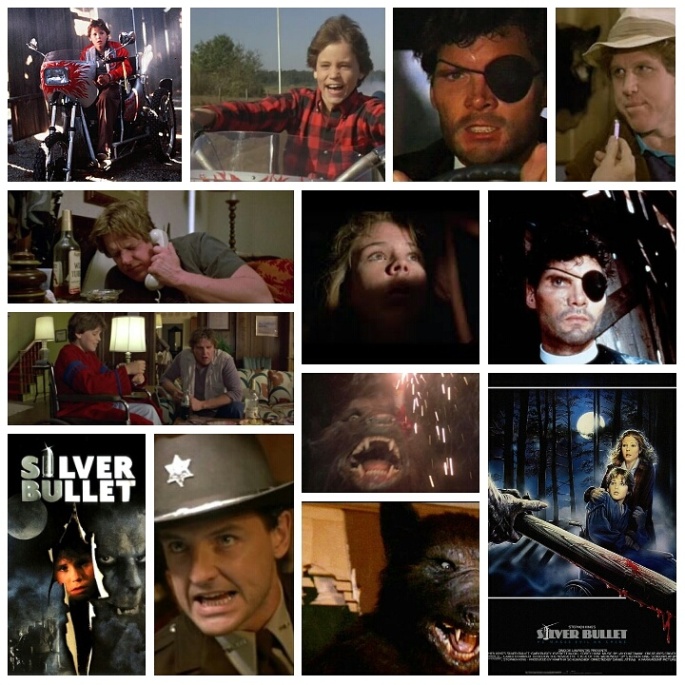
Stephen King’s Silver Bullet is one of the most charming werewolf flicks in the stable, one that combines adult orientated, gory horror with the fable-esque, childlike sensibility that seems to permeate King’s work. It’s also quite funny, thanks to the presence of a boisterous, rotund and quite young Gary Busey. Young Marty (Corey Haim) lives in a sleepy little town where not much of anything happens, until a rash of brutal murders occur in the area. Attributed to a serial killer by townsfolk, Marty has other ideas, specifically that a werewolf has taken up residence among them, and is snatching victims in the night. Taken seriously only by his sister (Megan Follows) and kindly Uncle Red (Busey) he bravely stalks suspect number one, who happens to be the creepy town priest (an intimidating Everett Mcgill). Things escalate into a series of gooey, effects driven set pieces that drip with wonderful 80’s schlock and awe, as of course is the tradition with anything based on King’s work. Other notables include Terry O Quinn, Bill Smitrovitch, Lawrence Tierney, King’s own son Joe Wright, and late great character actor James Gammon in an opening sequence cameo. It’s not all that scary, but more about the beloved tropes of such stories as these, the timeless monsters that inhabit them, as well the the intrepid young heroes whose lives growing up and finding themselves equally as important and high stakes as the horror elements. 

Stephen King’s Sleepwalkers: A Review by Nate Hill 

Stephen King’s Sleepwalkers has a reputation as one of the lesser quality adaptations of his work, which led me to put off watching it for years. Well I don’t know what film the critics saw, cause the one I watched was wicked good. Nestled in that perfect area of 80’s horror where the blood was corn syrup, the flesh was latex, there wasn’t a pixel or rendering in sight and atmospherics mattered more than excessive violence, this is one serious piece of horrific eye candy with the backbone of King’s wicked imagination to hold it steady. The story tells of a small Midwestern town (is there any other kind in the man’s work?) That falls prey to a pair of vampire werewolf hybrid creatures who subside off the blood of virgins and morph into slimy behemoths that conveniently show off the impressive prosthetics. Brian Krause is one of said creatures, drifting into town with his creepy mother (the wonderful Alice Krige) and setting his sights on severely virginal schoolgirl Madchen Amick, by dialing up the charm past eleven. People and animals start to die all over town and the suspicions arise, but the pair are cunning and have most likely been doing this for centuries almost unnoticed. It’s nothing too unique as far as the concept goes, but the fun of it lies in the gooey special effects and one demon of a performance from Krige, a veteran stage actress. She is one part beautiful seductress (even to her son, in one unsettling scene) and one part volatile banshee, setting your nerves on edge time and time again throughout the film. Krause does the demonic James Dean thing nicely and Amick shows blossoming reilience beneath the required mantle of terrified cream queen. The three of them run amok in a beautifully realized fever dream of psycho sexualized terror, small town atmospherics and a classic old school horror climate. This film loves it’s cameos, so watch for Clive Barker, Ron Perlman as a grouchy state trooper and King himself as the world’s dumbest graveyard caretaker. Baffles me why this was panned upon release. It’s actually one of the best films I’ve seen based on King’s horror work, and there’s a lot to compete with. 

Netflix’s Stranger Things: A Review by Nate Hill 

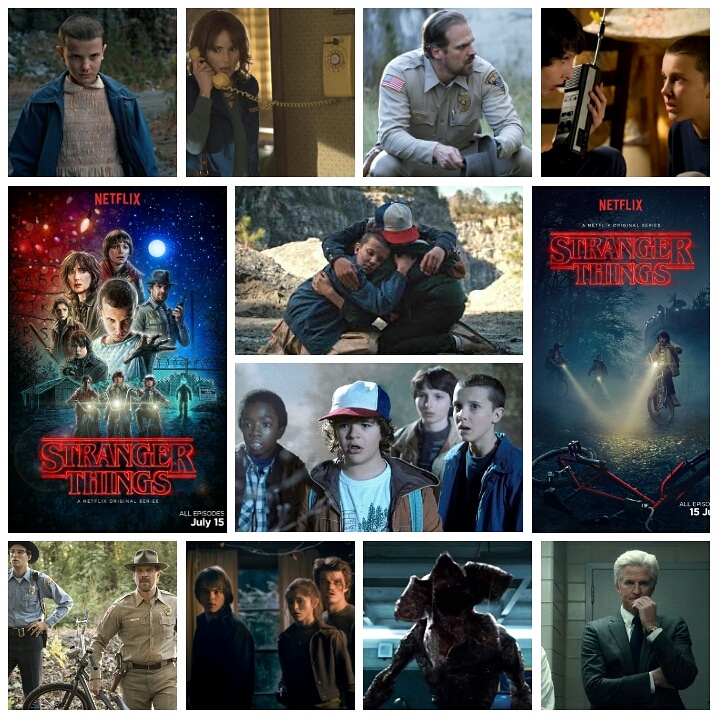
Netflix’s Stranger Things snuck up and floored me. You’d think that a long form mystery series concocted from the DNA of Amblin/ET/Goonies and retro, gooey Stephen King horror would have made a significant blip on my radar months in advance, but nope. That almost made watching it even more special; this wasnt something I’d spent oodles of time hyping up and thinking about (which often leads to expectations being dashed). It came out of the blue and knocked me sideways six ways to Sunday. I came home one night with the notion to check out the pilot before I went to bed. I fell deeply in love within the first ten minutes, and slashed my curfew to bits as I devoured about half the season in one go, hitting stop only because I would have been depressed to wake up the following morning and have no more to watch. I took the next day off work to finish up the remaining episodes, after which I sat there in a gaping stupor. I’ve since rewatced it all again. Yes, it’s that good. It’s not just the nostalgia bursting at the seams that suckered me in. This is is a show with a meticulous pace where you feel every beat naturally, some of the most fleshed out characters of recent times that you actually really CARE about, and a wondrous story relating to fear of the unknown, the bonds of friendships both new and old, redemption in the face of ages old trauma and grief, a reverence to all things creepy & crawly, an understanding of the importance fear holds in both our entertainment and collective psyches and above all, a sense of adventure. As soon as the retro opening credits flared up, I knew I was in for something special. They’re a flurry of neon letters that assemble in fashion and font achingly similar to King’s books, set to an ominous synth rhapsody that echoes everything from Refn to Sinoia Cave’s Beyond The Black Rainbow. Immediately we are transported to a setting drawn forth from the past and the nightmares of many other artists before it’s time, which is not to say it’s at all derivitive or lazy. That’s the issue with deliberatly nostalgic stuff: it can come across as forced or cheap novelty trying to play to our sentimental sides. This one uses it naturally and never feels like a gimmick for one second. What’s amazing is that despite the fact that nearly every element of story it uses has been done before multiple times throughout the years, it all somehow feels completely new, and never once leans on the crutch of inspiration any harder than it has to, which in this day and age deserves a goddamn medal. The story opens up in small town Hawkins, Indiana, sometime in the mid 80’s. Just outside of town, trouble brews deep within a mysterious CIA sanctioned research laboratory. A dangerous portal is opened, something from another dimension gets out, a girl with telepathic abilities named Eleven (Millie Bobby Brown) escapes into the town, and young Will Byers (Noah Schnapp) disappears without a trace from his home. All this happens in the first half hour, kicking off a well timed wind chime of inciting incidents to get the tale underway. The town is thrown into a panic as Will’s mother Joyce (Winona Ryder) frantically searches for him. The forlorn, sad sack police chief Hopper (David Harbour, beyond excellent in so many ways) tries to reign in the growing mania, but the situation only gets worse. Will’s sister Nancy (Natalia Dyer) witnesses another disappearance, and Eleven finds herself hiding out with Will’s endearing gang of buddies (Finn Wolfhard, Caleb Mclaughlin and Gaten Matarazzo), who valiantly launch a quest to ensure his safe return from the netherworld. Meanwhile, the laboratory’s sinister, silver haired head Doctor Brenner (a chilling Matthew Modine) is an amoral prick who will stop at nothing to get Eleven back and continue his godawful experiments. It’s a hell of a lot crammed into eight hours, but not a second is wasted, not a scene or a line of dialogue misplaced. Everything glides smoothly and the whole thing is so joyously watchable that I had trouble even thinking about picking up my phone or reaching for the iPad (I’m easily distracted). There’s teen drama, heartbreaking tragedy, first love, palpable danger without being too gory or messed up, and damn if the Spielberg/King flavour isn’t just delactable. The monster is a gooey, walking Venus fly trap that instills real fear in the opening moments of the pilot. The ideas explored are presented in ways that would make both the X Files and Twilight Zone jealous. My favourite performance has to be Brown as Eleven. Of all the child roles hers is the most difficult to land and she’s a revelation. Seeing the world outside the facility with new eyes, falling for Wolfhard, protecting her newfound friends, it’s all handled impeccably and I think we can expect great things from this young actress. David Harbour has consistently shown versatility in anything he does, and when one looks at his role here contrasted against work in, say, A Walk Among The Tombstones, it’s uncanny. His arc goes from sheepish to badass to tragic and he positively soars. Modine channels the very essence of King style villains, over pronouncing every syllable with poised venom on the tongue and cloaked malice oozing from every pore. Ryder works herself up into a frenzy that any mother must feel in the situation, and it’s just great to see her in a central role in anything these days. The kids provide heart and levity, proving wise beyond their years to the point of Calvin & Hobbes esque insight, yet still maintaining their innocence in the face of peril. Not only does the soundtrack showcase a whole whack of 80’s treasures (that Joy Division tho♡), the score itself by Kyle Dixon and Michael Stein is a love letter to everything from Tangerine Dream to Cliff Martinez, evoking the setting beautifully and bringing forth atmosphere in scene after scene after scene. Stranger Things lovingly blows a trumpet of times past, wears it’s influences proudly and unobtrusively on its sleeve and brilliantly blazes it’s own trail. There are monsters out there, both human and otherwise. Never give up hope, not matter how bleak the prognosis. There’s still some wonder and unknown to be discovered in this world of ours (and beyond). Redemption is only a few daring acts around the bend. Kindness goes a long way, as does trust. Friends don’t lie. These are but a few things you’ll discover if you give this one a shot, which I hope you will. Bring on Season 2, man.

Stephen King’s Firestarter: A Review by Nate Hill 

Film versions of Stephen King novels can be a tricky thing. Often they’re half assed,  clunky miniseries (ever tried to sit down and watch The Langoliers??), and when they’re given the lofty cinema treatment, he has famously turned his nose in the face of Kubrick’s might. I feel like Firestarter escaped unscathed, and still holds to this day, if a bit achingly retro now. It’s a thriller perceived in a childlike manner by its young protagonist, Charlie Mcgee (Drew Barrymore). Charlie can start fires with her mind, and certain shadowy agencies just can’t wait to get their hands on her. Her father (David Keith) once participated in some scary drug testing related to telekinesis back in the day, and some of whatever altered his DNA has been passed on to her. He will do anything to protect her, as the two frantically race across the country to safety, pursued by forces working for Hollister (Martin Sheen), a spook with too much power and nasty ideas about what to do with it. Also on their trail is pseudo spiritual whacko John Rainbird, who wants to absorb Charlie’s abilities, man what a freak. Rainbird is a native American in King’s novel, so white haired yankee boy Scott is an odd choice, but he does a fine job all the same. Two things are what makes this one really stand out in a special way. Tangerine Dream provides yet another ultrasonic, elemental synth score that has since become legendary. It accents the story in an almost fairy tale like way, gilding the danger with a fable style sound, but never stamping out the real menace. Barrymore is the other leg of the table, giving one hell of a fierce and vulnerable performance for such a young girl, her childlike honesty a prism for the audience to see the evil around her through innocent eyes. It’s great stuff, and one of the most solid King adaptations out there. Now there is a sequel (not sure if the man wrote a second book?) called Firestarter 2: Rekindled, which pales in comparison and runs about 45 minutes too long (!), but it’s worth a look for the casting of Marguerite Moreau as a grown up Charlie, Malcolm McDowell taking over from Scott as Rainbird, and Dennis Hopper as well. 

Hearts In Atlantis: A Review by Nate Hill

  
The one great benefit that any film based on a Stephen King story has is just that: it’s based on a Stephen King story. The guy is just such a prodigy of fiction that even if the film version of one of his books doesn’t deliver, one can still see the brilliant blueprint lurking beneath the frames. When the filmmakers are successful, however, we get a visually stimulating project founded on the tale he has weaved to support all the other elements. Hearts In Atlantis is based on an anthology volume of his, and in fact the story the film follows isn’t even called that, it’s actually ‘Low Men In Yellow Coats’. I can see why the director went with Hearts In Atlantis though, as it’s much more akin to the ethereal, sentimental tone he was going for, and less of an ominous hook. The story itself follows a mysterious man named Ted Brautigan (Anthony Hopkins), a recent tenant in the home of young Bobby Garfield (Anton Yelchin) and his wayward mother (a miscast Hope Davis). The setting is Midwestern America, in the dead heat of a 1950’s summer. Bobby spends his days cavorting in the local woodlands with his fastest of friends, Carole (Mika Boorem) and Sully (Will Rothhaar). He takes a shine to Ted though, who pays him a dollar a week to read to him, and warns him of shadowy ‘low men’, threatening figures who doggedly pursue him for nasty reasons. Ted becomes a father figure for young Bobby, whose mother has questionable ideas about not only raising a son, but taking care of her own affairs. Now the film may seem a bit thinly plotted to some, and there’s a reason for that. This story is actually a tiny fragment in a much larger tale, King’s magnum opus The Dark Tower. Ted and Bobby have important parts to play in that saga, in which the events of this film are but a sentence long. Some viewers may feel slighted by a lack of context, but the filmmakers here still find a way to make this its own story, crafting a touching coming of age story melded with whispers of otherworldly intrigue. The fusion of beguiling nostalgia and the vague menace that advances on Bobby and Ted makes for a unique tone, something just south of a thriller which can’t quite be pinned down by genre labels. Hopkins can be both terrifying and tender depending on the role. Here he is kindness incarnate as a man whose worldly intuition goes beyond telekinesis into the kind of qualities reserved for the best and brightest. Yelchin and Boorem, who would star alongside each other again a few years later in the lacklustre Along Came A Spider, are the superb heart of the film. Yelchin has shown a constant progression of strongly realized, believable work and the quality of his craft can be traced back to this stunning genesis role. Boorem is highly underused these days, and one need only watch her light up the screen with emotional sincerity in this to see why she should be working far more. There’s neat supporting work from Tom Bower, Celia Weston, Alan Tudyuk and David Morse as an older version of Bobby who yearns for days gone by. I found myself deeply enjoying this one whilst constantly drawing back to the knowledge and context I have for it via The Dark Tower, but the film on it’s own is enough to provide a rewarding experience for anyone who isn’t familiar with the multiverse. Amid King’s favourite topics and settings are Midwest adolescence, idiosyncratic nooks of Americana and the ever present supernatural aspect, dynamics which Hearts In Atlantis gives us aplenty, along with an open invitation to explore the universe farther, should one want to venture along the path to the Tower. I’d recommend it.