“CHEESEBURGERS, NO BONES!” : An Interview with Mick Garris by Kent Hill

Garris1

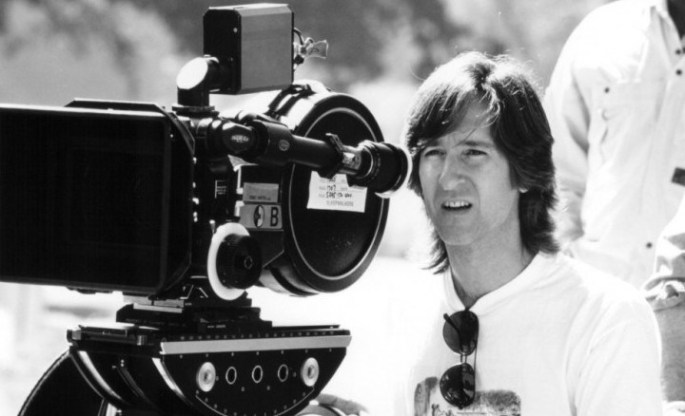
It took a while to get a hold of Mighty Mick – but I’m glad I had the patience. See Mick Garris is one helluva talented man. His passage through the movies is a veritable plethora of Amazing Stories – apart from the show-of-the-same-name where he achieved career lift off.

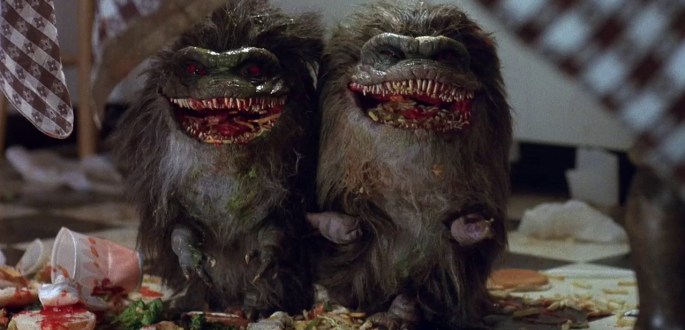
Since those early days he has gone on to become a prolific writer, director, producer, author, podcaster – the list goes on. He made me laugh with Critters 2, he was the writer of The Fly 2, which was one of the only times a film has forced me bring up my lunch, and he has conducted wonderful and insightful interviews with fellow filmmakers – some, sadly, that are no longer with us.

Through it all Mick remains the soft-spoken gentleman with a passion for his work and cinema in total. He has had a long successful run of adapting the works of Stephen King for the screen. I have vivid memories of sitting through, night after night, his extraordinary adaption of The Stand. This he beautifully followed up with further adaptions of Bag of Bones and The Shining, in which King adapted his own book, and which Mick credits as one of the best screenplays he’s ever read.

He was instrumental in bringing together the Masters of Horror as he was composing the elements which formed great movies either under his pen, or benefiting from his exquisite direction. Follow this link ( https://www.mickgarrisinterviews.com/  ) to Mick’s site and check out the bona fide feast of delights for cineastes he has on offer. As I said to the man himself, “You have a lot of fingers in a lot of pies, and I can’t wait to cut me a slice of whatever you serve up next.”

So, without further ado,  it is my privilege to present to you . . . the one, the only . . . Mick Garris.

Christopher Nolan’s The Dark Knight Rises

Christopher Nolan’s The Dark Knight Rises faced a tricky maneuver: providing a follow up to the earth shattering, delirious success that was 2008’s The Dark Knight. The film was never going to be as good as or better than that lightning in a bottle stroke of genius. However, the film we did get is one epic, operatic sonic boom of a Batman film, and if there’s one area where it does in fact outdo The Dark Knight, it’s in scope. The action set pieces here have an earth shattering, monumental quality to them, mainly thanks to Tom Hardy’s Bane, a full on monster who brings biblical destruction to Gotham City with some calculated, maximum impact attacks that almost blow the speakers of any system they’re shown on. Despite the apocalyptic blitzkrieg, Nolan loses none of that precious philosophy that has made this franchise glow so far, the sharp-as-a-tack dialogue and moral complexities of existing in a world of vigilantes and terrorists. It’s been eight years in Gotham since Batman took down the Joker and, somewhat controversially, the fallen angel that was Harvey Dent. Bruce Wayne has become a crippled recluse while the city more or less flourishes quietly, but there’s nothing that’ll roust a burg out of tranquil slumber like the arrival of a seven foot tall, highly trained psychopath bent on chaos. In a vertigo inducing opener set atop the clouds, Bane triumphantly crashes a CIA aircraft and makes off with its cargo, a mere taste of his brutality to come. Bruce is forced out of hiding to do battle with him, and before you know it they’re all thundering around Gotham’s tunnels and edifices, pursued by hordes of snarky GCPD, who no doubt have missed this kind of action for a near decade. The new commissioner (Matthew Modine) is a hotheaded nimrod, while Gordon (Gary Oldman, the gravitas is real with this guy) still hurts from the tragedy years before. Anne Hathaway throws a wicked curveball of a performance as Selina ‘Catwoman’ Kyle, and although no one will ever, *ever* top Michelle Pfeiffer’s brilliantly kinky turn years before, she’s a deadly force to be reckoned with both for Bruce and the criminal factions vying for power. Hathaway seems like a sanitized choice for the cat, but she’s deft, sexy, formidable, competent and looks damn good in that outfit careening around on Bruce’s batbike. Marion Cotillard is great as the mysterious Miranda Tate who may be more dangerous than she seems, a shtick which Cotillard unnervingly perfected first in Inception. Morgan Freeman and Michael Caine are top notch as Alfred and Lucius once again, Ben Mendelsohn plays up a sleazy business rival for Bruce, Juno Temple is cute as Selina’s off again, on again lover, Joseph Gordon Levitt’s intrepid detective gets a whole lot of plot momentum and crazy good dialogue, and the jaw dropping lineup of supporting work includes Brett Cullen, Burn Gorman, Desmond Harrington, Chris Ellis, Robert Wisdom, Tomas Arana, Aiden Gillen, Brent Briscoe, William Devane, Nestor Carbonell, Reggie Lee, Wade Williams, Christopher Judge, a brief reprisal from Liam Neeson and Cillian Murphy as that pesky Scarecrow, the only villain who appears in all three films. The story goes to places the other two films never ascended to, and if the Joker thought his antics aspired to anarchy, he’d do flips when Bane literally starts blowing up the city on a massive scale, an extended sequence that’s delirious in it’s armageddon worthy panic. On a more personal scale, Batman deals with being broken, the cost he must pay to ultimately save his city, and the unknowable matter of when to cash out as a superhero, or forever give up your soul to a fight that has neither end nor reason. My only issue with the story is how a certain third act revelation pretty much neuters Bane’s character arc and renders his whole fearsome nature somewhat too human and redundant when all is said and done, it’s a narrative decision Nolan should examine closely for his own sake, and avoid such an impotent cop-out when writing his next arch villain. The cinematography is aces, the cgi blending seamless, Hans Zimmer’s score gives us the classic thunderstorm passages we’ve come to love while adding a rhythmic chanting for further depth and flavour. There’s not much that can be said that’s negative about the film, it’s one hell of an achievement and doesn’t let up until the Big Bang of an ending provides release for the franchise and every character in it, an expository epilogue in which loose ends are tied, and some semblance of peace is found. A near perfect third act to the trilogy, and a superhero flick for the ages.

-Nate Hill
Tales of Enchantment, Aliens, Arthurian Legend and the Lone Ranger: An Interview with Edward Khmara by Kent Hill

Error
This video doesn’t exist

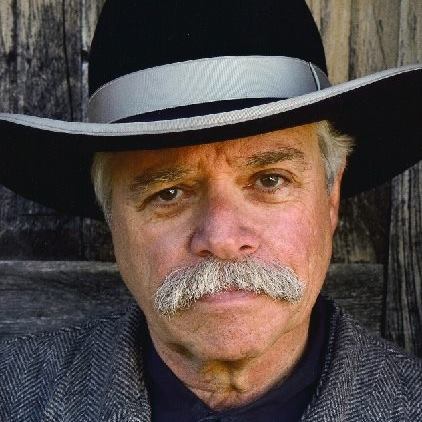
Edward Khmara grew up in California and had the desire to become an actor when he sold his first script and his career was set in motion.

20953522_10155553866626092_7928168128293857562_n

It was not the first script he’d written, but he was the one that got him noticed. It was a little film called Ladyhawke. But, as all first-time screenwriters know, once you make that sale, you have very little input into the journey your film will take from there.

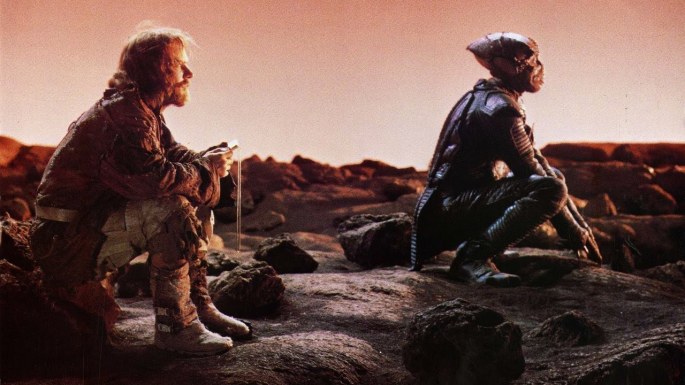
Still, now a screenwriter, Edward would go on to pen one of the truly great, often forgotten gems of the eighties, Hell in the Pacific in outer space: Enemy Mine. This time he would right in the middle of it all. From being on set, to being invited to watch dailies, to having to comfort his daughter after her terrifying encounter with a completely transformed Louis Gossett Jr. in his Drac make-up.

Like most folks who have worked in show business, Edward has known the lows as well as the highs. But those negative experiences didn’t discourage him as he charged ahead, tackling to legends. One in the form of a lavish television production with an all-star cast; Merlin would be the telling of Arthurian days solely from the perspective of the mythical wizard. Then of course there would be his work on the retelling of the life of another legend, one who achieved this status during his own lifetime, Bruce Lee.

But one of the truly heart-warming moments of our conversation was chatting with Edward about him finally getting his shot at the profession he sought after before he took to the typewriter – his part in Gore Verbinski’s Lone Ranger.

A true gentleman of the old school, full of great tales and tremendous experiences – it was a real pleasure to interview him and now to present to you my conversation with the legendary screenwriter (and sometimes actor) Edward Khmara.

Joseph Kosinski’s Oblivion 


Joseph Kosinski’s Oblivion is slightly flawed Sci-Fi heaven, a film that could have easily been perfect if it weren’t for a few snags, chief among them being over-length and lack of clear plotting. There’s so much going on in the realm of visual and auditory stimuli though that one can let oneself just get wrapped up in the pure music video style rhythm of it. Speaking of music, the film only really exists to serve the absolute banger of an electronic score from M83, a gorgeous album packed with sonic synths, beautiful thundering beats and celestial interludes complete with angelic vocals from Susanne Sundfor. Kosinski pulled a similar stunt with Tron: Legacy, hiring Daft Punk to whip up a soundtrack that outshines the actual film itself, and while that’s certainly the case with Oblivion as well, there’s much fun to be had in other aspects, particularly visually. Tom Cruise is Jack, steward and caretaker of a small piece of the earth’s surface after an alien ambush forced most of the human race to run off to one of Jupiter’s moons. Collecting data and doing routine scope checks on his sleek hover bike, he’s a curious fellow who begins to see the lapses in logic and believes there’s something else at play other than survival, a notion that his partner (Andrea Riseborough) and dispatch handler Sally (a sly Melissa Leo proves that one can still be effective when skyping in one’s performance). Jack is haunted by visions of a beautifully mysterious girl he’s never met (Olga Kurylenko) and pursued by dangerous surface dwelling scavengers led by Morgan Freeman and Jamie Lannister. The film’s story is a cool one indeed and has a whopper of a twist, but the pacing and exposition just can’t seem to get itself out of a slight muddle and impart these events to us in a clear, unhindered fashion, a kink that no doubt could have been worked out with a little more time spent in the editing room. The aesthetic production design is a wonder, calling to mind everything from Half Life 2 to Portal while retaining it’s own unique, modernized look (I want that glass sky pool/deck so bad). It’s all about that score though folks, and it’s an album for the ages, bringing to life a film that otherwise just wouldn’t have been as memorable. 

-Nate Hill
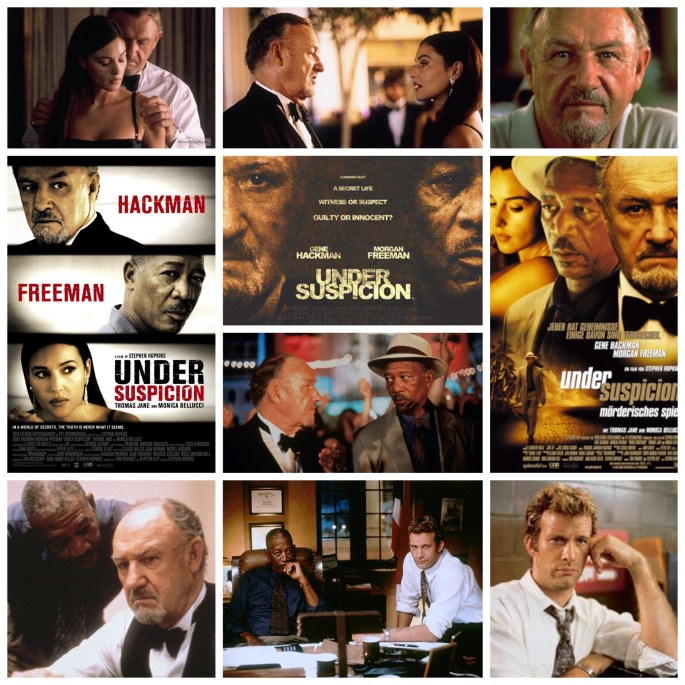
Stephen Hopkin’s Under Suspicion 


If Stephen Hopkin’s Under Suspicion were a meal I was served at a restaurant, I would throw it against the wall, flip the table, walk promptly back to the kitchen and knock the chef out cold. It’s a hollow, pointless piece, like digging into a pie that’s put before you only to find that under that layer of crust there’s no filling, only air. The premise is promising: wealthy businessman Gene Hackman who has political ties is grilled out of the blue by longtime friend and police detective Morgan Freeman and his partner Thomas Jane, regarding the murder of a thirteen year ago old girl in the slums of San Juan. Hackman is a successful, assured alpha socialite, and these type of men always have some type of close guarded secret which comes to light. Freeman is a dogged working man who probes him until it almost seems personal rather than routine. Sounds terrific, right? You would think. The acting is of course fine, as these guys couldn’t miss a beat if they tried, but the way the story is set up just rips the viewer off blind. These two thespians soar spectacularly, but their duel is structured around purposefully unreliable flashbacks, beating around the bush and oodles of red herrings that treat the audience like sixth graders watching a low rent magician at a birthday party. Hackman has a pretty trophy wife (Monica Belluci, underused) and a host of personal demons that he projects onto Freeman’s simple blue collar rhetoric like a defence mechanism. None of these narrative fireworks can save it though, especially when an ending rolls around that is the very definition of a letdown, through and through. In an attempt to explore the forces that drive a man to the edge of admitting guilt whether he is responsible or not, the filmmakers miss the boat on providing a focused treatise that takes itself seriously with these potentially fascinating themes, instead settling on an overcooked, ultimately vacant that could have been so much more.  

-Nate Hill

Tom Clancy’s The Sum Of All Fears


Surprisingly, The Sum Of All Fears is my favourite film version of Tom Clancy’s Jack Ryan novels. Alec Baldwin did a bang up job in the superb Hunt For Red October,

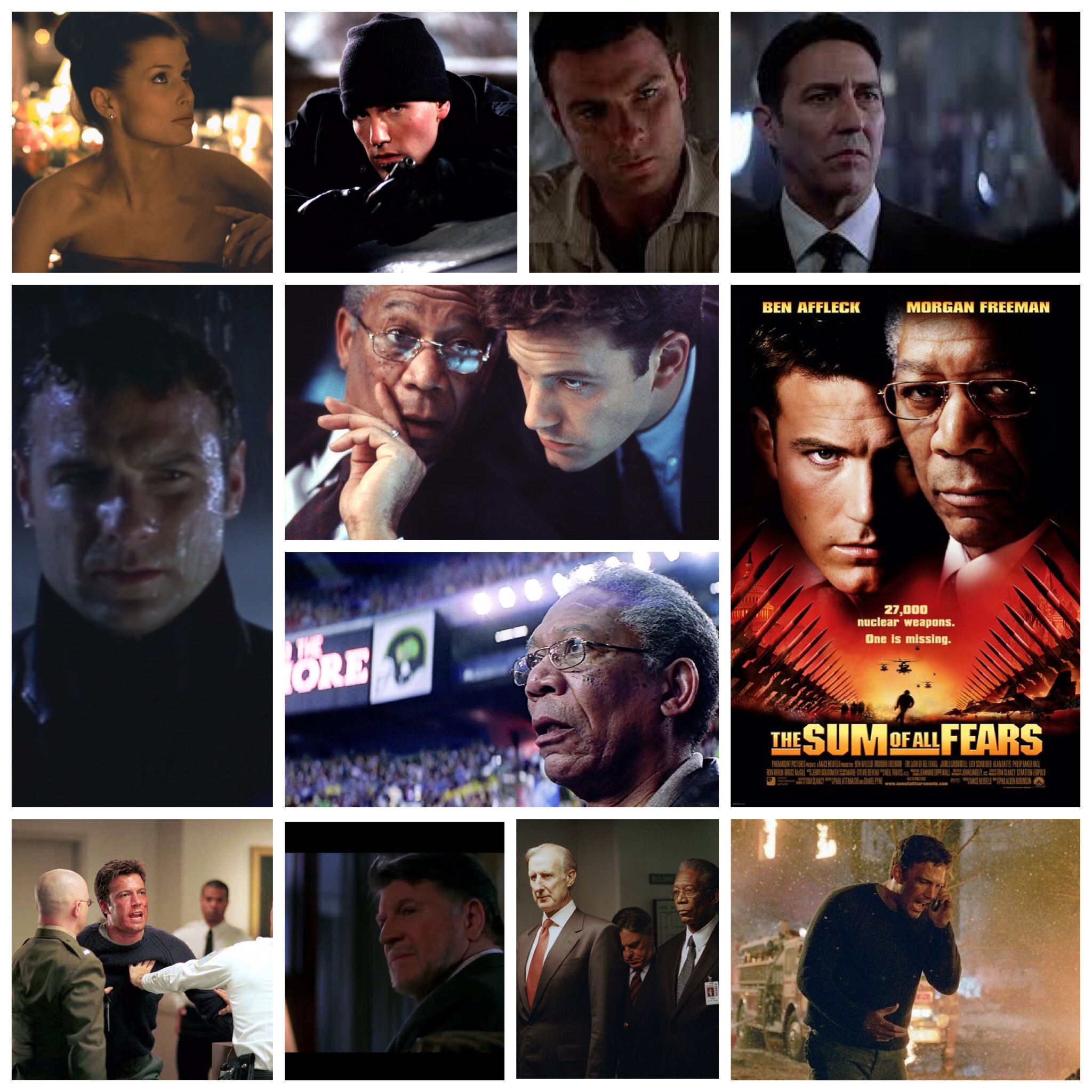
Harrison Ford held his in two beyond excellent entries, and we won’t speak of the Chris Pine/Keira Knightley snooze-palooza from a few years back. Why then do I gravitate towards this Ben Affleck incarnation? Who knows. Battfleck himself makes an adequate, inquisitive Ryan, on the younger end of the rope and under the guidance of CIA Yoda Morgan Freeman. I think it’s the early 00’s tone of the film itself though, the whip smart editing, Bourne-style escalation of suspense and terrific ensemble cast, a hallmark among Clancy films. Affleck embodies a younger, inexperienced Ryan whose infamous intuition is just breaching the surface of his character, right on time for a deadly plot to set off a nuclear device on American soil. A German radical (Alan Bates, underplaying evil nicely) with vague ties to a Neo Nazi faction is cooking up a false flag attack against Russia, using a long dormant warhead supplied by arch mercenary Colm Feore. Or at least I think that’s the crux of it, these cloak and dagger affairs can get pretty dense on you sometimes. There’s a sense of global danger though, a level of stress that ratchets up until even the stoic US President (an explosive James Cromwell) begins to lose it. The Russian President (Ciaran Hinds) gravely tries to sort out the misunderstanding, whilst Clancy staple character John Clark (Liev Schreiber gives Willem Dafoe a run for his money) covertly smokes out conspirators. Unease and tension nestle into the narrative, and when that impending disaster is minutes away during a hectic NFL game, you can feel the suspense in the air. The supporting cast is rich with talent including Michael Byrne, Bruce McGill, Philip Baker Hall, Josef Sommer, Ron Rifkin, Lisa Gay Hamilton and gorgeous Bridget Moynahan as Ryan’s fiancé. I’ve got nothing but love for Red October, Patriot Hames and Clear & Present Danger, but something about this one hit a frequency and resonated with me a little better, coming out on top as the most re-watchable, enjoyable entry.  

-Nate Hill

B Movie Glory: The Code


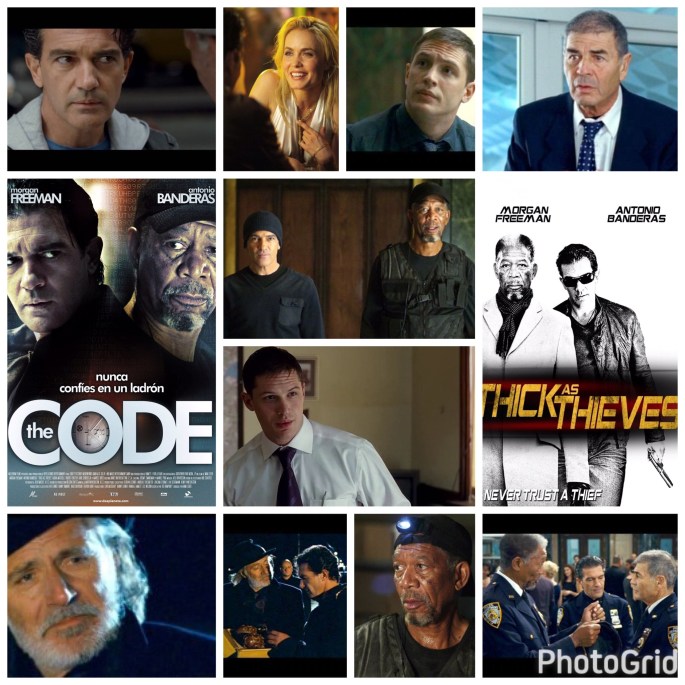
The Code, or Thick As Thieves as it’s known on DVD in some regions, is pretty much just Morgan Freeman and Antonio Banderas strutting their way through a B-grade, R-rated Ocean’s Eleven. It’s second tier stuff, but it has one hell of a cast and enough serpentine twists and betrayals to keep the viewer interested. Freeman plays a slick master burglar, recruiting Banderas’ younger thief to pull off one of those ‘impossible’ heists that requires all kinds of over elaborate planning and stylish execution. This is all in order to pay an outstanding debt to the Russian mob in the form of dangerous Rade Serbedzija, aka Boris the Blade, aka Boris the Bullet Dodger, who has a few surprising secrets of his own. All of them are also hounded by a classically dogged detective (Robert Forster, intensely excellent) and his rookie partner, who of all people is played by Tom Hardy in a role so small and random I’d love to hear the tale behind his casting. There’s also an obligatory love interest for Antonio, played by leggy Radha Mitchell. Now, it’s all mostly as pedestrian as it sounds, except for a few garnishing touches that elevate it just enough that it sticks in your memory. The master thief. The Ahab-esque cop. The vicious Eastern European gangster. The love triangle. Backstabbing. These are all ancient archetypes that have been done quite literally to death, and they’re all present and accounted for here, but there’s a few moments that genuinely surprise and break feee of that somewhat. Revelations involving the Russian who isn’t what he appears to be, a third act twist that feels welcome, and snares of dialogue that snap our attention amidst the cliches. For what it is, it does its job well enough, and a few times shows actual inspiration. Not bad at all. 

-Nate Hill
Red: A Review by Nate Hill 
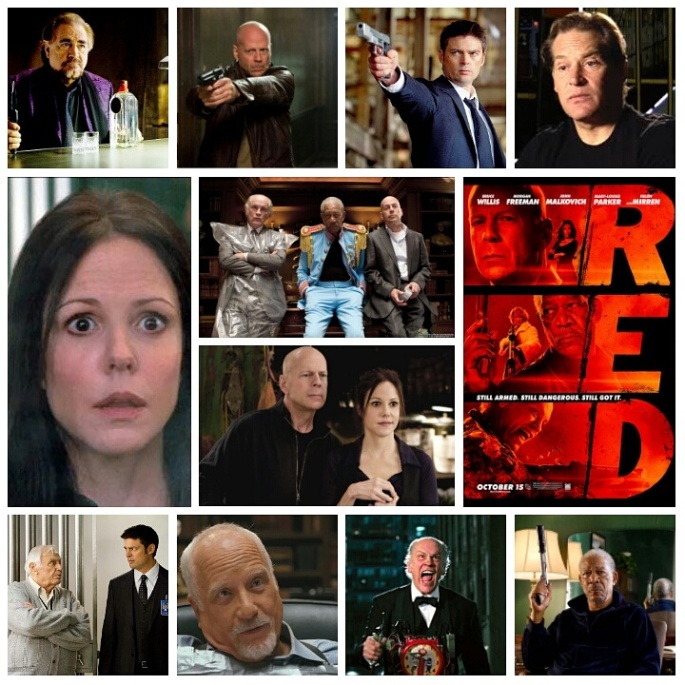
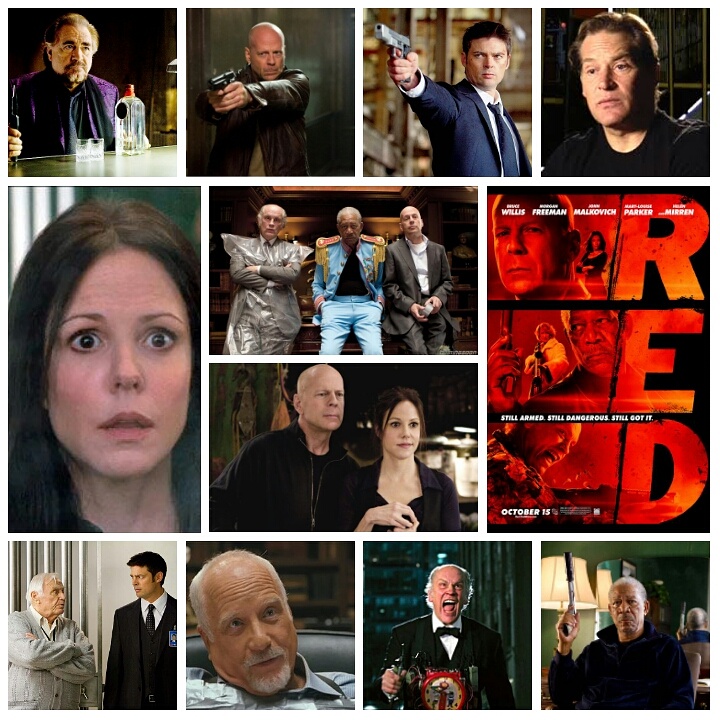
Despite being somewhat neutered by the ever present annoyance of the PG-13 rating, Red is some of the most fun you can have with in the glib assassin subgenre of action comedy. Bold, hilarious and just a little bit demented, it jumps right off the pages of the graphic novel it was based on for just under two hours of wiseass popcorn movie nirvana, hosted by a cast that’s almost too good to be true. ‘RED’ stands for ‘Retired Extremely Dangerous’, a moniker given to aging ex contract killers who have laid down the guns, but are still closely watched by the CIA. Frank Moses (Bruce Willis) is one such person, languishing in the doldrums of forced retirement, bored out of his mind and chatting endlessly with a cutey call center girl (Mary Louise Parker). Things get freaky when deranged former associate Marvin Boggs (John Malkovich) pays him a visit, belting out wild theories about the CIA sending operatives to terminate him. Before he knows it, Frank is swept up in espionage and intrigue once again, pursued by a slick, ruthless agency man (a deadly Karl Urban doing the anti-007 shtick nicely), with Parker in tow, whose terrified reactions to the escalating violence and deadpan sociopaths around her get funnier and funnier as the film progresses. Helen Mirren is regal gold as a well spoken ex MI6 spook who dissolves corpses in bathtubs full of acid, right before afternoon tea, I presume. Watching this dainty waif rock a Barrett 50 caliber and make red mist out of her enemies is one of the many mental pleasures one can get from this flick. Morgan Freeman takes it easy as another former buddy of theirs from the older, and I imagine, more agile days. As for the supporting cast, hell, take your pick. Richard Dreyfuss is a slimy Trump-esque politician lowlife, an underused James Remar shows up for a very brief cameo, as does that old toad Ernest Borgnine, Julian McMahon once again shows that no one wears a suit like Julian McMahan, and that lovable imp Brian Cox almost walks away with the film as a sly devil of a Russian agent who woos Mirren with the silver tongued virility of a fox. What works so well the dynamic between the three leads; Malkovich is mad as as hatter, Willis plays exasperated babysitter and Parker looks on in horror that starts to turn into amusement with every outlandish scenario. Action comedies are tricky recipes, and it’s easy to let too much of one ingredient slip into the pot. This one keeps a steady trigger finger that’s locked onto the funny bone and positively sails. 

PTS Presents Producer’s Notes with EVZEN KOLAR

KOLAR POWERCAST

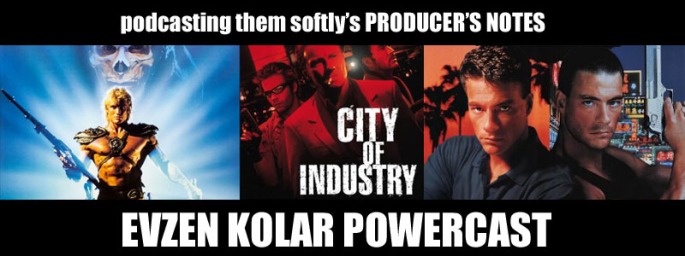
KOLARPodcasting Them Softly is incredibly proud to be joined with veteran producer Evzen Kolar whose credits include STREET SMART, the epic Cannon Film’s MASTERS OF THE UNIVRSE, DOUBLE IMPACT, SURF NINJAS, and a film that was made to be a featured film on Pocasting Them Softly, the 1997 hardnosed neo noir CITY OF INDUSTRY.  Evzen also produced the soundtrack that is a must own for any cinephile soundtrack junkie!  Before becoming a producer, Evzen worked as an assistant director, a unit manager on NEVER SAY NEVER AGAIN, and he has also done some stunt work.  Unknown to us prior, Evzen is married to Robert Shaw’s daughter, and we spend a fair amount of time talking about Robert Shaw!
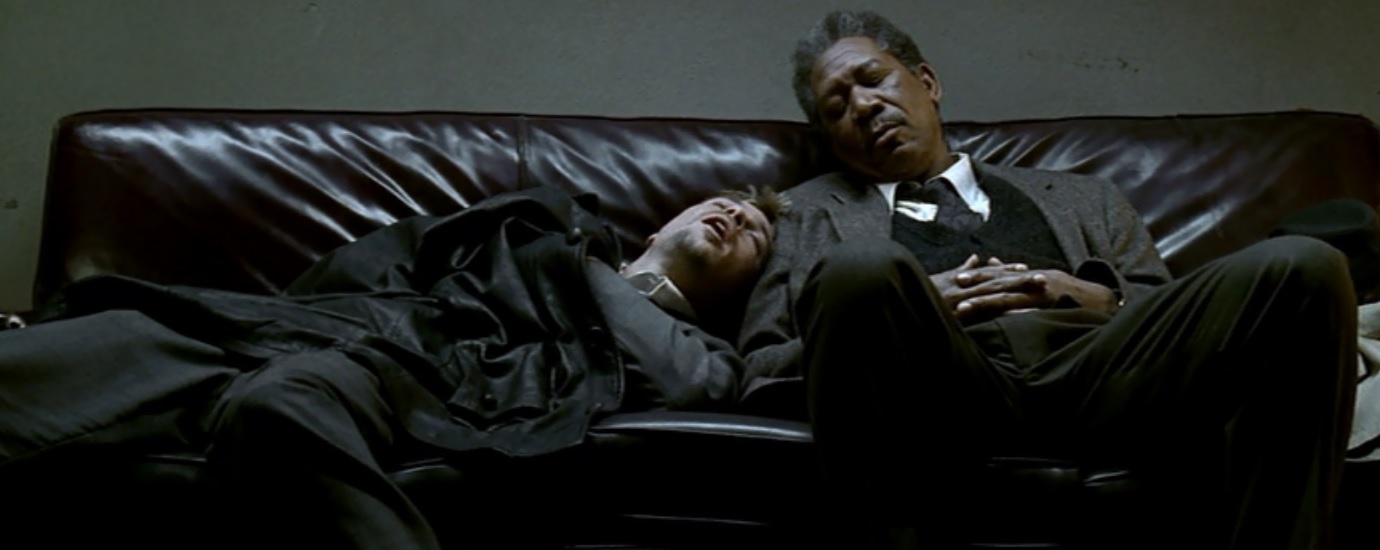
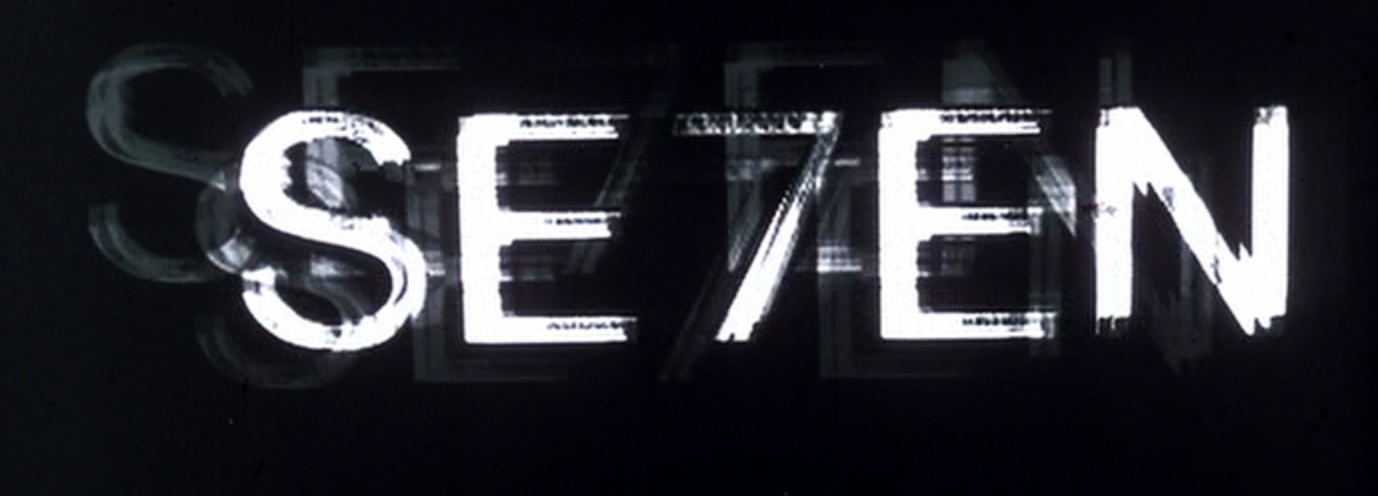
DAVID FINCHER’S SEVEN — 20TH ANNIVERSARY REVIEW — BY NICK CLEMENT

1

20 years ago, New Line cinema dropped a dark hearted cinematic wake up call in the form of David Fincher’s immortal serial killer thriller Seven. It made a legitimate star out of Brad Pitt, giving a nervously twitchy and playfully cocky performance as a young cop who thinks he knows what he’s getting himself into, and it further cemented Morgan Freeman’s status as a premiere acting force, giving him the chance to riff on the sage, retiring detective character made famous by so many genre offerings. And rather importantly, Seven boldly announced Fincher as a serious directorial talent to contend with, affording him the chance to take material that was directly up his casually cruel cinematic alley, and put his own distinct and rigorous aesthetic stamp all over it. To this day, the film remains frightening and startling to watch, as the twists and turns still feel fresh and diabolical, even when you know how it’ll all finish up. I vividly remember seeing this film on opening night in the theater, at the age of 15, on the same weekend that Showgirls opened, and I can still feel the unease that settled in over the sold-out crowd during those final moments, when we all realized what exactly was in that box out in that field.

2

Screenwriter Andrew Kevin Walker’s brilliantly constructed screenplay withstands the utmost scrutiny, and demands total respect; this is a perfect cinematic onion, revealing layer upon layer of themes and narrative implications as each section is peeled off and removed. One of the most fascinating aspects of the entire film is that while it’s a crisply plotted procedural, the psychological undercurrents were never glossed over, with the film exploring the true root of evil, with explanations that feel scarily honest and all too believable. And the fact that the ending remained in tact, after much deliberation and wrangling and ultimatums, is still one of those “Thank The Cinema Gods” moments where the money people and the creative entities could all come to terms with exactly how they knew a film should finish. Darius Khondji’s elegantly nightmarish cinematography is the stuff of legend, each shot museum worthy, while also displaying a sense of grit and atmospheric dread and danger that immediately pulls the viewer into this hellish world on display (wisely, the exact city in the narrative is never explicitly mentioned). Arthur Max’s haunting production design evoked urban decay in ways that few modern films have ever done; this movie feels like it’s rotting at the core. The exacting editing by Richard Francis-Bruce knew exactly how to accentuate each and every scene for maximum impact, while the unnerving score by Howard Shore filled the background, never overpowering, always accentuating. And it goes without saying that the opening credits sequence is one of the most dynamic and influential bits of title design ever put on screen (this is an area that Fincher has always excelled at in all of his incredibly stylish feature films).

3

When Kevin Spacey shows up at the top of the final act the movie somehow gets even more sinister than it had already demonstrated, and the way he needles both Pitt and Freeman during that infamous car ride is a full-on demonstration of how Spacey knows exactly how to own a scene with total command. While attending California State University at Northridge, I had the insane opportunity to view Seven on a frame-by-frame basis, and studying how Fincher controlled his filmmaking was more than eye opening. Close to 98% of the film is shot with a stationary camera, only going hand-held in a few key instances (the hall-way shoot-out near John Doe’s apartment; portions of those climactic moments out in the field), and it was thrilling to see how Fincher and his team were able to heighten fear and suspense more with camera set-ups and pacing than anything else. Seven leaves more up to your imagination than it was credited for doing, as way too many people complained of excessive violence, which, to be honest, just isn’t there on the screen. Yes, clearly, there are more than a few gruesome sights on display, but in comparison to some other genre entries, Seven feels carefully and intelligently restrained in every single area, while always allowing for the idea of horrific human behavior to be lurking in every corner. This is a great and influential piece of filmmaking that ages like a fine wine.