Initially I felt the same way about Déjà Vu as I did Gilliam’s12 Monkeys. Both of the inaugural screenings I attended were sullied by external forces which greatly influenced my mood during the viewings and thus, my opinion of the films.
But time, it was once said, is the ultimate critic. Under different circumstances I watched both films again, and, this time around, my feelings toward both movies were drastically adjusted.
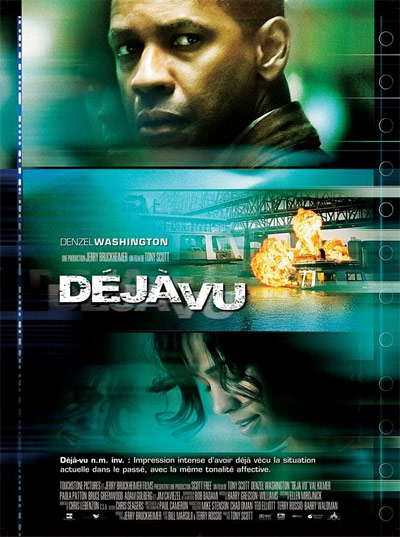
In several books on the art of screenwriting it is often put about that, if you cannot sum up the film you are writing in a single sentence, then you may want to rethink the plot. There is a great moment on the commentary track of this film in which the late, great Tony Scott admits that even he struggled to distill Déjà Vu into the logline form.
It’s a science-fiction/action/thriller/time-travel/romance in which the hero, Denzel Washington, meets the girl he will eventually fall in love with on the slab – dead as disco. Unbeknownst to him, he will eventually join a team that will, along with the help of a device that can see into the past, aid him in bringing her killer to justice. And it was from this humble yet intriguing premise that my guest, Bill Marsilii and his co-writer Terry Rossio constructed this rich, multi-layered tale which deserves more applause than some would proffer for its inventiveness and compelling real-world take on the age old time machine story.
???????????????????????????
But what I uncovered as I spoke to Bill was far more than a series of behind the scenes anecdotes and your typical boy meets idea, boy turns idea into a screenplay, screenplay sells for big dollars, boy lives happily and successfully ever after in Hollywood kind of scenario.
And yes, while it is true that Déjà Vu is the highest earning spec script thus far, beating out other entries like Basic Instinct, Panic Room and The Last Boy Scout, the story of how Bill came to, not only the concept, but how the writing and selling of the script changed his life is just as compelling as anything Jerry Bruckheimer and Co. managed to get onto the screen.
This interview, at least for me, proved also to be somewhat of a masterclass in, not only screenwriting, but the ever painful and soul-crushing journey the writer must endure to actually sell the script. It’s about the luck, timing, persistence and internal fortitude that you must have sufficient quantities to survive the gauntlet that exists between the page and the screen.
Bill’s heart-warming, inspirational adventure to make it in the realm where dreams are brought to life with that strange blending of art, science and commerce – that ultimately no one can tell you how, when a film is successful, it all comes together in the perfect proportions to ensure success is on the menu – is a conversation that could have gone on and on.
I hope you’ll will enjoy some extended insights into Déjà Vu, but more than that, I hope you, if you are one of those dreamers still out there trying to write your own ticket to cinematic glory, that Bill’s wisdom you’ll take onboard and continue pounding away on those keys until fortune smiles and your efforts will be coming soon, to a theater near us…
It’s hard not to be romantic about the sports film. From classics like The Natural and Bull Durham to more modern efforts like The Blind Side and Moneyball. They range across all genres and all sports. Football (Rudy, Any Given Sunday), Golf (Tin Cup, The Legend of Bagger Vance), of course, Baseball (Field of Dreams, For Love of the Game) and in the case of Hoosiers, Basketball (Blue Chips, He Got Game). But Hoosiers, and I happen to share this sentiment, is one of the finer examples of the sports genre and is, for my money, the best basketball film ever made.
Now, I use the term sports film very loosely. Yes all of the aforementioned contain the listed sports as part of their narratives. But, the games are not really what lies at the heart of these tales. The true centerpiece are themes like redemption, romance, the search for self, the search for acceptance – all these things within the characters either as player, coach, fan etc.
So why do I think Hoosiers is the best example of this genre? Well, it’s simple. Hoosiers has all of these working within it. Comedy, romance, drama, redemption, the search for self, the search for acceptance. Okay, so it doesn’t have a crazed Bobby De Niro terrorizing any of the players to feed his grossly misguided obsession and distorted view of the world – but that doesn’t mean that it lacks thrilling, intense and impactful moments that keep you watching and ultimately cheering for the underdog, the little team that could. One could argue that this is a key ingredient in these kinds of films. A down-on-his-luck former golf pro, a disgruntled former player trying to manage a failing team, a boxer with all the odds stacked against him or a basketball team from a town in the middle on nowhere that couldn’t possibly take on the big schools and win.
Then there are the characters – all looking for second chances. Hackman’s coach, Hopper’s alcoholic father, Hershey’s teacher. They all have something to prove, something to gain from the victories the home team are accumulating. And, they are all masterful turns by each of the three principals. Indeed from all concerned with the production. None more so than that of first-time screenwriter and my guest Angelo Pizzo.
The man who was headed for a career in politics eventually ended up going to film school. After graduating, and spending sometime working in the arena of television, Angelo felt the need, at last, to make a film about a subject he was passionate about – basketball. And, being unable to find writer for the project . . . well . . . he decided to have a crack at it himself.
This wonderful film, under marvelous direction, David Anspaugh, from a great script with a stellar cast and punctuated by a phenomenal Jerry Goldsmith score is a small miracle that has, not unlike the team portrayed in its story, taken on the giants and carved out its place in cinema history.
If you haven’t seen Hoosiers, I urge you to do so. Don’t get caught watchin’ the paint dry…
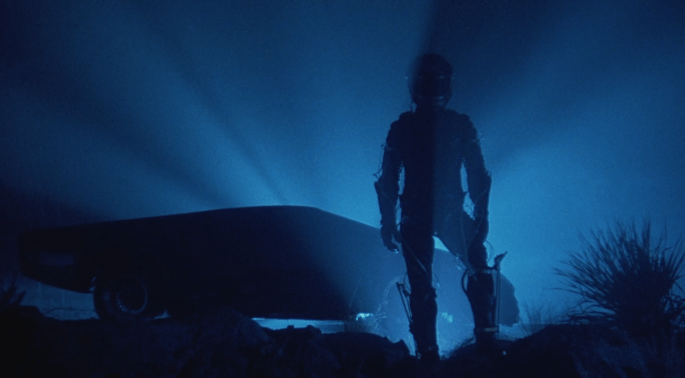
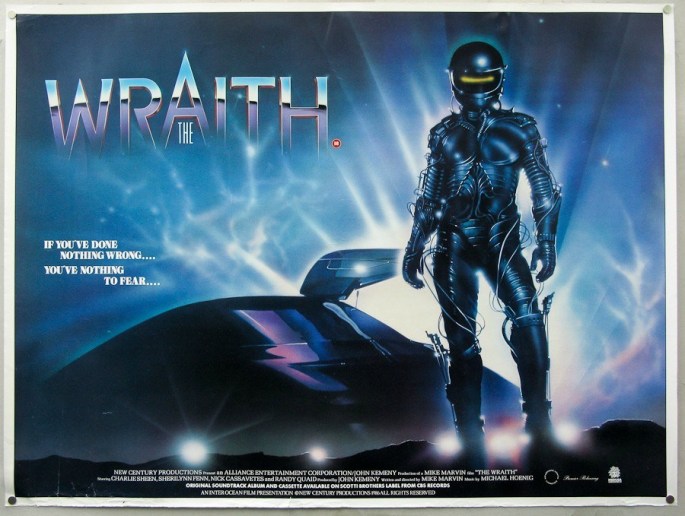
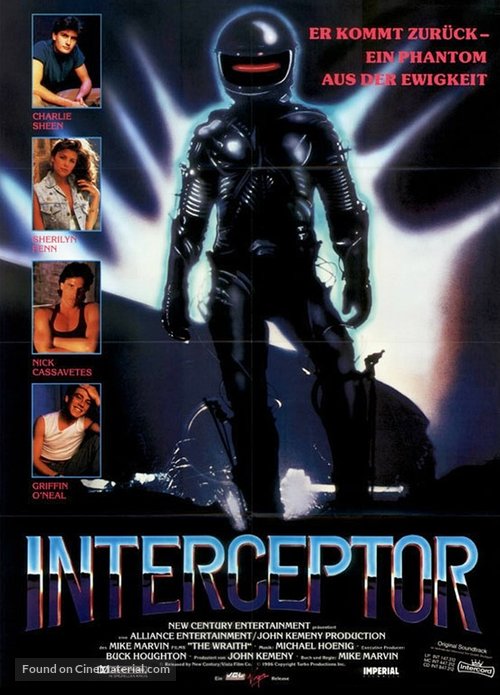
The Wraith was like many a glorious find back in the day at my local video store. The cover had a holographic shimmer to it – a strange robot-like character standing in front of some bad-ass, customized car that looked as though it would be more comfortable zipping through the galaxy rather than flying at break-neck speeds along the long stretches and cactus-lined roads of Arizona.
Yes sir, that cover held the promise of sci-fi mysticism combined with heat-thumping vehicular action to rival the Road Warrior.
Oddly enough, Dr. George’s post-apocalyptic action-adventure was the template for Mike Marvin’s Cult Classic. When the man who started out making skiing films came to Hollywood and saw an opportunity to fuse High Plains Drifter with Mad Max 2, one would assume it was a concept any studio would be happy to throw their weight behind.
But, then as now, the movie business can be treacherous, and Marvin’s experiences making The Wraith were far from pleasant. As a matter a fact, they were a nightmare. Plagued by unscrupulous producers, a tragic death while filming – along with all the other perils of production – it is a wonder that this certified 80’s classic ever made to to the screen.
Lucky for us, however, thanks must go, in no small part, to a string of wonderful performers, a dedicated crew and a talented director at the helm, The Wraith survives as a one of a kind mash-up of genres that has endured and is, for this film writer at least, yet to be equaled.
This interview was conducted before I was able to sample Mike’s great and candid commentary on the Region 1 DVD release of the film. And while some of what he relayed to me you will find on that release, the truly glorious thing that I experienced was to hear these insights, plus a couple that were not covered in that commentary track, first hand from this journeyman warhorse of a film-maker.
So seek out the The Wraith, those of you who have not yet experienced it. Let this interview, hopefully tantalize your interest to learn more about this incredible film that really was both ahead of its time, a product of its time and most assuredly one of a kind…
The films of Paul Kyriazi hold a special place in my cinema-viewing adventures throughout the years. I, naturally, encountered them during the heady days of the era of VHS – I still have my copies in that format of Paul’s work. Then, not unlike Terrence Malick, Paul disappeared, and I lamented his absence having come to admire his film-making style and diversity.
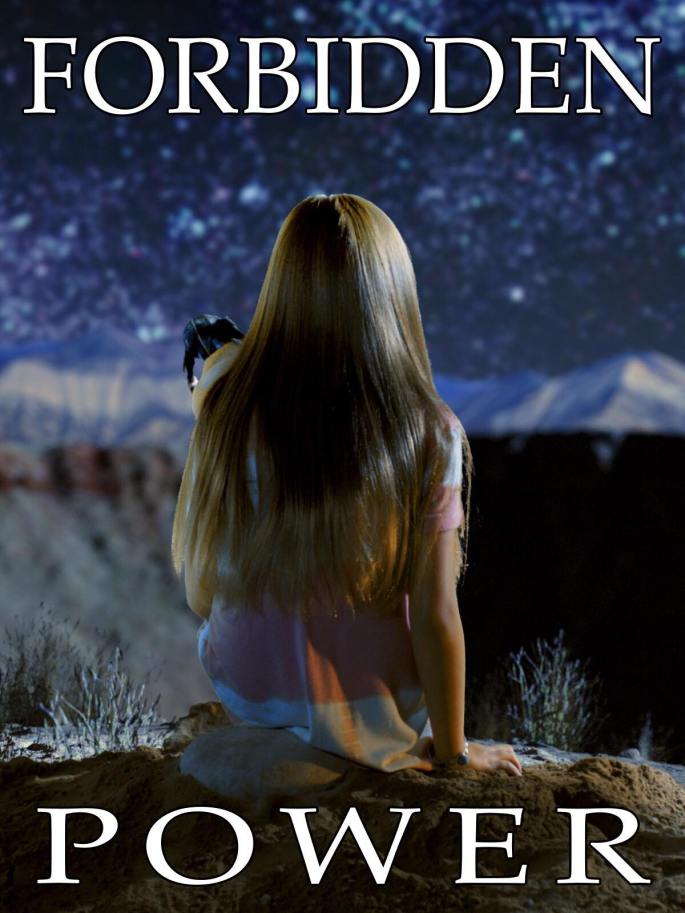
So, rejoice I did, when I learned that he had returned to the director’s chair. Eagerly I sat down to watch Forbidden Power – and I was not disappointed. With his new film, Paul returns with his unique voice, his visual dexterity and his great command of unfolding an exciting thriller that doesn’t release its grip on you till it’s time to fade to black.
Fascinated by his study in the field of personal empowerment, Paul takes us on a journey where the achieving of super-human abilities is contracted via sexual intercourse. The character at the center of the story is a mysterious and provocative woman – who seemingly hypnotizes her partners with a type of mystical persuasion. The character we follow, after his eerie yet passion-fueled encounter with the female antagonist, wakes to find her vanished, but also having left behind for him a gift of sorts.
In this superhero-movie-saturated age we find ourselves, it was refreshing to witness a different spin on the getting of super-powers. Our hero, just like in any superhero origin story, has a delightful time discovering the extent of his new-found abilities. But, as it is with the coming of great power, there comes along with it, great responsibility.
Thus we go along on the adventure, and soon discover that plot is deeper than one might first imagine. I’ve no intention of spoiling it for you here, because I want you to see the movie. What it will say is – this is well crafted film-making that you can definitely become immersed in.
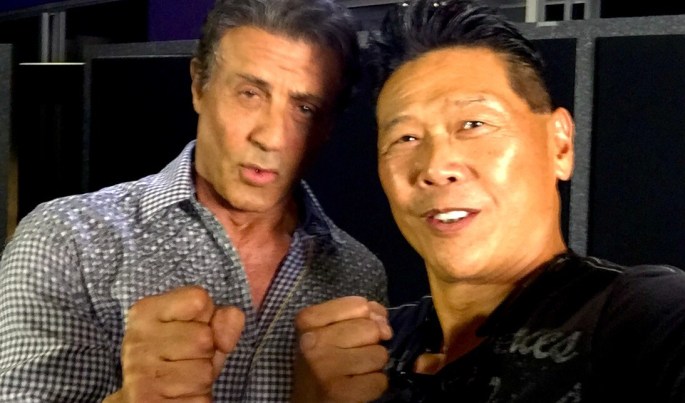
It was a true honor for this fan, not only to talk to Paul, but also to two of the film’s stars – the stunning and talented Nazanin Nuri and the man, the legend, Harry Mok (another exceptional, multi-talented performer whom I too, like Paul, encountered first in the heyday of home video).
I encourage you to seek out Forbidden Power, if you are a fan of Kyriazi cinema or not. I promise you, you will not be disappointed…
At age 8, I see The Making of 20,000 Leagues Under the Sea on Disneyland TV and decided to become a movie director. Age 16, I start filming 20 minute action stories using my father’s 8mm camera. Age 18, my father bought me a used Bolex camera. I film a 30 min color action movie titled Trapped and it wins the Berkeley Film Festival. I start taking karate to be like James Bond. My Sensei introduces me to samurai movies. Seeing that action with great film techniques of the Japanese directors, moves me into martial arts movies, even before the TV show Kung Fu. I transferred to San Francisco State University making more 20 minute karate stories and placing 3rd in the next Berkeley Film Festival. I graduate with a BA in film. I join the Air Force movie department and film space launches for NASA. I take leave to film my first feature Drawn Swords in 35mm black & white Techniscope. It’s about 3 samurai going to England to enter a fencing tournament. I use all my cash and credit cards, loans, and refinancing my car. I get out of the Air Force and return to San Francisco unable to sell my movie. I promise myself if I get another break I will make a color movie that is so commercial the distributors will have to buy it. I meet karate tournament fighter Ron Marchini who has me re-edit and sell his Philippine produced movie Murder in the Orient. Ron then hired me to write and direct Death Machines. To be commercial, we come up with a story of 3 karate killers (white, black, Asian) to cover all markets. Then we add a cop/gangster plot, big fight scenes in a karate dojo, bar, and police station, and we actually blew up a piper cub airplane. The completed movie is immediately picked up by Crown International Pictures with big advertising. It opened in 50 theaters in LA making it a #14 top grosser. However, I still can’t raise the money to produce my own movie, so I direct a sequence for Sesame Street. I pick up a copy of The Million Dollar Secret Hidden in Your Mind by Anthony Norvel. I take his classes for three months in LA, then return to the San Francisco. In 10 days I raise the money to produce and direct Weapons of Death. The panavision film plays all over the USA breaking a house record in a New York theater. I next produce and direct Ninja Busters. This was followed by the cops and gangsters story One Way Out. Next came writing and directing Omega Cop starring: Adam ‘Batman’ West, Troy Donahue, and Stuart Whitman. An actress from Weapons of Death hires me to produce a travelogue in Phuket, Thailand, Thailand Adventure proving you never know what contact will end up getting you movie work. I write two novels in hopes of getting them produced as movies. When many people ask me “How do you survive as a freelance?” I write How to Live the James Bond Lifestyle. In 2003, I produce In the West – a 90 minute travel production for Japan. Appearance by Pat Morita. In 2005, I produce my novel Rock Star Rising as an audio-book narrated by Rod Taylor, performed by Russ Tamblyn, George Chakiris, Robert Culp, James Darren, and Kevin McCarthy. It has full effects and music, making it an “audio movie” of sorts. In 2006, I direct the largest production in audio-book history, McKnight’s Memory. Narrated by Frank Sinatra Jr, it stars Robert Culp, Nancy Kwan, Don Stroud, Henry Silva, Alan Young, David Hedison, and Edd Kookie Byrnes. In 2007, I Direct Edd Byrnes’ My Casino Caper audio-book. It’s Edd’s memoir of being stalked for his 3 million dollar Las Vegas win. With Alan Young, Henry Silva, and David Hedison playing themselves, recreating the incident that happened in 1977. Michael Callen plays the part of criminal that stalked Edd. In 2008, I direct Barbara Leigh’s The King, McQueen, and the Love Machine audio-book. Her memoir of being a top model involved with Elvis, Steve McQueen and MGM president Jim Aubrey. Joe Esposito introduces it and plays himself in the dramatizations. In 2012, I update & expand the James Bond Lifestyle on Kindle, Nook, iTunes & Kobo. In 2013, I write & produce – 3 Wild Thrillers – Three fiction stories on Kindle that includes the audio-book. In 2014, I produce The Mexican Swimmer, a 3 hour audio-book performed by Julian Scott Urena. I also write Wicked Players, a story of gambling and survival in wild Las Vegas
I always imagined moving to New York City, before even really knowing what that meant. As a child, I spoke gibberish, pretending to be American, and constantly begged my family to travel to New York. Somehow, without having ever seen any of it in person, I was fascinated by the skyscrapers, Statue of Liberty, and the opportunity New York City had to offer. For as long as I can remember, I had this recurring dream, where I was swimming for so long, exhausted and not sure where I was going, until finally I’d look up and realize I’d swam all the way to New York City. I’d wake up screaming, “I made it! I made it!” I finally left everything in Switzerland behind and made my way to US as an Au Pair. In 2012, with just two suitcases, I moved to San Francisco and lived with a host family. After a year in the states, I began to feel comfortable communicating and expressing myself in English. I extended my job for another year and moved to Long Island, New York. After working for two years as an Au Pair, I was ready to pursue my dream. I moved to New York City and signed up for ESL classes to master my English. As fate would have it, I stumbled upon The William Esper Studio, an acting school that changed my life forever. I was honored to be accepted in Bill Esper’s acting class and enrolled in the two year full-time program. As cheesy as it sounds, acting found me! As I studied the art and spent time learning the craft in my classes, I increasingly realized that my entire journey led me to what I really love. Acting is my calling and all I want to do in my life. At the end of my first year of acting school, I spent the summer of 2016 in Switzerland. I wrote and starred in my first short film entitled “Where Am I”. The film was very well received at the Wellington Film Festival with an honorable mention as it won the “Best Narration” category. I graduated from The William Esper Studio in summer 2017 and was right away cast as the lead – playing Veronica Hawthorn – in Paul Kyriazi’s feature film “Forbidden Power”. After we were done shooting “Forbidden Power” in Seattle I traveled to Utah to film an experimental short film that I wrote, produced and starred in. That untitled short film is in the editing phase and expected to be released in 2018
Harry Mok’s career in the entertainment industry is attributed to his well-known expertise in the martial arts field. His career began as an actor and stuntman, performing and or starring in such films as Rambo II, Uncommon Valor, TC 2000, Talons of the Eagle, Femme Fontaine, For Life or Death, College Kickboxers, The Vineyard, Tiger Claws II, Ninja Busters, and more. In 1987, Harry produced and wrote his first feature film, The Vineyard, which was released by New World Pictures. Shortly after, he began producing, creating, and designing action games for Atari/Time Warner Interactive. During this period, Harry invented a new filming technology, a 180 degree five camera blue/green screen system that would revolutionize digitization of 2D characters. He filed a patent for this technology. In August of 2005 Harry was honored with induction into the prestigious GSKA Black Belt Hall of Fame. In January 2007, he was inducted into the World Martial Arts Masters Hall of Fame. He is currently based in Northern California. He is one of the founders of 10+ Entertainment and is currently involved with producing a new reality show, New Hollywood Stars.
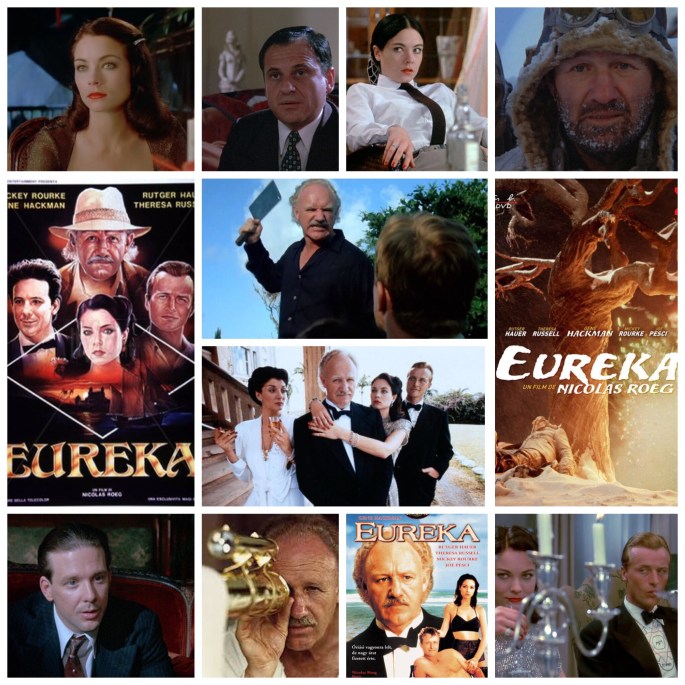
Nicolas Roeg’s Eureka is one of the strangest films I’ve ever seen, and I mean that in more of a disturbing way as opposed to a compliment. It’s a story that could have been given the straight n’ narrow Hollywood biopic treatment, and instead plays like the loudest, most disconcerting fever dream you’ve ever had, and you find yourself wondering how such a straightforward story can just seem so *odd*. A lurid meditation on greed and a balls-out cautionary tale for people who think that money can buy happiness, most of it focuses on Gene Hackman’s stubborn prospector Jack McCann, who after striking gold in a melodramatic Yukon set prologue, retires to his own Caribbean island to languish in riches. Life is anything but happy for him though, as his troublesome daughter (Theresa Russell) has brought along her scheming boyfriend (Rutger Hauer), who clashes with McCann right off the bat. Hauer is a no good schmooze with his hands in a bunch of dirty pies, Russell is headstrong and belligerent, and soon McCann becomes paranoid, angry, volatile and wrapped up in his own deluded mind. It also doesn’t help that a crime syndicate from Miami wants to build a casino on his island, an idea he abhors. They’re headed up by Joe Pesci and Mickey Rourke, two memorable faces who are ultimately eclipsed by the volcanically intense and overbearing performances from our three leads. This is an ugly, brutal picture of human beings at their utter nadir of social interaction and mental well being, a swirling maelstrom of malcontent that circles the toilet boil and plummets down the drain to a graphically violent conclusion from which there is no respite or glimmer of catharsis. I kind of get what Roeg was going for, but he’s so tonally off kilter and tries to hammer it home with such pulverizing, unnecessary force that we feel too shellshocked to get any sort of real message from the thing. The acting is quite impressive though, credit where credit is due. Hackman has never been more terrifying, Hauer is sleaze served a la flambé and Russell has a staggering courtroom monologue that should be in record books for most lines memorized in a single take, not to mention be up for acting awards all over the board. Bring a strong set of nerves to this one, and be prepared for little payoff after you sit through the depravity it has to offer.
This film might not seem like a big deal to you. It could merely appear as another throwaway action flick on your regular streaming service – one that you glance at out of curiosity, and then move on. But I really loved SHOWDOWN IN MANILA, and here’s the reason why . . .
Once, a long time ago, in the age of wonder, they were these glorious palaces that we called, Video Stores. They were a veritable treasure trove for cineastes of all ages to come and get their movie-fix. They housed the cinema of the ages and best of all, there would be movies you could find there, that hadn’t played at a cinema near you.
These were the titles that were made specifically for this new medium of VHS. Like the drive-in before it, these stores needed product. Thus a new genre was born, and it was called Straight-to-Video. What arose were glorious movies, some of which, sadly, died along with their era. Awesome were the sci-fi, the horror, and specifically speaking now, the action movies that would appear on the shelves. And such action. Real, intense, dynamic and always in frequent supply. It was good versus evil in all its glory – the villains wore dark shades and the heroes carried big guns. So, it was while watching SHOWDOWN that I was hit by this wave of nostalgia, engulfed by memories of the golden age of home entertainment.
The plot of the film is simple. But isn’t that true of the best action flicks? The package is a beautiful cocktail of old and new, peppered with filmmakers wishing to deliver a splendid throwback, mixed with the stars that climbed to the dizzying heights of VHS stardom.
For those who know what I’m talking about, and even those that don’t, I say, go check out this little gem that is cut from the past, and at the same time, is polishing by the future. So, here now, I present a trio of interviews with the film’s stars Alexander Nevsky(The man on the rise), Matthias Hues(The action legend), and the man responsible for that important seed from which all great cinema grows, the script, Craig Hamman(the veteran screenwriter).
Alexander Nevsky is a Russian bodybuilder, actor, writer, producer. His life changed when he saw Arnold Schwarzenegger in Pumping Iron and that spark would light the fire which continues to burn bright. In 1994 Nevsky graduated from State Academy of Management (Moscow). In 1999 he moved to California. He studied English at UCLA and acting at the Lee Strasberg Theatre Institute. He has risen from a bit-part-player to an international action star the cannot be ignored. With his imposing intensity, versatility and personal drive, Alex, I believe, is poised to enter the arena of formidable action superstars – its only a matter of when.
Matthias Hues is a German-born actor and martial artist as well as being an action movie icon. He came to L.A. not knowing how to act or even speak English. The fateful moment would come when he joined Gold’s Gym and the establishment’s manager received a call from a producer who had just lost Jean-Claude Van Damme for his movie and needed a replacement. Matthias tested for the role, and he managed to convince the producers to give him the part despite having no prior acting experience. The movie, No Retreat, No Surrender 2, was a moderate success, but it opened the door. He is, of course, most recognized for Dark Angel, but has also played everything from a gladiator turned private investigator in Age of Treason to an aging hit-man in Finding Interest to a bumbling idiot trying to kidnap a rich kid in Alone in the Woods to a dancing lion tamer in Big Top Pee-wee. He’s even played a Klingon general in Star Trek VI: The Undiscovered Country.
Craig Hamann came up alongside another young aspiring filmmaker whose work would go on to define a generation. When he and Quentin Tarantino embarked upon the journey to make their own movie, My Best Friend’s Birthday, there was no telling then, where the road would lead. Well we all know where Quentin ended up, but Craig too has enjoyed a long and prosperous career that has been anything but ordinary. He’s a writer, former actor, that has watched the industry ebb and flow. He’s directed Boogie Boys, had encounters with Demonic Toys and of course, of late, he’s been a part of an action-thriller in Manila. Craig has other projects in the works, and with the company he keeps, these efforts are, I’m sure, set to explode and entertain. Yet he remains a humble gentleman with a passion for his work and a dedication that has seen him endure as a great veteran of the movie business.
I was mid-way through my interview with C. Courtney Joyner when Tim Thomerson’s name came up. Joyner of course, had directed Tim in Trancers 3, and cooler still, he had just had him round for breakfast earlier that day. You might call it an imposition, but I mentioned that if there was even a remote possibility that he could put me in touch with Tim, I would be forever grateful. Courtney told me he was seeing Tim again on the weekend and would put forward my proposition. Soon after, I received a message with a phone number.
Now, I’m usually in the habit of arranging an appropriate time and day to call, but Courtney had left it open. I remember for the first time, in a long time, being nervous to make the call. After all this was Tim Thomerson who was going to be picking up the phone; a guy, a legend that I had watched for years. So I summoned my moxy and dialled the number. The familiar international ring-cycle began and then . . . “Thomerson,” the voice on the other end of the line said.
I’m going to come off as an idiot here, but I.D.G.A.R.A. “Damn,” I remember thinking. “He sounds exactly like he does in the movies.” Stupid, I’m well aware. But the moment was profound, and I was instantly transported to that time when I sat in the theatre watching Metalstorm, and that glorious afternoon I first sat down to watch Future Cop (aka Trancers). Here was Jack Deth now, on the end of the line and talking to me like we had been buddies since forever.
I did kinda wish we could have jumped into our chat right there. Tim was at once disarming, candid and as cool as i had expected him to be. He was off to his retreat in the desert to do “old man shit” as he put it, and, while I realize he is an aged gentleman now, that voice, the larger than life character that he is still packed all of the vitality, swagger and youthful exuberance that very much belies his years.
I didn’t have to wait long before we would talk again, and when we did, the conversation picked up right where it left off. I would take a significant amount of time to go through the length and breadth of his career, so I restricted myself to personal favourites among his credits. We talked about his beginnings, his great friendships, his bumping into Mel Gibson at the doctor’s office, him working with his idols, Australian Cinema and his meeting with the legend that was Sam Peckinpah.
For those of you who regularly check out my stuff here on the site (God bless you), I fear I might be starting to sound like a cracked record. A number of times in the past I have found myself gushing about the opportunities I have enjoyed whilst writing for PTS, and how humbled and indeed awe-struck I have been as a result of these encounters with the folks who make the movies. Sadly I’m now going to do it again. Tim Thomerson is a hero of mine and it was at once spellbinding and an indescribable treasure to have had the chance to shoot the breeze with an actor I have long held in high regard . . .
. . . and an equal pleasure it is, to now share it with you.
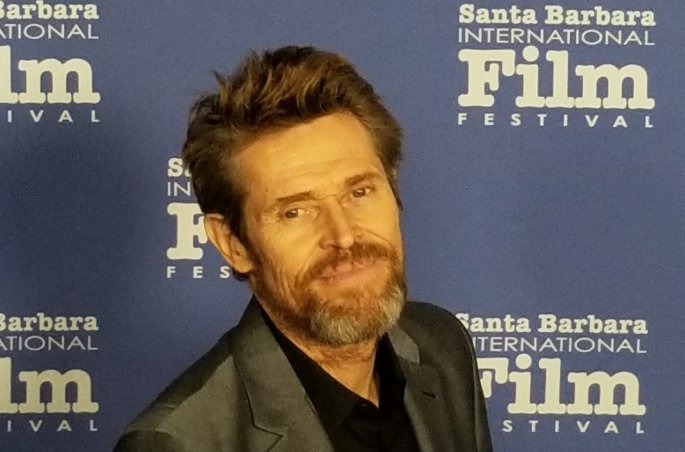
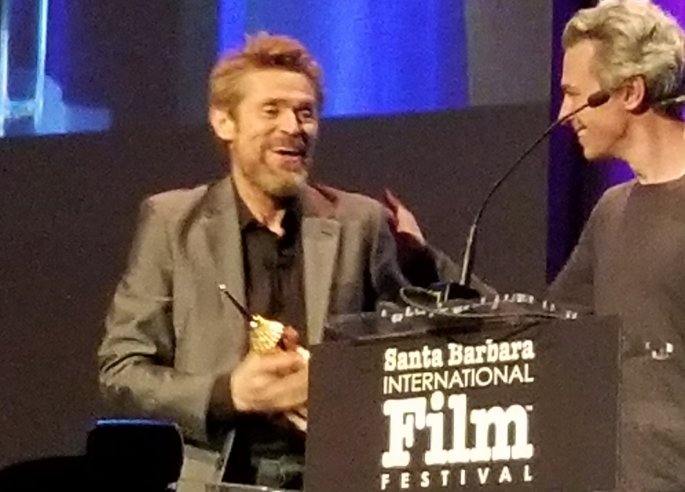
Willem Dafoe is an actor. He’s not a celebrity, he’s not a movie star, he’s an actor. An actor’s actor like Robert Mitchum or Lee Marvin. He arrived early in Santa Barbara where he was receiving the Cinema Vanguard Award with an hour and a half long Q&A moderated by Deadline’s Peter Hammond. Dafoe took his time with his fans lined up; taking photographs and signing autographs and then spending an ample amount of time speaking to the press.
Dafoe is currently on his third Academy Award nomination for best supporting actor. He was first nominated for Oliver Stone’s PLATOON, then SHADOW OF THE VAMPIRE, and now for Sean Baker’s THE FLORIDA PROJECT where Dafoe plays a motel manager and surrogate grand father to a six year old daughter of an unruly tenant.
Inside the Arlington Theare, a highlight reel started and showed everything from STREETS OF RAGE to PLATOON to THE LAST TEMPTATION OF CHRIST to SPIDER-MAN and THE GRAND BUDAPEST HOTEL. Noticeably missing from Dafoe’s greatest hits and Hammond’s Q&A were the four (soon to be five) collaborations with Abel Ferrara and his three films with Lars von Trier. To be fair any one of Dafoe’s performances from any one of his films would be worthy of being in the reel; yet those seven films are incredibly seminal to the Dafoe canon.
He spoke about being fired from his first feature film, Michael Cimino’s HEAVEN’S GATE for laughing out loud at a joke during a set break. He then went on to speak about how he was asked by Cimino to narrate a feature length documentary about the making (and unmaking) of HEAVEN’S GATE.
Dafoe spoke freely about his rich filmography. He stated the most physically demanding performance of his career had been when he played Jesus for Martin Scrosese. He talked about how taxing the crucifixion scene was, and how he could only stay in that pose for a maximum of twenty minutes before his body would start to give out.
Regarding MISSISSIPPI BURNING, Gene Hackman actually did hit him, they really smoked marijuana during the party scene in PLATOON, and how he was on three foot stilts doing motion capture work for JOHN CARTER ON MARS.
Dafoe is overly deserving for an Academy Award. Both on the account of his performance as Bobby Hicks in THE FLORIDA PROJECT and for one of those “lifetime achievement/we owe you one” Oscars. As Bobby Hicks, Dafoe is playing the guy, and for a career of playing that guy, he finally gets to shine and give one of his best performances as the guy.
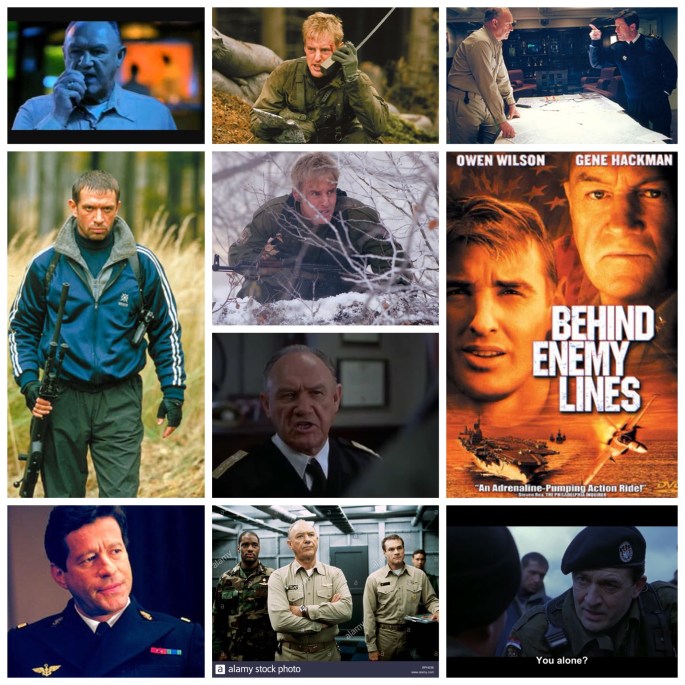
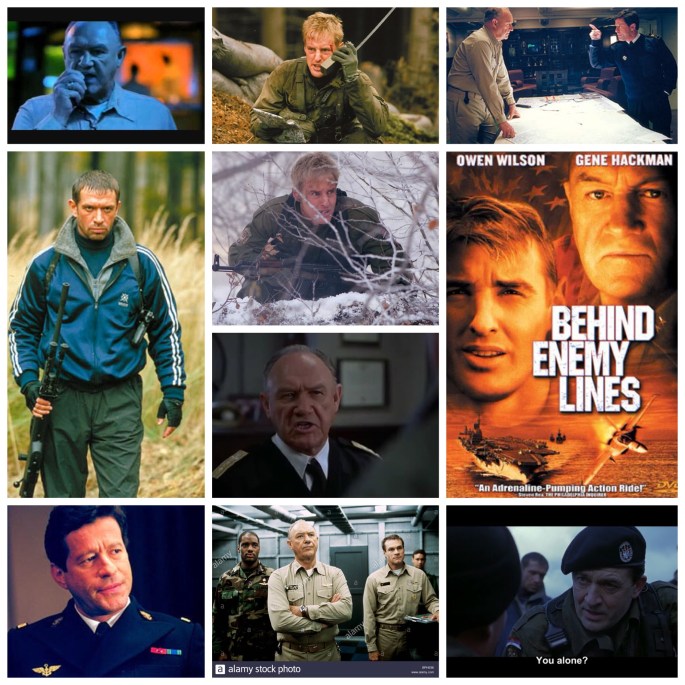
I’ve always enjoyed Behind Enemy Lines, a hyperactive, simple minded, highly kinetic Owen Wilson/Gene Hackman war survival flick. It’s lowbrow, full of plot holes and questionable in terms of representing both the military and the Serbian/Bosnian war, but it’s also explosive, jacked up fun that packs a visual and auditory wallop. Wilson is an Air Force pilot who goes awol after a crash, and runs afoul of some Serbian radicals running a sickening genocide operation somewhere out there, while Hackman is the fiery Admiral tasked with coaching him back to an elusive drop point, and helping him avoid obstacles along the way. In pursuit is a nasty rogue general (Olek Krupa), who wants to snuff him out as he’s witnessed the man’s squadron murder his copilot (Gabriel Macht), and also just because he’s the classic stock villain and has nothing better to do. His top assassin (Vladimir Mashkov, almost identical to Niko Bellik of Grand Theft Auto 4) is an Eastern European Bear Grylls with homemade grenades and the pain tolerance of a tank, also chasing poor Wilson. It’s fairly implausible, but oh so cinematic and one I often put on just to work out the sound system of my tv. Crazy souped up editing, jagged freeze frame effects and whatnot ensue, it’s cool and kind of like Tony Scott Lite in a way. Hackman could yell out any dialogue and be convincing, owning yet another role, especially in a scene where he has a wicked shouting match with an A-hole of a UN General (Joaquim De Almeida firing on all cylinders and then some). David Keith has a great bit as another Admiral assisting in Wilson’s plight too. It’s suspenseful, doesn’t take itself too seriously and shouldn’t be subject to too much scrutiny, lest you rob yourself of a pleasurable genre viewing experience. Plus the sequence where Wilson hides in a freaky, mud filled mass grave has stuck with me for years. Good stuff, man.
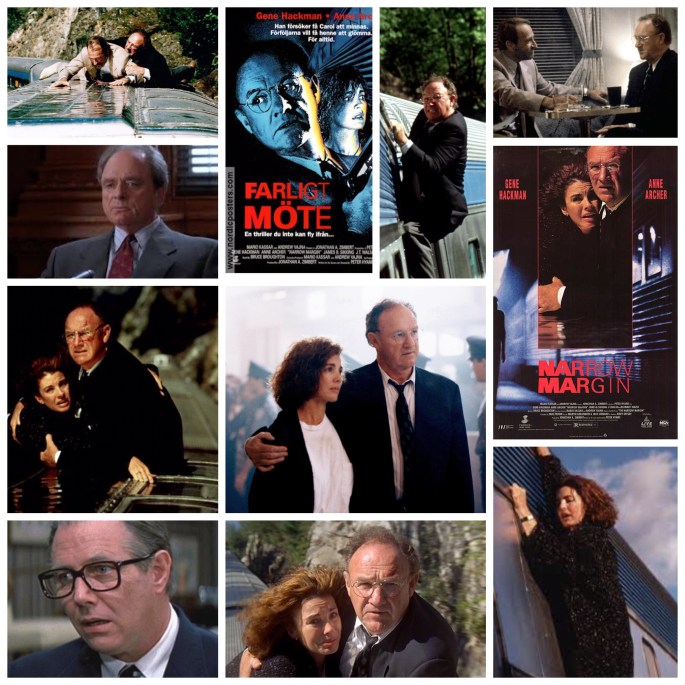
Peter Hyams Narrow Margin is a sleek thriller that attempts to blend courtroom intrigue with a single location white-knuckler, which it does.. mostly successfully. A better way to put it would be that it sandwiches a cat and mouse game set on a speeding train between an intro and epilogue both set in the decidedly more complicated realm of legal escapades. We open as an unfortunate lawyer (J.T. Walsh in a too brief cameo) is assassinated by the mobster scumbag (Harris Yulin, creepy as ever) he had shady ties too. A terrified Anne Archer hides in the shadows, witness to the murder, and therefore a valuable asset to the dogged prosecutor (Gene Hackman) who is trying to bring the kingpin down. The two of them are ambushed on a routine transport via helicopter and escape onto said train, and here’s where the narrative cops out just a little bit. Almost the entire rest of the film is spent on the train, an extended diversion of a set piece that steps in for what I thought would be a more cerebral battle of wills between these factions, in court and out. It’s not a huge deal, I was just expecting a little more, and the bits at either end of the film stand as my favourite sequences. Hackman plays stubborn like no other, having both literal and figurative tunnel vision here, the only one thing he cares about being the life of his witness. They’re harried at every turn by corrupt officials of many kinds, and pursued by a mystery woman (Susan Hogan, my acting mentor in college no less), while the train hurtles through the gorgeous Canadian wilderness, captured pristinely by Hyam’s lens as he dutifully does his own cinematography, the dynamo. It’s a thrilling little piece that benefits from Hackman’s spirited work, the photography and editing backing it up nicely.






















 Podcasting Them Softly