Peter Medak’s Romeo Is Bleeding

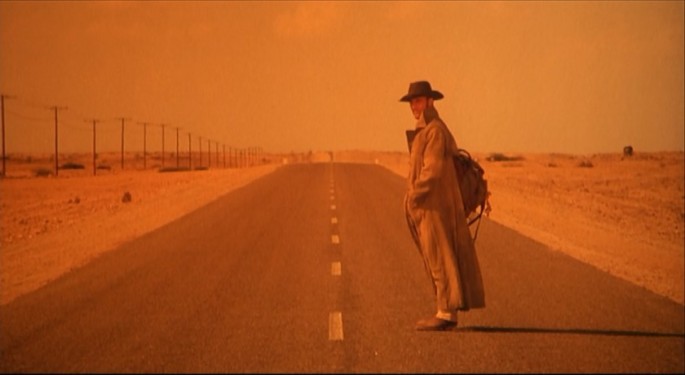
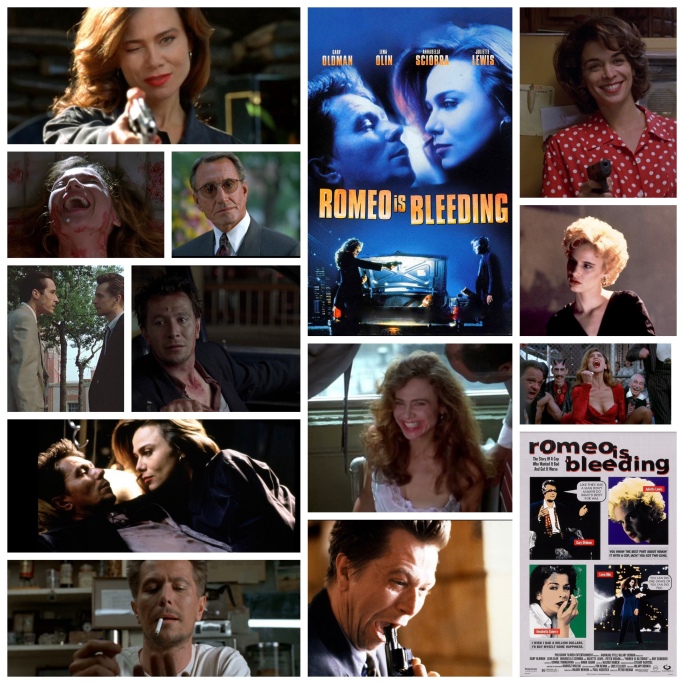
Somewhere out there in an anguished desert enclave along one of the many desolate stretches of American highway is Jim Dougherty (Gary Oldman), stranded in exile at a lonely rest stop cafe as Peter Medak’s brilliant, haunting neo-noir Romeo Is Bleeding opens.

Jim, as we learn through forlornly narration, was once a spectacularly corrupt NYC cop named Jack Grimaldi, a man who got too ambitious in the worst way and learnt every lesson the hardest possible fashion he could. Jack was a greedy, scheming piece of work who two timed his loyal wife (Annabella Sciorra, fantastic) with a ditzy cocktail waitress (Juliette Lewis) and did his best to upend everything the department works for by playing it against the mafia with increasingly disastrous results, stuck on a hollow treadmill chasing dollar signs. But his wife and mistress weren’t the only women in his life, as he soon meets Mona Demarkov, a seductive Russian contract killer played by Lena Olin in a performance that is to be applauded, feared and lusted after in equal measures. Mona is the wild card, the hurricane that upends an uneasy equilibrium Jack has toiled sweatily to set up like a house of cards, ready for her to blow down. Dumped in his lap by the Feds to babysit until mob operatives arrive to kill her, she manipulates, seduces and torments Jack within moments, but she’s only just begun. She escapes into New York and leads everyone on a terrifying goose chase of bloody mind games and gangland espionage, threatening to tear both organizations, not to mention Jack’s sanity, to pieces.

Oldman has never exuded the specific kind of sweaty desperation he showcases here, he’s got three women too many, nasty mafia Don Falcone (a quietly dangerous Roy Scheider) breathing over his shoulder and fellow cops inches away from sniffing out the rat in plain sight. Gary somehow comes across as likeable despite all this heinous behaviour, like a lost puppy who wandered into the wrong cave. Olin really lets loose with her work, she’s a villain not just for the noir hall of fame but for the ages, a murderous black velvet spider on a wanton spree of anarchic, sociopathic, psychosexual destruction and loving every minute of it. They’re supported by an epic roster of talent including Will Patton, David Proval, Larry Joshua, James Cromwell, Ron Perlman, Tony Sirico, Stephen Tobolowsky, Dennis Farina as a gregarious mafioso and the great Michael Wincott as Jack’s underworld pal Sal who turns on him like a jackal when things get out of control.

Many people seem to see this as an interesting yet ultimately flawed piece with uneven tone and what have you, but I couldn’t disagree more. For me this is pretty much as close to perfect as a film can get. Jim sits out there on the lonely byways of some forgotten region and recounts the tale of Jack, there’s such a beautifully mournful melancholy to his story, a true tragedy and cautionary tale laced with grit, jet black humour and an ever so subtle fairytale vibe. Writer Hilary Henkin spins a wild, surreal and slightly self aware screenplay here, while Mark Isham’s creepy, music box infused score gives off bushels of atmospheric portent. I feel like this is another one that was maybe ahead of its time, or perhaps just an acquired taste. I’m happy to see it has a budding cult following these days because it really deserves people’s time, it’s one of the very best crime films of the 1990’s and one of my all time favourite stories out there.

-Nate Hill

FUCK YOU ALL: The UWE BOLL Story Interviews by Kent Hill

I love the cinema of Uwe Boll. How you ask? Haven’t you read the reviews – don’t you know the stories? My answer: Yes.

I have read the press, I know all the stories. I watched as mindless degenerates hiding in their mother’s basements hurled shit across the web, and into the face of one of cinema’s most prolific, most passionate, fiercely independent figures. A man who needed, not a studio, but his own incredible knowledge and production savvy to make movies . . .

. . . all Uwe Boll ever wanted to do.

But I’m getting ahead of myself. Let’s set the ‘way-back machine’ for the late 90’s, and I’m tending the counter at the local video store – back when it was really its namesake – and they bring in a new coin-op to keep the punters in the store and spending money. That video game was called House of the Dead.

Supposedly so graphic and horrifying – as well as being literally rated R – HOTD was a shoot ’em up in the best, most fun sense of the genre. Behind the black curtain that was there to frivolously attempt to shield the eyes of the innocent from the mayhem, the masochistic, bullet-shredding magnificence, was a really cool world where the aim of the game was to blast your way through hordes of the undead with merciless glee.

So being a fan, and sneaking off to play while I should have been at the desk – when a friend of mine said, “I hear they’re going to make a movie based of this” – I was like, “take all my money man – this is gonna rock!” (And that was prior to The Rock  giving video game adaptations a shot)

UWE-BOLL-POSTER_24x36_FULLTITLE-WEBRES

I remember going to the cinema to see it, and soon being one of only a handful of people still watching after a good number of folks had walked out. So – why did I stay I can hear you ask? Well there are two reasons. One is simple – I enjoyed the movie on many levels. Yes it wasn’t the game, nor could it have been. I think people operate under the fallacy  that just because a video game has a backstory or mythology on which it is based, then it must be simple to adapt into a movie. I believe precisely the opposite to be true. I think truly solid adaptations rely more on the wit and invention of the filmmaker. To combine a good narrative with recognizable elements from the game to appease the faithful.

And, love him or despise him, that is exactly what Uwe Boll could do – and do well. For if he couldn’t dear reader, then those multitudes of investors that he went back to time after time, movie after movie would not have entertained him. If he were not commercially successful, the career of Uwe Boll would not exist, nor could it be captured in the brilliant, candid and touching portrait of a film about a filmmaker, a man, who refused to remain silent whether he was being applauded or damned.

Unlike Dan Lee West’s RAGING BOLL, which deals more with the sensationalist side of Boll’s career, S.P. Shaul’s picture meanders down the quite roads and sheds light on the personal figure behind the media circus, the private man, the family man, the man who in spite of those basement dweller’s vitriol – followed his dreams and fought many a battle to bring them into the cold light of reality.

FUCK YOU ALL, is not a gratuitous middle finger in the face from the man dubbed the worst filmmaker of all time. No dear PTS listener – it is about the pursuit of what inspires, the burden of making visions come alive as well as the reminiscences of a man who worked with and alongside the cream of the Hollywood crop while smiling at the absurdity of it all.

When and wherever you can see this, The Uwe Boll Story, I urge and hasten you. It is filled with insults and hatred but that is always counterbalanced by the friends and collaborators of Dr. Boll, speaking words of praise, constructive criticism, and overall of a man with whom it was always fun to go to work with – and as it is said best, by Brendan Fletcher (a long-time Boll collaborator), and I’m paraphrasing here: but he speaks to the haters of Boll and says . . . “when have they ever risked anything?”

It is a great film about a fascinating artist and I am most excited to present my chats now, not only with the filmmaker responsible for the documentary, but with the filmmaker who inspired him to make the journey . . .

. . . enjoy

UWE BOLL

uwe7_1.328.1

As a child, Uwe produced a number of short films on Super 8 and video before beginning his studies as a film director in Munich and Vienna. He also studied literature and economics in Cologne and Siegen. Uwe graduated from university in 1995 with a doctorate in literature. Uwe has since directed, written and produced over 30 movies with such stars as Ben Kingsley, Jason Statham, Ray Liotta and Ron Perlman. Uwe also runs and owns the BAUHAUS Restaurant in Vancouver alongside Michelin Star chef Stefan Hartmann.

(Courtesy of:http://uwebollraw.com/)

SEAN PATRICK SHAUL

Uwe and Sean

Sean is a Canadian Documentary Filmmaker who became aware of Uwe Boll whilst working on the production, Assault on Wall StreetHis first encounter the wild, unchecked hullabaloo of an Uwe Boll movie. Sean would then go back and watch a number of the master’s films before lightning struck – Uwe would be the subject of his next documentary. Boll never one to have a problem with being candid – Shaul received and all access pass to the life behind the great director – enough to construct this, his definite portrait of the man, the myth, the mouth . . . the man named, BOLL!

PLEASE VISIT: http://prairiecoastfilms.com/


After the Apocalypse: A Conversation with Barry Hunt by Kent Hill

images

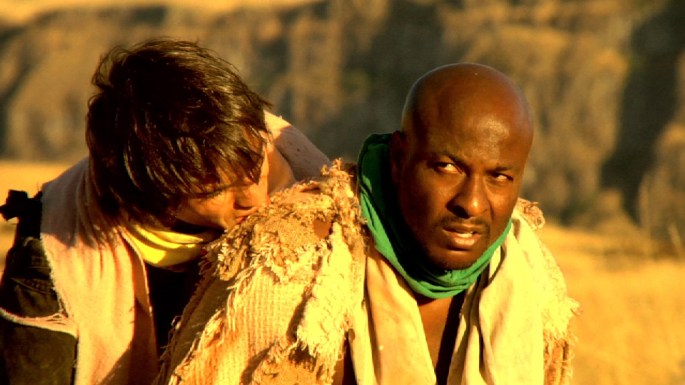
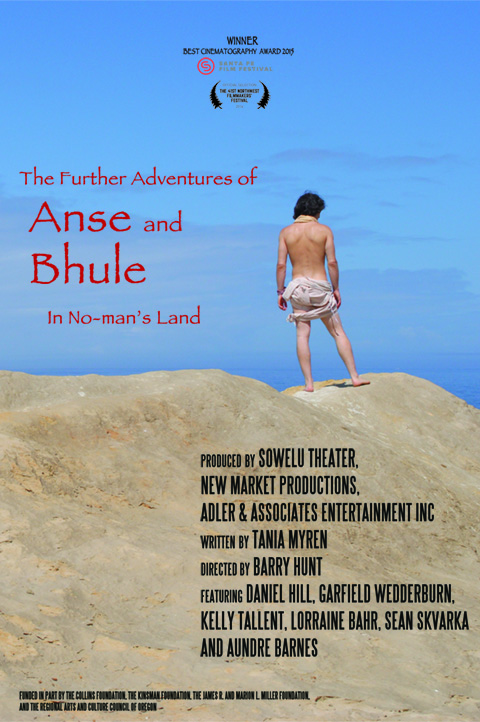
There are too few films in this day and age that leave you with something to ponder in the wake of experiencing them. But, The Further Adventures of Anse and Bhule in No-Man’s Land is, I’m pleased to report – does not fall into that category.

anse-and-bhule

As I remarked to its gentleman director – Barry Hunt – I found myself thinking to the influences which drove his artistic choices and compositions. I found traces of Herzog, Annaud, Jodorowsky – even Samuel Beckett.

For you see, this ain’t your typical day in the wake of the devastation of the world as we know it. Mr. Hunt has crafted here a sublime and visual feast that is as deep as it is vast. I found myself recalling films like Quest for Fire, Aguirre and Holy Mountain – even the lost children scenes from Mad Max: Beyond Thunderdome.

Old-company-2

One of the founders of the Sowelu Theatre in Portland , Oregon, Hunt has taken this intriguing, theatrical source material and constructed a film which is at once engaging and thought-provoking. And you can’t tell me there are too many films about which offer these sensations anymore. From the opening scene, to the world after the fall, Anse and Bhule also brought back to me the emotions evoked by McCarthy’s The Road. Both are absorbing journeys in which the characters we follow must shed, if you will, their emotional and even physical ties to all they have known. Then and only then can they truly become creatures of the new age, thrust upon them.

I urge you to seek this film out, and prepare yourself for a profound cinematic experience. The burgeoning cinema of Barry Hunt I eagerly anticipate. He has a new film in the spawning, and I have a feeling it will, just as Anse and Bhule did, exceed my expectations while completely stripping them away.

lower-rooms

https://vimeo.com/107316810

I present a fresh and brave new voice in the service of pure cinema. I give you, Barry Hunt.


Into the OTHERWORLD : An Interview with RICHARD STANLEY by Kent Hill

The-Otherworld-still3

It’s always a fascinating experience to sit down with Richard. The man is such a natural storyteller, with a unique perspective relating not only to cinema, but also to the world around him.

We caught up this time in the midst of bad weather, a troubled connection and, last but not least, a turbulent time in Richard’s beloved Montsegur. While our conversation touched upon this, along with the whys and wherefores of the situation, we eventually turned to movies. At this time it had been documented that Richard was again a part of an attempt to bring Moreau back to the screen – as a TV series. Having been hired by the same people that fired him during the doomed journey of his initial attempt, there seems to be, thanks to David Gregory’s documentary, a renewed interest in Richard’s take on his long-suffering passion project.

I did also bring up The Otherworld, which I had finally seen at the time. Stanley’s absorbing documentary-slash-ghost-story, and the myths and misconceptions surrounding it and ‘The Zone’ which forms the backdrop. Richard is steeped in the history of Montsegur and, flavored with his supernatural encounters, it is indeed a tale of great intrigue.

Also to we touched on, and I must say I highly anticipate, the writing of Richard’s autobiography. A project that was going smoothly until it was insisted, and initially resisted by its author, that a chapter be included on the subject of the collapse of Richard’s vision of Moreau. As thrilling a read as it will be – like I said Richard is a fascinating character – it will be equally riveting to finally have a recounting of the story from the embattled man at the center of the controversy.

Still, the future is full of possibilities, and I for one wait with inordinate eagerness for any and all of Richard’s creative endeavors to finally emerge . . . in whatever form they shall take.

Dust_1-840x461


“CHEESEBURGERS, NO BONES!” : An Interview with Mick Garris by Kent Hill

Garris1

It took a while to get a hold of Mighty Mick – but I’m glad I had the patience. See Mick Garris is one helluva talented man. His passage through the movies is a veritable plethora of Amazing Stories – apart from the show-of-the-same-name where he achieved career lift off.

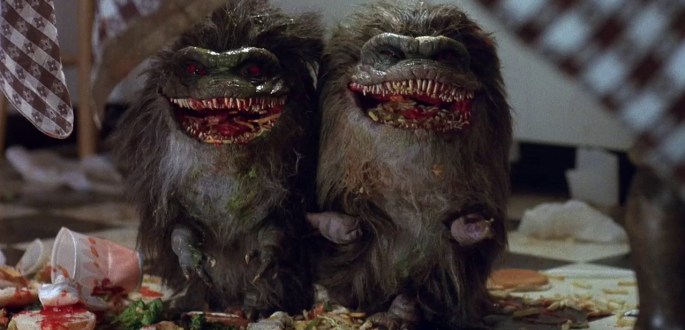
Since those early days he has gone on to become a prolific writer, director, producer, author, podcaster – the list goes on. He made me laugh with Critters 2, he was the writer of The Fly 2, which was one of the only times a film has forced me bring up my lunch, and he has conducted wonderful and insightful interviews with fellow filmmakers – some, sadly, that are no longer with us.

Through it all Mick remains the soft-spoken gentleman with a passion for his work and cinema in total. He has had a long successful run of adapting the works of Stephen King for the screen. I have vivid memories of sitting through, night after night, his extraordinary adaption of The Stand. This he beautifully followed up with further adaptions of Bag of Bones and The Shining, in which King adapted his own book, and which Mick credits as one of the best screenplays he’s ever read.

He was instrumental in bringing together the Masters of Horror as he was composing the elements which formed great movies either under his pen, or benefiting from his exquisite direction. Follow this link ( https://www.mickgarrisinterviews.com/  ) to Mick’s site and check out the bona fide feast of delights for cineastes he has on offer. As I said to the man himself, “You have a lot of fingers in a lot of pies, and I can’t wait to cut me a slice of whatever you serve up next.”

So, without further ado,  it is my privilege to present to you . . . the one, the only . . . Mick Garris.

B Movie Glory: Thomas Jane’s Dark Country

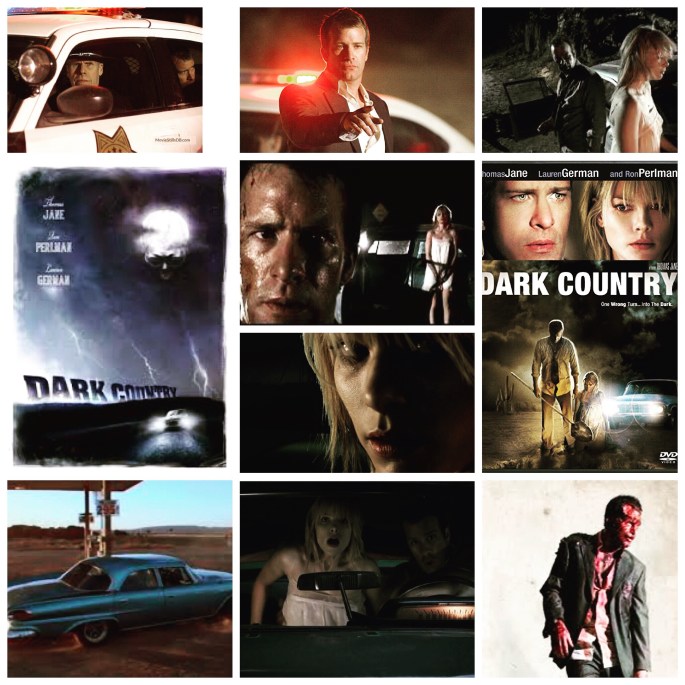
Dark Country actor Thomas Jane’s first venture behind the camera as director, and although the final product is a bit muddy and perplexing, it also creates an atmosphere of impenetrable mental fog and noxious delirium that’s in itself a success, even if the whole thing amounts to a big question mark. Jane has already proved to be a stalwart action hero, charismatic leading man and talented performer (anyone raising their hand to disagree with me gets a copy of Mark Pellington’s I Melt With You hucked across the classroom right at their head). Working off a script from veteran writer Tab Murphy, Jane concocts what can only be described as a Twilight Zone episode on opiates, with a hint of sketchy Midnite Movie added for flavour. Does it work? Yes and no. The story is nearly indecipherable except to someone glued to the screen inches away, kept abreast of every minute plot shift and disorienting, mumbled bit of dialogue. Jane and Lauren German play a couple driving from somewhere to somewhere, who encounter a freaky, whacked out hitchhiker (Chris Browning) somewhere around the Nevada desert. He’s bloodied up something fierce, babbling on about nothing and from the moment he arrives, their turns turns dour. It’s anyone’s guess what goes on from there… a dead body they must contend with, a suspicious state trooper (nice Ron Perlman cameo) on their tail, flashbacks to a weird encounter at a desolate roadside diner, ever creeping fog that seems to have followed Jane over from Stephen King’s The Mist to wreak more havoc, and so it goes. Plot is of little importance to him as a director though, and instead he seems more intent on clouding up the viewer’s perception of events until it’s more like a shadowy fever dream full of dead ends and few answers. An atmosphere piece with a logic tank that’s run dry, but succeeds in whipping up a neat nightmarish road trip through confusion and paranoia, if not much else.

-Nate Hill

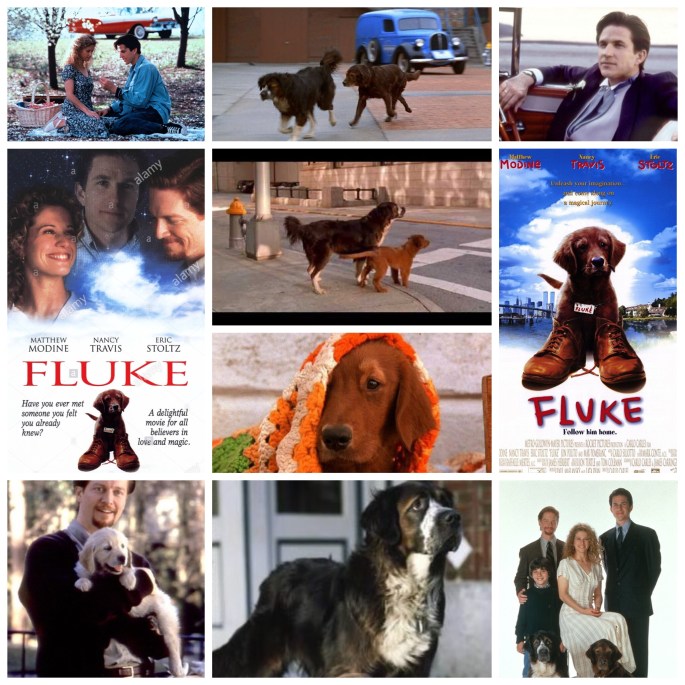
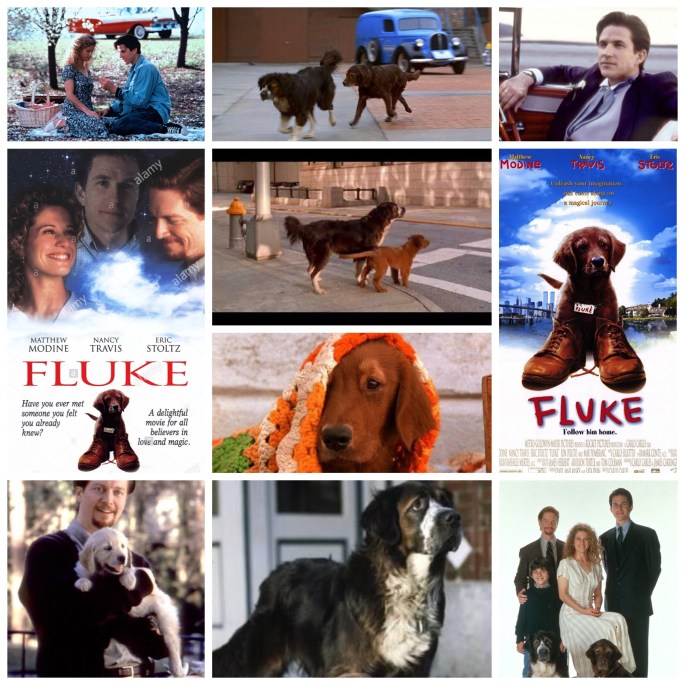
Fluke

On paper, or at least on poster, Fluke looks like a benign kid’s flick in the tradition of Beethoven or Babe, as a big fluffy Red Labrador gazes down adorably from the blockbuster shelf. Well, I rented this way back when I must have been like ten, and I can tell you it ain’t no children’s movie. There’s a sadness and deep thoughtfulness to the story that will sail over youngster’s heads, leaving them with just the scenes of talking dogs to keep them occupied. Based on a poignant novel by James Herbert, this is one of the oddest and most depressing family films out there, but it’s also unique and brave enough to go where it does, reaching beyond the sappy to try and become something more complex. Matthew Modine plays a successful businessman who is killed in a foolish car accident one night, leaving behind his wife (Nancy Travis) and son (Max Pomeranc). The film gets spiritual as we seen him reincarnated as that very same mutt from the DVD cover, a curious creature called Fluke. Born into frustrating circumstances, he finds himself pulled into one situation after the other, including bonding with an old woman who passes away, living in a junkyard for some time and making friends with a troupe of homeless urban canines, including tough St. Bernard Rumbo (Samuel L. Jackson), mongrel Sylvester (Ron Perlman) and wiseguy pup Boss (the late Jon Polito). Eventually though, he remembers he was once a man, and sets off to find the family he left behind, feeling alienated in his animal form. It’s a terribly sad film, one that’ll gouge your heart right out, if you can take that sort of thing. It’s also daring and complicated when it wants to be. Fluke feels all the more isolated when he does find his family, as his wife has become close with his old business buddy (Eric Stoltz), and he has nothing but his bark to communicate, a crushing interaction to see. This is one of a kind, and in no way should be in the kid’s section of any video store or iTunes manifest, it’s just too out there and thematically challenging, but that’s in a way where it’s strength as a story lies. Should be viewed as an existential, spiritually inclined drama about what it means to really live, in whatever form you’ve been given, and how someone can ruminate on the choices they’ve made through new eyes.

-Nate Hill

The Puppet Master: An Interview with Kevin McTurk by Kent Hill

Error
This video doesn’t exist

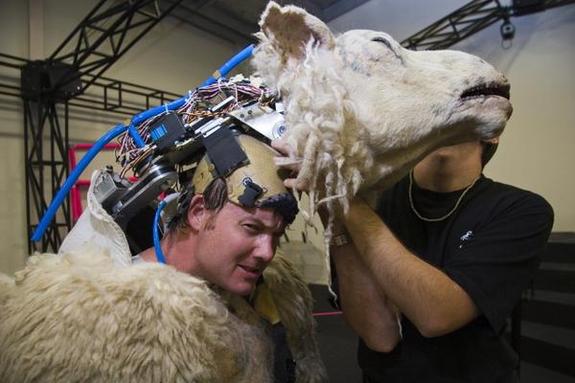
They say in the film business, never work with children or animals. Of course you may find yourself working with dinosaurs, aliens, lions, beast-people, scrunts, kothogas, ghosts, morlocks, Batman, Spiderman, Hellboy, kaijus, wolfmen, clones, cliffhangers, vampires, giant crocodiles, homicidal maniacs, killer sheep, Predators, cowboys and mysterious brides out to Kill Bill.

Sounds ominous, doesn’t it? But that’s just some of the astounding creations and magnificent beasts that Kevin McTurk has encountered in his eclectic career in the realms of special effects.

Kevin_McTurk_2014_800px

Working under the banners of legends like Stan Winston, Jim Henson and the new titans like Weta Workshop, Kevin has had his hand in erecting and simulating everything from the real world as he has from empires extraordinary. And, while I could have spent the entirety of our chat talking about his adventures working on the countless films, which are favourites of mine, he has in his CV, his impressive effects background is only part of the story.

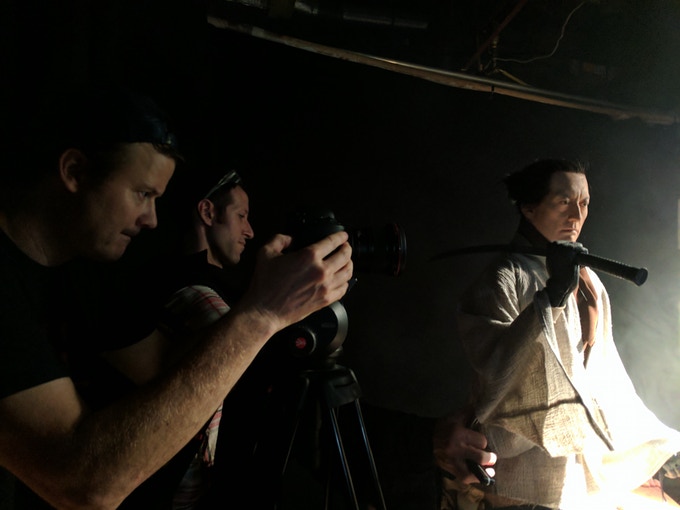
For Kevin McTurk is a bold and visionary filmmaker in his own right. His puppet films, The Narrative of Victor Karloch, The Mill at Calder’s End and now The (forthcoming) Haunted Swordsman are exercises in capturing a style from a bygone era with modern filmmaking techniques. The results are beautiful, not only in their aesthetic quality, but in the level of excellence from the many different disciplines on display.

There is still time for you to join Kevin in his latest cinematic offering (https://www.kickstarter.com/projects/935772123/the-haunted-swordsman-a-ghost-story-puppet-film), and to listen in now to the man himself talk about his movies, influences and career.

I give you the talented Mr. McTurk.

Visit Kevin’s website for more: http://www.thespiritcabinet.com/

content_l

If they look ninjas, and they’re dressed like ninjas, and they fight like ninjas…they’re ninjas: An Interview with Doug Taylor by Kent Hill

Doug Taylor began wanting to be and architect and dreamed of being like the dad in The Brady Bunch, ’cause he worked from home. But he soon became disillusioned with this notion and eventually found his way into film.

Like most of us, after learning the fundamentals, it then becomes a question of what next? Fortunately for Doug, a friend and fellow film student had made contact with a couple of producers who were in Canada making low-budget horror films. Thus the screenwriting career of Doug Taylor began.

What would begin with a small horror film would spawn a career that would see the talented Mr. Taylor rub shoulders with both the famous and the infamous of the industry. He worked with visionaries like Vincenzo Natali and the so-labeled Ed Wood of the age Uwe Boll. He has written for both film and television and those early seeds in the horror genre have seen him work on modern classics within it such as Natali’s brilliant and terrifying  depiction of the dysfunctional family in Splice.

So sue me. I am a fan of the films of Uwe Boll; thus I was most eager to hear Doug’s account of the making of In the Name of the King, and I was not disappointed. Like the storyteller he is, Doug gave me all the behind the scenes goodies that a film nerd craves. So much so I now re-watch the film with new eyes.

Anyhow. You’re just going to have to kick back and have a listen. Doug Taylor is great screenwriter who has lived a rich and varied life and enjoyed all success one can at the Hollywood heights. Yet he still lives in the city he grew up in and ultimately he accomplished his dream of being just like Mr. Brady, and working from home.

I really great gentleman, full of fascinating tales both on screen and off. Ladies and Gentlemen I give you . . . Doug Taylor.

The Island Of Dr. Moreau


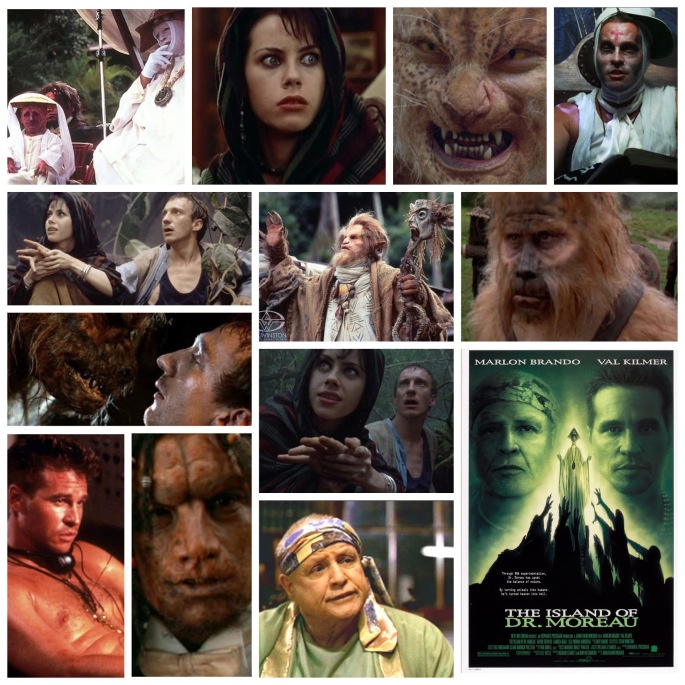
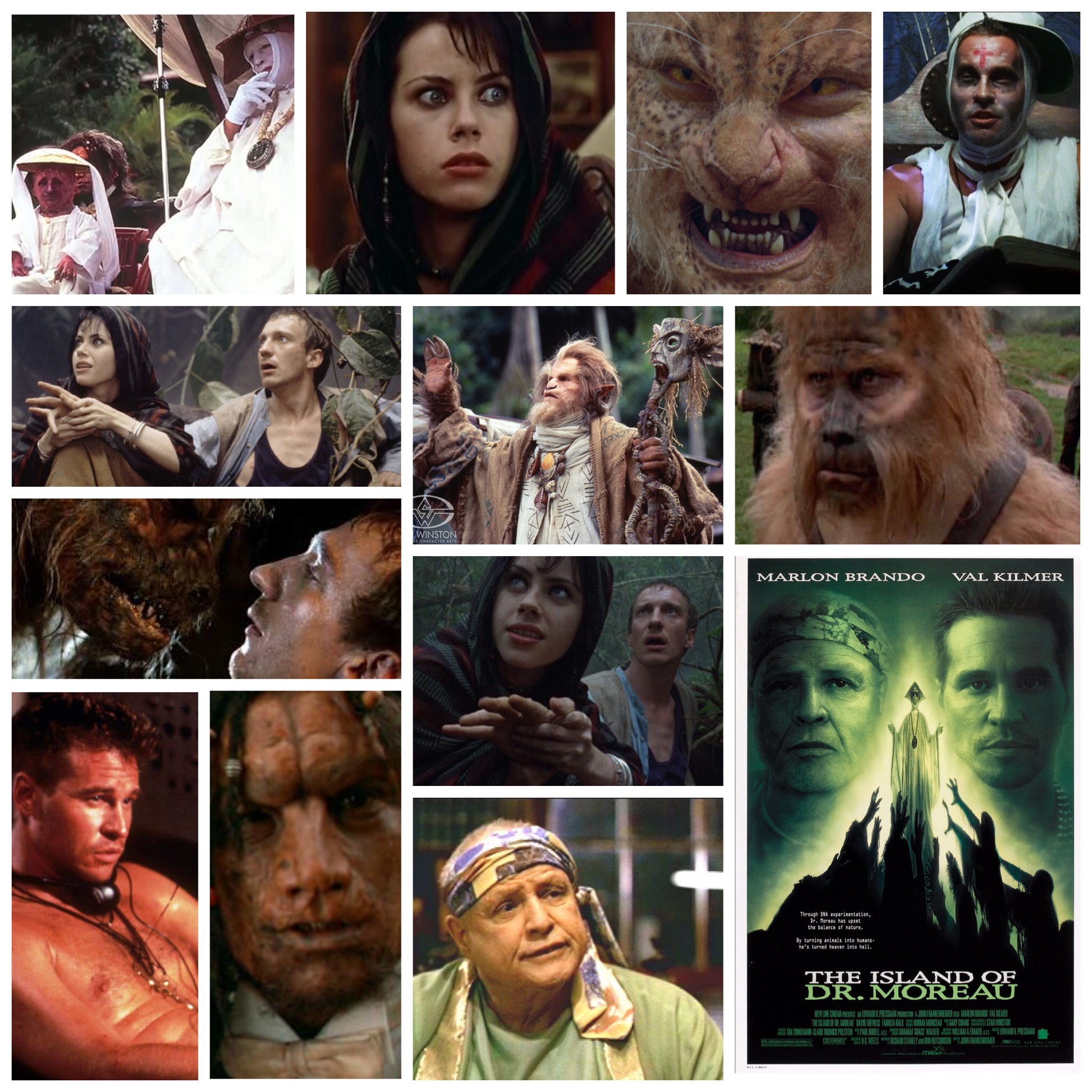
I don’t think there’s a film out there with a more volcanically troubled production history than John Frankenheimer’s The Island Of Dr. Moreau. It wasn’t even supposed to be helmed by him, rather an upstart named Richard Stanley, who’s control on the creative reigns was violently yanked away by the studio and given to notoriously fiery Frankenheimer, who, lets face it, could never really get his genetically altered ducks in a line when he took over. Between Val Kilmer acting like a lunatic and very nearly being replaced, Marlon Brando being an even bigger lunatic because he knew no one would ever replace him (the big guy had an ego to match his girth) and raging budget problems as a result of the antics, the making of this film was, in short, a fucking disaster. So now I’ve said my piece on the most talked about aspect of this film, I want to shift gears into an area that just doesn’t get covered a lot in discussion: the final film itself. Because of the maelstrom of bad PR circling the film like the storm that maroons our heroes on Moreau’s isle, many people just assume it’s a shit movie, which is not the case. I happen to love it, and if anything the level of obvious behind the scene chaos seeping through just gives it an organic unpredictability free from shackles of a script that I imagine was fairly generic in the conception phase. This is a bonkers film, no denial from me there, but I’ll be damned if I didn’t love every certifiable, furry prosthetic adorned, opulent, disorganized minute of it. David Thewlis took over from Kilmer as the lead, when Val had behavioural issues, but they’re both present and accounted for as the wreckage of a ship meets Moreau’s isle, a twisted Eden where human animal hybrids live under the delirious monarchy of the good Doctor, played with reliably laconic mania by Brando. He’s been playing god, the old codger, and his island is now home to a host of varied zoological wonders, and no narrative would be complete without it all going tits up in a giant mutiny later on. The practical effects are delightfully excessive and elaborate, packed onto specifically chosen actors who already have an ethereal, animalistic aura on their own. Ron Perlman is the sagely Sayer Of The Law, Marc Dacoscas the leopardly Lo Mai, Temuerra Morrison the lion like Azazello and wild eyed Fairuza Balk is feline goddess Aissa, who happens to be Moreau’s daughter. ‘She’s a pussy’ Kilmer quips in one of many candid slips of the tongue on his part. The inmates eventually run the asylum, or whichever clever parable you want to apply, and it hurtles towards a third act full of flying fur and fangs that releases the floodgates on Frankenheimer’s lack of cohesion, the mad scientist workshop of Stan Winston’s special effects, Brando’s bug eyed dementia and Kilmer’s ADHD riddled performance, in one scene going so off far off the rails that Thewlis has to literally break character and tell him to ‘quit fuckin around’, an unintentional laugh riot. Brando has a midget Mini Me, too, which is never fully explained but always good for a nervous laugh, as the thing looks like a fetus that vaulted out of the womb a few month too early, although I suppose that’s the point. Look, it’s a mess, but it’s a beautiful one, a kaleidoscopic parade of grotesque costumes and cartoonish performances wrapped up in a story so overblown and off the map it almost takes on a pulse of it’s own. For insight on what went down behind the scenes you can read Ron Perlman’s autobiography, watch the recent documentary on the film or simply check out IMDb trivia, but whatever went down for real, it ended up branding one of the most bizarre and wonderful creature features of the 90’s, and I love every feral, freaky minute of it. 

-Nate Hill